
A customer sees your Instagram ad on Monday. On Wednesday your email offers a different discount. By Saturday they’re in your store, and the shelf tag shows a third price. Nobody on your team made a mistake. Each channel just followed its own plan.
That gap is exactly what integrated marketing closes. So, what is integrated marketing, exactly? It’s a way of planning where every channel, message and team works toward one goal and tells one story, so customers get a single, consistent experience wherever they meet you.
It sounds obvious. It rarely happens. Most companies still run SEO, paid ads, email, social and sales as separate projects with separate numbers.
This article covers the definition, the principles, the benefits, every major tool category in detail, a nine-step plan, real brand examples, the mistakes to avoid and the metrics to track.
Integrated Marketing Explained: Definition, Origins and Core Principles
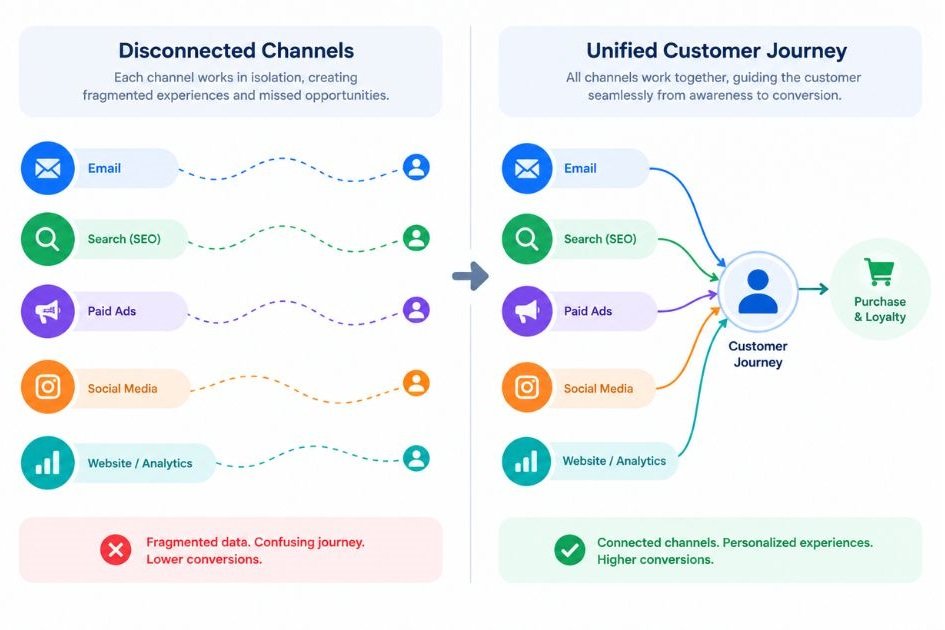
Integrated marketing is a strategy that coordinates every marketing channel, message and team around one goal and one customer experience. Instead of letting SEO, email, social media and paid ads run as separate projects, you plan them together so each channel reinforces the others.
The idea isn’t new. The term “integrated marketing communications” gained traction in the early 1990s, and Don Schultz of Northwestern University, together with Stanley Tannenbaum and Robert Lauterborn, published a well-known book on it in 1993. What changed since then is the number of places a customer can meet you. Back then it was TV, print and a shop. Now it’s search, Instagram, WhatsApp, marketplaces, email, podcasts and an app, often in the same afternoon.
Take Nike. Its “Just Do It” line shows up in TV ads, but also inside the Nike Run Club app, in SNKRS drops and in stores. Different formats. Same promise. That’s the pattern.
An integrated marketing strategy starts with one shared brief. Everyone, from the SEO writer to the paid media buyer to the sales rep, works from the same audience definition, the same core message and the same goal.
Integrated marketing coordinates every channel, message and team around a single goal and a single customer experience. It replaces separate channel plans with one shared brief, so SEO, email, social, paid ads and sales reinforce each other rather than compete. The approach grew out of the “integrated marketing communications” work of Don Schultz and colleagues in the early 1990s.
How Integrated Marketing Differs from Multichannel and Omnichannel
Integrated marketing aligns messages and goals across channels. Multichannel marketing simply uses several channels, often independently. Omnichannel marketing focuses on a connected customer experience, with data and context following the person from one channel to the next.
The three overlap, which is why people mix them up. Here’s the clean version.
| Multichannel | Omnichannel | Integrated marketing | |
|---|---|---|---|
| Main focus | Being present on many channels | Seamless customer experience across channels | One strategy, message and goal across channels |
| Starting point | The channel | The customer’s journey | The brand’s shared objective |
| Channel coordination | Low, channels run separately | High, data is shared in real time | High, planning is shared from the brief onward |
| Typical risk | Mixed messages | Heavy tech and data requirements | Slow planning if ownership is unclear |
| Example | A brand posting on five platforms with different offers | A shopper adds to cart on the app and checks out in store | A campaign with one theme across ads, email, content and retail |
Honestly, the best teams do all three. Integrated planning decides what you say and why. Omnichannel execution decides how the customer experiences it.
The Four Principles Behind It
Four principles hold every good integrated plan together.
Consistency means the same positioning, tone and visual identity everywhere. Consistency isn’t sameness, though. A LinkedIn post and an Instagram Reel should feel like the same brand without being copy-pasted.
Coordination means channels share a calendar. When the email launches, the ads, the landing page and the social posts launch with it.
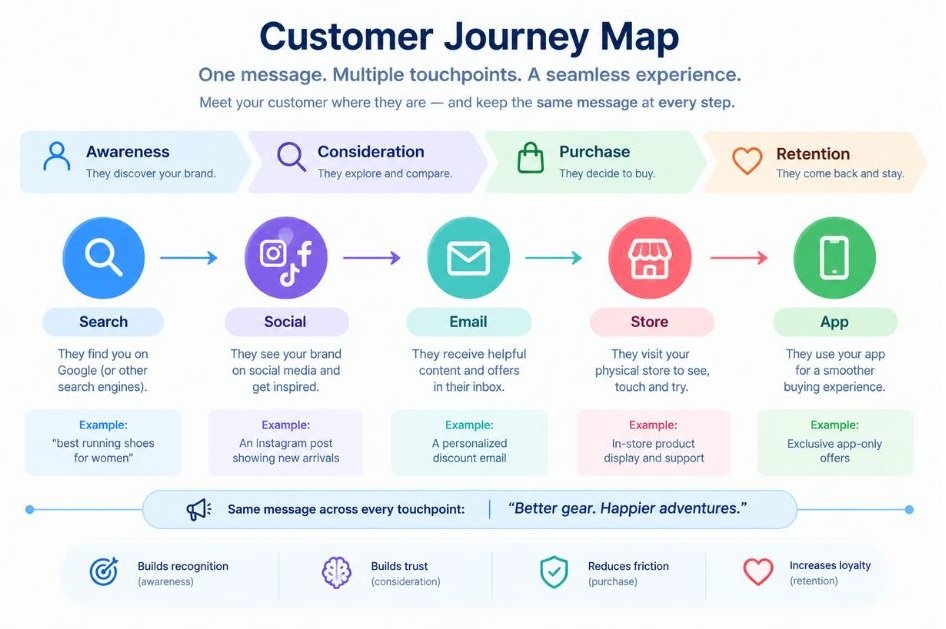
Customer focus means you plan around the journey from awareness to repeat purchase, not around your org chart.
Shared measurement means all teams read from one set of numbers. If paid media reports on clicks and email reports on opens and nobody connects them to revenue, you aren’t integrated. You’re just busy.
Why Does Integrated Marketing Matter Right Now?
Integrated marketing matters because customers now expect every touchpoint to act like one company, and most companies still look fragmented from the outside. Buying journeys cross devices and channels, so gaps in message or data show up as lost trust and lost sales.
Salesforce’s State of the Connected Customer report (sixth edition, 2023) found that 79% of customers expect consistent interactions across departments, yet 55% say it feels like they’re dealing with separate departments rather than one company. That gap is the opportunity.
Three shifts make it more urgent in 2026. First, AI search results and chat assistants now summarise brands from across the web, so contradictory messaging on your site, your socials and your listings gets reflected back at customers. Second, privacy rules, including India’s Digital Personal Data Protection Act, 2023, push teams toward first-party data, which only works if your tools talk to each other. Third, ad costs keep climbing on most platforms, so wasting impressions on disconnected messages hurts more every quarter.
Does this mean small teams can’t do it? No. A two-person startup can be more integrated than a 200-person enterprise, simply because there are fewer silos to break.
What Are the Real Benefits of Integrated Marketing?
The main benefits of integrated marketing are stronger brand recognition, less wasted spend, better customer data, higher conversion rates and faster decisions. Each one comes from the same source: channels reinforcing each other rather than working alone.
Stronger brand recall. When someone sees the same message in a search ad, a YouTube video and an email, it sticks. Repetition across formats builds familiarity faster than any single channel can.
Lower waste. Shared audiences and calendars stop you from paying to reach people who just converted. HubSpot’s shared contact record, for example, lets you suppress existing customers from acquisition campaigns automatically.
Better data. When one tool holds the full history of a contact, you see which combination of touchpoints produces a sale, not just the last click.
Higher conversion. A reader who finds your blog post through Google, joins your newsletter and then sees a relevant retargeting ad is warmer than a cold click. Each step makes the next one easier.
Faster, calmer decisions. One dashboard, one set of goals. Teams stop arguing about whose channel deserves credit.
That said, it won’t fix a weak product or a muddled brand. Integration amplifies whatever you’re already saying. If the message is confusing, you’ll just confuse people everywhere at once.
The benefits of integrated marketing come from channels reinforcing one another: stronger recall, less wasted ad spend, cleaner customer data, higher conversion and faster decisions. It amplifies a clear message but can’t repair a weak product or an unclear brand.
Which Channels and Tools Power an Integrated Campaign?
An integrated campaign usually combines owned channels (website, blog, email, app), earned channels (PR, reviews, word of mouth), paid channels (search, social, display, video) and sales touchpoints (store, calls, WhatsApp). Tools connect them so data, content and timing stay aligned.
You don’t need every tool below. Pick one per category, connect it to the rest and add more only when a real gap shows up. Here is what each category does, how it supports integration and where it falls short.
Content Management and SEO Tools (WordPress, Semrush, Ahrefs)
Your website is the hub that every other channel points to, so the content system behind it matters most. WordPress is the most widely used content management system (CMS), meaning software that lets you publish and organise pages without writing code. Pair it with an SEO plugin like Yoast or Rank Math to manage titles, schema and internal links.
Semrush and Ahrefs handle the research side. Both let you see which keywords you rank for, which competitors outrank you and where your content has gaps. Semrush’s Site Audit and Position Tracking tools help you spot technical issues and monitor rankings. Ahrefs’ Keywords Explorer and Content Gap report show you topics competitors cover that you don’t.
The integration angle: use search data to shape messages for every channel. If people search “best sunscreen for oily skin” thousands of times a month, that phrase belongs in your blog, your email subject lines and your ad copy too. The limit is that both tools estimate traffic and volumes, so treat the numbers as direction, not fact.
Email and Marketing Automation (HubSpot, Mailchimp, Klaviyo)
Email is where you own the relationship, and automation keeps it consistent. Marketing automation means software that sends messages based on behaviour, such as a welcome series after sign-up, rather than someone pressing send manually.
HubSpot’s Marketing Hub combines email, forms, landing pages, workflows and lead scoring on top of its free CRM, which makes it a natural centre for integrated work. Mailchimp is lighter and easier to start with, offering audience segments, a Customer Journey Builder and basic landing pages. Klaviyo is built for ecommerce, and it syncs deeply with Shopify so you can trigger abandoned-cart, browse-abandonment and post-purchase flows from real store behaviour.
In India, many brands add WhatsApp as a channel through providers such as Interakt or WATI, then trigger the same flow logic there as in email.
How does this support integration? Set up one flow per journey stage, then reuse the same message in email, WhatsApp and ads. The downside is complexity. Ten flows with no owner turn into ten contradicting messages within a year.
CRM Platforms (Salesforce, Zoho CRM)
A customer relationship management (CRM) system stores every interaction with a customer or lead in one place. Without it, marketing guesses what sales has said and sales guesses what marketing has promised.
Salesforce is the enterprise standard. Sales Cloud tracks deals, Marketing Cloud runs journeys, and Data Cloud unifies customer data from different sources. Zoho CRM is a lower-cost option popular with Indian small and mid-sized businesses, with workflow automation, Zia (its AI assistant) and tight links to Zoho Campaigns for email.
The integration payoff is lead quality. When a lead’s page visits, email clicks and ad touches sit on one record, sales calls them with context. It also lets marketing feed lead outcomes back to ad platforms. The catch: a CRM is only as good as the data entered. If sales reps skip fields, your reports will quietly mislead you.
Social Media Management (Hootsuite, Buffer, Sprout Social)
Social tools keep posting, replying and reporting in one place across platforms. That matters because social is where inconsistency becomes visible fastest.
Hootsuite offers scheduling, monitoring streams and a unified inbox for comments and messages. Buffer is simpler, strong at publishing queues and basic analytics, and a good fit for small teams. Sprout Social adds a smart inbox, social listening (tracking brand and keyword mentions across the web) and detailed reporting for larger teams.
Use them to run a single campaign calendar. When a launch email goes out at 10 a.m., the Instagram carousel, LinkedIn post and X thread go live in the same window with the same offer. And because the inbox is unified, community managers see complaints that customer care should know about.
Social tools can’t judge what’s on-brand, though. They schedule whatever you load. A shared style guide matters more than the scheduler.
Paid Media Platforms (Google Ads, Meta Ads Manager)
Paid media gives you speed and reach, and it’s where integration often breaks, because ad teams optimise for clicks while content teams optimise for rankings.
Google Ads covers Search, YouTube, Display and Performance Max, which runs your assets across Google’s inventory with automated bidding. Meta Ads Manager runs ads across Facebook, Instagram and WhatsApp, and offers Advantage+ Shopping campaigns, Custom Audiences built from your CRM lists, and the Conversions API, which sends sales events from your server to Meta.
Integration means feeding both platforms the same creative themes and first-party data. Upload customer lists to exclude existing buyers. Reuse your best organic post as an ad. Send offline conversions back from your CRM so the algorithms learn which leads become customers, not just who filled in a form.
The risk is platform bias. Each platform’s dashboard claims credit for the same sale, so never treat those reports as the final word.
Analytics and Attribution (GA4, Looker Studio, Triple Whale)
Analytics tools show whether the whole system works. Google Analytics 4 (GA4), which replaced Universal Analytics in July 2023, tracks events across your site and app, and it uses data-driven attribution by default, assigning credit to touchpoints based on observed behaviour. Google Tag Manager sits alongside it, letting you add tracking without developer help.
Looker Studio (Google’s free dashboard tool) pulls GA4, Google Ads, Search Console and many third-party connectors into one report, so every team sees the same numbers. For D2C ecommerce, Triple Whale unifies Shopify, ad platforms and email data into a single dashboard with its own attribution model.
Always use consistent UTM parameters (tags added to URLs, like utm_source and utm_campaign) across every link. One messy naming convention can break the whole picture. And remember that no attribution model is perfect, so pair it with holdout tests where you pause a channel in one region and compare results.
Project Management and Collaboration (Asana, Trello, Notion, Canva)
This is the least glamorous category and the one that decides whether the rest works. Integration is a people problem before a tech problem.
Asana handles dependencies and deadlines, so a launch can’t go live until the landing page task closes. Trello’s boards are quick for small teams running a visual content pipeline. Notion works as a shared wiki for brand guidelines, messaging pillars and campaign briefs. Canva’s Brand Kit stores logos, fonts and colours so anyone in the team produces on-brand creative.
From what we’ve seen with YUP learners building their first campaign plan, the gap is rarely creativity. It’s usually a missing shared calendar. A single page listing every asset, owner and date solves more problems than most software.
| Category | Example tools | Role in integration | Main limitation |
|---|---|---|---|
| CMS and SEO | WordPress, Semrush, Ahrefs | Website hub and search insight | Traffic data is estimated |
| Email and automation | HubSpot, Mailchimp, Klaviyo | Owned, behaviour-based messaging | Flow sprawl without ownership |
| CRM | Salesforce, Zoho CRM | One record per customer | Depends on clean data entry |
| Social management | Hootsuite, Buffer, Sprout Social | Shared calendar and inbox | Can’t judge brand fit |
| Paid media | Google Ads, Meta Ads Manager | Reach and speed | Self-reported credit |
| Analytics | GA4, Looker Studio, Triple Whale | Shared numbers | Attribution gaps |
| Collaboration | Asana, Trello, Notion, Canva | Shared plan and brand assets | Adoption discipline |
An integrated marketing stack needs one tool per job: a CMS and SEO tool for the website hub, email automation for owned messaging, a CRM for customer records, a social scheduler, paid media platforms, an analytics layer for shared reporting, and a collaboration tool for planning. Start with one tool per category and connect them before adding more.
How Do You Build the Plan? A Nine-Step Process
You build an integrated plan by auditing what you have, defining one audience and goal, writing one core message, assigning each channel a role, connecting your tools and measuring everything against shared KPIs. The steps below are in order.
People often ask what is integrated marketing in practice, once you strip out the theory. This is the answer.
- Audit your current channels. List every place you publish, advertise or talk to customers. Note the message, offer and tone on each. Inconsistencies show up fast.
- Define one primary audience. Write a short profile: who they are, what they want and where they spend time. Use CRM and GA4 data, not assumptions.
- Map the customer journey. Sketch the path from first awareness to repeat purchase. Mark each touchpoint where you currently show up.
- Set one business goal and the KPIs under it. Pick a goal like “increase repeat purchases by 15% this quarter.” Then choose 3 to 5 metrics, not 20.
- Write the core message and proof points. One sentence for the promise, three reasons to believe it. Put it in your Notion or Google Docs brand page.
- Assign each channel a role. SEO captures demand, paid social creates it, email converts and retains, WhatsApp supports service and reminders. No channel does everything.
- Connect your tools and data. Sync your CRM with your email tool and ad platforms. Standardise UTM tags. Set up one Looker Studio dashboard.
- Build a shared campaign calendar. One sheet or board with every asset, owner, channel and launch date. Review it weekly.
- Launch together, review monthly, adjust. Run channels in a coordinated window. Check results against your KPIs, retire what doesn’t work and double down on what does.
A good integrated marketing strategy fits on one page. If yours needs forty slides, you’re documenting the silos instead of removing them.
Take Nykaa as a reference point. It began as an online beauty retailer and added physical stores, a content arm and a loyalty programme (Nykaa Prive), all built around one idea: beauty advice you can trust, available however you prefer to shop. That’s the sort of single idea step 5 asks you to find.
Integrated Marketing Examples You Can Learn From
The best integrated marketing examples share one trait: a single, simple idea expressed differently on every channel. They don’t run the same ad everywhere. They run the same promise.
Coca-Cola: Share a Coke
In 2011, Coca-Cola Australia wanted to reconnect with teens and young adults. WARC’s case study notes that half of teens and young adults in Australia hadn’t tasted Coke, so the brand printed 150 of the country’s most popular names on its bottles. warc
The idea didn’t live on the label alone. The campaign extended to kiosks that printed names on cans on request, virtual cans people could send to Facebook friends, influencer seeding kits and media coverage. The results included a 7% rise in young adult consumption, more than 18 million media impressions and an 870% jump in traffic to Coke’s Facebook site. The packaging, retail, social and PR teams were all working from the same idea. slideshare
Nike: One Promise Across Product, App and Store
Nike treats its apps as marketing channels, not side projects. Nike Run Club and Nike Training Club give customers value for free, SNKRS builds hype around releases, and retail stores and social content carry the same “Just Do It” attitude. Each touchpoint feeds the others. A runner who trains with the app is a better prospect for new shoes than a stranger.
Nykaa: Content, Commerce and Stores Working Together
Nykaa’s integration is practical rather than flashy. Educational content, product discovery in the app, loyalty benefits and physical store experiences all point to the same position: a trusted place to buy beauty products. What you can copy is the logic. Content builds trust, trust drives purchase and the store or loyalty programme brings people back.
Zepto and Mamaearth: One Clear Promise, Repeated
Zepto’s promise is speed, and from its public marketing, that promise appears in app copy, hoardings and social content alike. Mamaearth built early growth around a clear “toxin-free” positioning, repeated across influencer content, ads and marketplace listings. Neither brand needed a clever framework. They picked one claim and said it everywhere.
What Goes Wrong: Common Mistakes and Limits
Most integrated marketing fails for ordinary reasons: unclear ownership, too many tools, copy-pasted content and measurement that doesn’t connect to revenue. Spotting these early saves months.
Treating consistency as sameness. A 15-second Reel and a 1,500-word blog post can’t carry identical copy. Keep the message the same. Change the format.
Buying tools before agreeing a plan. Teams often sign up for a CRM, a social tool and a dashboard tool in the same month, then discover nobody agreed on the audience. Plan first. Tools second.
No single owner. If four team leads each own a channel and nobody owns the whole journey, integration stalls. Name one person accountable for the shared calendar and shared numbers.
Ignoring offline touchpoints. Store staff, delivery packaging and customer care calls are part of the brand. For many Indian D2C brands, WhatsApp support and COD calls shape perception as much as ads do.
Chasing perfect attribution. You won’t get it. Use blended metrics and periodic experiments rather than waiting for a flawless model.
Some limits are real, too. Smaller teams may not have time for a nine-step process. In that case, start with steps 1, 4 and 8 only. Industries with long B2B sales cycles also need patience, since results can take quarters. And unified customer data brings legal duties: under the DPDP Act, 2023, you need a clear basis for processing personal data, so involve your legal advisor before merging datasets.
How Do You Measure Integrated Marketing Results?
You measure integrated marketing by tracking blended, business-level metrics (such as revenue per rupee of total ad spend) alongside channel-level ones, then testing which combinations of channels produce growth. No single metric captures it.
Marketing Efficiency Ratio (MER) is total revenue divided by total marketing spend across all channels. It needs no attribution model, which makes it a useful anchor for integrated work.
| Metric | What it shows | Where to find it |
|---|---|---|
| MER (revenue ÷ total ad spend) | Overall efficiency across channels | Finance data plus ad platforms |
| Blended customer acquisition cost | Cost to win one customer, all channels | CRM plus ad spend |
| Branded search volume | Growth in brand awareness | Google Search Console |
| Assisted conversions | Channels that help before the final click | GA4 |
| Repeat purchase rate | Retention strength | Shopify, CRM |
| Email and WhatsApp list growth | Owned audience building | Klaviyo, HubSpot, Interakt |
| Message consistency score | Share of assets passing a brand checklist | Internal audit |
Go beyond dashboards, too. Run geo holdout tests, where you pause a channel in one region for a few weeks and compare against similar regions. For larger budgets, marketing mix modelling (MMM), a statistical method that estimates each channel’s contribution from historical data, can help. Meta’s open-source Robyn and Google’s Meridian are two free options, though both need analyst time.
Review monthly. Look for patterns such as “branded search rose after the YouTube push” rather than channel scoreboards.
Where to Start This Week
Three things matter most. Consistency beats volume, so one clear message repeated across channels outperforms ten clever ones. Shared planning matters more than shared software, so fix the calendar before buying the tool. And measure the whole, not the parts, with blended numbers like MER next to your channel reports.
Your first move is small. Open a blank page, list every channel you use and write down the message each one currently carries. If they don’t match, you’ve found your starting point. Then build an integrated marketing strategy from there, one step at a time.
Frequently Asked Questions
Can you explain integrated marketing in one line?
Integrated marketing is the practice of aligning all your marketing channels, messages and teams around one goal so customers get a consistent experience. It replaces separate channel plans with one shared plan. The goal is that every touchpoint reinforces the others.
Integrated marketing vs omnichannel: what’s the difference?
Integrated marketing is about planning one strategy and message across channels. Omnichannel is about delivering a connected customer experience, with data and context moving with the person from one channel to another. In practice, you use integrated planning to decide what to say and omnichannel tools to deliver it smoothly.
Is integrated marketing the same as integrated marketing communications?
They’re close cousins. Integrated marketing communications (IMC) focuses on aligning promotional messages across advertising, PR, direct marketing and digital. Integrated marketing is broader, also covering product, pricing, sales and customer service so the whole experience is aligned, not just the communications.
Which channels should be part of an integrated campaign?
Include the channels where your audience already spends time and that you can run well. For most brands that means your website and SEO, email, one or two social platforms, a paid channel such as Google Ads or Meta, and a sales or service touchpoint like WhatsApp or a store. Adding more channels than your team can manage creates inconsistency.
Is integrated marketing worth it for a small business?
Yes, and it’s often easier for small teams. With fewer people, there are fewer silos. Start with a shared calendar, one core message and one dashboard. You don’t need an enterprise stack to get the benefit.
Who should use integrated marketing?
Any business that talks to customers through more than one channel. D2C brands, B2B software companies, retailers, local service providers and agencies all benefit. It matters most when your buyers take several steps before purchasing or buy repeatedly.
What tools do I need to start?
You need five at minimum: a website CMS such as WordPress, an email or automation tool such as HubSpot or Mailchimp, a CRM (HubSpot’s free CRM or Zoho CRM work for small teams), Google Analytics 4 with Looker Studio for shared reporting, and a planning tool like Notion or Asana. Add social scheduling and paid media tools as you scale.
How do I measure whether it’s working?
Track blended metrics such as MER, blended customer acquisition cost and repeat purchase rate alongside channel metrics. Add branded search volume as a signal of awareness. Review them monthly and run a holdout test when you want proof that a channel contributes.
Why isn’t my integrated campaign working?
Usually one of four things is wrong: the core message is unclear, channels have no assigned role, data isn’t connected between tools, or nobody owns the shared calendar. Audit the campaign against the nine steps above. Check consistency first, since it’s the cheapest problem to fix.
How long does integrated marketing take to show results?
It depends on your sales cycle. Email and paid channels can show movement within weeks. Brand and search effects, such as higher branded search volume, typically build over a few months. B2B companies with long buying cycles should judge progress over quarters, not weeks.

