
A decade ago, ordering milk online meant picking a delivery slot for tomorrow morning. Now a delivery partner can reach your door before your tea goes cold. Indian retail didn’t see that shift coming, and it’s changing how brands, kirana owners and investors think about shopping.
So what is quick commerce, and why are Blinkit, Zepto, Swiggy Instamart, Flipkart Minutes and Amazon Now spending thousands of crores to win it? The short version: it’s a bet that people will pay for speed, and that brands will pay to be seen at the exact moment those people decide to buy.
This guide covers how the model works, who leads the market as of October 2026, how each platform earns money, which tools sit behind a ten-minute promise, and what you should do next if you run a D2C brand or a marketing team. Figures come from company filings and named research firms. Where trackers disagree, we say so.
How Does 10-Minute Delivery Work in India?
Q-commerce is retail built around one promise: your order arrives in about 10 to 30 minutes. Platforms keep that promise by stocking a few thousand fast-moving products in small warehouses called dark stores, usually two to four kilometres from the customer, and handing each order to a nearby delivery partner.
What is quick commerce at its core, once you strip away the app design? A supply chain redesigned around geography. Traditional e-commerce ships from a handful of giant warehouses and wins on range. Q-commerce ships from hundreds of tiny ones and wins on time.
A dark store looks like a supermarket stockroom with no shoppers. Shelves are arranged for pickers, not browsers, and the building exists only to fill orders. Each one is fed by a larger mother warehouse on the edge of the city, which restocks it on a regular cycle.
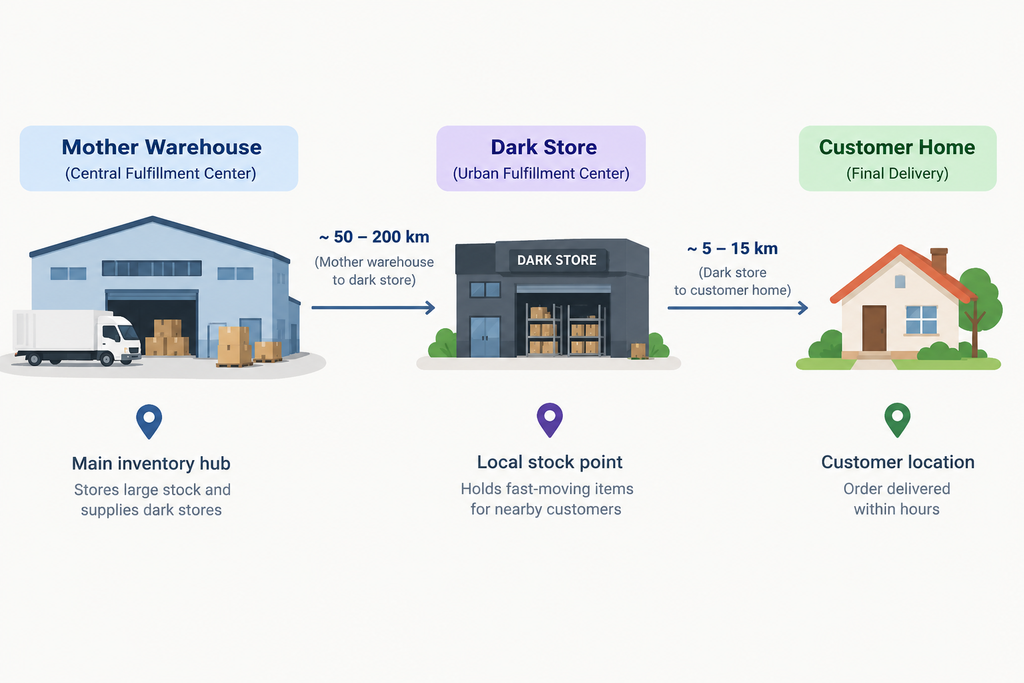
Here’s what happens after you tap “Place order”:
- Check stock. The app shows only items available in the dark store that serves your pincode.
- Route the order. The system assigns it to that store and to a picker.
- Pick and pack. The picker collects items using a handheld prompt and bags them.
- Dispatch. A delivery partner, usually a gig worker on a two-wheeler, takes the bag to you.
- Replenish. The store’s stock count updates, and low items trigger a refill request to the mother warehouse.
Zepto’s draft prospectus describes exactly this setup: a large network of gig workers run through its own in-house logistics platform.
Density decides everything. A dark store only works if enough people live within reach, which is why the model started in packed metros. CLSA’s August 2026 count across ten cities puts Bengaluru first with 735 dark stores, ahead of Delhi at 531 and Hyderabad at 484.
How Big Is India’s Q-Commerce Market in 2026?
India’s q-commerce market roughly doubled in a year. Redseer data reported by Digital in Asia put monthly gross merchandise value near ₹11,000 crore in early 2026, up about 100% year on year, on roughly 7.8 million orders a day.
Who captures that money? Datum Intelligence data cited by Reuters in January 2026 gave Blinkit about 48% of the market, Swiggy Instamart 24% and Zepto 22%. Other trackers put Blinkit anywhere between 46% and 50%, so read the split as “roughly half, a quarter, a quarter” rather than a precise table.
Company disclosures show the same ranking from a different angle:
| Platform | Dark stores (end of March 2026) | Orders in FY26 | Latest store signal |
|---|---|---|---|
| Blinkit | 2,243 | 916.6 million | 2,443 stores by June 2026 |
| Zepto | 1,139 | 640.2 million | Updated IPO papers filed June 2026 |
| Swiggy Instamart | 1,143 | 412.2 million | 1,171 stores in May 2026 |
Sources: Eternal’s shareholder letter (July 2026) as reported by Outlook Business and NewsBytes; Inc42 for Instamart’s May 2026 store count.
Notice the gap. Blinkit handled close to as many orders as Zepto and Instamart combined, according to Eternal. And in Q4 FY26, Blinkit’s net order value of ₹14,386 crore sat well ahead of Zepto’s ₹8,134 crore and Instamart’s ₹5,675 crore.
India’s q-commerce market has three clear leaders. Blinkit holds roughly 46% to 50% share, while Swiggy Instamart and Zepto each hold around a fifth to a quarter, per Datum Intelligence data cited by Reuters in January 2026. Redseer estimates monthly gross merchandise value passed ₹11,000 crore in early 2026.
Which Brands Lead Indian Q-Commerce?
Three platforms lead, two e-commerce giants are catching up, and two older grocery names are fighting for a smaller slice. Each wins in a different way, so the differences matter more than the rankings.
Blinkit
Blinkit began as Grofers in 2013 and now sits inside Eternal, the company formerly known as Zomato. It’s the market leader by almost every measure. Eternal reported 2,443 Blinkit dark stores at the end of June 2026, up from 1,544 a year earlier.
The financial story is just as strong. Blinkit’s adjusted EBITDA rose to ₹102 crore in Q1 FY27 from ₹37 crore in the previous quarter, which is its second straight profitable quarter on that measure. Its revenue line jumped to ₹15,664 crore, but be careful comparing that number. Blinkit moved to an inventory-led model, so it now books the full value of goods sold instead of just a commission.
Availability is its quiet advantage. A Bernstein study found Blinkit’s average in-stock rate was 94.4%, the best among major players. The trade-off is risk: Business Standard reported that inventory losses, mostly fruit and vegetables, cost Blinkit about 1.8% of order value.
Zepto
Zepto was founded in 2021 by Aadit Palicha and Kaivalya Vohra, and it’s the fastest mover in the top three on volume. Its updated draft prospectus, filed in June 2026, shows 1,139 dark stores, more than 2.3 million orders a day in the March 2026 quarter and about 48 million annual transacting users.
Its real edge is store productivity. Zepto’s stores averaged 2,140 orders per day in Q4 FY26, while estimates based on reported volumes put Blinkit near 1,357 and Instamart near 1,095, according to Outlook Business. More orders per building means each fixed cost gets spread thinner.
The weak side is cash. Zepto’s FY26 revenue was ₹22,624 crore, yet it posted a net loss of roughly ₹5,900 crore. The IPO plan includes a fresh issue of ₹8,010 crore, with the founders not selling shares. Bernstein also measured Zepto’s availability at 82.5%, the lowest of the major players it tracked.
Swiggy Instamart
Instamart is Swiggy’s grocery arm, and it’s the only one of the big three that sits next to a large food-delivery business. That helps. Food delivery profits have helped absorb Instamart’s losses, which hit ₹1,009 crore in adjusted EBITDA in Q4 FY26.
The direction is improving, though. Instamart’s net order value grew 38.9% to ₹5,817 crore in Q1 FY27, and Swiggy said the unit reached contribution breakeven in May 2026 across 1,171 dark stores, as reported by Inc42. Bernstein’s availability test scored it 83.8%, with a sharp drop later in the day that the brokerage linked to demand forecasting and restocking problems.
Flipkart Minutes
Flipkart Minutes launched in August 2024 and scaled faster than any entrant before it. By June 2026, Flipkart said it had 1,000 micro-fulfilment centres across more than 130 cities, with a target of 1,500 by the end of 2026, per TechCrunch.
Its bet is smaller cities. Around 90 of its 130 cities are tier-2 and tier-3 markets, and Gen Z makes up more than 40% of its customers. CLSA’s August 2026 data shows Minutes now has more dark stores than Instamart in the ten metros it tracks: 627 against 615. It still trails the leaders on availability, with Bernstein measuring 88.7%.
Amazon Now
Amazon Now is the other late entrant with deep pockets. TechCrunch reported in June 2026 that it runs more than 500 micro-fulfilment centres across over 15 cities. Amazon has announced plans to invest ₹2,800 crore in it, and it’s using its Prime membership base to pull customers in.
Reported order growth is fast, around 25% month on month, but the base is still small compared with the leaders. Amazon’s advantage isn’t speed. It’s the ability to sit q-commerce next to the biggest catalogue in Indian e-commerce.
BigBasket (BB Now) and JioMart
Tata’s BigBasket had 497 dark stores across the top ten cities in CLSA’s August 2026 count, and it raised fresh debt of ₹200 crore late in 2025 to back its q-commerce arm. Reliance’s JioMart competes too. Bernstein noted that the performance gap between the leaders and challengers such as Flipkart, Amazon, BigBasket and JioMart widened in 2025.
| Brand | Parent | Scale signal | Main edge |
|---|---|---|---|
| Blinkit | Eternal | 2,443 stores (June 2026) | Availability and profitability |
| Zepto | Zepto Ltd | 1,139 stores (March 2026) | Orders per store |
| Swiggy Instamart | Swiggy | 1,171 stores (May 2026) | Food-delivery cushion |
| Flipkart Minutes | Flipkart (Walmart) | 1,000+ centres (June 2026) | Smaller-city reach |
| Amazon Now | Amazon | 500+ centres (June 2026) | Prime base and catalogue |
| BB Now | Tata (BigBasket) | 497 stores in top 10 cities | Grocery heritage |
What Business Models Do Q-Commerce Platforms Use?
Indian q-commerce platforms run on either an inventory-led model, where the platform buys and owns stock, or a marketplace model, where sellers own stock and the platform earns fees. Most then add advertising, customer fees and memberships on top.
Inventory-led model
In this model the platform purchases goods from brands or distributors, stores them in its own dark stores and sells them to you directly. It earns the full margin between purchase price and selling price. It also carries the risk when milk expires or tomatoes spoil.
Blinkit made this shift, which is why its reported revenue exploded. Eternal’s Q1 FY27 revenue for Blinkit rose about 552% year on year largely because the accounting changed, not because sales grew 552%. Bernstein describes Blinkit as inventory-led. Zepto’s structure is described differently across sources, so check its prospectus before quoting a label.
Marketplace model
Here, the platform is a bridge. Sellers or brand partners own the stock inside the dark store, and the platform earns commission, fees and ad income. Swiggy Instamart primarily operates this way, according to Bernstein.
The reason this matters is law. India allows 100% foreign investment in marketplace e-commerce but prohibits it in inventory-based e-commerce. That tension sits under almost every regulatory complaint about the sector, and we’ll get to it shortly.
How platforms actually earn
Whichever model they pick, the revenue lines look similar:
- Product margin or commission. Business Standard reported Blinkit’s take rate at 27.5% of order value, with a contribution margin of about 4%.
- Advertising. Brands pay for visibility. Zepto’s ad revenue rose 151% to ₹1,636 crore in FY26, over 7% of its operating revenue. Pitch Madison estimated q-commerce ad spending at about ₹4,000 crore in 2025, up from ₹1,325 crore in 2024.
- Customer fees. Delivery, handling and small-cart charges add a layer of income on each order.
- Memberships. Subscription programmes such as Swiggy One, Zepto Pass and Amazon Prime bundle free delivery with repeat usage.
Indian q-commerce platforms use either an inventory-led model, where they own stock, or a marketplace model, where sellers do. Both layer on advertising, fees and memberships. Zepto’s advertising revenue grew 151% to ₹1,636 crore in FY26, per its updated draft prospectus.
What Tools and Technology Power a 10-Minute Promise?
Speed at this scale comes from five working parts: dark stores, forecasting software, picking and routing systems, rider apps and ad platforms. Platforms don’t publish their software stacks, so what follows describes how these tools generally work, backed by disclosed numbers where they exist.
Dark stores and mother warehouses
The dark store is the front line. It holds a narrow, high-velocity assortment: milk, eggs, snacks, cleaning supplies, phone chargers, and increasingly beauty and electronics. Space is tight, so every shelf must earn its place. Zepto’s prospectus says it plans to spend IPO money on expanding its dark store network and funding lease rentals for existing ones.
A mother warehouse sits behind a cluster of stores. It buys in bulk from brands, holds slower-moving items and sends top-ups to each dark store. If this link breaks, shelves empty by evening, which is the pattern Bernstein spotted at Instamart.
Demand forecasting and inventory software
Forecasting tools predict what each store will sell by hour and day, using order history, weather, local events and price changes. They decide how much each store orders from the mother warehouse.
Why does that matter to you? Because poor forecasting shows up as “out of stock” on your screen. Bernstein found Blinkit’s availability barely moved through the day, while Instamart’s fell by 11% and Zepto’s by 6%.
Picking and order-routing systems
When you check out, routing software selects the store, and picking software sequences the items to cut walking time inside a cramped space. Pickers typically work from handheld devices or a phone, scanning each item to avoid wrong substitutions. Every second saved here lets a platform offer a faster promise without hiring more riders.
Rider apps and route planning
The delivery partner uses a separate app that offers orders, shows the pickup point and plots the shortest route. Many platforms batch nearby orders when it won’t break the delivery promise. This is also where labour rules bite, since most riders are gig workers.
Advertising and retail media tools
Every major platform now sells ad placements: sponsored listings in search, banners on category pages and product recommendation slots. Brands typically bid for these through a self-serve portal, then track sales against spend. Because the buyer is already in a purchase mindset, ad returns can be strong, which explains why advertising is growing faster than the rest of Zepto’s business.
Memberships and basket-building tools
Programmes such as Swiggy One and Zepto Pass raise order frequency, while bulk-saving offers such as Instamart’s Maxxsaver and Zepto’s Super Saver push larger baskets. Bigger baskets dilute the fixed cost of delivery, so these tools do more for profitability than most customers realise.
Is Q-Commerce Actually Profitable Yet?
Only at store level, and so far only for the leader. Blinkit reported adjusted EBITDA of ₹102 crore in Q1 FY27, while Zepto lost roughly ₹5,900 crore in FY26 and Instamart reached contribution breakeven only in May 2026.
Contribution margin is the number that matters most here. It’s revenue per order minus the variable costs of picking, packing, delivery and wastage, before overheads. Business Standard put Blinkit’s at about 4%, on a per-store daily net order value of ₹8.27 lakh and an average basket of ₹518.
Four levers decide whether a platform gets from loss to profit:
- Density. More orders per store spreads rent and staff. Zepto’s 2,140 daily orders per store is the benchmark here.
- Basket size. A ₹518 basket earns more per delivery than a ₹330 one. The Arc estimated Zepto’s average order near ₹330, though sources differ on these averages.
- Advertising. High-margin income that doesn’t need extra riders.
- Wastage. Cutting that 1.8% inventory loss on perishables.
One warning: profit figures aren’t comparable across companies. Swiggy reports Instamart’s margin against gross order value, while Eternal reports Blinkit’s against net order value. Always check the denominator before comparing.
What Are the Regulatory Risks?
Regulators haven’t written a rulebook built for quick commerce, so platforms operate under overlapping laws on foreign investment, competition, food safety and labour. The biggest open question is whether dark stores make some platforms inventory-based retailers in practice.
In October 2024, the All India Consumer Products Distributors Federation wrote to the Competition Commission of India (CCI), asking it to examine whether Blinkit, Instamart and Zepto follow FDI rules. Its argument was that control over dark-store inventory blurs the line between marketplace and retailer. A law firm review by Lakshmikumaran and Sridharan also noted that food safety authorities had flagged violations at some dark stores.
Pricing is the second flashpoint. The CCI notified regulations in May 2025 on how to determine cost of production, which are aimed at assessing predatory pricing and deep discounting. And labour codes are changing the social security picture for gig riders.
Does that mean the model is in danger? Not necessarily. It means compliance costs are rising, and platforms with clean structures and strong margins are better placed to absorb them.
What Should Brands and Marketers Do About It?
Treat q-commerce as a performance channel with its own economics, not as a new shelf in the same store. Start with a small number of cities, protect your margin and measure everything per order.
Here’s a practical sequence:
- Pick pilot pincodes. Start in Bengaluru, Delhi or Hyderabad, where dark store density is highest, and look at where your buyers already live.
- Choose the right SKUs. Small packs, impulse items and repeat purchases do well. Bulky or slow-moving items eat shelf space and get delisted.
- Calculate contribution margin per order. Take platform commission, which can run from the high teens up, plus ad spend and margin support, and see what’s left. Don’t scale until it’s positive.
- Budget for ads from day one. With platform advertising growing this fast, organic visibility is shrinking. Test sponsored listings on your hero SKUs first.
- Watch availability. A product that’s out of stock loses rank and repeat buyers. Share forecasts with the platform and keep your mother warehouse supply steady.
- Track the right metrics. Monitor daily sales per store, repeat rate, ad return and stock-out hours, not just total revenue.
Where Is the Market Heading Next?
Expect four shifts over the next twelve months. Zepto’s listing will put public-market pressure on its losses. Flipkart will push towards 1,500 centres, and Amazon says it wants to reach 300 cities. Product availability is turning into the main competitive battleground, as Bernstein noted, because speed alone no longer separates the leaders. And more categories, from beauty to electronics, are moving into ten-minute delivery.
The honest caveat: projections for 2030 range widely, from about $40 billion to $65 to 70 billion in gross value depending on the source, so plan around what’s disclosed, not what’s forecast.
What to Take Away From India’s 10-Minute Retail Race
Three things matter. First, the model works on density: dark stores near customers, filled with the right products, restocked on time. Second, business models differ more than the apps suggest, from Blinkit’s inventory-led approach to Instamart’s marketplace structure, and that changes margins, risk and regulation. Third, profitability is arriving, but only for the scaled leader so far.
If you sell products in India, your next step is concrete: calculate your contribution margin per order on one platform, pick three pincodes and run a small test before spending big. The brands that win here won’t be the loudest. They’ll be the ones that know their numbers.
Frequently Asked Questions
What does q-commerce mean in simple words?
Q-commerce means getting everyday items such as groceries, snacks and household goods delivered in roughly 10 to 30 minutes. The platform stores products in a small warehouse near you called a dark store, and a delivery partner brings your order from there.
How is q-commerce different from regular e-commerce?
Regular e-commerce ships from large warehouses and delivers in a day or more, so it wins on range and price. Q-commerce ships from small local stores and delivers in minutes, so it wins on convenience but carries a narrower range and higher operating cost per order.
Which is the biggest 10-minute delivery app in India?
Blinkit. Datum Intelligence data cited by Reuters in January 2026 gave it about 48% share, and it had 2,443 dark stores by June 2026. Swiggy Instamart and Zepto follow, each with roughly a fifth to a quarter of the market.
Blinkit vs Zepto vs Instamart: which is better?
It depends on what you value. Blinkit leads on availability, at 94.4% in Bernstein’s test, and on profitability. Zepto has the highest orders per store, and Instamart benefits from Swiggy’s food-delivery customer base. For brands, the right pick depends on your target pincodes and margins.
How do 10-minute delivery apps make money?
They earn through product margin or commission, advertising, delivery and handling fees, and memberships. Advertising is growing fast: Zepto’s ad revenue rose 151% to ₹1,636 crore in FY26. Platforms that own inventory also keep the full retail margin.
Are dark stores legal in India?
Yes, dark stores themselves are legal. The dispute is about who owns the stock inside them. India permits 100% foreign investment in marketplace e-commerce but not in inventory-based e-commerce, so platforms with foreign investors face scrutiny over how they structure ownership.
Is q-commerce actually profitable?
Not for most players yet. Blinkit posted adjusted EBITDA of ₹102 crore in Q1 FY27, but Zepto lost about ₹5,900 crore in FY26 and Instamart only hit contribution breakeven in May 2026. Profit depends on density, basket size, advertising income and low wastage.
How can a D2C brand sell on Blinkit, Zepto or Instamart?
Start by applying through each platform’s brand or vendor onboarding process, then agree on pricing, margin and supply terms. Next, pick a few pilot cities, stock the mother warehouse and run sponsored listings on your best sellers. Check each platform’s current seller requirements, since they change.
Why do items show as out of stock so often on these apps?
Usually because of forecasting and restocking gaps. A dark store carries limited space, so one bad prediction can empty a shelf. Bernstein found Instamart’s availability dropped 11% during the day and Zepto’s fell 6%, while Blinkit’s dropped 5%.
Will q-commerce kill kirana stores?
It’s not that simple. Platforms take high-frequency purchases such as milk, snacks and top-up groceries, which hurts small stores in dense metros. But kiranas still win on credit, relationships and reach in smaller towns. Some analysts also suggest hybrid models where kiranas partner with platforms.


