

Ask ChatGPT for the best project management tool for a ten-person agency and it names four products. Ask Google the same thing and an AI Overview names a few more. If your brand isn’t in those answers, the buyer never meets you, and no rankings report will tell you it happened. AI Searchability is how easily AI search engines can find, understand, trust and cite your brand when they answer a question.
This matters because the click is shrinking. Pew Research Center’s July 2025 analysis of 900 US adults found that people clicked a traditional result in 8% of visits when a Google AI summary appeared, compared with 15% when it didn’t. Only 1% of visits included a click on a source inside the summary itself. Visibility has moved from the blue link to the answer.
So what do you actually do about it? This article covers how AI engines pick their sources, the technical and content changes that make your pages easy to cite, and a detailed walkthrough of every tool worth using. That includes free options such as Google Search Console and Bing Webmaster Tools, plus paid platforms like Semrush, Ahrefs Brand Radar, Otterly.AI, Peec AI and Profound. You’ll finish with a 30-day plan you can start on Monday.
Why Does Visibility in AI Answers Matter More Than Rankings Now?
AI answers often settle the question on the results page itself. When a summary satisfies the reader, only the sources named inside it get remembered, and very few people click through to check them.
Rankings still matter, because AI features draw on the same index. But a number-one ranking that sits below a confident AI summary now earns less attention than it did two years ago. Pew found that around two-thirds of searches ended without any link click whether or not a summary was present, which tells you how much of search behaviour is already about getting an answer rather than visiting a site.
There’s another shift worth noticing. Pew’s data also showed that Wikipedia, Reddit and YouTube together made up about 15% of the sources shown in the AI summaries it examined. Your competitors aren’t only other brands. They’re also forum threads and video reviews.
The upside is real, though. Bing’s new reporting gives early proof that citations can be earned by ordinary sites. Search Influence, an SEO agency, published its own Bing data in February 2026: 19,717 Copilot citations across 86 pages, with a single comparison page collecting 69% of them. Whole Whale, a nonprofit digital agency, reported roughly 48,000 citations across 34 pages over about three months. Neither report shows click data, and both teams say citations don’t automatically equal traffic. Still, someone is reading those answers, and your brand either shows up in them or it doesn’t.
AI answers now resolve many searches on the results page, so being cited matters more than being ranked alone. Pew Research Center found that people clicked a traditional link in 8% of visits with an AI summary versus 15% without one. Brands that earn citations in Copilot, ChatGPT and Google AI features stay visible even when the click never happens.
How Do AI Engines Decide Which Brands to Cite?
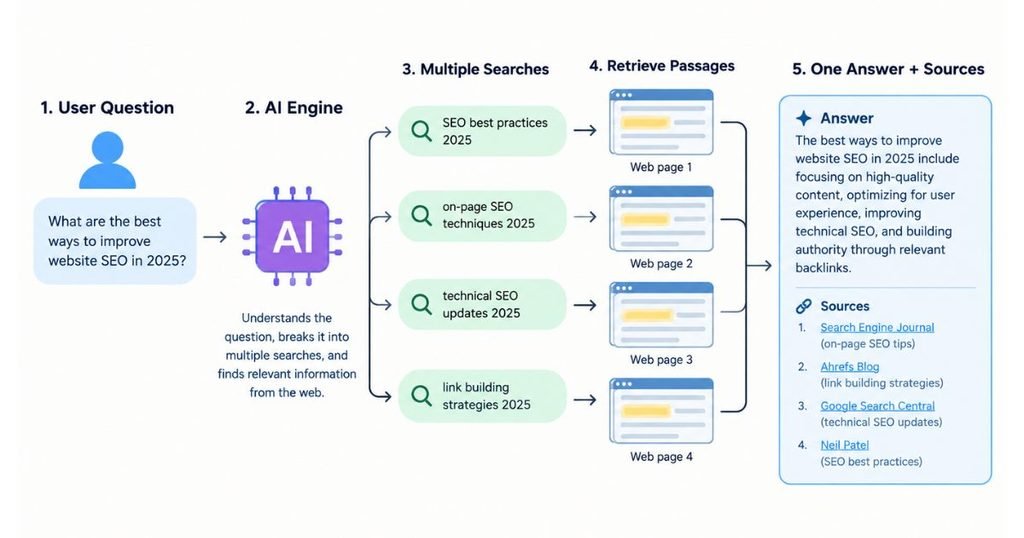
AI engines retrieve passages from indexed pages, often by splitting one question into several related searches, then cite the sources whose passages answer clearly and come from entities the web already trusts. Three things have to line up: the page must be reachable, the passage must be extractable, and the brand must be believable.
Google describes this in its Search Central guidance on AI features. Both AI Overviews and AI Mode may use what it calls query fan-out, which means issuing multiple related searches across subtopics and data sources to build one response. The two features can also use different models, so the answers and links they show won’t always match. Google is equally clear that a page has to be indexed and eligible to appear with a snippet, and that there are no additional requirements or special optimisations for these features.
That’s reassuring and slightly annoying at the same time. There’s no secret switch. The work is in the basics, done more carefully than most competitors bother to.
Here’s how fan-out plays out in practice. Take the question “best quick commerce app in India”. An engine may quietly search for delivery speed, pricing, city coverage and user reviews separately. Zepto, Blinkit and Swiggy Instamart each have pages and third-party coverage touching those subtopics. A newer entrant that only publishes one generic homepage has far less to offer the retrieval step.
The Three Layers You Control
Retrieval means crawlers can fetch your page and the engine’s index contains it. Extraction means a specific paragraph, table or list answers a sub-question cleanly enough to be lifted. Trust means other credible sources mention your brand in the same context, which is why off-site signals get their own section later.
Think of it as retrieval, extraction and trust.
Why the Same Prompt Gives Different Answers
AI answers aren’t fixed rankings. Run one prompt five times and you may see five slightly different source lists. That’s normal, and it’s the reason serious measurement relies on repeated sampling rather than a single screenshot.
Which Technical Settings Let AI Crawlers Read Your Site?
Your site is readable to AI engines when the right crawlers can fetch your pages, your important content appears in the HTML rather than hidden behind scripts, and nothing at the server, CDN or firewall level turns bots away. Most visibility problems that look like content problems are actually access problems.
Google’s own guidance lists the basics: allow crawling in robots.txt and through any CDN or hosting layer, and keep content easy to find through internal links. For other engines, the user-agent names matter a lot, because blocking the wrong one is the fastest way to disappear.
Which AI Crawlers Should You Allow?
Each major AI company runs separate bots for training, search indexing and live user requests. Based on vendor documentation as summarised by several 2026 crawler guides, the main ones look like this.
| Crawler | Operator | What it does | Typical stance |
|---|---|---|---|
| GPTBot | OpenAI | Collects data for model training | Your call |
| OAI-SearchBot | OpenAI | Builds the index behind ChatGPT search | Allow |
| ChatGPT-User | OpenAI | Fetches a page when a user asks | Allow; robots.txt may not apply |
| ClaudeBot | Anthropic | Collects data for model training | Your call |
| Claude-SearchBot | Anthropic | Improves Claude’s search results | Allow |
| Claude-User | Anthropic | Fetches a page when a Claude user asks | Allow |
| PerplexityBot | Perplexity | Builds Perplexity’s search index | Allow |
| Perplexity-User | Perplexity | Fetches a page on user request | Generally ignores robots.txt |
| Google-Extended | Control token for Gemini training | Your call | |
| Bingbot | Microsoft | Feeds Bing and Copilot | Allow |
The split matters. OpenAI treats each setting independently, so you can block GPTBot to stay out of training data while still allowing OAI-SearchBot so ChatGPT search can cite you. Blocking only the training bot and assuming you’ve vanished from every OpenAI surface is a common mistake, and so is the reverse.
One honest caveat: robots.txt is a request, not a lock. User-triggered fetchers such as ChatGPT-User and Perplexity-User are documented as not always following it, because a human asked for the page. If you need real control, use firewall rules or IP allowlisting.
What About Schema Markup, JavaScript and llms.txt?
Schema markup is structured data that labels what a page contains, such as an Article, an Organization or a Product. Google says no special markup is needed to appear in its AI features, but clean Organization and Article schema still removes ambiguity about who you are and who wrote what, which helps every engine that reads it.
JavaScript is a quieter risk. Many AI crawlers fetch raw HTML and don’t render scripts the way a browser does, so a pricing table that only appears after a script runs may be invisible to them. Put your core facts in the HTML.
Then there’s llms.txt, a proposed plain-text file that points AI systems to your most useful pages. Google’s guidance doesn’t use it, and keeping one won’t change Google rankings. Some other AI tools may read it. Treat it as a cheap experiment, not a strategy. It takes an hour to set up and shouldn’t take more.
Allow the search and user-fetch bots of each AI engine, since blocking OAI-SearchBot, Claude-SearchBot or PerplexityBot removes you from those engines’ answers. Training bots such as GPTBot and ClaudeBot are a separate decision. Google says its AI features need no special markup or llms.txt, only normal indexing and snippet eligibility.
How Do You Write Content That AI Engines Want to Quote?
Write the answer first, in two or three plain sentences, and put the explanation after it. AI engines evaluate passages rather than whole pages, so a section that opens with a clean, self-contained answer is far easier to lift than one that builds slowly to a point.
That sounds obvious. It almost never happens in practice. Most blog posts spend the first 150 words warming up.
Lead Each Section With a Direct Answer
Under every heading that asks a question, open with a short answer of roughly 40 to 60 words that makes sense without any surrounding text. Avoid phrases like “as mentioned above”, because a lifted passage has no “above”. And skip the hedging. If the honest answer is “usually yes”, say “usually yes” first and add the exceptions after.
Use Tables and Lists for Comparable Facts
Comparisons, steps and specifications belong in real HTML tables and lists, not in paragraphs describing them. The Bing data hints at why. Search Influence found that structured comparison content earned its citations, and a CRO consultancy’s own Copilot report showed its best-of pages with HTML comparison tables leading the citation count. Two small samples don’t prove a rule, but they point the same way.
Publish Something Other Sites Can’t
If three competitors write the same sentence, an engine cites one of them. Original numbers, first-hand tests, screenshots of your own dashboards and named experts give you something the others lack. Attribute every statistic to a named source and year, and say plainly when a figure is a sample rather than a benchmark.
Show That the Page Is Maintained
Where a topic changes, such as pricing, features or platform rules, put a visible date on the claim and say what changed. “As of October 2026” is more useful to a reader and to an engine than timeless phrasing that may be two years stale.
Which Tools Track and Improve Your Brand’s Presence in AI Answers?
Start with the free tools, Google Search Console and Bing Webmaster Tools, then add one paid tracker such as Semrush, Ahrefs Brand Radar, Otterly.AI, Peec AI or Profound once you know which prompts matter. Free tools show what already happens on your site. Paid trackers show what AI engines say about you when no one visits your site at all.
No single tool covers every engine, and all of them sample answers rather than record every conversation. So pick the one that fits your size and the engines your buyers use. Prices change often and several vendors list different figures in different places, so confirm current plans on each vendor’s own page before you commit.
| Tool | Type | Best for | Main limitation |
|---|---|---|---|
| Google Search Console | Free | Overall Google traffic, including AI features | No separate AI report |
| Bing Webmaster Tools AI Performance | Free | Copilot and Bing citation data | No click data, Microsoft engines only |
| Semrush AI Visibility Toolkit | Paid | Teams already inside Semrush | Prompt limits on lower plans |
| Ahrefs Brand Radar | Paid add-on | Historical mentions and share of voice | Keyword-first method; accuracy debated |
| Otterly.AI | Paid | Small teams on a tight budget | Some engines cost extra |
| Peec AI | Paid | Agencies and multi-country tracking | Tracking only, no fixes |
| Profound | Paid, enterprise | Large brands needing depth and compliance | Cost; full coverage on custom plans |
Google Search Console
Google Search Console is Google’s free reporting tool for how your site performs in Google Search, and it is the only place to see your real Google data. Google states that pages appearing in AI Overviews and AI Mode are counted inside the normal search traffic reports. There’s no dedicated AI filter.
What does that mean for you? Use the Performance report to watch impressions and clicks on the question-style queries you’ve optimised. A rise in impressions with flat clicks on those pages is a hint that an AI answer is absorbing demand. Use the URL Inspection tool to confirm your key pages are indexed and snippet-eligible, because Google says both are conditions for appearing in its AI features. Check the Page Indexing report for pages marked as blocked or excluded.
The limit is obvious. You can’t isolate AI Overview impressions from ordinary ones, so treat Search Console as your baseline and pair it with a tracker for the AI-specific view.
Bing Webmaster Tools AI Performance Report
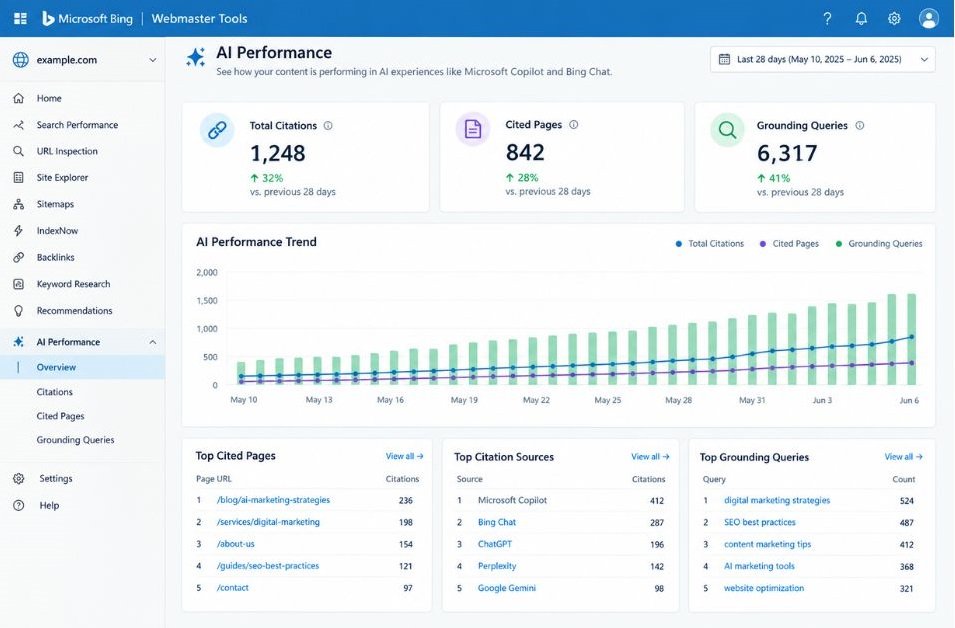
Bing Webmaster Tools is Microsoft’s free site-owner dashboard, and since February 2026 it includes an AI Performance report in public preview. It’s the first time a major platform has shown site owners their own citation data from AI answers.
The report covers citations in Microsoft Copilot, Bing’s AI-generated summaries and select partner integrations. Its main views are total citations, the number of cited pages, grounding queries (the phrases the AI used when retrieving your content) and a trend line over time. Verify your site in Bing Webmaster Tools, then open the report at bing.com/webmasters/aiperformance.
Here’s how to use it. Sort your cited pages and look at what they have in common. In Search Influence’s data, the cited pages were structured comparison pages, and one page took 69% of citations. If your top cited page is a table-heavy comparison, build more pages in that format. Also read the grounding queries as topic ideas, with one warning: they are the engine’s retrieval phrases, not what real people typed.
The limits matter. The report shows no click data, so you can’t tie citations to visits. It covers Microsoft’s surfaces only, and it won’t show which other sites were cited next to you. Microsoft has said more data will arrive during 2026.
Semrush AI Visibility Toolkit
Semrush’s AI Visibility Toolkit is a paid module inside the Semrush platform that measures how your brand appears in AI-generated answers. It has four parts that work together.
Prompt Research works like keyword research for AI, helping you find and prioritise the questions worth targeting. Prompt Tracking monitors your visibility for a chosen set of prompts in ChatGPT Search and Google AI Mode, with daily updates and position data. Brand Performance runs a large set of common queries through language models and reports how those platforms describe you against competitors, including sentiment, with weekly updates. Visibility Overview and Competitor Research give a wider view and refresh monthly.
According to Semrush’s help documentation, the standard toolkit includes one domain for Brand Performance and 25 tracked prompts. Extra prompts are sold in blocks of 50 for $60 a month, and extra domains cost $99 each per month. Semrush One bundles the toolkit with its SEO suite on higher tiers with larger limits. Check which countries your plan supports for Prompt Tracking, because location coverage has changed across Semrush’s documentation.
It suits teams that already live in Semrush, since AI data sits beside keywords and backlinks. The trade-off is that the starter prompt allowance runs out quickly if you track many products or markets.
Ahrefs Brand Radar
Ahrefs Brand Radar is the AI visibility product inside Ahrefs, and it measures brand mentions, citations and share of voice across Google AI Overviews, AI Mode, ChatGPT, Perplexity, Gemini and Copilot. Its pitch is scale. It draws on an index of more than 250 million prompts, which gives you retroactive data without setting anything up first.
Practically, you enter your brand and competitors and see where each appears, which pages get cited, and how share of voice has moved over time. Ahrefs has since added custom prompt tracking with choices for model, location and frequency, and it also tracks YouTube and Reddit mentions, two sources Ahrefs’ own research linked to higher AI visibility. Historical data is the standout. Several reviewers note that rivals such as Peec and Otterly don’t offer it.
Be careful with two things. Brand Radar is sold as an add-on, and Ahrefs lists different entry prices in different places, so verify the current cost. And reviews from competing vendors question its accuracy for ChatGPT and Perplexity because the model was built around keywords before prompts. Those reviewers have a commercial interest, so run a few manual checks of your own before you trust any single number.
Otterly.AI
Otterly.AI is a dedicated AI search monitoring tool aimed at small teams and solo marketers. It tracks whether your brand is mentioned and which of your URLs get cited, and it shows how that shifts over time.
Its entry plan has been listed at around $29 a month in several 2026 comparisons, covering a small set of prompts across engines such as ChatGPT, Google AI Overviews, Perplexity and Copilot. Extra engines, including AI Mode, Gemini and Claude on some plans, are priced as add-ons. Otterly also offers a GEO audit that checks your pages for the things that influence citations, so it points to what you can change as well as what you’ve earned.
Use it when you want a low-cost pilot to learn which prompts you appear in before paying for something larger. The limits are prompt volume and the way extra engines add up in cost.
Peec AI
Peec AI is a tracking platform built for running large prompt sets across markets. It reports a visibility score, which shows the share of AI answers that mention your brand, along with sentiment and the sources engines cite. Engines usually include ChatGPT, Google AI Overviews, AI Mode, Copilot, Perplexity and Gemini, though entry plans let you choose a subset, so confirm which ones.
It supports many languages and countries, which makes it a natural fit for agencies and brands selling across regions. Several comparisons also mention unlimited seats on its plans. Entry plans in 2026 comparisons sat at roughly a hundred dollars a month or less, with higher tiers adding prompts.
The honest limit is that Peec AI is a monitoring tool. It tells you where you stand but doesn’t fix pages for you, so someone on your team still needs to turn the data into content and technical changes.
Profound
Profound is an enterprise AI visibility platform positioned around depth, compliance and scale. It combines tracking of brand visibility across many AI engines with crawler-level data, a conversation explorer that shows how topics get discussed, and views for managing multiple brands or clients.
Plan structures reported in 2026 range from a starter tier limited to ChatGPT, through a growth tier covering a few engines, to an enterprise tier that can reach roughly nine or more engines, with security features such as SSO and SOC 2 compliance. Prices differ between sources, from a few hundred dollars a month for self-serve plans to custom enterprise quotes, so ask for a current quote.
It fits large brands and agencies with multiple regions, legal review needs and budget for it. For a small site, it’s more than you need.
Manual Prompt Audits and Server Logs
The cheapest tool is a spreadsheet. List 20 to 30 prompts your buyers would really type, run each in ChatGPT, Perplexity, Gemini, Claude and Google AI Mode, and record whether you’re mentioned, how, and which sources appear. Repeat monthly. It’s slow, but it shows you the real wording of answers, which dashboards often compress.
Server logs add the other half. Look for requests from OAI-SearchBot, Claude-SearchBot, PerplexityBot and Bingbot to confirm they can actually reach your key pages. Also check Google’s Rich Results Test and the Schema Markup Validator after any structured data change, since broken markup creates the ambiguity you were trying to remove.
How Do You Build the Off-Site Signals AI Engines Trust?
You build them by getting your brand mentioned accurately in places AI engines already pull from, such as review sites, forums, video platforms and trade publications. An engine that reads five independent sources saying the same thing about you is more likely to repeat it.
Remember the Pew finding that Wikipedia, Reddit and YouTube formed a notable slice of the sources in AI summaries. Ahrefs’ own research also tied YouTube and Reddit mentions to higher AI visibility across the major platforms. That points to a plain priority: be present where people discuss and demonstrate products.
Consider a beauty brand like Mamaearth competing for questions about the best sunscreen for Indian summers. The answer is unlikely to come only from the brand’s own site. Retail pages such as Nykaa, creator reviews on YouTube and community threads all feed the picture. A brand that ignores those places leaves the story to others.
Practical Off-Site Moves
Keep your facts consistent first. Your brand description, founding details, pricing model and category should read the same on your site, LinkedIn, Google Business Profile and directories. Next, earn reviews on the platforms your category uses. Then pitch data or commentary to trade publications that already rank for your topics, and answer questions on Reddit and Quora as a named, helpful participant rather than a marketer dropping links.
This is the slowest part of the work. It’s also the hardest for competitors to copy quickly.
What Does a 30-Day Plan Look Like?
A 30-day plan starts with access and measurement, moves to your ten most valuable pages, and finishes with tracking. You don’t need a big budget, only a short list of priorities done in order.
- Verify your sites. Add and verify your domain in Google Search Console and Bing Webmaster Tools, and open the AI Performance report.
- Audit crawler access. Review robots.txt, your CDN and firewall rules so OAI-SearchBot, Claude-SearchBot, PerplexityBot and Bingbot can reach your pages.
- Build a prompt list. Write 25 questions buyers actually ask, grouped by product, problem and comparison.
- Run a baseline audit. Test every prompt manually across ChatGPT, Perplexity, Gemini, Claude and Google AI Mode, and record mentions and cited sources.
- Rewrite ten priority pages. Add direct-answer openings, standalone definitions, comparison tables and dated, sourced statistics.
- Fix entity basics. Add Organization and Article schema, correct inconsistent brand details across profiles, and move key facts out of scripts into HTML.
- Start one off-site push. Choose a single channel, such as reviews or one trade publication, and ship something there.
- Add one paid tracker if needed. Pick a tool from the section above once you know your prompt list, and set weekly reporting.
How Do You Know Whether It’s Working?
Watch four signals together: citation counts in Bing’s report, your share of mentions across tracked prompts, referral traffic from AI platforms in your analytics, and growth in branded searches. None is perfect alone.
Citations show presence. Share of voice shows how you compare with named competitors. Referral traffic, which you can segment in Google Analytics 4 by sources such as chatgpt.com and perplexity.ai, shows actual visits. Branded search growth and sales calls where prospects say they found you through an AI assistant show influence that never produces a click.
A few cautions keep you honest. Answers vary between runs, so look at trends over several weeks rather than a single day. Citations don’t equal clicks, as Whole Whale’s own comparison of Bing citations with site analytics showed. And a tool’s sample won’t match a competitor tool’s sample, so choose one and compare it against itself over time.
Conclusion
AI Searchability comes down to three habits: let the right crawlers in, write passages worth quoting, and get your brand mentioned accurately across the web. None of it requires secret tactics. Google itself says the fundamentals still apply, which means disciplined execution beats clever tricks.
The practical order is simple. Verify Search Console and Bing Webmaster Tools this week, fix any crawler blocks, rewrite your ten most valuable pages with answer-first openings, and build a prompt list you can test every month. Add a paid tracker only when you know what you want it to measure.
FAQs
What is AI search visibility?
AI search visibility is how often and how favourably your brand appears in answers generated by tools such as ChatGPT, Google AI Overviews, Perplexity, Gemini, Claude and Microsoft Copilot. It covers both mentions of your brand and citations that link to your pages. You measure it by tracking a set of prompts over time and recording where you appear.
Is GEO different from SEO?
Generative engine optimisation (GEO) is the practice of making content easy for AI systems to retrieve and cite, while SEO targets rankings in traditional results. They overlap heavily. Google says its AI features run on core search systems and the same fundamentals apply. GEO adds extra attention to answer-first passages, entity consistency, crawler access for non-Google engines and off-site mentions.
Do I need an llms.txt file?
No, not for Google. Google’s guidance says it doesn’t need llms.txt or special markup to appear in AI Overviews or AI Mode. Some other AI tools may read the file, and it costs little to create, so it’s a reasonable low-priority test. Just don’t expect it to rescue weak content or blocked crawlers.
Can I block GPTBot and still appear in ChatGPT?
Yes. OpenAI uses separate crawlers for separate jobs. GPTBot gathers training data, while OAI-SearchBot builds the index behind ChatGPT search. You can block the first and allow the second. Check your robots.txt after any change, and remember that ChatGPT-User, which fetches pages on a person’s request, may not follow robots.txt rules.
Which tool should I start with if I have no budget?
Start with Google Search Console and Bing Webmaster Tools, both free. Search Console gives your baseline Google performance. Bing’s AI Performance report shows real citation data from Copilot and Bing’s AI summaries. Add a manual spreadsheet audit of 25 prompts, and only pay for a tracker once you know which prompts matter.
Why isn’t my brand showing up in ChatGPT even though I rank on Google?
Usually one of three reasons applies. OAI-SearchBot may be blocked by robots.txt or your firewall. Your page may bury the answer deep in the text instead of leading with it. Or other sources may describe your category without mentioning you. Test the exact prompt, look at which sites ChatGPT cites instead, and compare their pages with yours.
Is SEO dead because of AI?
No. Google’s own guidance says SEO fundamentals still apply to its AI features, and those features pull from the same index. What has changed is that ranking alone no longer guarantees attention, since AI answers can satisfy the reader first. Treat SEO as the foundation and AI visibility as the layer that measures and extends it.
How long does it take to see results?
Technical fixes such as unblocking crawlers can show up in weeks, since crawlers revisit regularly. Content rewrites and new comparison pages usually take longer, often a few months, depending on how quickly they’re crawled and indexed. Off-site reputation work is slowest. Track monthly trends instead of expecting a clean before-and-after result.
Does a small business need to worry about this?
If your customers ask AI assistants for recommendations in your category, yes, though at a smaller scale. A local firm can focus on consistent business details, a complete Google Business Profile and Bing Places listing, genuine reviews and a few clear answer-first pages. Bing specifically called out Bing Places for Business as infrastructure that keeps citations accurate.
Can I trust the numbers from AI visibility tools?
Treat them as directional, not exact. Tools sample prompts at set times, and AI answers vary from run to run. Different vendors also use different prompt sets and methods, so their numbers won’t match each other. Use one tool consistently, validate a handful of results by hand, and judge success by trends over time.


What Is SEO In Digital Marketing? Complete Beginner’s Guide
October 8, 2026 - 10:35 am[…] has said that SEO best practices remain foundational and that no separate strategy is needed for AI search. That’s why AI in SEO now means two jobs at once: using AI to work faster, and shaping your pages […]
What Is Integrated Marketing? Strategies, Benefits, Examples
October 8, 2026 - 12:35 pm[…] shifts make it more urgent in 2026. First, AI search results and chat assistants now summarise brands from across the web, so contradictory messaging on […]