
Most ads get about two seconds of attention, so the standard advice is to keep them short. That advice falls apart the moment your buyer needs convincing. Long Advertising Copy exists for that moment. It lets you answer objections, show proof and make a clear offer in a single piece, without a salesperson in the room.
Long-form ad copy is advertising text that runs from a few hundred to several thousand words, written to carry a reader from first attention to a clear decision in one sitting. You’ll find it in sales letters, landing pages, print and magazine ads, email sequences and the expanded primary text of social ads.
This article covers when longer copy wins, how a high-converting ad is built, which frameworks to use, and every tool worth adding to your workflow, from research to editing to testing. You’ll also get a seven-step writing process and ten FAQs. Read it in order or jump around, but the later sections build on the earlier ones.
When Does Longer Ad Copy Beat Shorter Copy?
Longer copy wins when the purchase is expensive, complex, unfamiliar or risky. Shorter copy wins when the product is cheap, well known or bought on impulse. The deciding factor is how many questions your buyer needs answered before they’ll act, not the word count itself.
Think about what a reader is actually doing when they decide whether to buy a ₹40,000 course versus a ₹199 phone case. The course buyer is hunting for reasons to say no. They want to know who teaches it, what the syllabus covers, whether people like them got results, and what happens if it doesn’t work out. Every unanswered question is a place to quit.
The idea isn’t new. Claude Hopkins argued in his 1923 book Scientific Advertising that ads should give reasons and facts, not slogans. David Ogilvy later built his career on the same belief, and his 1958 Rolls-Royce print ad ran a headline about the electric clock followed by a long block of specific, factual body copy. John Caples proved the same point with his 1926 ad for the U.S. School of Music, which opened with “They laughed when I sat down at the piano” and then told a full story before making the pitch.
But doesn’t everyone say people don’t read online? Partly. The Nielsen Norman Group has reported for years that web users scan pages and read only a fraction of the words. That’s the point. Scanners skim headlines and subheads, and interested buyers read the details. Long-form copy serves both by being layered: a skimmable skeleton on the outside, and depth for anyone who wants it.
Platform limits shape this too. On Meta (the company behind Facebook and Instagram), primary text is typically cut off after roughly 125 characters with a “See more” link, so your first line has to earn the tap. Google’s Responsive Search Ads cap you at 15 headlines of up to 30 characters and 4 descriptions of up to 90 characters, so the long argument has to live on the landing page the ad points to. In practice, “long copy” often means a tight ad that leads to a long page.
Indian D2C brands show this split clearly. Mamaearth’s product pages spend real space on ingredients and claims because a face serum is a considered purchase, while a quick-commerce banner for Zepto can say almost nothing because the buyer already knows what a grocery order is.
Long-form ad copy outperforms short copy when buyers need information to feel safe, such as with high-priced, complex or unfamiliar products. Short copy works better for cheap, familiar or impulse purchases where the decision takes seconds. The right length is whatever it takes to answer every question a buyer would otherwise leave with.
What Makes an Ad Convert? The Anatomy of a Long-Form Ad
A high-converting long-form ad has five working parts: a headline that earns the read, a lead that confirms the reader’s problem, a body that builds belief, proof that removes doubt, and an offer with a clear next step. Skip any one and the others have to work twice as hard.
Headline and hook
The headline has one job: get the right person to read the next sentence. It doesn’t need to explain everything. It needs to make a specific reader feel “this is about me.”
Strong headlines usually do one of four things. They name a specific result, flag a problem the reader already feels, make a curious but credible promise, or call out the audience directly. Weak ones announce the brand or play with clever wordplay that only the writer finds funny.
Here’s a rule worth following: if someone read only your headline and nothing else, would they know who the ad is for and what’s in it for them? If not, rewrite it.
Lead, body and proof
The lead is the first paragraph after the headline. It should mirror what the reader is already thinking, in words they’d use themselves. Hopkins-style specificity beats adjectives here. His famous campaign for Schlitz beer didn’t call the beer “pure.” It described how the bottles were washed with live steam and how the brewery drilled for water through rock. Nothing special, really, since every brewer did similar things. But Schlitz was the first to explain it, and the explanation made the claim believable.
The body then builds belief step by step. Explain how the product works, who it’s for, and what changes after someone uses it. Use concrete numbers, named features and plain language.
Proof does the heavy lifting against doubt. Useful types include customer testimonials with real names and details, case results with actual numbers, third-party reviews, certifications, media mentions and demonstrations. A testimonial that says “Great product!” proves nothing. One that says “I cut my reporting time from six hours to forty minutes” proves a lot.
Offer, risk reversal and call to action
An offer is what the reader gets, at what price, with what bonuses and by when. The call to action (CTA) is the single next step you want them to take. Be specific: “Start your 14-day trial” beats “Learn more.”
Risk reversal means taking the downside off the buyer’s shoulders through a money-back guarantee, a free trial or a no-questions return policy. It matters most in long-form ads because the people who read that far are seriously considering a purchase and are often one worry away from leaving.
One CTA per ad. Repeat it, sure, but don’t offer three different actions and let the reader choose.
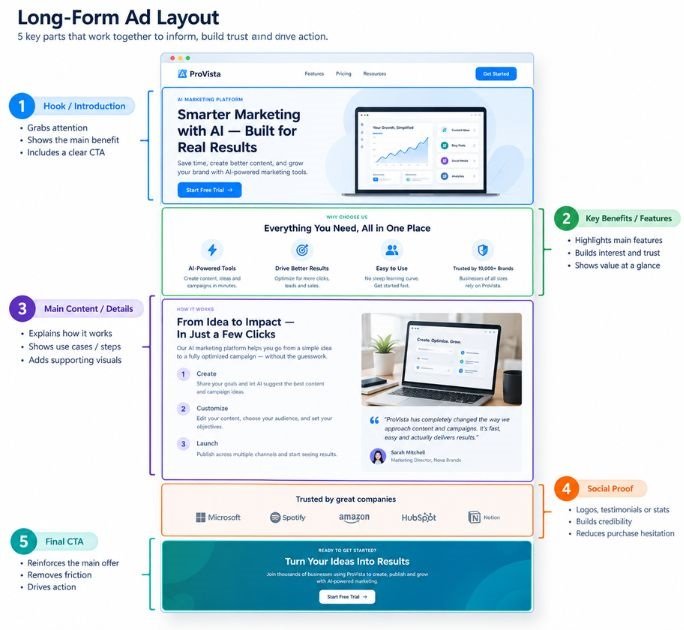
A high-converting long-form ad has five parts: a headline that earns attention, a lead that mirrors the reader’s problem, a body that builds belief, proof that removes doubt, and an offer with one clear call to action. Specific facts, such as numbers, named features and real testimonials, persuade better than adjectives.
Which Copywriting Frameworks Should You Use?
Use AIDA for general-purpose ads, PAS when the reader has an obvious pain, BAB when the transformation is the selling point, and the 4 Ps or PASTOR for long sales pages. A copywriting framework is a repeatable structure that tells you what to say and in what order, so you’re never staring at a blank page.
Frameworks aren’t magic formulas. They’re scaffolding. You’ll fill them with your own research, and a good one stays invisible to the reader.
AIDA
AIDA stands for Attention, Interest, Desire, Action. It’s one of the oldest models in advertising, usually traced to the American advertising pioneer Elias St. Elmo Lewis in the late 1800s.
You grab attention with a headline, build interest with a relevant fact or story, create desire by showing what life looks like with your product, and close with a clear action. It’s flexible enough for display ads, emails and landing pages. The weakness is that it says little about proof, so add testimonials and data inside the Desire stage.
PAS (Problem, Agitate, Solve)
PAS opens with the problem, makes the reader feel its cost, and then presents your product as the way out. “Your ad spend keeps climbing. Your conversions don’t. Every week you wait, the gap grows. Here’s how to fix the page that’s leaking your budget.”
PAS works well when the pain is real and widely felt. It backfires when you agitate too hard, because readers who feel manipulated stop reading. Keep the agitation honest and tied to facts.
BAB (Before, After, Bridge)
BAB describes the world before your product, paints the world after, and shows your product as the bridge. It’s strongest when the transformation is easy to picture, as with fitness, finance, skincare or productivity tools. A personal finance app might contrast the dread of month-end with the calm of seeing every rupee tracked.
The 4 Ps and PASTOR
The 4 Ps are Picture, Promise, Prove, Push. You paint a picture of the desired outcome, promise it’s achievable, prove it with evidence, and push the reader to act.
PASTOR, created by copywriter Ray Edwards, stretches this into a full sales-page structure: Problem, Amplify, Story and Solution, Transformation and Testimony, Offer, Response. It’s built for long copy, because it covers the story, the proof and the close. If you’re writing a 2,000-word page, PASTOR gives you a map.
So which should you pick? Start from the reader’s state of mind. Cold audience with a vague need? AIDA. Pain they already feel? PAS. Visible transformation? BAB. A high-ticket offer that needs a story and a lot of proof? PASTOR.
AIDA suits general ads, PAS suits ads where the reader already feels a clear pain, BAB suits visible transformations, and PASTOR suits long sales pages with a story and strong proof. Pick the framework based on what the reader already knows and feels, then fill it with real customer language.
Which Research Tools Give You Better Ad Angles?
The best research tools show you what real customers say in their own words and what competitors already run. Reddit, Amazon reviews, G2 and Trustpilot give you customer language. AnswerThePublic, Google Trends and SparkToro show demand and audience. The Meta Ad Library and Google Ads Transparency Center show competitor ads.
Most weak ad copy fails before the first sentence is written, because the writer guessed at what the audience cares about. Research replaces guessing. Pull phrases straight from customers into a simple document, sorted by theme: problems, desired outcomes, objections, and words they use to describe the product.
Reddit, Amazon reviews, G2 and Trustpilot
These four are voice-of-customer sources, meaning places where buyers describe their experience unprompted.
Reddit is a forum site organised into topic communities called subreddits. Search for your category plus words like “worth it,” “regret” or “alternative,” and sort by top posts. You’ll find problems stated bluntly and in exact phrasing.
Amazon reviews are most useful in the three-star range. Five-star reviews are often vague praise and one-star reviews are often shipping complaints. Three-star reviews tend to say “I liked X but wished for Y,” which hands you both a benefit and an objection.
G2 and Trustpilot do the same for software and services. G2 splits reviews into “What do you like best?” and “What do you dislike?” prompts, which saves sorting time. A caution: reviews are self-selected and skew toward extremes, so treat them as a source of language and themes, not as a statistical sample.
AnswerThePublic and Google Trends
AnswerThePublic takes a keyword and returns the questions, comparisons and prepositions people search with, such as “is X worth it” or “X vs Y.” Those questions become your subheads and objection-handling paragraphs.
Google Trends is Google’s free tool for comparing search interest over time and by region. Use it to check whether demand is rising or fading, whether it’s seasonal, and which regions or states care most. If interest in your category spikes before Diwali and slumps afterward, your copy and budget should follow that rhythm.
SparkToro
SparkToro is an audience research tool that shows which websites, podcasts, YouTube channels and social accounts a target audience pays attention to, along with the words in their public bios. It won’t write your ad, but it tells you where your reader hangs out and how they describe themselves, which helps you pick the right tone and examples. Its free tier is limited, and its data comes from a sample of public sources, so treat the results as directional.
Meta Ad Library and Google Ads Transparency Center
The Meta Ad Library is a public database of ads currently running across Facebook, Instagram and Meta’s other platforms. Search by competitor name or keyword and you can see their copy, creative and how long an ad has been live. As a rule of thumb, an ad that’s been running for months is probably working, since nobody keeps paying for a loser.
The Google Ads Transparency Center does a similar job for ads on Google Search, YouTube and Display. You can look up an advertiser and see the ads they’ve run.
Use these for pattern spotting, not copying. Note which hooks competitors repeat, which claims everyone makes, and what nobody is saying. The gap is your angle.
Research tools turn guesses into evidence. Reddit, Amazon reviews, G2 and Trustpilot supply customer language, AnswerThePublic and Google Trends reveal demand, SparkToro maps audience habits, and the Meta Ad Library and Google Ads Transparency Center show what competitors are running. Use them to find an angle, not to copy someone else’s ad.
Which Writing and Editing Tools Help You Draft Faster?
AI assistants like Claude and ChatGPT speed up drafting and variations. Hemingway Editor tightens sentences, Grammarly catches errors and tone problems, and CoSchedule’s Headline Analyzer scores headline strength. No tool replaces judgment, but each removes a specific kind of friction from the writing process.
Claude and ChatGPT as drafting partners
Claude (from Anthropic) and ChatGPT (from OpenAI) are AI assistants that generate and rewrite text from your instructions. They’re useful for producing ten headline options in minutes, rewriting a paragraph in a different tone, turning your research notes into a first-pass outline, and playing a skeptical buyer who raises objections you’ve missed.
The quality of the output depends on the quality of your input. Paste in your customer-language document, state the audience, the framework and the offer, and you’ll get something usable. Ask for “a great ad” and you’ll get something generic.
Three limits to respect. First, these tools can invent facts, so verify every claim, number and testimonial yourself. Never let an AI write a customer quote. Second, they default to safe, familiar phrasing, which flattens your voice. Third, advertising claims carry legal weight: in India the Advertising Standards Council of India (ASCI) has rules on misleading claims, and Meta and Google have their own ad policies. You’re responsible for every sentence you publish.
Hemingway Editor
Hemingway Editor is a free web tool that highlights hard-to-read sentences, adverbs, passive voice and complex words, and gives your text a reading grade. Paste your draft, then work through the yellow and red highlights.
For ad copy, aim for a reading level around grade 6 to 8. That isn’t dumbing down. Plain language is faster to process, and your reader is skimming. Don’t obey it blindly though. Hemingway will flag a deliberate fragment or a long sentence that builds rhythm, and sometimes the flagged version is the better one.
Grammarly
Grammarly checks spelling, grammar, punctuation, clarity and tone, and works inside browsers, Google Docs and many other apps. Its tone detector is handy when you’re writing for an audience you don’t belong to. Its suggestions can sand your voice down, so accept the corrections for errors and be pickier about the style rewrites. A typo in a long ad is more costly than in a short one, because it gives a skeptical reader a reason to doubt you.
CoSchedule Headline Analyzer
CoSchedule Headline Analyzer is a free tool that scores a headline out of 100 based on word balance, length, sentiment and clarity, and suggests tweaks. Paste in your ten headline candidates and compare. Treat the score as a prompt for discussion, not a verdict. A headline can score modestly and still be the best one for your audience, because the tool doesn’t know your reader. Always let live testing have the final say.
How Do You Write Long-Form Ad Copy, Step by Step?
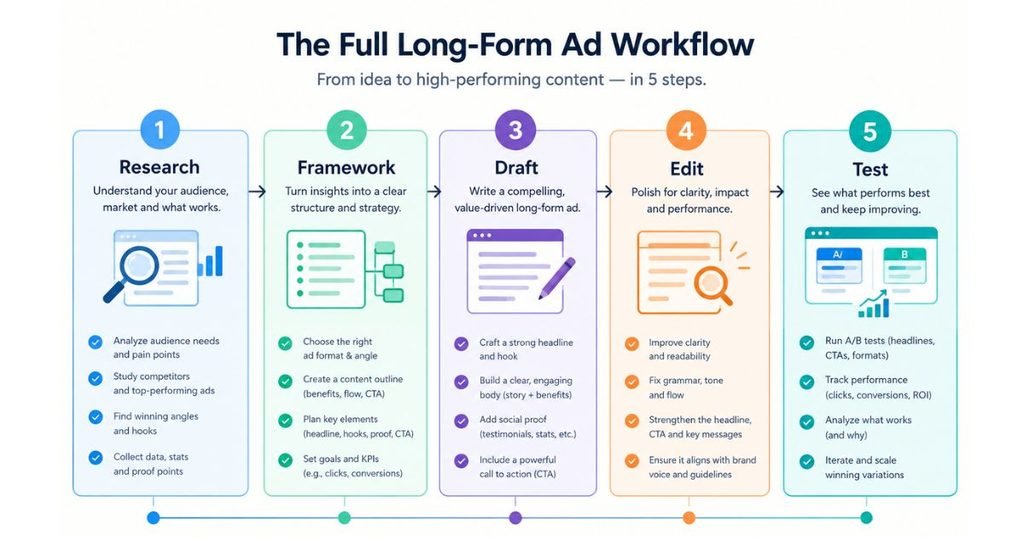
Write long-form ad copy in seven steps: define the reader and offer, gather customer language, choose a framework, write the headline and lead, build the body and proof, close with the offer, then edit hard. Following this order keeps you from polishing sentences before you know what you’re saying.
- Define one reader and one offer. Write a single sentence: “This ad is for [specific person] who wants [specific outcome] and will [specific action].” If you can’t fill it in, you aren’t ready to write.
- Collect customer language. Spend an hour in Reddit threads, Amazon three-star reviews and G2 comments. Copy exact phrases into a document under problem, outcome and objection.
- Choose a framework. Pick AIDA, PAS, BAB or PASTOR based on the reader’s state of mind, and write its stages as empty headings.
- Write 15 to 20 headlines, then pick three. Bad headlines are cheap to write and expensive to publish. Generate many, cut hard, and plan to test the finalists.
- Draft the body without editing. Fill each framework stage with facts, specifics and proof. Don’t stop to fix wording. A messy full draft beats a polished half one.
- Add proof and close with a clear offer. Place testimonials, numbers and guarantees near the claims they support. End with one CTA, repeated if the page is long.
- Edit in three passes. Cut first (remove anything that doesn’t serve the reader), clarify second (shorten sentences, replace vague words with specific ones), and proofread last. Read the whole thing aloud. Wherever you stumble, the reader will too.
A few formatting habits help long copy get read. Keep paragraphs to one to four sentences. Use subheads that carry meaning on their own, so a scanner gets the story from the subheads alone. Bold only the key phrases that matter. And put the strongest proof early, not buried at the bottom.
An example from the Indian market makes the process concrete. Say you’re writing for a hypothetical audio brand selling wireless earbuds at a mid-range price, in the style of boAt. Your research might show buyers complain about battery that dies after a few months and call quality that sounds fine in reviews but fails on real calls. Your lead then speaks to those two doubts, your body explains the battery and microphone specifics, your proof comes from real call-quality tests, and your offer includes a clear warranty. The copy practically writes itself once the research is done.
Write long-form ad copy in seven steps: define one reader and one offer, collect customer language, choose a framework, write many headlines, draft the body fast, add proof and a single call to action, and edit in three passes. Research comes before writing, and editing comes after.
Which Testing and Analytics Tools Prove What Works?
Meta Ads Manager and Google Ads have built-in experiment tools for ads, VWO and Optimizely test landing pages, Microsoft Clarity and Hotjar show how people behave on the page, and Google Analytics 4 tracks what happens after the click. Ad copy testing replaces opinion with data, and your favourite headline will lose more often than you’d expect.
Ad copy testing is the practice of showing different versions of an ad or page to comparable audiences and measuring which one produces more of the result you care about. The rules are simple but often broken. Change one variable at a time. Run the test long enough to gather meaningful data. Judge by the metric tied to money (purchases, leads, qualified calls), not just clicks.
Meta Ads Manager A/B tests
Meta Ads Manager has a built-in A/B Test feature that splits your audience into non-overlapping groups, so each person sees only one version. Use it to compare two headlines, two primary-text lengths, or a short ad against a long one. Meta’s Advantage+ creative options can also generate text variations, but run these as a deliberate test rather than letting the system mix everything at once, or you won’t know what drove the result.
Google Ads experiments
Google Ads offers an Experiments feature that lets you test changes against a copy of an existing campaign with a share of traffic. With Responsive Search Ads, Google rotates combinations of your headlines and descriptions and reports asset performance ratings. Those ratings are helpful for spotting weak lines, but they’re a guide, not a controlled test, so confirm important decisions with a proper experiment.
VWO and Optimizely
For the long page behind the ad, you need a landing-page testing tool. VWO (Visual Website Optimizer) and Optimizely let you create page variants, split traffic and see which converts better, often with a visual editor that doesn’t need a developer. Google Optimize, the free option many marketers used, was shut down in September 2023, so most teams moved to these tools or similar ones. Both are paid products, and statistical rigour depends on having enough traffic. A page with 200 visitors a month can’t produce a trustworthy test, so for low-traffic pages, test bigger changes and judge over a longer period.
Microsoft Clarity and Hotjar
Microsoft Clarity is a free tool that records user sessions and builds heatmaps showing where people click and how far they scroll. Hotjar offers similar features plus on-page surveys. They answer the question the numbers can’t: why are people leaving? If your scroll map shows that most visitors quit before your proof section, move proof higher. If they click on a non-clickable image, make it clickable or remove it.
Google Analytics 4
Google Analytics 4 (GA4) is Google’s analytics platform, and it tracks events like scrolls, clicks, form submissions and purchases. Set up conversion events and link your campaigns using UTM parameters (tags added to a URL that tell GA4 where traffic came from). Then you can compare not just which ad got more clicks, but which one brought visitors who actually bought. An ad that gets fewer clicks but more sales is the better ad.
Test ad copy with one variable at a time and judge by revenue-linked metrics, not clicks. Meta Ads Manager and Google Ads handle ad-level tests, VWO and Optimizely test landing pages, Microsoft Clarity and Hotjar show where readers drop off, and Google Analytics 4 connects every variant to actual conversions.
What Mistakes Kill Conversions in Long-Form Ads?
The most common conversion killers are writing about yourself instead of the reader, making claims without proof, burying the offer, stacking multiple calls to action, and publishing without testing. Each one is fixable, and most come from skipping research or editing.
Talking about the brand, not the buyer. “We are a leading provider of…” is the sound of a reader leaving. Count the “we” and “our” words in your draft. If they outnumber “you” and “your,” rewrite.
Claims without proof. “The best results in the industry” needs evidence or needs to go. Specific, checkable statements build trust and keep you inside advertising rules.
Length without structure. Long copy fails when it’s a wall of text. Break it up with meaningful subheads, short paragraphs and lists where lists genuinely help.
Burying the offer. Readers who are ready to buy shouldn’t have to scroll through a thousand words to find the price and button. Place a CTA early and repeat it.
Too many asks. “Buy now, or sign up for the newsletter, or follow us on Instagram” gives people a way to do nothing. One main CTA.
Ignoring mobile. Most Indian internet users browse on phones. Read your copy on a small screen. A paragraph that looks fine on desktop can look like a block of concrete on mobile.
Skipping the test. Honestly, this is the big one. Without testing, you’re running on opinions, and opinions in marketing meetings are usually loud and wrong.
Conclusion
Three ideas matter most. Length should follow the buyer’s questions, not a rule of thumb. Research and structure come before polish, since a framework filled with real customer language beats clever writing every time. And no draft is finished until it’s been tested against real behaviour.
Long Advertising Copy rewards marketers who do the unglamorous work first: mining reviews, studying competitors, writing twenty headlines, and measuring honestly. Pick one product this week. Spend an hour on Reddit and Amazon reviews, draft a PAS or AIDA outline, and set up one A/B test on the headline. That’s a complete loop, and it’ll teach you more than any article can.
FAQs
What is long-form ad copy?
Long-form ad copy is advertising text that runs from a few hundred to several thousand words. It’s designed to take a reader from first attention to a decision without outside help. You’ll see it in sales pages, direct-mail letters, print ads and detailed landing pages.
How long should long-form ad copy be?
Long enough to answer every question the buyer has, and no longer. For a mid-priced product, that might be 500 to 1,000 words. For a high-ticket offer or complex service, 2,000 words or more is common. Let the buyer’s questions, not a word count, set the length.
Is long copy better than short copy?
Neither wins by default. Long copy tends to work better for expensive, complex or unfamiliar products, and short copy tends to work better for cheap, familiar or impulse purchases. The only reliable answer for your product is a test.
Do people actually read long ads?
Not everyone does, and that’s fine. Many visitors skim, while serious buyers read the details. Write a layered piece where subheads, bold key phrases and short paragraphs serve skimmers, and the full text serves people who want depth.
What’s the difference between AIDA and PAS?
AIDA (Attention, Interest, Desire, Action) builds toward a purchase by creating desire for a benefit. PAS (Problem, Agitate, Solve) starts with a pain point and moves toward relief. Use AIDA when the reader is neutral or unaware, and PAS when they already feel the problem.
How do I write ad copy for Meta ads if only the first line shows?
Make the first line a standalone hook: a specific result, a pointed question or a direct call-out to your audience. Since Meta typically truncates primary text after roughly 125 characters, put your strongest idea before the “See more” cut. The rest of the text can expand the argument for those who tap.
Which free tools should a beginner start with?
Start with Reddit and Amazon reviews for customer language, Google Trends for demand, the Meta Ad Library for competitor research, Hemingway Editor for readability, CoSchedule Headline Analyzer for headlines and Microsoft Clarity for behaviour data. All of these have free versions. That’s enough to run a solid research-to-test workflow without spending anything.
Can I use ChatGPT or Claude to write my ads?
Yes, as a drafting and brainstorming partner, but not as a final author. Feed them your research and constraints, then verify every claim and rewrite the output in your own voice. Never publish an AI-generated testimonial or statistic you haven’t verified.
Is it worth testing if my budget is small?
Yes, but test smarter. With small budgets, test big differences (a totally different hook or offer) instead of tiny ones like a single word. Run tests long enough to gather meaningful results, and focus on one variable. Even a basic headline test can stop you from scaling a weak ad.
Why isn’t my long-form ad converting?
Check the likely causes in order. First, is the headline attracting the right audience? Second, does your scroll data show readers leaving before the proof? Third, is the offer clear and the CTA visible? Fourth, is the traffic matched to the message? Fixing one weak link, then testing again, usually beats rewriting everything.


