

Most marketing teams don’t fail because they lack ideas. They fail because nobody is steering. Campaigns launch without a clear audience, budgets get split out of habit, and results are judged by whichever number looks best in the monthly deck. So what is marketing management, and why does it separate teams that grow from teams that just stay busy?
It’s the discipline that turns scattered marketing activity into a plan with owners, targets and a feedback loop. If you’re a new marketing manager, a founder who now runs marketing, or someone aiming for that title, this guide gives you the concepts, the roles, the process, every major framework and software tool in detail, and the strategies that work right now.
The Core Concepts Behind Marketing Management
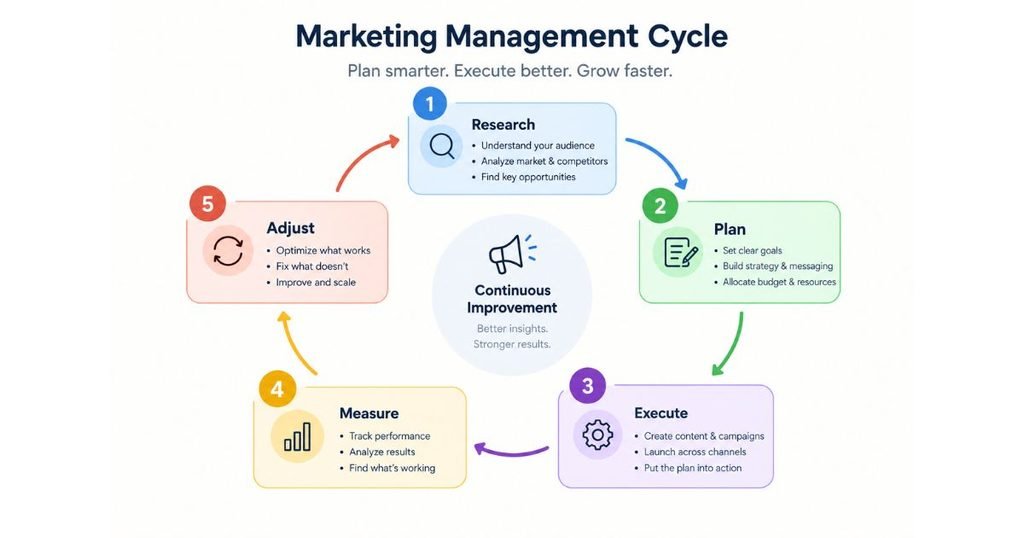
Marketing management is the planning, execution and control of activities that find customers, deliver value to them and turn that value into revenue. It covers research, positioning, pricing, promotion, distribution and measurement. Every campaign, channel and tool sits underneath this one job.
Three ideas hold the whole thing together. Get these right and the rest of the article will feel obvious.
Needs, Wants and Demand
A need is a basic requirement, like food or transport. A want is a need shaped by culture and personality, like a specific brand of coffee. Demand is a want backed by the ability to pay.
Why does this split matter? Because marketers rarely create needs. They shape wants and make products easy to afford and easy to find. Zepto didn’t invent the need for groceries. It made a 10-minute delivery window feel like a normal expectation.
Value and Customer Relationships
Customers buy the option that gives them the best mix of benefits for the cost, not the cheapest one. That ratio is value, and managing it is the heart of the job.
Philip Kotler, the academic most associated with modern marketing management, frames the discipline as choosing target markets and then getting, keeping and growing customers by delivering superior value. The American Marketing Association’s current definition is broader still. It describes marketing as the activities and processes for creating, communicating, delivering and exchanging offerings that have value for customers, partners and society. Notice the word “keeping.” Acquisition gets the budget, but retention usually decides profit.
The Marketing Mix: 4Ps and 7Ps
E. Jerome McCarthy popularised the 4Ps in 1960. They give you four levers to pull for any product: product, price, place and promotion. In 1981, Bernard Booms and Mary Jo Bitner extended the list to seven for services by adding people, process and physical evidence.
| P | What it covers | Example |
|---|---|---|
| Product | What you sell and its features | Nykaa’s own beauty labels alongside third-party brands |
| Price | List price, discounts, payment terms | boAt’s low-to-mid price band for audio products |
| Place | Where and how customers can buy | Mamaearth on its site, marketplaces and offline retail |
| Promotion | Advertising, content, PR, offers | Amul’s topical ad campaigns |
| People | Staff who touch the customer | Swiggy’s delivery partners and support team |
| Process | How the service is delivered | Zepto’s dark-store picking and dispatch flow |
| Physical evidence | Proof the service is real | App interface, packaging, store design |
Marketing management is the planning, execution and control of activities that find customers, deliver value and convert that value into revenue. Its foundation is the marketing mix, introduced as the 4Ps by E. Jerome McCarthy in 1960 and extended to the 7Ps for services by Booms and Bitner in 1981.
How Has Marketing Management Evolved Over Time?
Marketing management has moved from pushing what a company makes to building what customers want, and it’s now shifting again toward data-led, automated decisions. Each stage changed who holds power in the relationship: first the factory, then the salesperson, then the customer, and increasingly the algorithm.
Early businesses followed a production mindset. If you could make it cheaply, it sold. A selling mindset came next, where aggressive persuasion pushed unwanted products. Then Theodore Levitt’s 1960 Harvard Business Review essay “Marketing Myopia” argued that companies fail when they define themselves by their product rather than by the customer need they serve. Railroads, his famous example, thought they were in the rail business, not the transport business.
The customer-centred era followed. Brands began researching audiences first and building offers second. India’s Amul is a long-running illustration. Its “Amul girl” billboards, which began in 1966, kept a product as ordinary as butter culturally current for decades by reacting to everyday news.
Today you’re managing a fourth shift. Digital channels give you real-time data, platforms like Google and Meta automate bidding and targeting, and generative AI now drafts copy, variants and reports in minutes. The manager’s job hasn’t shrunk. It has moved from doing every task to setting direction and checking quality.
That last part trips people up. Faster tools reward clear thinking more, not less.
What Does a Marketing Manager Actually Do?
A marketing manager owns the plan that links business goals to marketing activity, manages the team and budget that execute it, and reports results to leadership. Day to day, that means setting priorities, approving campaigns, reading performance data and fixing whatever isn’t working.
Roles and Day-to-Day Responsibilities
Titles vary by company size. A startup might have one person doing everything. A large brand splits the work across specialists who report into a head of marketing or Chief Marketing Officer (CMO).
Common marketing manager roles include:
- Brand manager: protects positioning, tone and consistency across channels.
- Product marketing manager: owns launches, messaging and sales enablement for a specific product.
- Performance marketing manager: runs paid campaigns and watches acquisition cost.
- Content and SEO manager: builds organic traffic through articles, video and search optimisation.
- CRM and lifecycle manager: handles email, push notifications and retention journeys.
- Marketing analyst: builds dashboards and explains why numbers moved.
A typical week for a mid-level manager includes a budget check, a creative review, a performance meeting with the paid team, a sync with sales, and a stakeholder update. Notice how little of that is “being creative.” Most of it is deciding, prioritising and removing blockers.
Skills and Career Path
Hard skills include market research, analytics, budgeting, channel knowledge and tool fluency. Soft skills matter just as much: writing a clear brief, persuading finance to fund a test, and giving a designer feedback they can act on.
The usual path runs from executive to manager, senior manager, director and then CMO, though many people move sideways between brand, performance and product marketing along the way. From what we’ve seen with YUP course learners, the biggest gap isn’t knowing frameworks. It’s knowing which framework fits the problem in front of you. The tools section below fixes that.
The Marketing Management Process, Step by Step
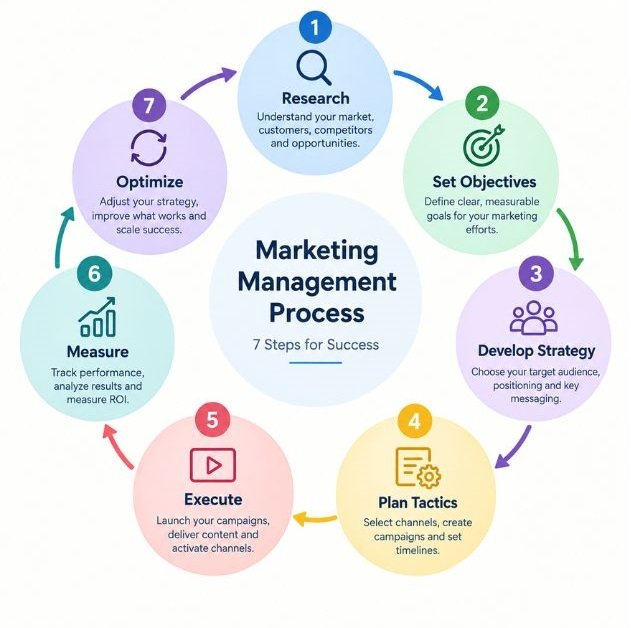
The marketing management process is a repeating cycle of seven steps: research the market, segment it, choose targets and position the offer, set objectives, build the strategy and mix, execute, then measure and adjust. You don’t run it once. You run it every planning period.
- Research the market. Study customers, competitors and conditions. Use surveys, interviews, search data and sales records. The goal is evidence, not assumptions.
- Segment the market. Split a broad audience into groups with shared needs, behaviours or demographics.
- Choose targets and position the offer. Pick the segments you can serve best, then decide what space you want to own in their minds. Mamaearth launched in 2016 around toxin-free baby care, a tight segment and a sharp position, before widening into skincare and haircare.
- Set objectives. Write goals with numbers and dates, such as reducing customer acquisition cost by 15% within two quarters.
- Build the strategy and mix. Decide the channels, budget split, messaging and offers using the 4Ps or 7Ps.
- Execute. Launch campaigns with named owners, timelines and approval paths.
- Measure and adjust. Compare results against objectives, find the cause of any gap, and feed what you learn into the next cycle.
Skipping step one is the most common shortcut. It also costs the most. A campaign built on a guess can look polished and still miss because it speaks to nobody in particular.
Frameworks and Tools Every Marketing Manager Uses
Marketing management tools fall into two groups. Frameworks are thinking tools that structure analysis and decisions. Software tools are the platforms where you collect data, run campaigns and manage work. You need both, and each section below explains what the tool is, how to use it, a real example and where it falls short.
Analysis Frameworks
These help you understand your situation before you commit budget.
SWOT Analysis
SWOT is a four-box grid that lists your internal Strengths and Weaknesses and your external Opportunities and Threats. It’s often attributed to Albert Humphrey at Stanford in the 1960s, though the origin is debated.
To use it, gather your team, list honest points in each box, then connect them. Match strengths to opportunities to find growth moves, and match weaknesses to threats to find risks that need fixing first. Nykaa, for instance, could list its curated brand portfolio as a strength and rising competition from marketplaces as a threat.
The limit is that SWOT is only a list. Teams stuff it with vague points like “good brand.” Force each item to be specific and backed by data, or the exercise is wasted.
PESTLE Analysis
PESTLE scans the outside world across six areas: Political, Economic, Social, Technological, Legal and Environmental. Use it when you enter a new market, plan a yearly strategy or face sudden change.
Work through each letter and ask what’s shifting and how it affects your customers or costs. A food-delivery brand like Swiggy would track fuel prices (economic), gig-worker regulation (legal), and changing eating habits (social). Rate each factor by impact and likelihood so you focus on a handful, not thirty.
PESTLE doesn’t tell you what to do. It tells you what’s coming. Pair it with SWOT to turn observations into choices.
Porter’s Five Forces
Michael Porter introduced this model in a 1979 Harvard Business Review article. It judges how attractive an industry is using five forces: competitive rivalry, threat of new entrants, threat of substitutes, bargaining power of buyers and bargaining power of suppliers.
Score each force from low to high for your market. In quick commerce, rivalry is intense, buyer switching costs are low, and new entrants keep arriving, which signals thin margins unless you build loyalty. That reading should shape your pricing and retention plans.
The weakness is that it’s a snapshot of an industry, not of your company. It also ages quickly in fast-moving categories, so revisit it often.
Strategy Frameworks
These help you decide where to play and how to win.
STP: Segmentation, Targeting and Positioning
STP is the backbone of marketing strategy. You split the market into segments, select the ones worth pursuing and craft a position that makes your offer clearly different for them.
Start by segmenting on behaviour or need, not just age and city. Then score each segment on size, growth, profitability and fit. Finally, write a one-sentence positioning statement that names the audience, the category, the key benefit and the proof. boAt’s focus on young, style-conscious buyers who want affordable audio is a textbook example of picking a segment and speaking its language.
The trap is choosing too many targets. A brand trying to appeal to everyone usually resonates with no one.
Ansoff Matrix
Igor Ansoff published this growth model in 1957. It maps four routes: market penetration (existing product, existing market), market development (existing product, new market), product development (new product, existing market) and diversification (new product, new market).
Risk rises as you move from penetration to diversification. Use the matrix to rank growth options, starting with the least risky. A beauty brand might push repeat purchases first, then enter new cities, then add a new product line, and only later try an unrelated category.
Ansoff doesn’t measure whether an option is profitable. Back each route with a business case before choosing.
BCG Growth-Share Matrix
Bruce Henderson of the Boston Consulting Group created this matrix in 1970 to manage a portfolio of products. It plots each one by market growth and relative market share into four groups: Stars, Cash Cows, Question Marks and Dogs.
Fund Stars to keep growing, milk Cash Cows to pay for everything else, test Question Marks selectively and consider exiting Dogs. A consumer company with a mature flagship and a few new launches can use this to decide where each rupee goes.
Critics point out that market share isn’t the only driver of success and that “Dog” products can still be useful. Treat it as a discussion starter, not a verdict.
AIDA Model and the Marketing Funnel
AIDA stands for Attention, Interest, Desire and Action. E. St. Elmo Lewis proposed it around 1898 to describe how a sale progresses. Modern marketers stretch the idea into the marketing funnel, which adds stages after purchase such as retention and advocacy.
Map your content and channels to each stage. Short videos and search ads grab attention, comparison pages build interest, reviews and demos create desire, and clear offers drive action. Then measure drop-off between stages to find the leak.
Real journeys aren’t this tidy. People loop, skip stages and research on several devices, so treat the funnel as a planning aid and not a literal path.
Software Tools
These platforms are where the plan becomes daily work.
Google Analytics 4 (GA4)
GA4 is Google’s free analytics platform that tracks website and app behaviour as events. It replaced Universal Analytics, which stopped processing standard data on July 1, 2023.
Set up conversion events first, such as purchases or lead form submissions. Then use Explorations to study user paths and the Acquisition reports to see which channels bring valuable traffic. Linking GA4 to Google Ads lets you feed conversions back into bidding.
Its learning curve is steeper than the old version, and data sampling or consent settings can affect accuracy. Always check your tagging before trusting a dashboard.
HubSpot
HubSpot is a customer relationship management (CRM) platform with marketing, sales and service modules. It stores contacts, tracks every interaction and automates follow-ups.
Use it to score leads, build email workflows, and show sales which prospects are ready to talk. Its reporting links marketing activity to closed deals, which is how you prove marketing’s contribution to revenue. A free CRM tier exists, but advanced automation sits in paid plans, so check current pricing.
Costs climb as your contact list grows, and a messy setup produces messy data. Define your lifecycle stages before you import anything.
Semrush
Semrush is a search and competitive research suite. It covers keyword research, site audits, backlink analysis and competitor tracking.
Start with a keyword gap analysis to find terms your competitors rank for and you don’t. Run a site audit to catch technical issues, and track rankings weekly. It’s valuable for planning content and for benchmarking your organic and paid presence against rivals.
Its numbers are estimates, not exact figures. Use them to compare and prioritise, and confirm real performance in Google Search Console.
Google Ads
Google Ads lets you buy placements across Search, YouTube, Display and Performance Max campaigns. You pay for outcomes such as clicks or conversions, depending on the bidding strategy.
Begin with Search campaigns on high-intent keywords, write ads that match the query, and send traffic to a focused landing page. Add negative keywords to block waste. Once you have enough conversion data, test automated bidding such as target CPA or target ROAS.
Automation needs clean conversion tracking. Feed it poor data and it will optimise toward the wrong goal very efficiently.
Meta Ads Manager
Meta Ads Manager is the buying and reporting interface for Facebook and Instagram ads. It offers audience targeting, creative testing and Advantage+ campaigns that automate placement and audience selection.
Test several creatives per campaign because creative is now the biggest lever on results. Build custom audiences from your customer lists and website visitors, and exclude recent buyers to avoid wasted spend. Review frequency and cost per result weekly.
Results swing with creative fatigue and privacy changes that limit tracking. Pair platform numbers with your own sales data before judging a campaign.
Mailchimp
Mailchimp is an email and marketing automation platform with templates, audience segments and basic customer journeys. It’s a common first choice for small businesses.
Segment your list by behaviour, then set up a welcome series, an abandoned cart reminder and a re-engagement flow. Test subject lines, and watch click rate and unsubscribes more closely than open rate, which privacy features have distorted.
It suits small teams. Larger organisations with complex journeys may outgrow it and move to a full CRM.
Canva
Canva is a browser-based design tool with templates for social posts, presentations, videos and ads. It lets non-designers produce on-brand assets quickly.
Set up a brand kit with your logos, fonts and colours so every file stays consistent. Build templates for recurring formats and let team members edit within them. It speeds up testing because you can produce several ad variants in an hour.
It won’t replace a designer for brand identity or complex work. Use it for volume, and keep specialists for the pieces that define your look.
Asana
Asana is a work management tool for organising tasks, deadlines and approvals. Marketing teams use it to run campaign calendars and creative requests.
Create a project template for each campaign type with owners, due dates and dependencies. Use the timeline view to spot clashes and the reporting view to see workload. It reduces the “who’s doing this?” confusion that quietly eats hours.
A tool can’t fix unclear ownership. Decide who approves what first, then build that into the workflow.
Marketing management tools split into frameworks that guide thinking and software that runs execution. Frameworks like SWOT, STP and the Ansoff Matrix help you decide what to do, while platforms like Google Analytics 4, HubSpot and Google Ads help you do it and measure the result. Strong managers choose the framework to fit the problem, then pick software to support it.
Marketing Management Strategies That Work Right Now
The strategies that work today combine a clear brand position with measurable channels and strong retention. Winning teams rarely rely on one tactic. They stack content, paid media, lifecycle marketing and data so each supports the others.
Content-led marketing builds trust before the sale. Helpful articles, videos and tools attract people who are researching, and they keep working long after publishing. Mamaearth’s founders leaned on educational and ingredient-focused content to explain a category many Indian parents were new to.
Performance marketing buys measurable action through Google Ads and Meta Ads Manager. It’s fast and testable, but it rents attention. Stop paying and the traffic stops. That’s why mature brands balance it against owned channels like email and SEO.
Lifecycle and retention marketing keeps existing customers buying. Nykaa’s loyalty programme and its mix of online and physical stores are built around repeat behaviour, since repeat buyers cost less to serve than new ones.
Influencer and community marketing borrows credibility. boAt grew with celebrity and creator partnerships and cricket-linked visibility, speaking in the style of its young audience. Authenticity matters here. Audiences spot a forced endorsement fast.
AI-assisted marketing speeds up research, drafting, testing and reporting. Use it for first drafts, audience analysis and creative variants, then apply human judgment on brand voice and accuracy. Teams that treat AI output as final copy tend to publish generic work.
Whichever mix you choose, tie it to a single positioning idea. Tactics change every quarter. Positioning shouldn’t.
How Do You Measure Marketing Performance?
You measure marketing performance by tracking a small set of metrics tied to revenue and cost, then comparing them with targets every period. The most useful ones are customer acquisition cost, customer lifetime value, return on ad spend, marketing efficiency ratio and conversion rate.
| Metric | Formula | What it tells you |
|---|---|---|
| Customer Acquisition Cost (CAC) | Total sales and marketing spend ÷ new customers | What it costs to win one customer |
| Customer Lifetime Value (LTV) | Average order value × purchase frequency × customer lifespan | How much a customer is worth over time |
| Return on Ad Spend (ROAS) | Revenue from ads ÷ ad spend | Efficiency of a single paid channel |
| Marketing Efficiency Ratio (MER) | Total revenue ÷ total marketing spend | Efficiency across all channels combined |
| Conversion rate | Conversions ÷ visitors × 100 | How well your pages and offers persuade |
Look at LTV against CAC together. If a customer is worth far more than they cost to acquire, you can afford to spend more to grow. If not, fix the offer or retention before scaling. ROAS only sees one channel at a time, while MER shows the whole picture, so use both.
Honestly, vanity metrics cause more bad decisions than bad data does. Followers, impressions and reach feel good, but they don’t pay salaries. Report them for context and judge success by revenue, margin and retention.
Marketing performance is best judged by a few revenue-linked metrics: customer acquisition cost, lifetime value, return on ad spend, marketing efficiency ratio and conversion rate. Compare LTV with CAC to decide how aggressively to scale, and use MER alongside ROAS to see total efficiency instead of single-channel results.
Common Mistakes in Marketing Management
Most marketing management mistakes come from skipping fundamentals: unclear targets, no measurement plan or too many channels at once. They’re easy to spot and cheap to fix if you catch them early.
- Starting with tactics, not goals. Teams pick channels first, then hunt for a reason. Write the objective before the plan.
- Targeting everyone. A broad audience produces vague messaging and expensive ads.
- Ignoring retention. Spending heavily on acquisition while existing customers quietly leave is a leaky bucket.
- Trusting platform numbers blindly. Meta and Google each claim credit for the same sale. Cross-check with your own revenue data.
- Changing too much at once. If you alter the offer, creative and audience together, you’ll never know what worked.
- No feedback loop with sales. Marketing may celebrate leads that sales can’t close.
Pick one of these and audit your own plan against it this week. It takes an hour and usually pays for itself.
Conclusion
Three ideas are worth keeping. Marketing management starts with the customer and the value you deliver, not the channel you like. The seven-step process keeps your effort tied to evidence and goals. And the right framework or tool beats the most tools, so pick based on the problem in front of you.
So, what is marketing management once you strip away the jargon? It’s the habit of deciding with data, executing with clear owners and learning from every cycle. Start small. Pick one framework from this guide, apply it to your current plan this week, and see what changes.
FAQs
How would you define marketing management in simple terms?
Marketing management is the process of planning, running and measuring the activities that attract customers and keep them buying. It connects business goals to research, positioning, pricing, promotion and distribution. A marketing manager coordinates all of this and is accountable for the results.
Marketing management vs marketing: what’s the difference?
Marketing is the broad set of activities that create and communicate value, such as advertising, content and pricing. Marketing management is how you organise, direct and measure those activities. Think of marketing as the work and management as the planning, decisions and accountability around it.
What does a marketing manager do every day?
A marketing manager reviews performance data, sets priorities, approves creative, manages budgets and coordinates with sales, product and finance. They also guide the team and report results to leadership. Most of the day goes to decisions and communication rather than hands-on design or writing.
What are the main steps in the marketing management process?
There are seven: research the market, segment it, choose targets and position your offer, set objectives, build the strategy and mix, execute campaigns, then measure and adjust. The cycle repeats each planning period, and what you learn at the end feeds the next round of research.
Which marketing management tools should a small business start with?
Begin with Google Analytics 4 to understand your traffic, a simple email tool like Mailchimp for customer communication, and Canva for creative. Add Google Ads or Meta Ads Manager once you know your offer converts. Use SWOT and STP before spending anything, since they cost nothing and sharpen decisions.
Is a marketing management course or degree worth it?
It can be, depending on what you need. A formal programme gives structure, credentials and networking, which help for corporate roles. Practical courses and real campaign experience often build usable skills faster. Many successful managers combine both, using study to learn frameworks and projects to practise them.
Is marketing management the same as digital marketing?
No. Digital marketing is one set of channels, including SEO, social media, email and paid ads. Marketing management covers the whole strategy, online and offline, from research to pricing to measurement. A digital marketer executes in channels while a marketing manager decides which channels deserve the budget.
How do you measure whether marketing management is working?
Track metrics tied to revenue: customer acquisition cost, lifetime value, return on ad spend, marketing efficiency ratio and conversion rate. Compare them with the targets you set in the plan. If acquisition cost falls while retention and revenue hold or rise, your approach is working.
Why isn’t my marketing working even though I run lots of campaigns?
Usually the problem sits upstream of the campaigns. Common causes are an unclear target audience, weak positioning, no clear goals or broken tracking. Run campaigns without those fixed and activity will rise while results stay flat. Audit your research, targeting and measurement before adding new channels.
Can AI replace marketing managers?
AI can already draft copy, analyse data and run parts of ad optimisation, but it can’t set business priorities, build stakeholder trust or own accountability for outcomes. Managers who use AI well will likely outperform those who don’t. The role is shifting toward direction, judgment and quality control.


