

Open a food delivery app at 9 pm in any Indian metro and the problem shows up in one screen. Dozens of restaurants sell nearly identical biryani, each with a bigger discount than the last, all chasing the same hungry customer. That’s a red ocean strategy in action: competing head-on in a market where rivals, products, and price cuts all look alike.
The term comes from W. Chan Kim and Renée Mauborgne, the INSEAD professors who published Blue Ocean Strategy in 2005. They called crowded markets “red” because rivals fight over the same customers until the water turns bloody. Most businesses still operate in these markets, and plenty make serious money there.
This guide covers what the approach means, the analytical tools that help you compete in it, how real companies play it, and where it pays off or backfires. You’ll also get a step-by-step way to decide whether to fight in a crowded market or look for open water.
What Does “Red Ocean” Mean in Business?
A red ocean is an existing industry with defined boundaries, accepted rules, and established competitors, where companies grow by taking market share from each other. Competing there means beating rivals on price, features, brand, or distribution.
Kim and Mauborgne split the business world into two kinds of oceans. Red oceans are every industry that exists today. Blue oceans are industries that don’t exist yet, where demand is created rather than fought over.
The authors studied 108 companies that launched new businesses. According to their 2005 book, 86% of the launches were line extensions inside existing markets. Those launches brought in about 62% of revenues and 39% of profits. The other 14% created new markets and delivered 38% of revenues but 61% of profits.
That doesn’t make a red ocean a mistake. It means that most of the money, most of the jobs, and most of the competition sit in red water, and you need to know how to operate there.
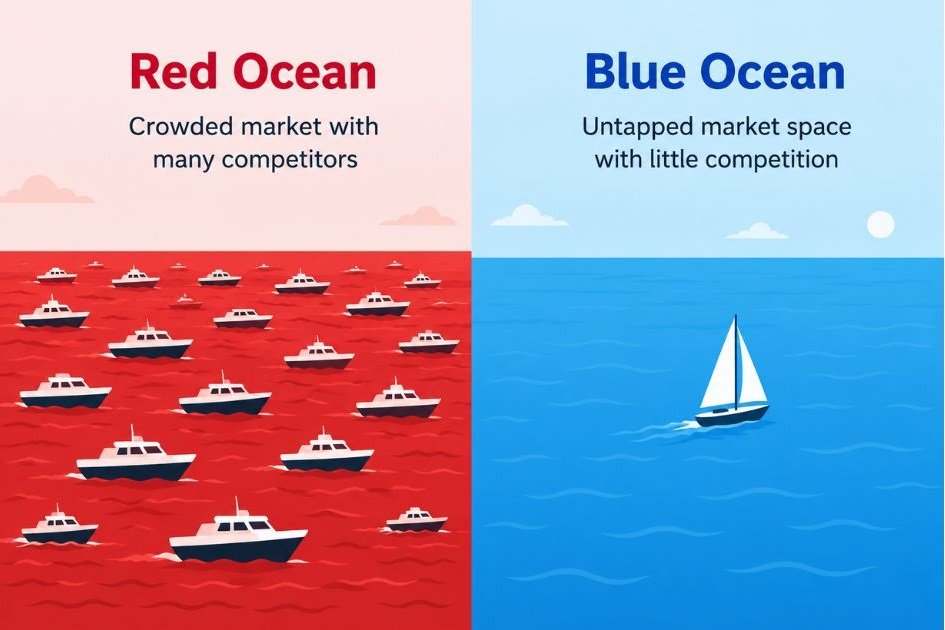
A red ocean is any existing market where competitors fight over the same customers using known rules. Kim and Mauborgne’s 2005 research found that 86% of new business launches were line extensions in these markets, yet they produced only 39% of profits. Red oceans hold most of the world’s revenue but not most of its upside.
What Are the Core Characteristics of a Red Ocean Market?
A red ocean market has fixed boundaries, visible competitors, and a zero-sum fight for share. If you can name five direct rivals in ten seconds, you’re probably standing in one.
Here are the traits that show up again and again:
- Defined industry lines: Everyone agrees on what the product is and who the customer is. Think airlines, cement, or smartphones.
- Known competitors: Rivals watch each other’s pricing, launches, and ad spend almost daily.
- Zero-sum share: Your gain is somebody else’s loss, because total demand grows slowly.
- The value-cost trade-off: Companies pick either higher value at higher cost or lower value at lower cost.
- Commoditisation: Products start to look the same, so price becomes the main reason to buy.
- Shrinking margins: As rivals copy each other and discount, profit per sale falls.
The thing is, none of these traits are fatal on their own. Together, they explain why a crowded market rewards discipline more than creativity.
Which Tools Help You Compete in a Red Ocean?
No single tool wins a red ocean. You need a toolkit that tells you how strong the competition is, where you’re weak, and where to place your bets. The ten tools below are the ones practitioners use most, with the specific way to apply each.
1. Porter’s Five Forces
Porter’s Five Forces is a framework from Michael Porter, published in Harvard Business Review in 1979, that measures industry attractiveness through five pressures: rivalry among existing competitors, threat of new entrants, threat of substitutes, bargaining power of buyers, and bargaining power of suppliers.
To use it, rate each force as low, medium, or high for your industry, then note what drives that rating. Airlines are a classic case. Rivalry is intense, fuel and aircraft suppliers hold real power, and customers compare fares in seconds. The result is thin margins even for the biggest carriers.
The output is a map of where profit leaks out of your industry. If buyer power is your biggest problem, you’d invest in loyalty programmes and switching costs. If supplier power is the problem, you’d look at backward integration or multiple vendors.
2. SWOT Analysis
SWOT analysis is a planning grid that lists your internal Strengths and Weaknesses next to the external Opportunities and Threats you face. It’s simple, which is exactly why it gets done badly.
A useful SWOT is specific and comparative. “Good brand” is useless. “Brand recall of 60% among urban women aged 25 to 34, versus 40% for our nearest rival” is something you can act on. Build the grid with sales, finance, and product people in the same room, since each sees different gaps.
Then convert the grid into moves. Match strengths to opportunities (attack), match weaknesses to threats (defend), and drop anything that doesn’t lead to a decision.
3. PESTLE Analysis
PESTLE analysis scans six outside forces that shape a market: Political, Economic, Social, Technological, Legal, and Environmental. It tells you what’s changing around the competition, not just inside it.
Consider quick commerce in India. Rules on foreign investment, fuel costs, urban lifestyles, dark-store technology, labour regulations for gig workers, and packaging norms all affect who wins. Each factor can hit rivals unevenly.
Score every factor by likelihood and impact, then review it every quarter. A PESTLE that’s done once and filed away is a decoration.
4. Competitor Benchmarking
Competitor benchmarking compares your product, price, channels, and marketing against your top three to five rivals on the same criteria. It answers one question: where exactly are we ahead or behind?
Start by choosing 8 to 12 criteria that customers care about, such as delivery time, price per unit, app rating, or warranty. Score every competitor, including yourself, using real data from app stores, price pages, review sites, and customer interviews. Tools like SimilarWeb, Semrush, and Meta Ad Library help you see traffic and ad activity.
The point isn’t to copy the leader. It’s to find gaps they’ve left open, such as a segment they ignore or a service level they can’t match.
5. Perceptual Mapping
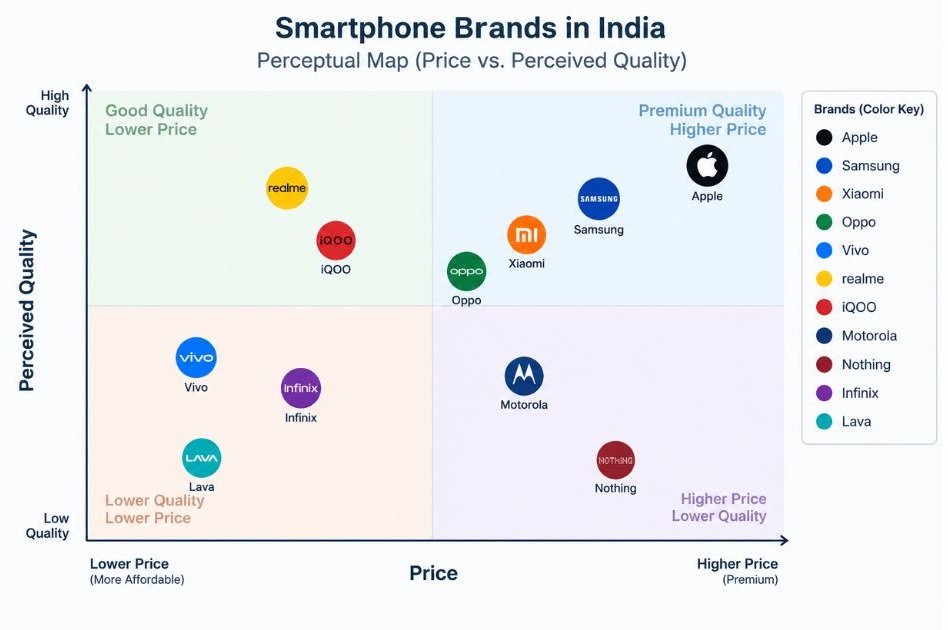
Perceptual mapping is a chart that plots brands on two axes that customers care about, such as price (low to high) and quality (basic to premium). It shows how customers see you compared with rivals, which can differ sharply from how you see yourself.
Build one by surveying 50 to 100 customers and asking them to rate each brand on the two attributes. Plot the averages. Clusters of brands mean a crowded position. Empty corners mean either an opportunity or a position customers don’t want.
6. Porter’s Generic Strategies
Porter’s generic strategies are three ways to win in an existing market: cost leadership, differentiation, and focus. He introduced them in Competitive Strategy (1980) and warned that companies stuck in the middle tend to underperform.
Cost leadership means being the lowest-cost producer and passing some savings to customers. DMart (Avenue Supermarts) follows this closely with its everyday low price model. Differentiation means offering something customers value enough to pay extra for, as Apple does with design and software. Focus means serving one narrow segment better than anyone else. Mamaearth began with toxin-free baby care, a tight niche, before widening its range.
Pick one as your core and be honest about whether you can sustain it. A cost leader who can’t actually out-save Reliance isn’t a cost leader.
7. Value Chain Analysis
Value chain analysis breaks your business into activities, from inbound logistics and operations to marketing, sales, and service, so you can see where you create value and where you only create cost. Porter described it in Competitive Advantage (1985).
List every activity, attach its cost, and ask two questions about each: does the customer notice it, and do rivals do it better? Activities that customers don’t notice and rivals do cheaper are candidates for outsourcing or automation. Activities customers love, like fast delivery or after-sales support, deserve more investment.
In a red ocean, the winner is often the company that quietly trims waste in the invisible steps while protecting the visible ones.
8. Ansoff Matrix
The Ansoff Matrix, created by Igor Ansoff in 1957, is a growth grid that crosses existing and new products with existing and new markets. It gives four routes: market penetration, market development, product development, and diversification.
Red ocean companies mostly use the first two. Penetration means selling more of the same product to the same customers through promotions, loyalty schemes, or wider distribution. Product development means adding variants for the same audience, like a new flavour or pack size. Market development takes your product to a new city or customer group. Diversification is the riskiest because both product and market are new.
Rank the four options by expected return and risk, then fund the cheapest ones first.
9. BCG Growth-Share Matrix
The BCG matrix, developed by Boston Consulting Group in the early 1970s, classifies each product or business unit by market growth rate and relative market share into four groups: Stars, Cash Cows, Question Marks, and Dogs.
Stars hold high share in fast-growing markets and need investment. Cash Cows hold high share in slow markets and fund everything else. Question Marks have low share in growing markets and need a decision: invest or exit. Dogs have low share in slow markets and usually drain resources.
In a crowded market, this tool stops you from spreading money evenly across every product. It forces you to feed winners and stop bleeding on losers.
10. Customer Segmentation and Targeting (STP)
STP stands for Segmentation, Targeting, and Positioning. You divide the market into groups with similar needs, choose the groups you’ll serve, and craft a clear promise for each.
Segment by what actually changes behaviour: usage frequency, budget, occasion, or problem to solve, not just age and gender. Score each segment on size, growth, competitor intensity, and your ability to serve it. Then write one positioning line per target segment.
When every rival fights for the “average customer,” the brand that deeply understands one segment tends to win it.
What Are Real-World Examples of Competing in a Red Ocean?
Real red ocean examples share one pattern: a crowded market, rivals who copy each other, and a fight that’s decided by scale, speed, or brand. Four cases show how different it can look.
Reliance Jio vs Airtel and Vodafone Idea
When Reliance Jio launched in September 2016, it offered free voice calls and very cheap data. Incumbents had to cut prices or lose subscribers. The price war squeezed margins across the sector, and Vodafone and Idea Cellular completed their merger in 2018 partly in response. Jio won through heavy network investment and aggressive pricing, which only a company with deep pockets could attempt.
Coca-Cola vs Pepsi
The cola war is the textbook red ocean. In the 1970s and 80s, Pepsi’s blind taste test campaign pushed Coca-Cola into a reformulation, famously launching “New Coke” in 1985 and then reversing course. Both companies still spend heavily on advertising, celebrity endorsements, and distribution deals to move share by fractions of a percent.
Swiggy, Zomato, and Quick Commerce
Food delivery in India is a long-running discount and speed battle between Swiggy and Zomato. The fight extended into quick commerce with Blinkit (acquired by Zomato in 2022), Swiggy Instamart, and Zepto, all racing to promise delivery in minutes. Dark-store density, delivery speed, and discount depth decide who gains share.
Samsung vs Apple in Smartphones
Smartphones are a mature, crowded market where Samsung and Apple compete on features, camera quality, ecosystems, and financing offers. Samsung covers many price tiers, while Apple holds a premium position. Each launch cycle triggers a copy-and-counter response from the other.
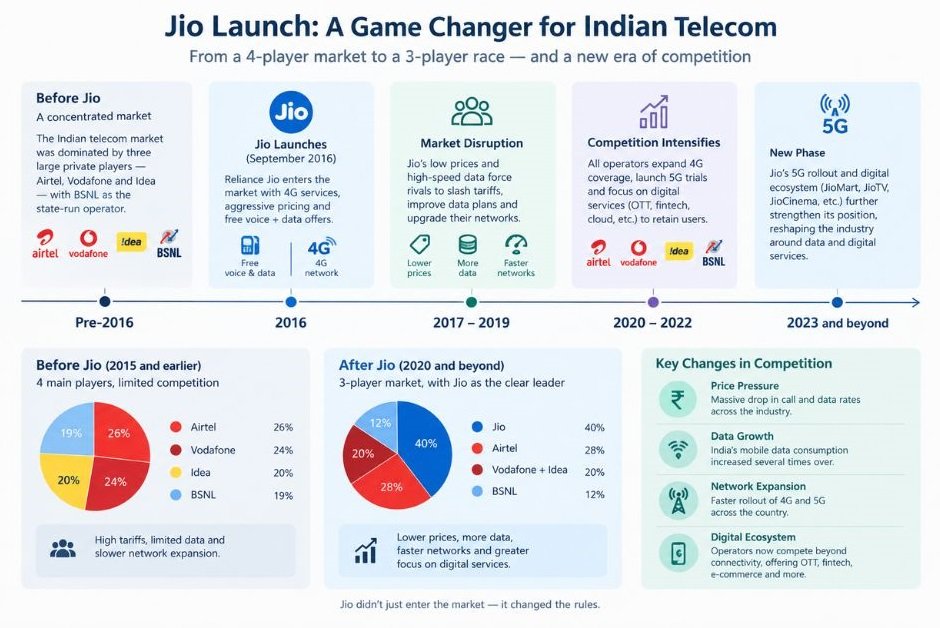
Companies in red oceans win through scale, speed, or brand, not through new rules. Jio’s 2016 price disruption, the Coke and Pepsi rivalry, and India’s quick commerce race all show that crowded markets reward whoever can sustain the fight longest.
What Are the Advantages of Competing in a Red Ocean?
The main advantage is certainty: demand already exists, customers understand the product, and you can measure everything. You aren’t betting on a market that may never appear.
Not every red ocean market is a bad place to build a business. Here’s what you gain:
- Proven demand: You don’t spend years educating customers on why the category matters.
- Lower strategic risk: Rivals have already tested pricing, channels, and messaging, so you learn from their mistakes.
- Easier financing: Investors and banks understand known industries and can benchmark your plan against peers.
- Available talent and suppliers: Skilled people and vendors already exist, which shortens your launch time.
- Clear metrics: Market share, customer acquisition cost, and margin comparisons are widely available.
- Faster learning: Competitors’ moves expose what customers value, so your tests give quick feedback.
- Acquisition options: Fragmented markets often end in consolidation, which can reward efficient players.
To be fair, these advantages favour companies with execution strength. A strong operator in a mature market often beats a weak innovator in an empty one.
What Are the Disadvantages of Competing in a Red Ocean?
The biggest disadvantage is margin pressure: when rivals are alike, the easiest way to win a sale is to cut price, and everyone ends up poorer. Growth also depends on taking share from someone who’s fighting back.
Here’s where it tends to hurt:
- Price wars: Discounting is easy to copy and hard to reverse once customers expect it.
- Thin profits: Promotions, advertising, and trade margins eat into earnings.
- Commoditisation: If customers can’t tell you apart, they stop being loyal.
- High marketing costs: Standing out in a crowded category costs more each year.
- Slow market growth: In mature categories, there’s little new demand to share.
- Copycat risk: Any new feature is matched quickly, so advantages fade.
- Innovation neglect: Teams focus on beating rivals, not on discovering what customers actually want next.
Honestly, the last one does the most damage over time. Companies get so absorbed in watching competitors that they stop looking at customers.
How Does a Red Ocean Differ From a Blue Ocean?
A red ocean is an existing, crowded market where you compete for share, while a blue ocean is an untapped market where you create demand and make competition irrelevant. The differences show up in how you think about customers, rivals, and value.
| Factor | Red Ocean | Blue Ocean |
|---|---|---|
| Market space | Existing industry | New or unclaimed space |
| Competition | Beat rivals | Make rivals irrelevant |
| Demand | Exploit existing demand | Create new demand |
| Value and cost | Choose one | Pursue both together |
| Focus | Existing customers | Non-customers |
| Profit potential | Shrinks as rivals copy | Higher until imitated |
| Risk | Lower, known market | Higher, unproven demand |
Blue ocean thinking uses tools like the Strategy Canvas and the Eliminate-Reduce-Raise-Create (ERRC) grid to find uncontested space. Nintendo’s Wii is a common example: it skipped the graphics arms race and targeted casual and family players.
When Should You Choose to Compete in a Red Ocean?
Compete in a red ocean when demand is proven, you have a real cost or brand advantage, and the market is still growing or fragmented. If you don’t have one of those edges, the red ocean strategy will cost you more than it returns.
Many companies don’t get to choose. If you run a restaurant, a retail shop, or an agency, you’re already in one. The practical question is how to compete well. Here’s a process you can follow.
- Map the market. List your top five competitors and note price, positioning, and channels.
- Run Five Forces. Identify which force takes the most profit from your industry.
- Benchmark honestly. Score yourself against rivals on the criteria customers use to decide.
- Pick one generic strategy. Choose cost leadership, differentiation, or focus, and commit.
- Choose a segment. Use STP to find a group you can serve better than anyone.
- Fix the value chain. Cut cost in invisible activities and invest in visible ones.
- Allocate with BCG. Fund Stars, harvest Cash Cows, and decide on Question Marks.
- Review every quarter. Update PESTLE and your perceptual map, and watch for new openings.
Step 8 matters more than it looks. Markets that feel locked can open up quickly when a technology or regulation shifts, and the companies that spot it first often move out of the red altogether.
Conclusion
Red oceans aren’t traps. They’re where most of the world’s business happens, and you can do very well there if you compete with intent. Pick one way to win, use the right analytical tools to see where profit sits, and don’t spread your money evenly across everything you sell.
At the same time, keep one eye on the horizon. The companies that stay healthiest in crowded markets are the ones that regularly ask whether they could stop fighting for share and start creating demand. Pull out your last competitor benchmark this week and look for one gap rivals haven’t filled. That’s your next move.
FAQs
What is a red ocean in simple words?
A red ocean is a market that’s already full of competitors selling similar things to the same customers. Companies grow by taking customers from each other. Think of Indian telecom, food delivery, or soft drinks.
What’s the difference between a red ocean and a blue ocean?
In a red ocean you compete inside known industry boundaries and try to beat rivals. In a blue ocean you create a new market space where competition doesn’t matter yet. Red oceans offer lower risk and tighter margins, while blue oceans offer higher upside and higher uncertainty.
Is competing in a red ocean bad for business?
No. Red oceans carry proven demand, and many large profitable companies operate in them. The danger is competing without a clear edge, because price wars and copycats drain profit. With a defined cost, brand, or niche advantage, it can be a very good place to build.
Which industries are examples of red oceans?
Airlines, telecom, smartphones, soft drinks, retail, food delivery, banking, and consumer packaged goods are all mature red ocean industries. Each has several established players, similar offerings, and frequent price competition.
How can a company survive in a red ocean?
Pick one clear way to win: lowest cost, strongest differentiation, or a niche you serve better than anyone. Then support it with tools like Five Forces, competitor benchmarking, and segmentation. Review your position every quarter, because rivals will keep moving.
Who coined the term “red ocean”?
W. Chan Kim and Renée Mauborgne, professors at INSEAD, introduced the red and blue ocean idea in their 2005 book Blue Ocean Strategy. They used the colours to contrast bloody, crowded markets with open, uncontested ones.
Which tools are best for analysing a red ocean?
Porter’s Five Forces shows how profitable the industry is, SWOT and benchmarking show where you stand, and perceptual mapping shows how customers see you. The Ansoff and BCG matrices guide growth and investment decisions. You don’t need all ten at once, so start with Five Forces and benchmarking.
Can a red ocean turn into a blue ocean?
Sometimes. A company can break out of a crowded market by redefining what customers value, as Nintendo did with the Wii. It usually means dropping features that rivals fight over and adding something non-customers want. It’s difficult, but it’s what separates category creators from category followers.
Should a startup enter a red ocean?
It can, if the startup has a sharp niche, a cost edge, or a new distribution method. Entering head-on against bigger players with the same offer rarely works. Starting narrow, like Mamaearth did with toxin-free baby care, gives you a place to build before you widen.
What do most companies get wrong about competing in a red ocean?
They copy rivals and default to discounting. That creates a race to the bottom where nobody earns well. The better path is to pick a lane, protect margins, and spend on what customers actually notice instead of what competitors just announced.


