
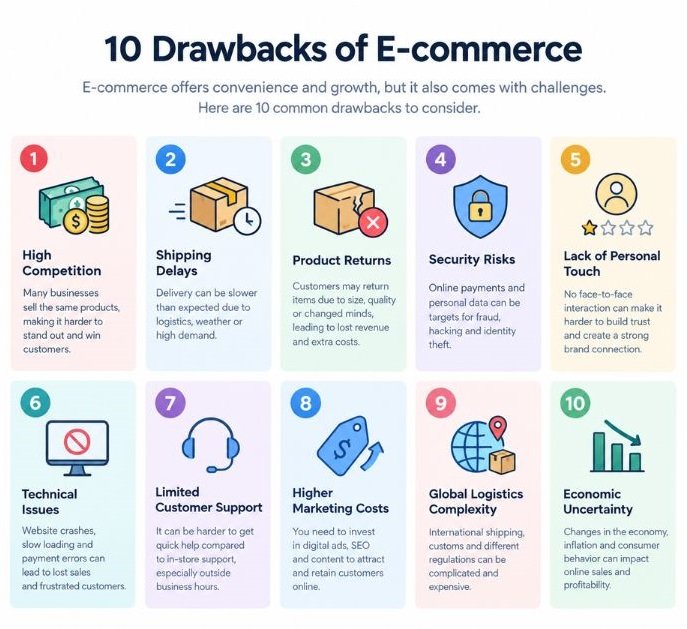
E-commerce keeps growing, and so does the list of problems nobody mentions in the pitch deck. Returns eat margins. Carts get abandoned. Ad costs climb every quarter. If you sell online, buy online, or advise people who do, you need to see the Disadvantages of E-Commerce clearly before you put more money into it.
This isn’t an argument against selling online. It’s a reality check. According to the National Retail Federation (NRF) and Happy Returns’ 2025 Retail Returns Landscape report, shoppers were expected to send back about 19% of online sales that year. Baymard Institute’s running average across 50 studies puts online cart abandonment at 70.22%. Those two numbers alone show how much revenue leaks out of a typical store before it ever becomes profit.
Below you’ll find 10 major drawbacks. Each one comes with a real example, the data behind it, and the specific tools that help you reduce the damage. Where a problem is mostly Indian, like cash on delivery, we say so.
Why Can’t Shoppers Touch, Try, or Test What They Buy?
Online shoppers can’t feel fabric, check fit, smell a perfume or judge true colour before they pay. That gap creates doubt, wrong purchases and returns. It’s the most basic limit of online selling, and no page design removes it completely.
Photos and reviews help, but a screen shows colour differently on every phone. A “medium” in one brand isn’t a “medium” in another. Fashion, footwear, eyewear, beauty and furniture feel this the hardest, because the buyer’s decision depends on how the product looks and feels on them or in their home.
Some brands have narrowed the gap with technology. Lenskart lets shoppers try frames on their face using a 3D try-on feature in its app, and Nykaa offers virtual try-on for makeup shades. Neither replaces a store visit, but both cut the guesswork.
If you sell products where fit or feel matters, these tools are worth a look:
- Shopify’s 3D model and AR support lets you upload a 3D file so shoppers can view a product in their own room through their phone camera. It suits furniture, decor and bags.
- Perfect Corp’s YouCam offers virtual try-on for makeup, skincare and accessories. It suits beauty brands that struggle with shade-matching returns.
- Kiwi Sizing is a Shopify app that adds size charts and a size recommendation quiz to product pages. It suits apparel stores where “wrong size” is the top return reason.
Tools alone aren’t enough. Show products on real people with their height and size stated. Add a 15-second video. Put honest, specific reviews near the top of the page. And write product descriptions that admit limits, such as “runs small, size up.” That sounds obvious. Most stores still skip it.
How Much Do Returns Really Cost an Online Store?
Returns cost far more than the refund. NRF and Happy Returns projected US retail returns at $849.9 billion for 2025, or 15.8% of annual sales, and about 19% of online sales. Every returned order adds shipping, inspection, repackaging and often a markdown on the product.
A return is a second delivery with no revenue attached. If a shirt sells for ₹999 and costs ₹120 to ship each way, you’ve lost ₹240 before anyone checks whether the shirt can be resold. Some items come back damaged or can’t be sold at full price at all.
Fraud makes it worse. The same NRF study says about 9% of returns were fraudulent, which includes wardrobing (wearing an item once and returning it) and returning a different item than the one shipped. Yet 82% of shoppers say free returns influence where they buy, so removing free returns can cost you sales too. It’s a real trade-off, and it depends on your margins.
Indian fashion marketplaces such as Myntra and Ajio have built entire reverse-logistics operations just to handle this volume. A small store can’t copy that, but it can use the same tools in smaller form:
- Happy Returns (a UPS company) offers box-free, label-free drop-off points in the US, which cuts the cost and effort of a return. It suits US-facing sellers.
- Shiprocket’s returns management lets Indian sellers create return pickups, track reverse shipments and set return reasons inside the same dashboard they use for forward orders.
- ClickPost gives brands a returns and NDR (Non-Delivery Report) workflow with courier recommendations, so you can compare how different couriers handle reverse pickups.
- Shopify’s built-in returns tools let customers request returns online and let you approve, decline or offer an exchange.
Start by tagging every return with a reason. Within a month, three or four products will account for most of your returns. Fix those listings first. Offer exchanges before refunds, because an exchange keeps the sale alive.
Returns are a second delivery with no revenue attached. The NRF and Happy Returns 2025 report projected US returns at $849.9 billion, or 15.8% of retail sales, with about 19% of online sales sent back and about 9% of returns fraudulent. Tagging every return with a reason code is the fastest way to find which products drive the loss.
Why Do Shipping Delays and RTO Hurt Margins?
Delivery is where online stores lose margin quietly. Shipping fees, delays, failed attempts and, in India, Return to Origin (RTO) on cash-on-delivery orders all add cost after the sale is already made. RTO means a parcel fails delivery and travels back to the seller.
Cash on delivery (COD) is the Indian twist. Logistics platforms such as ClickPost and Shadowfax report that cash still accounts for roughly 55% to 65% of online orders in India. Benchmarks published by Eshopbox and Base in 2026 put average RTO at 20% to 40%, with COD orders returning at around three times the rate of prepaid ones. ClickPost estimates each returned parcel costs ₹150 to ₹300 in direct logistics, before you count the ad spend you wasted to win that buyer.
Festive seasons make it worse. During Diwali sales, impulse COD buying jumps, first-time buyers flood in, and many brands see RTO climb into the low-to-mid 30s percent at the exact moment cash flow is tight. Treat those figures as industry estimates from vendors, not audited data. Your category and pincodes will differ.
Tools that reduce RTO and delivery pain:
- GoKwik scores COD orders for risk at checkout, so you can block, confirm or push prepaid on orders that look likely to fail.
- Shiprocket compares courier rates and delivery performance by pincode, and includes NDR management, where you can message the buyer and request a reattempt before the parcel goes back.
- ClickPost adds courier allocation and delivery tracking, so you see which courier fails on which routes.
- WhatsApp Business API (through partners such as Interakt or WATI) lets you send automated order confirmation and delivery reminders on the channel Indian buyers actually read.
The simplest first move costs almost nothing: offer a small prepaid discount, say ₹50 or 5%, and confirm every COD order by WhatsApp before dispatch. And stop shipping COD to pincodes where you’ve had repeated failures.
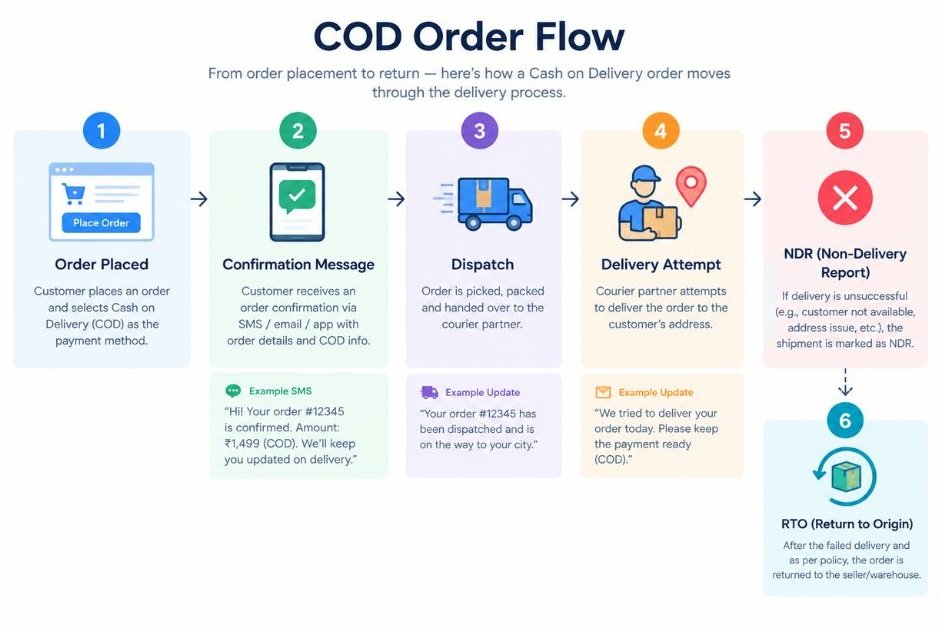
RTO is a parcel that fails delivery and returns to the seller, and in India it’s driven mainly by cash on delivery. 2026 benchmarks from Eshopbox and Base put average RTO at 20% to 40%, with COD roughly three times higher than prepaid. Confirming COD orders by WhatsApp and offering a prepaid discount are the lowest-cost first fixes.
How Big Is the Cybersecurity and Fraud Risk?
Online stores hold payment details, addresses and phone numbers, so they’re constant targets for fraud and data theft. IBM’s 2025 Cost of a Data Breach Report found the average breach in India cost ₹220 million (₹22 crore), up 13% from ₹195 million in 2024.
That figure averages large organisations, not a ten-person D2C brand. But small sellers face their own versions: card-testing bots that hammer your checkout with stolen card numbers, fake orders, account takeover and fake payment links sent to your customers in your brand’s name. IBM’s India findings list phishing (18%), third-party or supply chain compromise (17%) and vulnerability exploitation (13%) as the leading attack routes. The supply chain one matters to you, because every plugin, app and script on your store is a possible way in.
The law adds pressure. India’s Digital Personal Data Protection Act, 2023 puts obligations on businesses that collect personal data, including consent and reasonable security safeguards. Check with a lawyer on exactly what applies to you, since the rules are being phased in.
Here’s what to put in place, and what each tool does:
- Cloudflare sits in front of your site as a web application firewall (WAF). It filters malicious traffic, blocks bots and can rate-limit checkout attempts. The free plan covers the basics.
- PCI DSS-compliant payment gateways such as Razorpay, Stripe or PayU handle card data on their servers, so raw card numbers never touch your store. PCI DSS is the security standard for card payments.
- Razorpay’s risk tools flag suspicious transactions, and 3D Secure or OTP verification adds a second check on card payments.
- Wordfence or Sucuri are security plugins and services for WordPress and WooCommerce stores, covering malware scanning and login protection.
- An authenticator app for two-factor login on your admin, email, ad accounts and domain registrar. Most hijacked stores were taken through a reused password.
Audit your plugins every quarter. Delete anything you don’t use. That one habit closes more doors than most paid tools.
Why Do Most Online Shoppers Leave Without Buying?
Most people who add something to an online cart never buy it. Baymard Institute’s average across 50 studies is a 70.22% cart abandonment rate. Part of that is browsing, but Baymard estimates better checkout design alone can lift a large store’s conversion rate by 35.26%.
So not all abandonment is your fault. Baymard’s survey found that about 42% of US online shoppers had abandoned a cart simply because they were “just browsing” or not ready to buy. The rest comes from things you can change: surprise shipping fees, forced account creation, long forms, slow pages and too few payment options. Baymard’s benchmark of 60 leading checkout flows found the average site has 39 areas that could be improved.
In India, mobile checkout adds another layer. Shoppers expect UPI and one-tap payment. If your store makes them type a card number, you’ve already lost many of them.
Tools to find and fix the leaks:
- Google Analytics 4 (GA4) funnel exploration shows you the exact step where people drop, from product view to add-to-cart to payment. It’s free and it’s the first place to look.
- Microsoft Clarity records anonymous sessions and builds heatmaps, so you can watch where users stall or rage-click on checkout. It’s free with no traffic limit.
- GoKwik and Shopflo offer one-click checkout built for Indian stores, with saved addresses, UPI and COD handling.
- Klaviyo or WebEngage send abandoned cart emails, push notifications and WhatsApp reminders, which recover some of the shoppers who left.
Show the total price, including shipping, as early as possible. Allow guest checkout. Put UPI first on mobile. Then test one change at a time.
Online cart abandonment averages 70.22% across 50 studies, according to Baymard Institute. Roughly four in ten US shoppers who abandon say they were only browsing, but Baymard estimates better checkout design can raise a large store’s conversion rate by 35.26%. Show the full price early, allow guest checkout and offer local payment methods first.
Is Customer Acquisition Getting Too Expensive for Online Stores?
Yes, for most brands that rely on paid ads. Customer acquisition cost (CAC) is total sales and marketing spend divided by the number of new customers won. Online, more brands bid on the same audiences in Meta Ads Manager and Google Ads, so each new customer tends to cost more over time.
Online selling removes the shop rent but replaces it with ad rent. And ad rent doesn’t build an asset. When you stop paying Meta or Google, the traffic stops. That’s why many direct-to-consumer (D2C) brands that grew online first, such as Mamaearth and boAt, later built offline distribution alongside their websites. The online channel gave them speed. Offline gave them reach without a per-click bill.
We haven’t cited a single industry CAC number here, because it swings wildly by category and no single figure is reliable. What matters is your own number compared with your first-order margin. If a customer pays you ₹800 in gross profit once and costs ₹1,000 to win, you need repeat purchases to survive.
Tools and measures that help:
- Meta Ads Manager and Google Ads give you campaign-level data on cost per purchase. Their ROAS (return on ad spend) numbers only reflect each platform’s own attributed sales, which often overlap.
- Marketing Efficiency Ratio (MER) is total revenue divided by total ad spend across all channels. It needs no attribution model and shows whether the business as a whole is getting more efficient.
- Google Analytics 4 shows which channels bring new versus returning buyers.
- Klaviyo and WebEngage help you turn first-time buyers into repeat ones through email and WhatsApp flows, which lowers your blended CAC.
Build owned channels early: an email list, a WhatsApp opt-in list, SEO content and a referral offer. They take longer than ads. They also stop costing you every time someone clicks.
How Do Price Transparency and Marketplaces Squeeze Profit?
Online buyers compare prices in seconds, so small price gaps decide sales. Marketplaces such as Amazon India, Flipkart and Meesho also stand between you and the customer, charging fees and setting rules you don’t control.
A price comparison takes one search. Your competitor’s discount shows up next to yours on Google Shopping or on the marketplace listing itself. That pushes sellers into a discount race where the winner is whoever can survive the thinnest margin, and that’s rarely the small brand.
Marketplace dependence adds a second risk. You pay commission, shipping fees and sometimes advertising to appear on the first page. The platform owns the customer relationship and can change its fees, its search ranking or its seller policies. Listings get suspended. Buy Box (the featured seller spot on an Amazon product page) moves to a competitor overnight. Selling only on marketplaces means your business sits on someone else’s land.
Tools that give you control:
- Prisync tracks competitor prices across stores and marketplaces and alerts you when they change, so you react with data and not guesswork.
- Google Merchant Center lets you list products free on Google surfaces, which sends shoppers to your own site and not a marketplace.
- Amazon Seller Central and Flipkart Seller Hub show your fees, return rates and account health, which you should check weekly if marketplaces are a big share of your sales.
- Shopify or WooCommerce with a WhatsApp catalogue gives you a direct channel where you own the customer’s contact details.
Compete on something besides price: bundles, quality, packaging, speed or a brand people recognise. Keep at least some sales on your own store, so a marketplace policy change can’t wipe out your month.
What Happens When Your Website Is Slow or Goes Down?
You lose sales instantly. Your store only earns money when it loads fast and checkout works. Slow pages, crashed servers and payment gateway failures stop orders, and they tend to hit during sales events when traffic is highest.
Speed isn’t cosmetic. A 2020 study by Deloitte and Google, “Milliseconds Make Millions,” found that a 0.1 second improvement in mobile site speed lifted retail conversion rates by 8.4%. Small delays cost real money.
Dependence is the deeper problem. A store sits on top of hosting, a payment gateway, a courier API, plugins and a CDN (content delivery network, a network of servers that deliver your files from a location near the shopper). If one fails, the whole sales process can fail. Large Indian sales events such as Flipkart’s Big Billion Days and Amazon’s Great Indian Festival show the scale of planning needed, since the platforms prepare capacity weeks ahead. Your store faces the same traffic spikes on a smaller scale, with a smaller team.
Tools that protect you:
- Google PageSpeed Insights scores your pages and lists the specific fixes, such as compressing images, which usually give the biggest gain.
- Google Search Console’s Core Web Vitals report shows how real users experience your site’s loading speed and stability.
- UptimeRobot checks your site every few minutes and alerts you by email, SMS or WhatsApp the moment it goes down. The free plan is enough to start.
- Cloudflare CDN caches your pages and images closer to shoppers, which speeds up loads and absorbs traffic spikes.
Before any big sale, run a test order end to end. Keep a backup payment gateway enabled. And remove apps you don’t need, since each one adds code that slows the page.
Can Online Stores Build Real Trust Without Human Contact?
Yes, but it takes deliberate work. Online stores have to earn trust without a shopfront, a face or a handshake. Fake reviews, look-alike sites and slow support make shoppers cautious, and one bad delivery can cost you a repeat customer.
Shoppers have been burned. They know about fake reviews, sites that disappear after taking payment and products that look nothing like the photos. A new store starts with a trust deficit, and it has to close that gap with proof.
Regulators are paying attention, too. India’s Central Consumer Protection Authority issued guidelines on dark patterns in 2023, which cover tricks like fake urgency timers and hidden charges. India also has a Bureau of Indian Standards norm for online consumer reviews (IS 19000:2022). The direction is clear: honest presentation isn’t optional.
Support is the other half. A customer in a shop gets an answer in 30 seconds. Online, they wait for an email. That wait is where trust drops.
Tools that help:
- Judge.me and Google Customer Reviews collect reviews from verified buyers after purchase, which carries more weight than reviews you paste on yourself.
- WhatsApp Business API gives you fast, familiar support. Use it for order updates, return requests and quick answers.
- Freshdesk or Zendesk turn emails, chats and messages into tickets so nothing gets lost, and they show you which questions repeat so you can fix the cause.
- Trustpilot gives you a third-party review profile that shoppers recognise.
Put your real address, phone number and policies where people can find them. Reply to messages in hours, not days. Send a short update at each delivery stage. These feel small. They’re what a physical shop gives for free.
How Heavy Is the Compliance and Tax Burden?
Selling online means dealing with tax registration, platform rules and data law from day one. In India, that includes GST (Goods and Services Tax) registration and filings, tax collected at source by marketplaces, consumer protection rules for e-commerce and data privacy obligations under the DPDP Act, 2023.
Most sellers on marketplaces need a GST registration, though exemptions exist for some small intra-state goods sellers, so confirm your own case with a chartered accountant. Marketplaces also collect tax at source (TCS) and deduct tax at source (TDS) on your sales, which affects your cash flow and the paperwork you need at filing time. If you sell across states or abroad, the rules multiply.
The Consumer Protection (E-Commerce) Rules, 2020 require clear disclosure of seller details, return and refund terms and grievance contacts. Miss these and you risk complaints or listing removal. These rules change often, so treat this section as a starting map, not legal advice.
Tools that reduce the paperwork:
- ClearTax handles GST filing and e-invoicing for small and mid-sized sellers.
- Zoho Books is an accounting tool with GST-ready invoicing, expense tracking and bank reconciliation, which keeps your records filing-ready.
- Tally Prime is a widely used accounting and inventory tool among Indian businesses, and many accountants already know it.
- Marketplace reports from Amazon Seller Central and Flipkart Seller Hub download settlement and tax statements you can feed into your accounting tool.
Hire an accountant early. It’s cheaper than fixing a year of messy filings later.
Drawbacks, Fixes and Tools at a Glance
| Drawback | Main cost to you | First fix | Tool to try |
|---|---|---|---|
| No physical experience | Wrong purchases, returns | Size guides, real-model photos | Kiwi Sizing, Shopify AR |
| Returns | Double shipping, markdowns | Tag return reasons, offer exchanges | Shiprocket, Happy Returns |
| Shipping and RTO | Failed deliveries, lost margin | Prepaid discount, COD confirmation | GoKwik, ClickPost |
| Cyber and fraud risk | Data breach, chargebacks | Audit plugins, enable 2FA | Cloudflare, PCI DSS gateways |
| Cart abandonment | Lost sales | Show total price early | GA4, Microsoft Clarity |
| Rising CAC | Shrinking margin | Track MER, build owned channels | Meta Ads Manager, Klaviyo |
| Price wars and marketplaces | Thin margin, platform risk | Differentiate, sell direct | Prisync, Google Merchant Center |
| Slow site and downtime | Lost orders | Test before sales | PageSpeed Insights, UptimeRobot |
| Low trust | Fewer repeat buyers | Verified reviews, fast support | Judge.me, Freshdesk |
| Compliance | Penalties, cash flow stress | Hire an accountant early | ClearTax, Zoho Books |
Conclusion
Online selling is a good business model with real costs, and most of them show up after launch. The Disadvantages of E Commerce come down to a few repeating leaks: returns, failed deliveries, abandoned carts and ad bills that rise faster than margins.
Three takeaways matter most. Measure your return rate, your RTO and your CAC before you scale spend. Fix checkout and delivery first, since they cost less to improve than traffic costs to buy. And build channels you own, like email, WhatsApp and search, so a platform change can’t hurt you overnight.
Pick the one drawback from this list that is costing you the most today. Run one fix this week, measure it, then move to the next.
FAQs Disadvantages of E-Commerce
What are the biggest drawbacks of e-commerce?
The biggest drawbacks are returns, delivery problems, cart abandonment, rising ad costs and security risk. For Indian sellers, cash on delivery and RTO add another layer. Most of these can be reduced with better processes and tools, but none disappear completely.
What is the biggest disadvantage of online shopping for customers?
The biggest one is not being able to touch or try a product before paying. Shoppers also deal with delivery delays, fake reviews and the hassle of returns. Reading verified reviews and checking the return policy before you buy lowers the risk.
Is e-commerce still worth it despite these drawbacks?
For most businesses, yes. Online selling reaches far more customers than a single shop can. But it isn’t cheap or easy. Work out your numbers first: your return rate, your CAC and your margin after shipping. If those don’t leave a profit, a bigger website won’t fix it.
E-commerce vs offline retail: which has higher costs?
They cost different things. Offline retail carries rent, staff and stock in every location. E-commerce carries shipping, returns, platform fees and ad spend. Online costs scale with every order, while shop rent is fixed, so a high-return, low-margin product can be worse online.
How do I reduce return rates in my online store?
Tag every return with a reason code for 30 days. Fix the three or four products with the most returns first, usually by improving photos, size charts or descriptions. Then offer exchanges before refunds and add a size recommendation tool. Expect returns to drop, not vanish.
Why is my RTO so high on COD orders?
Most RTO comes from buyers who change their mind, aren’t home or don’t have cash ready. Impulse orders, wrong addresses and long delivery times make it worse. Confirm each COD order on WhatsApp, offer a prepaid discount, block repeat-failure pincodes and use NDR tools to rebook failed deliveries.
how to reduce cart abandonment on my store
Show the full price including shipping early, allow guest checkout and put UPI first on mobile. Use Google Analytics 4 to find the step where shoppers drop, and Microsoft Clarity to watch real sessions. Then send abandoned cart reminders by email or WhatsApp. Change one thing at a time so you know what worked.
is cash on delivery bad for ecommerce
It isn’t bad, but it’s expensive. COD brings sales from buyers who don’t trust online payments, yet its RTO rate runs around three times higher than prepaid, according to 2026 industry benchmarks. Use it with controls: risk scoring, order confirmation and a small prepaid discount.
How can I protect my online store from fraud and data theft?
Use a PCI DSS-compliant gateway so card data never reaches your server. Put Cloudflare in front of your site, turn on two-factor login for every admin account and delete unused plugins. Review the risk tools in your payment gateway and keep software updated. Most breaches start with a weak password or an old plugin.
Who should avoid starting an e-commerce business?
Skip it, or wait, if your product has thin margins and high return rates, such as cheap fashion with no differentiation. It’s also hard if you can’t afford ad spend or inventory risk. Test demand first through a marketplace or WhatsApp catalogue before you build a full store.


