

Most managers run their teams on theories they’ve never read. The one-to-one meeting, the KPI dashboard, the hybrid schedule: each traces back to an argument someone made decades ago, usually because something was breaking.
That’s why the evolution of management thought is worth an hour of your time. Once you know which problem each of these management theories was built to solve, you stop copying frameworks blindly and start picking the right one for the situation in front of you.
This guide covers every major stage, from Adam Smith’s pin factory to AI-assisted teams in 2026. You’ll get the key thinkers, the core idea behind each theory, a real company example, and a comparison table that shows when to use what.
It’s written for practitioners, not exam candidates. So expect less memorising and more “what does this still get right, and where does it fall apart?”
What Is Management Thought, and Why Does Its History Still Matter?
Management thought is the body of ideas, theories, and research that explains how organisations should be structured and how people should be led. Its history shows how those ideas shifted as work moved from workshops to factories to offices to laptops.
The evolution of management thought is usually split into five stages. Classical theories (1880s to 1930s) focused on efficiency and structure. The human relations movement (1920s to 1960s) put people at the centre. Quantitative and quality approaches (1940s onward) brought in maths and process control. Systems and contingency theories (1950s to 1970s) argued there’s no single best way. Modern thinking (1980s onward) tackles strategy, learning, change, and speed.
Textbooks draw the lines a little differently, but this sequence is the most common.
Why bother with any of it? Because old ideas never really leave. Taylor’s stopwatch lives on in warehouse productivity dashboards. Fayol’s plan-and-control loop sits inside every quarterly review. And when Google ran Project Oxygen in 2008 to test whether managers actually mattered, the finding sounded closer to Mary Parker Follett in the 1920s than to Frederick Taylor: coaching and clear communication ranked well above technical brilliance.
Honestly, most “new” management trends are old theories with fresh branding. Spotting that saves you a lot of money on consultancy decks.
How Did Management Work Before the Classical Era?
Before the classical era, management was informal and craft-based. Owners ran workshops by instinct, and skills passed down through apprenticeships. The Industrial Revolution (roughly 1760 to 1840) broke that model by putting hundreds of workers under one roof.
Start with Adam Smith. In The Wealth of Nations (1776), he described a pin factory where ten workers, each doing one narrow task, could produce about 48,000 pins a day. One person doing every step alone might manage a few dozen. That’s the division of labour, the idea that splitting work into specialised tasks raises output, and it’s the seed of nearly every efficiency theory that followed.
Robert Owen came at it from the opposite side. Running the New Lanark cotton mills in Scotland from 1800, he improved housing, cut working hours, and kept young children out of the mills. He argued this made workers more productive, comparing them to “vital machines” that deserved the same care as the equipment.
Charles Babbage, better known for designing early mechanical computers, added the analytical layer in On the Economy of Machinery and Manufactures (1832). He timed tasks, proposed paying part of wages as a share of profits, and argued that mental work could be divided just like manual work. Sound familiar? It should.
India has its own early example. Tata Steel introduced an eight-hour working day in 1912, according to the company’s own history, a welfare-first move that put it ahead of most industrial employers of the period.
But welfare alone didn’t solve the factory owner’s real headache: nobody knew how to measure a good day’s work. Which brings us to the classical thinkers.
What Are the Classical Management Theories?
Classical management theories are the first formal systems for running organisations, developed between roughly 1880 and 1930. They treat the organisation like a machine and focus on efficiency, structure, and clear rules. Three schools dominate: scientific management, administrative theory, and bureaucratic theory.
Scientific Management (Frederick Taylor, the Gilbreths, Henry Gantt)
Scientific management is the approach of studying tasks with time and motion measurement to find the most efficient way to do each job, then training and paying workers to follow it. Frederick Winslow Taylor, a mechanical engineer who worked at Midvale Steel and Bethlehem Steel, set it out in The Principles of Scientific Management (1911).
His four principles were simple. Replace rule of thumb with measured methods, select and train workers scientifically, make sure the work follows the method, and split responsibility so managers plan and workers do.
Frank and Lillian Gilbreth zoomed in on motion study. Frank reportedly cut a bricklayer’s movements from 18 to about 5, while Lillian brought in psychology and worker welfare, which is why she’s often called the first lady of management. Henry Gantt, who worked under Taylor, gave us the Gantt chart, still the default way to show a project timeline, plus a bonus system that rewarded workers for hitting daily targets.
Henry Ford’s moving assembly line at Highland Park in 1913 is the classic application. A year later he paired it with the famous $5 day, an early admission that pure efficiency, without pay that keeps people from quitting, doesn’t hold up.
The weakness is obvious. Taylor treated workers as parts of a machine, unions pushed back hard, and the backlash led to a US congressional investigation in 1912.
Administrative Theory (Henri Fayol)
Administrative theory looks at the organisation from the top down, asking what managers should do and which principles should guide them. Henri Fayol, a French mining engineer who ran the Comambault mining company, published it in Administration Industrielle et Générale in 1916.
Fayol defined five functions of management: planning, organising, commanding, coordinating, and controlling. Modern textbooks often compress these into plan, organise, lead, and control.
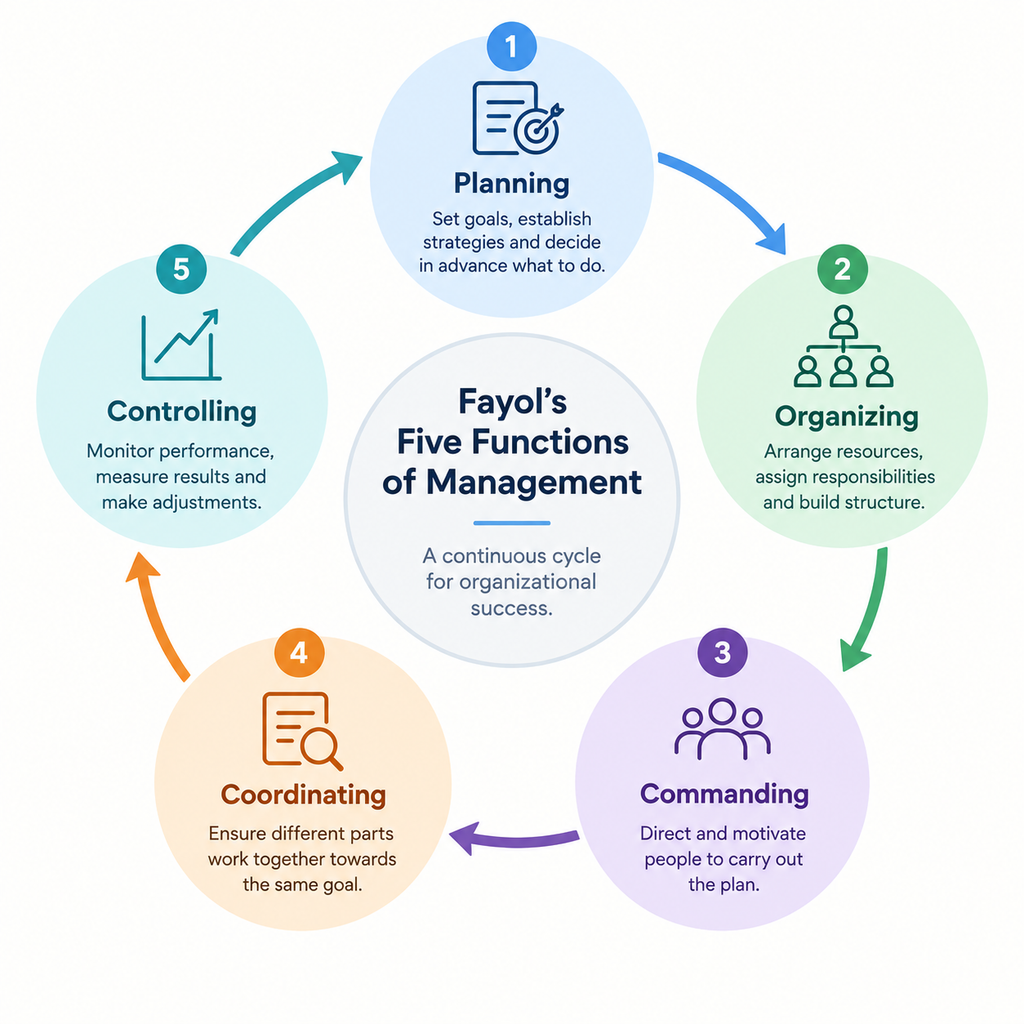
His 14 principles of management are:
- Division of work
- Authority and responsibility
- Discipline
- Unity of command (one boss per person)
- Unity of direction (one plan per goal)
- Subordination of individual interest to the general interest
- Remuneration
- Centralisation
- Scalar chain (a clear line of authority)
- Order
- Equity
- Stability of tenure
- Initiative
- Esprit de corps (team spirit)
Fayol himself said these weren’t rigid laws, and that’s the part people forget. Unity of command, for instance, is exactly what a matrix organisation breaks every day. Luther Gulick and Lyndall Urwick later packaged his ideas into the acronym POSDCORB in 1937, which public administration students still memorise.
Bureaucratic Theory (Max Weber)
Bureaucratic theory describes an organisation run on formal rules, a fixed hierarchy, written records, and promotion by merit rather than favour. Max Weber, a German sociologist, developed it in the early 1900s as an ideal type, a model for comparing real organisations against, not a recommendation.
Weber’s ideal bureaucracy has six features: specialised roles, a clear hierarchy, written rules, impersonal treatment, hiring on qualifications, and careers within the organisation.
Bureaucracy gets mocked, but it solved a real problem: favouritism. In Weber’s day, jobs often went to relatives and friends. Rules and merit made large organisations fairer and more predictable, which is why Indian Railways, with well over a million employees, couldn’t run any other way. The cost shows up as red tape and slow decisions.
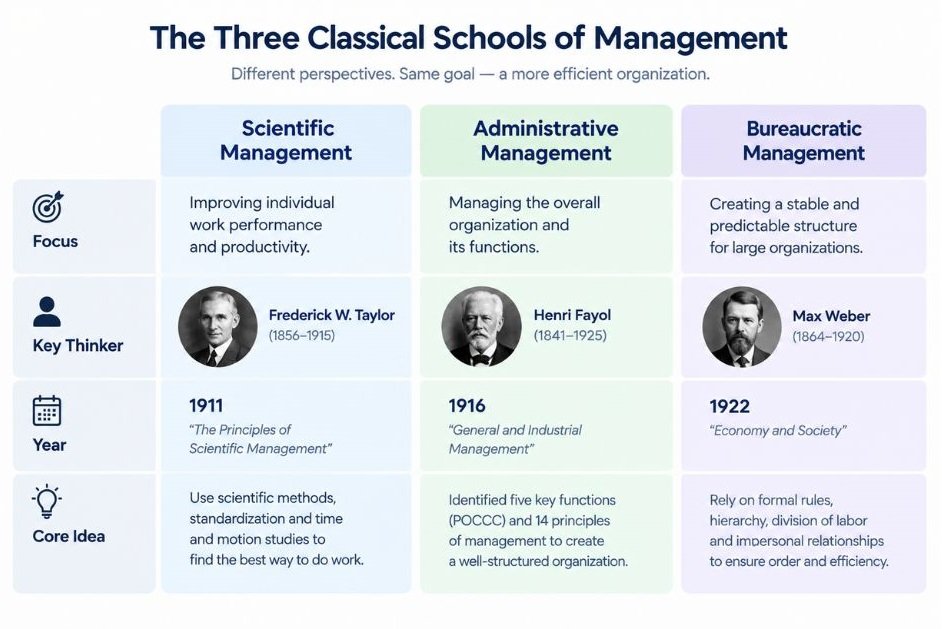
Classical management theories, developed between roughly 1880 and 1930, treat organisations as efficiency machines. Taylor’s scientific management optimised individual tasks, Fayol’s administrative theory defined what managers do, and Weber’s bureaucratic theory set out the rules and hierarchy that let large organisations run fairly.
What Did the Human Relations Movement Change?
The human relations movement showed that people aren’t just machines with wages. Social needs, recognition, and group norms shape output as much as pay or process do. It took off in the 1920s and 1930s and reshaped how managers think about motivation.
Hawthorne Studies and Elton Mayo
The trigger was an experiment that went sideways. At Western Electric’s Hawthorne Works in Cicero, Illinois, researchers began testing in 1924 whether better lighting raised output. It did, but output also rose when the lights were dimmed. Elton Mayo of Harvard joined in 1928 and concluded that attention and a sense of belonging mattered more than the physical changes.
That became the Hawthorne effect: the tendency of people to change their behaviour when they know they’re being observed.
Here’s the catch. When economists Steven Levitt and John List re-examined surviving Hawthorne data in 2011, they found much weaker evidence for the effect than the legend suggests. The lesson still stands, just with less drama.
Mary Parker Follett and Chester Barnard
Mary Parker Follett, a social worker turned management writer, was decades ahead of her time. In Creative Experience (1924), she argued for “power with” rather than “power over,” and for resolving conflict through integration, finding a solution that gives both sides what they actually need instead of splitting the difference. Her “law of the situation” said orders should come from the facts of the task, not from the boss’s rank.
Chester Barnard, president of New Jersey Bell, wrote The Functions of the Executive (1938). His acceptance theory of authority flips the usual view: authority exists only if the people receiving an order choose to accept it. He also gave the informal organisation, the unwritten networks and relationships behind the formal chart, a legitimate place in management thinking.
Motivation Theories (Maslow, McGregor, Herzberg)
Abraham Maslow’s hierarchy of needs (1943) ranks human needs in five levels: physiological, safety, belonging, esteem, and self-actualisation. Managers took it to mean people won’t chase growth while they’re worried about pay or job security. The strict pyramid order has weak research support, but the underlying point holds up.
Douglas McGregor’s The Human Side of Enterprise (1960) split manager mindsets in two. Theory X assumes people dislike work and need close control. Theory Y assumes people want to contribute and will self-direct when they see purpose. Most managers say they’re Theory Y. Check how they behave when a deadline slips.
Frederick Herzberg’s two-factor theory (1959) separated hygiene factors, like salary, policies, and working conditions, which prevent dissatisfaction, from motivators, like achievement, recognition, and meaningful work, which build engagement. Fixing pay stops the complaints. It doesn’t make anyone care more.
The human relations movement began with the Hawthorne studies (1924 to 1932) and showed that recognition, group belonging, and informal relationships influence productivity alongside pay and process. Motivation theories from Maslow, McGregor, and Herzberg turned that insight into practical management guidance, though later research has challenged both the Hawthorne effect and the strict order of Maslow’s hierarchy.
How Did Quantitative and Quality Approaches Shape Management?
Quantitative and quality approaches applied maths, statistics, and process control to management decisions. They grew out of World War II problem-solving and Japan’s post-war manufacturing rebuild, and they gave managers measurable ways to cut waste and defects.
Operations research came first. During World War II, British and American scientists used mathematical modelling to plan convoy routes, radar placement, and logistics. After the war, businesses borrowed the methods under the name management science: linear programming, inventory models, and project scheduling tools such as PERT and CPM.
Then came quality. W. Edwards Deming, an American statistician, taught statistical process control to Japanese engineers from 1950, and Japan’s Deming Prize followed in 1951. His message was blunt: most defects come from the system, which management owns, not from careless workers. Joseph Juran added the idea that quality must be planned, controlled, and improved as three separate activities, known as the Juran trilogy.
Total quality management (TQM) is the 1980s movement to make quality everyone’s job. Around the same time, Motorola created Six Sigma in 1986, aiming to push defects towards 3.4 per million opportunities, and General Electric later made it famous. Toyota’s production system, built on eliminating waste, became the model for lean.
Maruti Suzuki brought Japanese shop-floor discipline into Indian car manufacturing from the early 1980s, and that quality reputation helped it build its hold on the Indian market.
So what’s the catch? These tools thrive where work repeats. They struggle with creative work, where nobody agrees on what a “defect” even looks like.
What Are Systems and Contingency Theories?
Systems theory sees an organisation as a set of connected parts interacting with its environment, while contingency theory says the best way to manage depends on the situation. Together they replaced the classical search for one universal method.
Biologist Ludwig von Bertalanffy gave the first push with general system theory in the 1950s: living things are open systems that exchange inputs and outputs with their surroundings. Daniel Katz and Robert Kahn applied the idea to companies in The Social Psychology of Organizations (1966), describing the organisation as an open system that takes in resources, transforms them, and must adapt or fail.
Contingency research then tested whether one structure fits everyone. Joan Woodward’s studies of South Essex manufacturers, published in 1965, found that production technology (unit, mass, or continuous process) shaped which structure worked. Paul Lawrence and Jay Lorsch’s Organization and Environment (1967) compared firms in the plastics, food, and container industries. Firms in unstable markets needed more differentiation between departments, and stronger integration to hold them together.
Look at Amazon and Indian Railways. Amazon splits work into small autonomous teams, the famous two-pizza teams, because its environment changes fast. Indian Railways runs a rule-heavy hierarchy because safety and scale reward predictability. Neither is wrong.
If you take one phrase from this section, take “it depends.” It’s the most honest answer in management, and the hardest to fit on a slide.
Which Modern Management Thinkers Matter Most?
The modern management thinkers who matter most are Peter Drucker, Michael Porter, Peter Senge, John Kotter, and Clayton Christensen, alongside the Lean and Agile movements. Between them they cover goals, strategy, learning, change, and innovation.
- Peter Drucker (The Practice of Management, 1954) introduced management by objectives (MBO), where managers and employees agree goals together and review results against them. He also popularised the term “knowledge worker.” Andy Grove at Intel adapted MBO into OKRs (Objectives and Key Results), which John Doerr carried to Google in 1999.
- Michael Porter (Competitive Strategy, 1980) gave strategy a toolkit: the five forces that shape industry profitability and three generic strategies of cost leadership, differentiation, and focus. Reliance Jio’s 2016 launch, with free voice calls and low-priced data, was a textbook cost-leadership play that forced rivals to reprice.
- Peter Senge (The Fifth Discipline, 1990) described the learning organisation, built on five disciplines: personal mastery, mental models, shared vision, team learning, and systems thinking.
- John Kotter (Leading Change, 1996) turned change into an eight-step process that starts with creating urgency. It grew out of his 1995 Harvard Business Review article on why transformation efforts fail.
- Clayton Christensen (The Innovator’s Dilemma, 1997) explained why successful incumbents lose to cheaper, simpler entrants: they listen to their best customers and ignore the low end. His original evidence came from the disk drive industry.
- Lean and Agile: Lean grew out of Toyota’s system and was named in The Machine That Changed the World (1990) by Womack, Jones, and Roos. Eric Ries adapted it for startups in The Lean Startup (2011). Agile began in February 2001, when 17 software developers met in Utah and signed the Agile Manifesto. Spotify’s squad model is the most copied version, though people who worked there have described it as a snapshot, not a blueprint.
Notice the pattern. Each idea fills a gap the last one left. Drucker added goals to Fayol’s planning. Senge added learning to Barnard’s cooperation.
How Are AI and Hybrid Work Reshaping Management in 2026?
AI and hybrid work are pushing management back to its oldest questions: how to measure work, how to motivate people, and how much to control. The data suggests the real bottleneck isn’t the technology. It’s whether managers know how to guide their teams through it.
According to Gallup’s Q2 2026 workforce survey, fielded in May 2026, 52% of US employees use AI at work at least a few times a year, and 30% use it a few times a week or more. Yet only 14% of employees in organisations that have implemented AI strongly agree it has changed how work gets done, per Gallup’s May 2026 data.
Managers sit inside that gap. Gallup found that employees whose managers actively support AI use are nearly twice as likely to use it frequently, but only 36% of employees in AI-integrating organisations strongly agree their manager does. In Gallup’s survey of chief human resources officers, reported in August 2026, 50% said they lacked confidence in their managers’ ability to guide employees on AI.
That’s Barnard and Herzberg in 2026. A tool doesn’t change behaviour. Clear purpose and a manager people trust do.
There’s a Taylorist risk too. Critics of algorithmic management in warehouses and gig platforms argue that tracking every task by software revives scientific management with better sensors.
Hybrid work raises the contingency question. Gallup’s May 2026 data show that among remote-capable US employees, 52% work hybrid, 26% are fully remote, and 22% are on-site. In Gallup’s November 2025 survey, 61% of them said hybrid is their preferred setup.
Managing that mix draws on McGregor’s Theory Y (judge output, not presence) and Katz and Kahn’s systems view (design how the parts connect, not just where they sit).
Gallup data from 2026 show that 52% of US employees use AI at work at least a few times a year, but only 14% in AI-adopting organisations strongly agree it has changed how work gets done. Employees whose managers actively support AI use are nearly twice as likely to use it frequently, which makes manager capability the main bottleneck. Hybrid work, the norm for 52% of remote-capable US employees, adds a contingency challenge that older theories still help solve.
Which Management Theory Should You Use, and When?
Use scientific management for repeatable tasks, administrative and bureaucratic ideas when scale and compliance matter, human relations when engagement is the problem, quality methods for defects, systems thinking for cross-team issues, and contingency thinking to choose between them. Most real teams blend several.
| Theory | Era | Core idea | Best for | Watch out for |
|---|---|---|---|---|
| Scientific management | 1880s to 1910s | Find the one best method through measurement | Repetitive, measurable work | Treating people as machines |
| Administrative theory | 1910s to 1930s | Managers plan, organise, command, coordinate, control | Structuring a growing team | Rigid hierarchy |
| Bureaucratic theory | Early 1900s | Rules, hierarchy, merit | Large, regulated organisations | Red tape, slow decisions |
| Human relations | 1920s to 1960s | Needs and relationships drive output | Low engagement, high turnover | Soft focus with no results |
| Quality (TQM, Six Sigma) | 1950s onward | Reduce variation and defects | Process-heavy operations | Creative work |
| Systems theory | 1950s to 1960s | Parts interact, so fix the connections | Problems that cross teams | Analysis paralysis |
| Contingency theory | 1960s | No best way, it depends | Choosing between approaches | Using “it depends” to avoid deciding |
| Agile and Lean | 1990s onward | Short cycles, feedback, waste removal | Uncertain, fast-changing work | Ceremony without learning |
Run this checklist before you adopt any approach:
- What problem am I actually solving: output, quality, engagement, speed, or coordination?
- Is the work repeatable and measurable, or creative and uncertain?
- How stable is the environment around my team?
- What do my people need to do their best work, and have I asked them?
- Which single change can I test for 30 days, and how will I measure it?
- Am I copying a framework from a company in a very different context?
Conclusion
The evolution of management thought isn’t a ladder where each theory replaces the last. It’s a toolbox, and three things are worth carrying out of it.
First, every theory solved a real problem and created a new one for the next thinker to fix. Taylor’s efficiency raised the people question that Mayo took on, and contingency theory finally told everyone to stop looking for one answer. Second, nothing here has been fully replaced. Your team likely uses five of these ideas right now without a label on any of them. Third, 2026’s biggest management question, how to lead people through AI and hybrid work, is a human relations question wearing new clothes.
So here’s your next step. Pick one problem on your team this week, match it to a row in the comparison table, and run a 30-day experiment.
FAQs: Management Theories and Thinkers
What is the evolution of management thought?
The evolution of management thought is the history of how ideas about running organisations have changed, from Adam Smith’s division of labour in 1776 to Agile teams and AI-assisted work today. It’s usually grouped into classical, human relations, quantitative, systems and contingency, and modern stages. Each stage responded to problems the previous one couldn’t solve.
Who is called the father of management?
It depends on who you ask. Frederick Taylor is the father of scientific management, Henri Fayol is the father of modern administrative theory, and Peter Drucker is widely called the father of modern management. If an exam asks, check which school your course is teaching.
What’s the difference between scientific management and administrative theory?
Scientific management works from the bottom up, studying individual tasks to find the most efficient method. Administrative theory works from the top down, defining what managers do and which principles guide the whole organisation. Taylor optimised the job. Fayol defined the manager’s job.
Theory X vs Theory Y: what’s the difference?
Theory X assumes people dislike work and need close supervision and incentives. Theory Y assumes people want to contribute and will self-direct when they see purpose. Douglas McGregor presented them in 1960 as two mindsets managers hold, not two types of employee.
How many stages are there in the evolution of management thought?
There’s no fixed number. Most textbooks use four to six: pre-classical, classical, human relations (also called neoclassical), quantitative, systems and contingency, and modern. The labels vary, but the sequence rarely does.
How do I choose the right management theory for my team?
Start with the problem, not the theory. Low engagement points to human relations ideas, high defect rates to quality methods, and slow adaptation to Agile or contingency thinking. Run the checklist above, then test one change for a month and measure it.
Who should study the history of management thought?
Anyone managing people, or heading that way. New managers get a vocabulary for why teams behave as they do, and founders get a shortcut past mistakes other companies already made. If you’re preparing for an MBA or a business exam, it’s core syllabus anyway.
Are old management theories still worth learning in 2026?
Yes, mostly because they never left. Productivity dashboards echo Taylor, OKRs descend from Drucker’s MBO, and today’s trust debates about hybrid work replay McGregor. They aren’t complete answers, and Taylor’s treatment of workers is rightly criticised, but they’re the roots of the tools you use daily.
Is the Hawthorne effect real?
Partly. Workers did change their behaviour under observation, but the original Hawthorne data is messier than the legend. Steven Levitt and John List’s 2011 re-analysis found much weaker evidence for the effect. Treat it as a useful caution about measurement, not a proven law.
What do most people get wrong about management theories?
They treat management theories as rival answers to pick from, instead of tools built for different problems. They also adopt a framework’s rituals, like daily stand-ups or OKR templates, without its logic. That’s why so many Agile and TQM rollouts fail: the ceremony arrives, but the thinking doesn’t.


