

Most brands lose the sale long before the checkout page. The buyer felt a need, searched, compared three options, and quietly picked someone else while your ad was still running. If you can’t tell which stage that happened in, you’re probably fixing the wrong problem.
The Consumer Buying Decision Process is the five-stage path a person follows from noticing a need to judging the purchase afterwards: need recognition, information search, evaluation of alternatives, purchase decision, and post-purchase behaviour.
This guide walks through each stage with real examples from India and abroad. You’ll also see the frameworks behind the model, the tools that track every stage in detail, and how AI search has reshaped the middle of the journey in 2026. By the end, you’ll know where your buyers get stuck and what to do about it.
What Are the Five Stages Buyers Move Through?
Buyers move through five stages: they recognise a need, search for information, evaluate alternatives, make the purchase, and judge the result afterwards. The order stays the same for a ₹50 snack and a ₹50 lakh home. What changes is how long people spend in each stage.
The buyer decision process is the sequence of mental and practical steps a person takes to choose, buy and assess a product. Many marketing textbooks trace the idea back to philosopher John Dewey’s 1910 book How We Think, which described how people work through a problem. Philip Kotler later turned it into the five-stage version marketers use today.
| Stage | What the buyer is asking | Your job |
|---|---|---|
| 1. Need recognition | “I need or want something.” | Be present when the need appears |
| 2. Information search | “What are my options?” | Be easy to find and easy to trust |
| 3. Evaluation of alternatives | “Which one is best for me?” | Make comparison simple and in your favour |
| 4. Purchase decision | “Should I buy it now, here?” | Remove friction and doubt |
| 5. Post-purchase behaviour | “Did I choose well?” | Deliver on the promise and invite a repeat |
Here’s the part textbooks tend to skip. Real buyers don’t move in a straight line. They skip stages, loop back, and sometimes jump straight from a trigger to a purchase. Treat the five stages as a map of what has to happen, not a script of what always will.
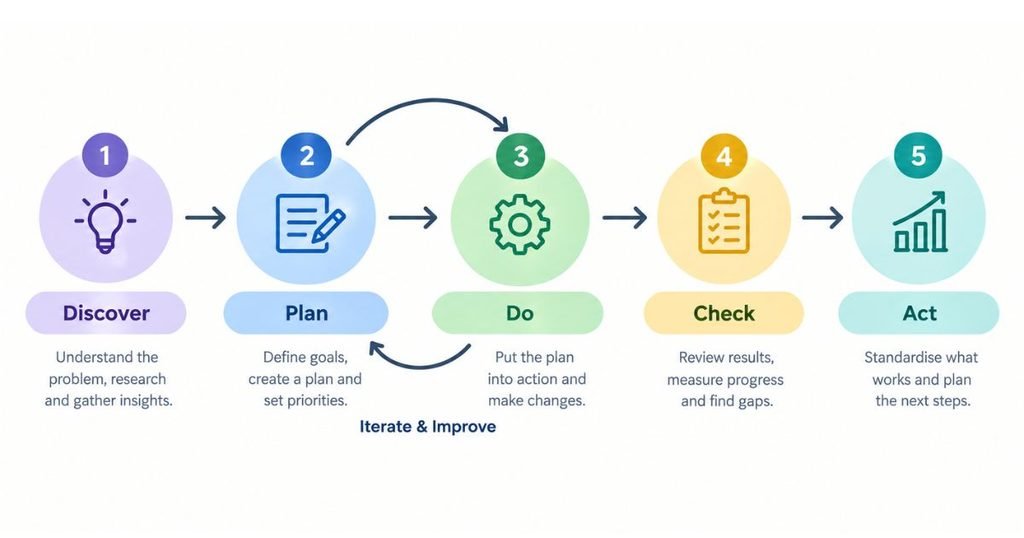
The five stages of the buyer decision process are need recognition, information search, evaluation of alternatives, purchase decision and post-purchase behaviour. The sequence applies to every purchase, but low-cost routine buys compress it into seconds while high-cost buys stretch it across weeks or months. Buyers often loop between stages instead of moving in a straight line.
Stage 1: Need Recognition
Need recognition happens when a buyer notices a gap between where they are and where they want to be. The gap can come from inside, like hunger or a broken phone, or from outside, like an ad or a friend’s new gadget.
It’s 11:40 pm and you want something sweet. You open Zepto, scroll for a minute, and an ice cream tub is on its way, because Zepto’s whole pitch is delivery in about ten minutes. That small moment is stage 1 in action. Nothing was researched. A feeling met a convenient app.
Internal triggers
Internal triggers come from the buyer’s own body or situation: hunger, a cracked phone screen, a laptop that freezes during every video call. Maslow’s hierarchy of needs (1943) is a handy lens here. Basic needs drive routine purchases, while esteem and belonging sit behind many premium ones, like a first iPhone.
External triggers
External triggers come from the outside world: an Instagram reel, a colleague’s new earbuds, a sale banner. Nykaa’s Pink Friday Sale, and festive events like Amazon’s Great Indian Festival and Flipkart’s Big Billion Days, push shoppers to act on wants they already had. They don’t invent the desire. They set a deadline for it.
What does this mean for you? Show up before the search starts. Video, creator partnerships and PR all work at this stage, but judge them by branded search and direct traffic, not last-click ROAS.
Stage 2: Information Search
Information search is the stage where a buyer collects facts to reduce the risk of a wrong choice. The riskier or costlier the purchase, the longer and wider this search runs.
Kotler groups the sources buyers use into four types:
- Personal sources: family, friends, colleagues
- Commercial sources: brand websites, ads, sales staff, product pages
- Public sources: reviews, ratings, news coverage, YouTube comparisons
- Experiential sources: trials, demos, free samples, in-store handling
Reviews matter more than most brands admit. BrightLocal’s Local Consumer Review Survey 2024, which polled 1,141 US consumers, found that 75% read reviews always or regularly when researching a business, and 50% trust online reviews as much as recommendations from friends and family. Another 59% expect a business to have between 20 and 99 reviews before they trust its star rating. That’s US data, so check it against your own audience, but the direction holds for most categories.
Think about how you’d buy a phone. You’d check ratings on Amazon India, watch a teardown on YouTube, and scroll a Reddit thread for complaints nobody puts in an ad. boAt is rarely missing from a shortlist in earbuds and smartwatches, partly because it shows up on every marketplace listing, in creator videos and in sports sponsorships. Buyers can’t consider a brand they never meet during the search.
The takeaway is blunt. If you’re missing from the places buyers look, you don’t make the shortlist, and you never get a chance to compete in stage 3.
Stage 3: Evaluation of Alternatives
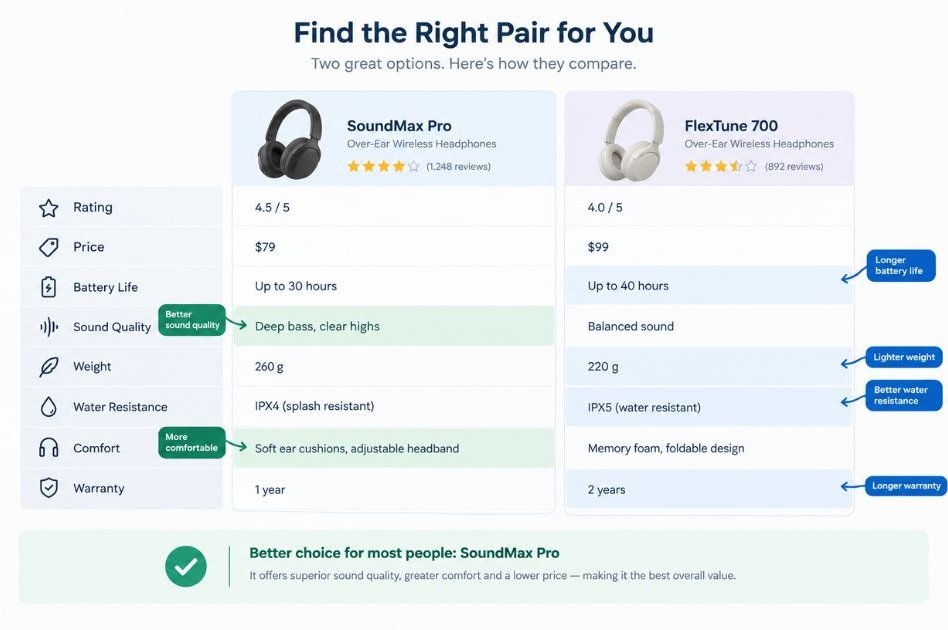
Evaluation is where the buyer compares the shortlisted options against criteria that matter to them, such as price, features, brand trust, delivery time and reviews. Most buyers weigh a few deciding factors, not every specification.
Take a family choosing a compact SUV in India. The shortlist might be the Hyundai Creta and the Kia Seltos. The decision rarely comes down to engine specs. It comes down to boot space, service network, resale value and what the neighbour said. Each buyer ranks those criteria differently, which is why one car doesn’t win every comparison.
Google and The Behavioural Architects studied this phase of consumer buying behaviour in their 2020 “messy middle” research and updated it in 2023. Their finding: buyers don’t evaluate in a tidy line. They loop between exploring and evaluating, again and again, until they feel confident enough to buy.
Evaluation criteria buyers actually use
Buyers usually weigh price, quality signals, brand reputation, features, convenience and risk. Risk is the one marketers forget. A cheaper product with fewer reviews often loses to a pricier one with thousands, because the buyer is buying certainty too.
Mental shortcuts that tip the scale
Buyers lean on shortcuts when comparing. Social proof (many others bought this), scarcity (only 3 left), anchoring (the crossed-out price) and the decoy effect all change choices. Dan Ariely’s well-known Economist subscription example showed that adding a deliberately unattractive third option made the bundle look like a bargain.
These tactics work, but they backfire when they’re fake. Use them honestly. A made-up countdown timer wins one sale and loses the next ten.
Stage 4: Purchase Decision
The purchase decision is the moment a buyer commits to a brand, a seller, a payment method and a time. Even a fully convinced buyer can walk away here. Baymard Institute puts the average documented online cart abandonment rate at 70.22%, based on 50 studies and updated in September 2025.
Why do they leave? Baymard’s data on shoppers who abandoned for reasons other than just browsing is revealing:
- 40% said extra costs such as shipping, tax and fees were too high
- 20% said delivery was too slow
- 19% didn’t trust the site with their card details
- 18% were forced to create an account
- 17% found checkout too long or complicated
Kotler adds two forces that act between intention and action: the attitudes of other people (“my brother says don’t buy it”) and unexpected situational factors, like a sudden expense or a stock-out.
India has an advantage here. According to NPCI data reported by StartupTalky, UPI handled 24.07 billion transactions worth ₹29.37 lakh crore in September 2026. Paying is no longer the hard part. Showing the total price early, offering guest checkout and keeping the flow to one or two screens is. Amazon’s one-click ordering and the single-screen checkouts on quick commerce apps exist for the same reason: every extra step gives doubt another chance.
Online shoppers abandon roughly 70% of carts, according to Baymard Institute’s analysis of 50 studies. The most common reason is unexpected extra costs at 40%, followed by slow delivery and lack of trust in the site. Brands that show total costs early and cut checkout steps remove the most common causes of drop-off.
Stage 5: Post-Purchase Behaviour
Post-purchase behaviour is what the buyer does after paying: they use the product, compare it with their expectations, then keep it, return it, review it or buy again. A good experience creates repeat orders and referrals. A gap between promise and reality creates returns and one-star reviews.
Psychologist Leon Festinger’s cognitive dissonance theory (1957) explains a quieter problem. After a big purchase, buyers often feel doubt: did I overpay, was the other one better? If nobody reassures them, that doubt turns into returns or negative word of mouth.
You can reduce it with simple moves. Send an order confirmation that restates why they chose well, add setup tips in the first week, and make returns painless. Memberships like Swiggy One and Nykaa Prive are built to turn a first order into a habit, so the buyer’s next need starts with your app.
Here’s the loop most funnels miss. Today’s post-purchase reviews become tomorrow’s stage 2 research for someone else. A brand that ignores stage 5 slowly poisons its own stage 2.
Post-purchase behaviour decides whether a first sale becomes a repeat customer. Buyers often feel doubt after large purchases, a pattern called cognitive dissonance, and reassurance through onboarding and easy returns reduces it. Reviews written after purchase also feed the information search of future buyers, so stage 5 shapes stage 2.
What Changes How Buyers Move Through the Stages?
Purchase involvement is the effort and risk a buyer attaches to a decision, and it controls how long each stage lasts. Low-involvement buys like salt take seconds. High-involvement buys like a car or a home loan can take months.
Consumer buying behaviour shifts with involvement and brand differences. Marketing researcher Henry Assael described four types in 1987:
| Type | Involvement | Brand differences | Example |
|---|---|---|---|
| Complex buying | High | Large | Laptop, home, car |
| Dissonance-reducing | High | Small | Mattress, modular kitchen |
| Habitual buying | Low | Small | Amul butter, table salt |
| Variety-seeking | Low | Large | Chips flavours, shampoo |
Four groups of factors then bend the path:
- Psychological: motivation, perception, beliefs and attitudes
- Personal: age, income, occupation and lifestyle
- Social: family, peers, creators and communities
- Situational: festive season, urgency, budget at that moment
A habitual buyer needs a reminder and a shelf. A complex buyer needs proof, comparisons and patience. Sending the same message to both wastes money on one of them.
Which Frameworks Explain Buyer Decisions?
Five frameworks come up most often: Kotler’s five-stage model, the Engel-Kollat-Blackwell (EKB) model, the Howard-Sheth model, AIDA, and Google’s messy middle. Kotler’s is the simplest to apply. Google’s is the closest to how people shop online today.
| Model | Origin | Best for | Limitation |
|---|---|---|---|
| Kotler five-stage | Marketing textbooks | Auditing a funnel quickly | Reads as a straight line |
| EKB model | Engel, Kollat, Blackwell, 1968 | High-involvement, complex purchases | Detailed and hard to apply fast |
| Howard-Sheth model | Howard and Sheth, 1969 | Repeat purchases and brand learning | Heavy on theory |
| AIDA | E. St. Elmo Lewis, 1898 | Ad copy and landing pages | Ignores post-purchase |
| Messy middle | Google and The Behavioural Architects, 2020 | Digital journeys with many touchpoints | Says little about stage 5 |
No single model fits every buyer decision process, so pick the one that matches your question. Use Kotler to audit, AIDA to write copy, EKB when the purchase is expensive and slow, and the messy middle when your buyers compare across five tabs.
Which Tools Help You Track Each Stage?
No single tool covers all five stages. Google Trends and Search Console show early demand, Google Analytics 4 maps the path to purchase, Microsoft Clarity shows where buyers hesitate, and CRM and survey tools capture post-purchase signals. Pair one tool with each stage instead of buying a bundle.
| Stage | Tool | Metric to watch |
|---|---|---|
| 1. Need recognition | Google Trends, Meta Ads Manager | Search interest, reach, branded search |
| 2. Information search | Search Console, Semrush or Ahrefs, review platforms | Non-brand clicks, review count and rating |
| 3. Evaluation | GA4, Clarity or Hotjar | Product page to cart rate, scroll depth |
| 4. Purchase | GA4, Clarity, Google Ads remarketing | Checkout completion rate |
| 5. Post-purchase | Typeform, WebEngage, MoEngage or Klaviyo | NPS, repeat purchase rate, return rate |
Here’s what each tool does, how to use it, and where it falls short.
Google Trends (stage 1)
Google Trends is a free tool that shows how search interest in a topic changes over time and by region. Set the location to India, pick a five-year window, and compare terms like “air fryer” or “running shoes”. You’ll spot seasonal triggers, such as electronics searches climbing before festive sales. The “Related queries” panel hints at the problems people are trying to solve. The limitation: it shows relative interest on a 0 to 100 scale, not actual search volume.
Google Search Console, Semrush and Ahrefs (stage 2)
Google Search Console is a free report of the queries that brought people to your pages. Semrush and Ahrefs are paid tools that show the keywords competitors rank for and the questions searchers ask. Together they reveal what buyers type while researching. Build a page for each question that appears again and again, such as “X vs Y” or “is X worth it”. The limitation: keyword tools estimate volumes, so treat the numbers as a guide, not a count.
Google Analytics 4 (stages 2 to 4)
Google Analytics 4 (GA4) is Google’s analytics platform that tracks user behaviour as events. Its Funnel exploration report lets you build steps from view_item to add_to_cart to begin_checkout to purchase, and shows the percentage lost at each step. Path exploration shows which pages people visit between steps. Segment by new and returning users, since they sit at different stages. The limitation: reports are only as good as your event setup, so test your tags before trusting the data.
Microsoft Clarity and Hotjar (stages 3 and 4)
Microsoft Clarity and Hotjar are behaviour analytics tools that record sessions and build heatmaps of clicks and scrolling. Clarity is free and flags rage clicks and dead clicks, where users tap repeatedly on something that doesn’t respond. Hotjar adds on-page surveys. Watch 20 recordings of sessions that ended at checkout and write down every moment of hesitation. The limitation: recordings show what happened, not why, so pair them with a survey.
Meta Ads Manager and Google Ads (stages 1, 3 and 4)
Meta Ads Manager and Google Ads are the ad platforms where you reach buyers at the trigger stage and bring them back later. Build custom audiences from site visitors, then show dynamic product ads featuring the exact items they viewed. Meta’s Advantage+ shopping campaigns combine prospecting and retargeting in one setup. Google Ads remarketing does a similar job across Search and YouTube. The limitation: platform-reported conversions overlap and over-credit, so compare them with your total revenue.
Review platforms (stages 2, 3 and 5)
Google Business Profile, Trustpilot, and marketplace reviews on Amazon and Flipkart are where public evidence lives. Ask for a review a few days after delivery, when the product has actually been used, and reply to the negative ones in public. Prospective buyers read your replies as closely as the complaints. The limitation: reviews you incentivise can break platform rules, so ask neutrally.
Survey tools: Typeform, Google Forms, Qualtrics (stages 1 and 5)
Typeform, Google Forms and Qualtrics let you ask buyers directly. Add a one-question prompt on the order confirmation page: “What made you decide to buy today?” Add another: “How did you first hear about us?” A post-purchase Net Promoter Score (NPS) survey, which asks how likely a customer is to recommend you from 0 to 10, measures stage 5. The limitation: people answer inaccurately about their own motives, so read patterns, not single replies.
Lifecycle messaging: WebEngage, MoEngage and Klaviyo (stages 5 and 1)
WebEngage, MoEngage and Klaviyo are customer engagement platforms that trigger emails, push notifications and WhatsApp or SMS messages based on behaviour. Set up a post-purchase flow: order confirmation, usage tips on day three, a review request on day seven, and a replenishment reminder when the product is likely to run out. That last message doubles as a stage 1 trigger for the next purchase. The limitation: too many messages push people to unsubscribe, so cap the frequency.
How Has AI Search Changed the Journey in 2026?
AI assistants now handle a large share of stages 2 and 3. Shoppers ask ChatGPT, Gemini or Google’s AI Overviews to explain options and build a shortlist before they visit any brand site. Your brand has to be cited in those answers, not only ranked in search results.
The numbers show how fast this moved. According to L.E.K. Consulting’s 2026 research, as summarised by MarTech, 46% of AI users now start purchase research on a standalone AI platform, up from 25% in 2024. And 53% mainly use it to compare options and narrow a shortlist.
Trust hasn’t moved as fast. Product.ai’s 2026 findings, also reported by MarTech, show that 86% of US shoppers who used AI for product research verified its recommendation through another source before buying. So AI gets you onto the shortlist, but reviews, ratings and clear product details still close the sale.
What should you do? Publish clear product specs, honest comparison pages and a proper FAQ. Collect reviews on third-party platforms. Get mentioned in credible places, since AI answers draw on them. These figures come mostly from US-based research, so Indian behaviour may differ, but the direction is the same.
In 2026, AI assistants have become a major starting point for product research, with L.E.K. Consulting reporting that 46% of AI users begin on a standalone AI platform, up from 25% in 2024. Most shoppers still verify AI recommendations elsewhere, with Product.ai finding that 86% of US users do. Brands therefore need both AI visibility and third-party proof such as reviews.
How Do You Apply the Five Stages to Your Marketing?
Start by finding the stage where most buyers drop off, then fix that stage before you spend more on traffic. These five steps give you an audit you can finish in a day.
- Interview five recent customers. Ask what first made them start looking, and what almost stopped them buying.
- Assign one metric to each stage. Use branded search for stage 1, non-brand organic traffic for stage 2, product page to cart rate for stage 3, checkout completion for stage 4 and repeat purchase rate for stage 5.
- Build a funnel in GA4. Run Funnel exploration and find the step with the biggest percentage loss.
- Diagnose the leak. Watch Clarity recordings of that step and add a one-question survey asking what held buyers back.
- Fix one thing and measure. Change a single element, such as showing shipping costs on the product page, and compare results over two to four weeks.
The point of the Consumer Buying Decision Process is diagnosis. A brand with plenty of traffic and a weak checkout needs stage 4 work, not more ads. A brand with a great product and poor reviews has a stage 2 problem. Fixing the wrong stage is the most expensive mistake in this whole model.
Conclusion
The five stages are simple to list and hard to execute: a need appears, the buyer searches, compares, buys, then judges what they bought. Most brands over-invest in stage 4 ads and under-invest in stages 2, 3 and 5, where trust is built and repeat sales are earned.
Three things to remember. Buyers loop instead of moving in a line. Reviews connect stage 5 back to stage 2. And in 2026, AI answers sit in the middle of the journey, so your brand needs proof outside your own website.
Pick one stage this week. Find its metric, find the biggest leak, and fix one thing.
Frequently Asked Questions
What are the five stages of buying decisions?
The five stages are need recognition, information search, evaluation of alternatives, purchase decision and post-purchase behaviour. A buyer first notices a need, then researches options, compares them, buys, and finally judges whether the choice was right. The order is the same for all purchases, but the time spent differs by cost and risk.
Who created the five-stage buying model?
Philip Kotler popularised the five-stage version in his marketing textbooks. The thinking behind it goes back to John Dewey’s 1910 book How We Think, which described how people solve problems. Other researchers, including Engel, Kollat and Blackwell in 1968, built more detailed models on the same idea.
Is the buying decision process the same as the marketing funnel?
Not quite. The buying decision process describes what the buyer thinks and does, while the marketing funnel describes what the brand does at awareness, consideration and conversion. The two overlap, but the buyer’s view includes stage 5, which many funnels stop short of.
How long does each stage take?
It depends on involvement. A habitual purchase like salt can pass through all five stages in seconds. A car or home loan can take weeks or months, with the buyer spending most of that time in stages 2 and 3. Measure the time from first visit to purchase in GA4 to see your own average.
What is the difference between high-involvement and low-involvement purchases?
High-involvement purchases are costly, risky or tied to identity, so buyers research heavily. Low-involvement purchases are cheap and routine, so buyers decide fast, often from habit. High-involvement buyers need proof and comparisons. Low-involvement buyers need availability and reminders.
How do I find out which stage my customers are stuck at?
Build a funnel in GA4 and look for the biggest drop between steps. Then use Microsoft Clarity recordings and a short survey to understand why people leave. A large drop between product page and cart points to stage 3. A large drop between cart and payment points to stage 4.
Does the five-stage model work for B2B?
Yes, with changes. B2B purchases involve several decision makers, longer research, and formal evaluation like demos and proofs of concept. The same five stages apply, but you’ll map each stakeholder, such as the user, the budget holder and the approver, through them.
Is the buying decision process still relevant in 2026 with AI search and social media?
Yes. Consumer buying behaviour has shifted online, but the stages haven’t gone away. They just happen in different places. AI assistants and social platforms now shape stages 2 and 3, and many buyers loop between them, as Google’s messy middle research showed. Use the model as a diagnostic checklist, not a strict sequence.
Why do people leave items in the cart without buying?
The top reasons in Baymard Institute’s data are extra costs (40%), slow delivery (20%), lack of trust in the site (19%) and forced account creation (18%). Many people are also just browsing, so some abandonment is normal. Show full costs early, offer guest checkout and display clear delivery dates to cut the avoidable part.
What do most brands get wrong about the last stage?
They treat the purchase as the finish line. Stage 5 decides repeat sales, returns and the reviews that future buyers read. Add a post-purchase flow with reassurance, usage tips and a review request, and measure repeat purchase rate along with NPS.


