

A hotel runs a lovely campaign promising warm, personal stays. Then a guest reaches the front desk at midnight, meets a tired receptionist who isn’t allowed to change a room, and hears “the system won’t let me.” The ad was fine. The promise broke anyway.
That gap between what a business says and what actually happens is exactly what the Service Marketing Triangle was built to explain. It shows why marketing a service is a three-way job, not a two-way one, and why so many good campaigns fail at the counter, on the call, or at the doorstep.
This guide covers the model from scratch, then goes through every tool you can use to measure and fix it, with real examples and a step-by-step way to apply it to your own business.
What Is This Framework and Where Did It Come From?
The Service Marketing Triangle is a model that maps three groups, the company, its employees and its customers, and the three types of marketing that connect them: external, internal and interactive. A service succeeds only when all three connections hold at the same time.
The model builds on work by Philip Kotler and Christian Grönroos, and it was popularised in the textbook Services Marketing by Valarie Zeithaml and Mary Jo Bitner. You’ll see it in almost every MBA services course for a simple reason. It explains something product marketing never had to.
Here’s the difference. A shampoo brand makes a promise through advertising, produces the bottle in a factory, and ships it to a shelf. The customer never meets the people who made it. A service has no factory. It’s produced by a person (or a person plus software) at the exact moment the customer uses it.
That’s why services are described with four traits:
- Intangible: you can’t hold or inspect a haircut before you buy it.
- Inseparable: production and consumption happen together, often with the customer present.
- Variable: quality changes with who delivers it and when.
- Perishable: an empty seat on a flight can’t be stored and sold tomorrow.
Every one of those traits pushes the real marketing moment away from the advertisement and into the interaction. The triangle is the map for that shift.
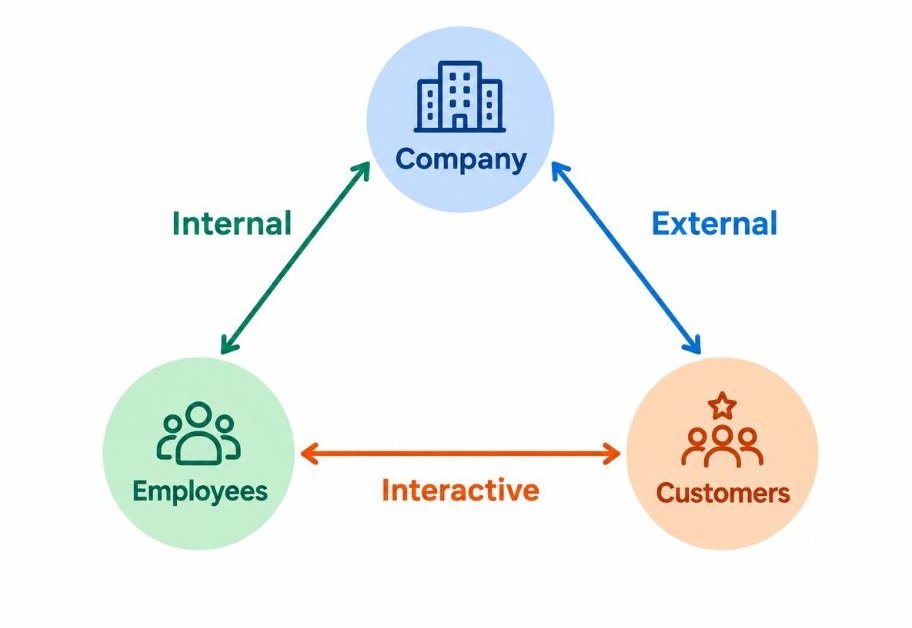
This three-sided model shows that a service has three interdependent parties (company, employees, customers) and three marketing jobs: making promises through external marketing, enabling them through internal marketing, and keeping them through interactive marketing. If any one side is weak, the promise breaks, however good the advertising is.
Who Sits at the Three Corners of the Triangle?
Take Taj Hotels. A guest sees the brand promise on a screen, a manager decides what the hotel can afford to deliver, and a butler or front-desk associate decides whether the guest feels looked after. Three different people, three different roles, one experience. That’s the triangle in miniature.
The Company Corner
The company corner is management and the business itself: strategy, brand, budgets, systems, policies. This corner decides what gets promised and what resources exist to keep the promise. When people say “the company let me down,” they usually mean a decision made here that shows up somewhere else.
The Employees Corner
This corner covers everyone who delivers the service, whether they’re front-line staff, back-office teams, franchise partners or gig workers. In a bank it’s the relationship manager and the person processing your loan file. In a food delivery app it includes the rider. Software can sit here too when it delivers part of the service.
The Customers Corner
Customers aren’t passive recipients. They take part in producing the service. A Cult.fit member who skips the trainer’s plan changes the result. A patient who leaves out symptoms changes the diagnosis. Good service design assumes the customer is a participant and helps them play that role well.
What Is External Marketing? (Making the Promise)
External marketing is the communication between the company and its customers that sets expectations about what the service will be like. It includes anything that tells a customer what to expect before they use the service: advertising, pricing, public relations, website copy, sales conversations and online reviews.
Most marketers already know this side, which is exactly the problem. It gets all the budget and attention while the other two sides get almost none.
Here are the external marketing tools, each with what it actually does for a service business:
- Advertising and brand messaging: sets the headline expectation. For services, the safest ads describe a believable experience rather than a perfect one, because every unmet expectation becomes a complaint later.
- Pricing: acts as a quality signal. Since customers can’t inspect a service in advance, a high price suggests premium treatment and a low price suggests basic treatment. Your price also sets the standard they’ll judge you against.
- Public relations and content: builds credibility through stories, expert articles, awards and press. It matters more in services because trust substitutes for the product trial that isn’t possible.
- Reviews and social proof: lets past customers set expectations for new ones. A hotel’s Google rating or a clinic’s patient stories often carries more weight than the brand’s own claims.
- Sales conversations: every pre-sales call, demo and quote is a promise. Salespeople who overpromise to close deals create problems that surface months later.
- Digital touchpoints: the website, app store listing and onboarding emails. They show how organised the service is, and customers read that as a preview of the experience.
A recent Indian example shows how tightly external promises tie to delivery. In January 2026, Blinkit changed its tagline from “10,000+ products delivered in 10 minutes” to “30,000+ products delivered at your doorstep” after the Union Labour Ministry raised concerns about delivery worker safety, according to PTI reports. Eternal, Blinkit’s parent, told stock exchanges the change wouldn’t affect its operations. Whatever your view on the policy, the marketing lesson is clear: a headline promise sets a standard that the people at the other end of the triangle feel every day.
A warning on this side. External marketing is the only corner where overpromising is easy and cheap. Keep your claims inside what your team can deliver on an average Tuesday, not on your best day.
What Is Internal Marketing? (Enabling the Promise)
Internal marketing is the work a company does to hire, train, equip, motivate and inform its employees so they can deliver the promises made in external marketing. In the triangle it’s the line between the company and its employees.
It’s the least glamorous side and the one that quietly decides everything else. The idea goes back to Leonard Berry’s work in the early 1980s, which treated employees as internal customers and jobs as internal products. If your people don’t want the job you’re offering, they won’t give customers a good experience in it.
The evidence backs this up. In PwC’s 2018 Experience Is Everything survey of 15,000 consumers across 12 countries, 71% said employees have a significant impact on their customer experience. The dataset is a few years old, so treat it as directional, but the pattern matches what practitioners see year after year.
Here are the internal marketing tools in detail:
- Recruitment and role fit: hire for attitude and judgment, then train for skill. A cheerful person without product knowledge is fixable. A skilled person who dislikes customers usually isn’t.
- Training: covers product knowledge, communication, handling complaints and understanding the brand promise. Training should include the “why” behind the promise, so staff can improvise when a situation isn’t in the manual.
- Empowerment: gives front-line staff authority to solve problems without asking permission. Ritz-Carlton is the textbook case. Its credo describes staff as ladies and gentlemen serving ladies and gentlemen, and the company is widely reported to let employees resolve guest issues on the spot.
- Internal communication: tells employees about campaigns, offers and changes before customers see them. Nothing frustrates a customer more than knowing about a discount the support agent hasn’t heard of.
- Rewards and recognition: reinforce the behaviours you want. If you reward only speed, don’t expect thoughtful service.
- Tools and systems: includes CRM access, inventory visibility and clear escalation paths. A friendly agent without information is still a poor experience.
- Culture and leadership: shows up in how managers treat staff. Employees tend to treat customers the way they’re treated.
James Heskett and colleagues formalised this logic in their service-profit chain, published in Harvard Business Review in 1994. It links employee satisfaction to loyalty and productivity, then to the value customers receive, and finally to customer satisfaction, loyalty and profit.
Honestly, internal marketing gets misread as pizza parties and posters. It’s closer to making the job doable.
Internal marketing is the preparation that makes promises deliverable: hiring, training, empowering, informing, rewarding and equipping employees. In PwC’s 2018 survey of 15,000 consumers, 71% said employees significantly shape their customer experience, which is why internal marketing sits at the base of the triangle.
What Is Interactive Marketing? (Keeping the Promise)
Interactive marketing is what happens in the live moment between an employee and a customer, when the promise made externally is either kept or broken. It’s also called real-time marketing, and in many services it’s the product itself.
Jan Carlzon, then CEO of Scandinavian Airlines, called these encounters “moments of truth” in his book of the same name. His point was that a brand is judged in short, repeated contacts with staff, often lasting only seconds, not in the boardroom or in advertising. Add those up across a year and you get millions of tiny verdicts.
The tools for this side are practices more than media:
- The service encounter: any direct contact, whether face to face, by phone, chat, email or in an app. Each encounter should be designed, not left to chance. Decide what a great five-minute call sounds like.
- Scripts versus discretion: scripts keep quality consistent on routine requests, while discretion lets staff respond to the unusual. The best teams use scripts for the first 80% and trust judgment for the rest.
- Service recovery: the process for fixing things when they go wrong. Acknowledge the problem fast, apologise sincerely, fix it, and compensate when fair. Customers whose problems are solved well often become more loyal than those who never had one.
- Customer co-creation: guides customers through their own part of the service, such as clear onboarding steps, forms that make sense and instructions that prevent mistakes.
- Technology-mediated interaction: chatbots, self-service kiosks and app flows now carry part of the interaction. They work well for simple, repeatable tasks and badly when a customer is upset or the situation is unusual. Always provide a clear route to a human.
Swiggy and Zomato show how fragile this side is. A rider arriving late, or a restaurant packing an order wrongly, is where the app’s brand experience is won or lost, and neither moment involves the marketing team at all.
How Does the Triangle Connect to the 7 Ps of Services Marketing?
The 7 Ps are the services marketing mix: product, price, place, promotion, people, process and physical evidence. Bernard Booms and Mary Jo Bitner extended the classic 4 Ps with the last three in 1981, because services need levers that physical goods don’t.
The triangle and the 7 Ps work together. The triangle tells you who has to act and in which relationship. The 7 Ps tell you what you can adjust.
| The P | What it means for a service | Triangle side it mostly supports |
|---|---|---|
| Product | The service offering and its features | External (what you promise) |
| Price | What customers pay and what that signals | External |
| Place | Where and how the service is accessed | External and interactive |
| Promotion | Communication that sets expectations | External |
| People | Staff, and customers who take part | Internal and interactive |
| Process | The steps and flow of delivery | Interactive and internal |
| Physical evidence | Tangible cues such as premises, uniforms, app design | External and interactive |
Three of these deserve a closer look because they’re the ones goods marketers rarely handle:
- People: staff and customers are both part of the product. Their appearance, tone and behaviour shape quality. This is where internal marketing pays off.
- Process: the sequence of steps a customer goes through, including waiting time, handoffs and paperwork. A slow process makes a friendly employee look ineffective.
- Physical evidence: the tangible proof that a service exists and is good. Think of a clean clinic waiting room, a well-designed bank app or a branded delivery bag. Customers use these to judge an intangible offer.
Which Tools Help You Measure and Fix Each Side?
You can’t improve what you don’t measure, and services are harder to measure than products. These five tools cover the triangle from different angles. Each is explained below with what it does and where it fits.
SERVQUAL
SERVQUAL is a survey instrument that measures service quality by comparing what customers expected with what they perceived. A. Parasuraman, Valarie Zeithaml and Leonard Berry developed it in 1988.
It scores five dimensions:
- Reliability: doing what you promised, accurately and on time.
- Responsiveness: willingness to help and answer promptly.
- Assurance: staff knowledge and courtesy, and their ability to inspire trust.
- Empathy: individual attention and care for the customer.
- Tangibles: the look of facilities, equipment, staff and communication materials.
Customers rate expectation and experience on each item, and the difference is your gap score. Reliability usually carries the most weight in research on the tool, so fix it first. SERVQUAL mostly diagnoses the interactive side but also reveals problems rooted in the other two.
The Gaps Model
The Gaps Model is a diagnostic framework by Parasuraman, Zeithaml and Berry (1985) that identifies five places where service quality breaks down. It’s the best companion to the triangle because each gap lines up with one of its sides.
- Knowledge gap: management misunderstands what customers expect.
- Standards gap: management knows the expectation but sets the wrong service standards.
- Delivery gap: standards exist but staff don’t meet them.
- Communication gap: external promises don’t match what is delivered.
- Perception gap: what customers perceive falls short of what they expected.
Gap 4 is an external marketing failure. Gaps 2 and 3 usually trace back to internal marketing, meaning poor training, weak systems or unclear standards. Gap 3 also shows up directly in interactive marketing. Run it as a team exercise and you’ll often find the biggest gap isn’t where you assumed.
Service Blueprinting
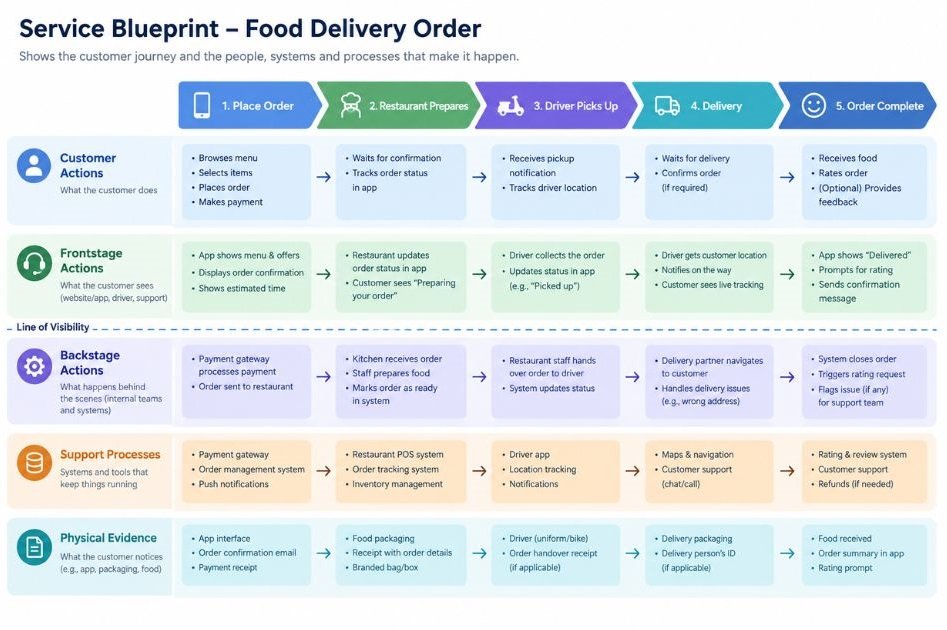
A service blueprint is a diagram of every step in a service, separating what the customer sees from what happens behind the scenes. Lynn Shostack introduced the method in Harvard Business Review in 1984.
A blueprint has five layers: customer actions, onstage employee actions (visible to the customer), backstage employee actions (invisible), support processes (systems and other teams), and physical evidence. A “line of visibility” divides onstage from backstage.
Why it matters: most service failures begin backstage, where the customer can’t see them. Blueprinting exposes the handoffs where things get lost, and it shows exactly where employees need better tools or authority.
Customer Journey Mapping
A customer journey map charts the stages a customer passes through, from first awareness to repeat use, along with what they do, think and feel at each stage. It’s the customer’s-eye counterpart to the blueprint’s operational view.
Build it in four moves. List the stages, mark every touchpoint, note the emotion at each, and highlight the pain points. Then match each pain point to a triangle side. A confusing price page is external, a staff member who couldn’t answer a question is internal, and a rude call is interactive. Interview real customers rather than guessing, because teams are consistently wrong about where customers struggle.
Service Metrics: NPS, CSAT, CES and eNPS
Four metrics give you a running scorecard.
- Net Promoter Score (NPS): asks how likely a customer is to recommend you on a 0 to 10 scale. Subtract the percentage of detractors (0 to 6) from promoters (9 to 10). Fred Reichheld introduced it in Harvard Business Review in 2003.
- Customer Satisfaction Score (CSAT): asks how satisfied a customer was with a specific interaction, usually on a 5-point scale. It’s best right after a service encounter.
- Customer Effort Score (CES): asks how easy it was to get an issue resolved. It’s useful for support and process design because low effort strongly predicts loyalty.
- Employee Net Promoter Score (eNPS): asks employees how likely they are to recommend working at your company. It’s the internal marketing health check, and it often predicts customer scores a few months ahead.
Track both customer and employee metrics together. If CSAT is falling while eNPS is falling, the cause is probably inside the company, not in your ads.
The five most practical tools for managing a service are SERVQUAL, the Gaps Model, service blueprinting, journey mapping and a metrics scorecard (NPS, CSAT, CES, eNPS). Use them together: the Gaps Model finds where quality breaks, the blueprint and journey map show why, and the metrics confirm whether fixes work.
How Do You Apply the Triangle Step by Step?
Applying the triangle means auditing each side in order, starting with the promises you make and ending with the metrics that confirm you keep them. Here’s a sequence that works for most service businesses.
- List your promises. Collect every claim in ads, your website, sales decks and onboarding emails. Write each one as a sentence a customer could hold you to.
- Map the journey. Build a journey map and a blueprint for your two or three most common customer paths.
- Measure the gaps. Run a short SERVQUAL-style survey and compare it against your list of promises. Look for the widest gap.
- Fix internal enablers first. Before changing any messaging, check whether staff have the training, tools and authority to deliver. This step is where most budgets should go.
- Design the key moments. Decide what a great encounter looks like, write the recovery process for the three most common failures, and train for them.
- Rewrite external promises. Adjust claims so they sit just inside what you can deliver reliably.
- Review every quarter. Track NPS, CSAT, CES and eNPS together, and rerun the gap check when something changes.
The order matters. Many teams start at step 6 because it’s the easiest to change. But rewriting an ad doesn’t fix a broken process.
What Mistakes Break the Triangle?
Most failures come from neglecting one side while overinvesting in another. Four patterns show up repeatedly.
The first is overpromising. A bold external claim lifts conversions this month and creates complaints next month. The second is treating front-line staff as a cost to minimise rather than the people who deliver the brand. High turnover and thin training show up directly in customer experience.
The third is leaving interactive marketing to chance. If nobody has designed what happens in a complaint call, each agent improvises and quality swings wildly. And the fourth is letting technology replace judgment. Chatbots can lower costs, but customers still want a human option when something goes wrong.
One limitation to be upfront about. The model was built around people-delivered services, so it fits hotels, hospitals, banks, airlines and consultancies most naturally. For mostly self-serve products such as SaaS, you’ll need to treat the app or the support team as the “employee” corner and adapt accordingly. The logic still holds, but the details change.
Conclusion
Three ideas are worth carrying away. Every service promise needs three things to be true: it was made honestly, the team was prepared, and the live moment went well. Internal marketing is the most neglected of the three and usually the cheapest to improve. And measurement only works when you track customer and employee signals together.
Pick one customer journey in your business this week and walk it with the Service Marketing Triangle in mind. Note where the promise, the preparation and the delivery drift apart. That single exercise will tell you more than another campaign report.
FAQs
What is the triangle in services marketing?
It’s a model showing three parties (company, employees, customers) and the three marketing activities connecting them: external, internal and interactive. It explains why a service needs more than advertising to succeed, because promises have to be enabled and kept by people.
What are the three sides of the triangle?
External marketing runs between company and customers and makes the promise. Internal marketing runs between company and employees and enables the promise. Interactive marketing runs between employees and customers and keeps the promise during the service encounter.
What is the difference between internal and external marketing?
External marketing targets customers and sets expectations, using advertising, pricing and PR. Internal marketing targets employees and prepares them to meet those expectations, using training, communication, tools and recognition. One makes promises, the other makes them achievable.
Is the triangle the same as the 7 Ps?
No. The 7 Ps are the levers you can adjust (product, price, place, promotion, people, process and physical evidence). The triangle shows which relationships those levers affect and who has to act. They’re complementary, and most practitioners use both.
Why does interactive marketing matter so much?
Because in a service, the customer experiences the product during the interaction. A great ad can’t repair a rude call, and a poor ad can sometimes be rescued by a brilliant encounter. Interactive marketing is where promises are kept or broken, which is why retention depends so heavily on it.
How do I use this model in a small business?
Start small. Write down your three biggest promises, ask five customers whether you kept them, and ask your team what stops them from delivering. Fix the biggest obstacle first. You don’t need a formal survey to see where your gaps are.
Who should use this model?
Any business where a person delivers part of the product: clinics, salons, schools, gyms, agencies, banks, hotels, logistics firms and consultancies. If your customers judge you mostly by how they were treated, this model applies.
Does it work for online and app-based businesses?
Yes, with some adjustment. Treat support teams, delivery partners and the app itself as the employee corner. Your external promise is the app store listing and ads, and the interactive moment is the onboarding, support chat or delivery. Food delivery and quick commerce apps are good examples.
Is it still relevant in 2026 with AI chatbots?
Yes. AI changes who or what sits at the employee corner, but it doesn’t remove the need to enable, train and monitor whatever delivers the service. A chatbot that gives wrong answers is a broken internal marketing job and a damaged interactive moment at once.
Why are my customers unhappy even though my ads perform well?
Probably a gap between promise and delivery. Strong ads bring customers in with expectations your team can’t meet. Check your training, tools, staffing and process before you spend more on promotion, and compare what you say in ads with what customers report experiencing.


