

A press release used to need a week of drafting, approvals, and distribution before anyone read it. Now a founder’s offhand reply can get screenshotted, picked up by a journalist before lunch, and trending by dinner. That shift is why so many marketers and founders keep asking what is PR in social media, and how it differs from simply posting content on a schedule.
Here’s the short answer. It’s the work of earning attention, trust, and coverage on social platforms instead of paying for it. You do it by building relationships with journalists, creators, and customers, and by managing what gets said about your brand in public.
This guide walks you through the full picture. You’ll learn what social media PR covers, why it matters in 2026, and which tools fit each stage of the work. You’ll also get a step-by-step strategy, a crisis response plan, and a simple way to measure results.
It’s written for beginners. But if you already run a brand’s social channels, the tool breakdown and the measurement section should save you a few expensive mistakes.
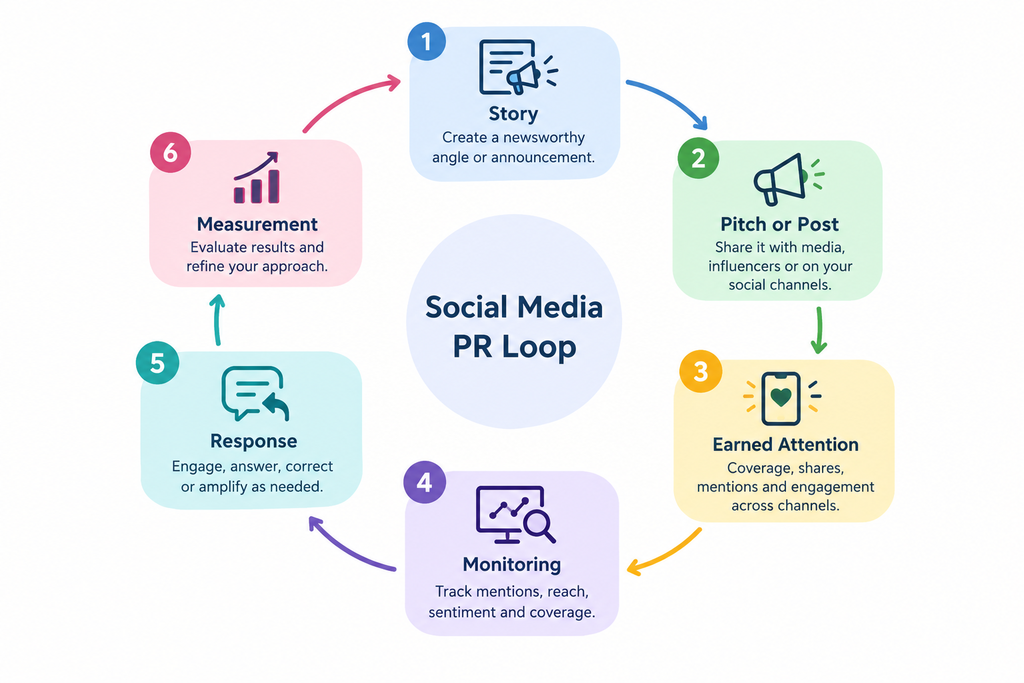
What Does PR in Social Media Actually Mean?
So, what is PR in social media? It’s the practice of building and protecting a brand’s reputation on social platforms through earned attention: mentions, shares, press coverage, creator endorsements, and community conversations. You don’t buy that reach. You earn it, and then you manage it.
Take Amul. The dairy brand’s topical ads, which Amul’s own history dates to 1969, react to news, sport, and film within hours, and today they travel mostly through social feeds. Nobody pays to make people share them. The reaction is the PR.
That’s the model in miniature. A brand shows up in a public conversation at the right moment, and other people carry the message for it.
Two terms are worth pinning down before we go further.
Earned media is publicity you gain on merit, such as a journalist quoting you or a creator reviewing your product, rather than placement you pay for.
Reputation management is the ongoing work of monitoring and shaping how audiences perceive your brand.
How Is Social Media PR Different From Traditional PR?
Traditional PR mostly works through gatekeepers: editors, producers, and publications who decide whether your story runs. Cycles are slow, and the conversation is largely one-way.
Social media PR adds a direct line to audiences. You can respond in minutes, see reactions in real time, and talk to the same people who read the coverage. The two overlap constantly, because a good post can earn a mention and a good mention gets shared on social.
How Is Social Media PR Different From Social Media Marketing?
Social media marketing aims at measurable business actions such as clicks, leads, and sales, usually through your own content and paid ads. Social media PR aims at reputation and trust, and it relies on other people talking about you.
They feed each other. Strong PR makes your ads more believable, and good marketing gives PR something to point at.
| Aspect | Social Media PR | Social Media Marketing | Paid Social Advertising |
|---|---|---|---|
| Main goal | Reputation, trust, coverage | Engagement, leads, sales | Immediate reach and conversions |
| How reach is gained | Earned through mentions, press, creators | Owned content plus some paid | Bought through ad platforms |
| Typical metrics | Share of voice, sentiment, coverage quality | Engagement rate, clicks, conversions | CPM, CPC, ROAS |
| Speed of results | Slow to build, durable | Medium | Fast, stops when spend stops |
| Control over message | Low, others shape it | High | Highest |
PR in social media is the practice of earning attention, trust, and coverage on social platforms through mentions, press, creators, and community conversations rather than paid placement. It differs from social media marketing because its goal is reputation, not direct sales. The two work best together: PR builds credibility, and marketing converts the attention it creates.
Why Does Social Media PR Matter in 2026?
Social media PR matters because your customers, your competitors, and the journalists who cover you all spend time on the same platforms, and trust now moves through those platforms faster than through any press office. If people are talking about you and you’re absent, someone else is writing your story.
Start with scale. DataReportal’s Digital 2026 report counted 5.66 billion social media user identities worldwide as of October 2025, equal to 68.7% of the global population. One caveat: “user identities” aren’t unique people, since one person can hold several accounts. The direction is still clear.
Then there’s trust. Edelman’s 2026 Trust Barometer found that 70% of respondents are unwilling or hesitant to trust someone with different values, backgrounds, or information sources. For brands, that pushes attention toward voices that feel familiar: creators, peers, and employees. The same report found that 78% of employees trust their employer, the most trusted institution it measured. Your own team is a PR channel whether you plan it that way or not.
And journalists? Muck Rack’s State of Journalism 2026 report surveyed nearly 1,100 journalists on where they spend their time and what makes a pitch land. The detailed findings sit behind a download form, so read the full report before you plan outreach. A safe working assumption in the meantime: before anyone covers you, they’ll look at your social profiles.
Speed is the last piece. A complaint can reach thousands of people before your customer support team has opened the ticket. That’s both the risk and the opportunity.
Social media PR matters in 2026 because DataReportal counted 5.66 billion social media user identities as of October 2025, and Edelman’s 2026 Trust Barometer shows people lean toward familiar voices such as peers, creators, and employees. Brands that don’t take part in those conversations leave their reputation to others.
What Are the Core Parts of Social Media PR?
A social media PR strategy has seven core parts: brand storytelling, media relations, creator relations, community management, social listening, crisis communication, and employee advocacy. You don’t need all seven on day one. Start with storytelling and listening, then add the rest as your team and budget grow.
Brand Storytelling
Your story is the thing people repeat, so make it specific. A founder’s real reason for starting, a customer result, or a number from your own data gives a journalist or creator something to work with.
“We’re passionate about quality” gives them nothing. Almost every brand says it. It shows.
Media Relations on Social Platforms
Media relations means building working relationships with journalists, editors, and bloggers. On social, that starts with following reporters who cover your niche, reading what they post, and replying with something useful before you ever pitch.
Pitch where they’ve said they want to be pitched. Some reporters welcome a DM, others find it intrusive, and their bios or recent posts usually tell you which.
Creator and Influencer Relations
Creator PR means giving creators a real reason to talk about your brand, not scripting them. Indian D2C brands such as boAt and Mamaearth are widely reported to have built early awareness through creator and celebrity partnerships, which makes their public campaigns worth studying.
Disclose paid partnerships clearly. India’s ASCI influencer advertising guidelines require disclosure, and hiding it damages exactly the trust you’re trying to build.
Community Management
Every reply you write in public is PR. A calm, specific answer to an angry comment is read by far more people than the commenter. Set a tone of voice, a response-time target, and a rule for when a conversation moves to private messages.
Social Listening and Reputation Monitoring
Social listening is the process of tracking online conversations about your brand, competitors, and industry to understand sentiment and spot problems early. It’s your early-warning system. Without it, you find out about a crisis from a journalist’s email.
Crisis Communication
Crisis communication is the plan for responding when negative attention spikes. You write it before you need it, because nobody drafts well at midnight with a hashtag trending. We cover the full playbook in its own section below.
Employee Advocacy
Employee advocacy means encouraging your team to share company news and their own work on their personal accounts. Give them shareable content and clear guidelines, not scripts. Posts from real people usually feel less polished and more believable than a brand page.
Which Social Media PR Tools Do You Actually Need?
A beginner’s social media PR stack needs four jobs covered: publishing, monitoring, media outreach, and measurement. Free tools such as Meta Business Suite, Google Alerts, Canva, and Google Analytics 4 cover all four at a basic level. Paid platforms like Sprout Social, Brandwatch, and Muck Rack add depth once you outgrow them.
Below, each tool is explained by what it does, how PR teams use it, and where it falls short. Plans and prices change often, so check each vendor’s current page before you commit.
Free Starter Tools
Meta Business Suite is Meta’s free dashboard for managing Facebook and Instagram in one place. You can schedule posts, answer comments and direct messages from a single inbox, and read basic performance insights. For PR, the inbox is the valuable part, because one person can catch complaints and press queries across both platforms. The limit is obvious: it covers Meta’s apps only, so X, LinkedIn, and YouTube need something else.
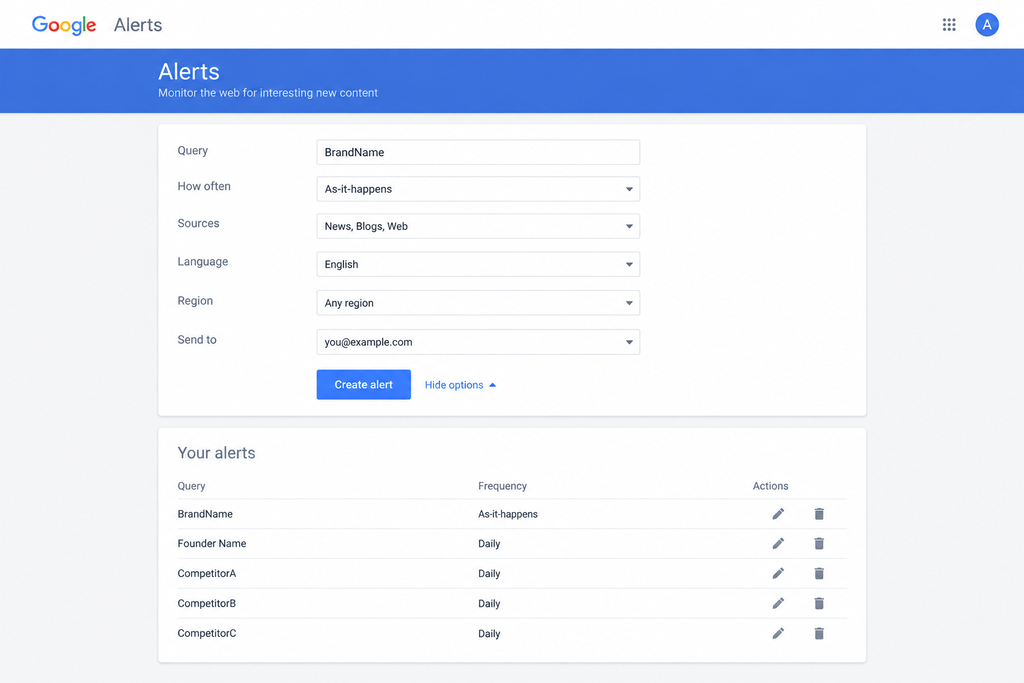
Google Alerts is a free Google service that emails you when new web pages match a keyword you’ve saved. Set alerts for your brand name, your founder’s name, your product names, and your top two competitors, using quotation marks for exact matches. It works as a basic early-warning system for news and blog mentions. It won’t catch most social posts, and emails can lag, so treat it as a safety net rather than your main monitor.
Canva is a design tool with templates, a brand kit for storing logos, colors, and fonts, and quick resizing between formats. PR teams use it to produce quote graphics, data snapshots, statement cards, and simple press kits fast. A clean visual helps a journalist or creator grasp your story in seconds. Some features sit behind paid plans, and popular templates can make every brand look alike, so customise them.
Publishing and Engagement Platforms
Buffer is a straightforward scheduling and analytics tool that covers networks such as Instagram, Facebook, LinkedIn, X, and TikTok. It suits small teams that want a clean queue and simple reports, and it has offered a limited free plan, so check the current channel and post limits. Its monitoring and listening features are lighter than the bigger suites, which matters once PR volume grows.
Hootsuite is a long-running management platform that combines scheduling, a monitoring dashboard with live streams, a shared inbox, analytics, and team approval workflows. PR teams like it when several people, or an agency and a client, need to review posts before they go live. Listening features depend on your plan, and the interface can feel busy for a solo user.
Sprout Social pairs publishing with a Smart Inbox that pulls messages and mentions from connected networks into one stream. It also offers approval workflows, social listening, and polished reporting. Mid-size teams like it because the reports are easy to show to leadership. It costs more than most rivals, so it’s hard to justify before you have steady volume.
Social Listening and Monitoring Tools
Mention is a monitoring tool that tracks your brand, competitors, and keywords across social platforms, news sites, blogs, and forums, then sends real-time alerts with sentiment tags. Use Boolean queries (AND, OR, NOT) to cut noise, for example your brand name NOT “job opening”. It’s quicker to set up than enterprise suites. Coverage of some networks is limited by what each platform allows, so you won’t see everything, especially private groups.
Brandwatch is an enterprise social listening and consumer intelligence platform. It collects large volumes of public conversation, supports detailed Boolean queries, tracks sentiment and topic trends, and allows historical analysis. For PR, that means you can see not only that mentions are rising but why, and which communities are driving them. It’s priced for larger organisations and has a real learning curve.
Meltwater combines media monitoring across news, broadcast, and online sources with social listening, a journalist database, and reporting dashboards. If your PR mix is half press coverage and half social conversation, seeing both in one place saves hours each week. The trade-off is cost, which can be heavy for a small team.
Media Relations and Outreach Tools
Muck Rack is a PR platform built around a journalist database. Profiles show a reporter’s recent articles and beats, so you pitch the right person with the right angle. It also monitors coverage and builds reports. It’s aimed at professional PR teams, so it’s likely overkill for a solo founder.
Cision offers a large media database, press release distribution through PR Newswire, and monitoring and reporting tools. Agencies and corporate communications teams use it to run formal announcements at scale. The same warning applies: it’s built for volume and budget, and mass-blasting releases gets you ignored.
Featured is the main home of journalist-request sourcing after HARO’s shutdown. HARO’s successor Connectively closed in 2024, and Featured later took HARO over and brought it back, according to BuzzStream’s alternatives roundup. Journalists post questions, and experts reply with quotes. Qwoted and Help a B2B Writer work similarly, and the #journorequests hashtag on social platforms is the free route. Reply fast, and only when you have real expertise.
BuzzSumo is a content research tool that shows which articles and topics earn the most shares, and which writers and influencers cover a subject. Use it to find angles the press already likes and the people writing about your niche before you pitch. Free use is limited, and deeper features need a paid plan.
Measurement Tools
Google Analytics 4 (GA4) is Google’s free analytics platform. Pair it with UTM parameters, short tags such as utm_source, utm_medium, and utm_campaign that you add to links, so GA4 can show which post or creator sent each visitor. Google’s free Campaign URL Builder creates them. This connects PR activity to traffic and conversions, which is what leadership asks about. Mentions without a link, like a post that just names your brand, won’t show up this way, so track those with a listening tool.
| Tool | Best for | Main limitation | Cost level |
|---|---|---|---|
| Meta Business Suite | Facebook and Instagram inbox and scheduling | Meta platforms only | Free |
| Google Alerts | Basic news and blog mention alerts | Misses most social posts | Free |
| Canva | Quote cards, data graphics, press kits | Some features paid | Free tier and paid |
| Buffer | Simple scheduling for small teams | Lighter listening | Limited free tier and paid |
| Hootsuite | Team approvals and shared inbox | Busy interface, plan-dependent listening | Paid |
| Sprout Social | Inbox, reporting, listening for mid-size teams | Higher price | Paid |
| Mention | Real-time brand monitoring | Platform data limits | Paid |
| Brandwatch | Deep listening and trend analysis | Cost and learning curve | Enterprise |
| Meltwater | Press plus social monitoring | Cost | Paid, enterprise |
| Muck Rack | Journalist research and coverage reports | Built for pro teams | Paid |
| Cision | Media database and release distribution | Volume focus, budget | Paid |
| Featured | Expert quotes for journalist requests | Competitive, needs real expertise | Free and paid options |
| BuzzSumo | Finding angles and writers by topic | Limited free access | Free limited and paid |
| Google Analytics 4 | Linking PR links to traffic | Can’t see unlinked mentions | Free |
A beginner can run social media PR with free tools: Meta Business Suite for publishing and inbox, Google Alerts for mentions, Canva for visuals, and Google Analytics 4 with UTM links for measurement. Paid platforms such as Sprout Social, Brandwatch, Meltwater, and Muck Rack become worthwhile when mention volume or media outreach outgrows spreadsheets.
How Do You Build a Social Media PR Strategy Step by Step?
You build a social media PR strategy by setting one clear goal, auditing your reputation, choosing platforms and audiences, preparing story angles, building relationships, setting up monitoring, and reviewing results monthly. Follow the order below. Skipping the audit or the monitoring step is where most beginner plans fall apart.
- Set one clear goal. Pick something you can check, such as earning five pieces of relevant coverage in a quarter or raising the share of positive mentions. One goal beats five vague ones.
- Audit your current reputation. Search your brand on each platform and on Google, read recent reviews and comments, and note the common themes. This is your baseline.
- Map your audiences and platforms. Journalists and B2B buyers often sit on LinkedIn and X, consumer creators on Instagram and YouTube. Choose two platforms, not six.
- Build a bank of story angles. List original data you hold, founder opinions, customer stories, and timely hooks tied to news. Aim for at least ten before you pitch anyone.
- Build relationships before you pitch. Follow target reporters and creators, share their work with useful comments, and answer their questions. Pitching a stranger cold has a poor hit rate.
- Set up monitoring and a response workflow. Create Google Alerts, connect a listening tool if you have budget, and decide who replies, how fast, and who approves sensitive responses.
- Publish, pitch, and track. Use UTM links on everything you control, log every piece of coverage, and review results every month.
Does this need a big team? Not at the start. One person with a clear checklist can run steps one to seven for a small brand, and a spreadsheet is enough to track coverage until volume justifies a paid tool.
How Do You Handle a Social Media PR Crisis?
A social media PR crisis is a sudden spike of negative attention that threatens trust in your brand. The safest response is to pause scheduled posts, verify the facts, acknowledge the issue publicly, explain what you’re doing, and follow up with results. Speed matters, but accuracy matters more.
Duolingo shows how this can go sideways. In 2025, the company announced an “AI-first” approach amid reports that it had cut contractors, and the reaction from many users was angry. In May 2025 it deleted all of its posts on TikTok and Instagram, and according to Ypulse it lost over 400,000 TikTok followers. Cryptic changes to its profiles followed, and it was unclear at the time whether the move would win people back.
The lesson isn’t “never go quiet.” It’s that a policy backlash is a trust problem, and trust problems need a plain explanation, not a stunt.
- Pause all scheduled and automated posts immediately. A cheerful promo landing in the middle of a backlash makes everything worse.
- Verify the facts internally. Find out what actually happened before you say anything. Get legal and leadership aligned in minutes, not days.
- Acknowledge publicly and specifically. Name the issue, say what you know, and say when you’ll update people. Avoid vague apology language.
- Respond where the conversation is happening. Reply in the same channel, and move individual complaints to private messages only after a public acknowledgement.
- Follow up and review. Share what changed, then run a short internal review of how you found out and how fast you responded.
One more point. Don’t delete critical comments unless they break clear community rules. Removing legitimate criticism is usually screenshotted and spreads further.
How Do You Measure Social Media PR Results?
You measure social media PR by tracking share of voice, sentiment, the reach and engagement of earned posts, referral traffic and conversions, and the quality of media coverage. Pick three or four that match your goal, record a baseline first, and report them monthly.
- Share of voice: Your share of total brand mentions compared with your main competitors, which a listening tool such as Brandwatch or Meltwater can calculate.
- Sentiment: The proportion of positive, neutral, and negative mentions. Automated sentiment tagging misreads sarcasm, so sample and check manually.
- Earned reach and engagement: Impressions, shares, and comments on posts that others published about you.
- Referral traffic and conversions: Visits and actions from UTM-tagged links, viewed in Google Analytics 4.
- Coverage quality: Whether the outlet is relevant to your audience and whether your key message appeared in the piece.
Be careful with advertising value equivalency (AVE), the habit of valuing coverage by what the same space would cost as an ad. AMEC’s Barcelona Principles, the industry’s measurement framework, reject AVE as a measure of communication value. Report outcomes such as traffic, sign-ups, sentiment shift, and message pull-through instead.
Honestly, this is the hardest part of PR to get right. Attribution is imperfect, and some of the best results, like a stronger reputation, move slowly. That doesn’t mean you skip measurement. It means you measure trends, not single posts.
What Mistakes Do Beginners Make in Social Media PR?
The most common beginner mistakes are treating PR as ad hoc posting, pitching without research, ignoring comments, over-automating replies, and reporting vanity numbers. Each is avoidable with the process above.
Pitching without research tops the list. A reporter who covers fintech doesn’t want your skincare launch, and one careless mass pitch can get you muted. Read their recent work first.
Ignoring the comment section comes next. People notice when a brand only talks and never listens. Over-automation has a similar effect: auto-replies to sensitive complaints read as cold, and a scheduled cheerful post during a news tragedy can do real damage.
There’s also the follower trap. A big count that doesn’t produce mentions, coverage, or traffic isn’t PR success. And here’s a quieter one: nobody owns it. If PR belongs to “everyone,” it belongs to no one, so name an owner and a backup.
Conclusion
Social media PR comes down to three habits. Tell specific stories people want to repeat, listen to what’s being said about you, and respond fast and honestly when things go wrong. Tools help, but the free ones get a beginner surprisingly far. Spend your money only after the process works.
Your next move is small. Set up Google Alerts for your brand today, pick one goal for this quarter, and pick two reporters or creators to start engaging with this week. Check results in a month.
FAQs
Can you explain social media PR in simple words?
Social media PR is how a brand earns attention and trust on social platforms without paying for it. That includes getting mentioned by journalists, being talked about by creators and customers, and handling public criticism well. In short, it’s managing your reputation in public conversations.
Is social media PR the same as social media marketing?
No. Social media marketing aims at actions like clicks, leads, and sales, using your own content and paid ads. Social media PR aims at reputation and trust, using earned attention from others. They work best together, because credibility from PR makes marketing more believable.
How do I start social media PR with no budget?
Start with free tools. Set up Google Alerts for your brand, use Meta Business Suite to manage Facebook and Instagram, and design visuals in Canva’s free tier. Follow five to ten journalists in your niche, engage with their posts, and answer requests on #journorequests or through Featured. Track results with Google Analytics 4 and UTM links.
Who needs social media PR?
Any brand with a public audience can use it, including startups, creators, D2C companies, B2B firms, and nonprofits. It matters most when trust drives the buying decision, such as in food, finance, health, or education. Very early-stage businesses can keep it light: a clear story, a monitored inbox, and a few good media relationships.
Is social media PR worth it for a small business?
Usually yes, in a lean form. Earned mentions and honest community replies cost mostly time, and they build credibility that ads can’t buy. It may not pay off quickly, and results are harder to attribute than a paid campaign. If you need sales this month, run ads alongside it rather than waiting on PR alone.
Which social platform is best for PR?
It depends on your audience. LinkedIn and X suit B2B and journalist outreach, Instagram and YouTube suit consumer brands working with creators, and Facebook still reaches many local and family audiences. Choose two platforms where your audience and relevant reporters actually spend time, and do those wel.
How do I find journalists on social media?
Search your topic on X and LinkedIn, then note who writes the articles and posts you see. Check their bios, since many state their beat and how they like to be contacted. A media database such as Muck Rack or Meltwater speeds this up, and BuzzSumo can show who writes about your topic.
What do most beginners get wrong about social media PR?
They treat it as posting more. Social media PR is about relationships and reputation, so the common errors are pitching reporters without reading their work, ignoring comments, deleting criticism, and reporting follower counts instead of coverage and outcomes. Fixing those usually improves results quickly.
How long does social media PR take to show results?
Expect a few months before you see steady results. A strong reaction to a timely post can happen in hours, but relationships with journalists and creators build slowly. Set a quarterly goal, record a baseline now, and judge progress by the trend in mentions, sentiment, and coverage.
What should I do if a post about my brand goes viral for the wrong reasons?
Pause your scheduled posts, then confirm what actually happened before you respond. Acknowledge the issue publicly and specifically, say what you’re doing about it, and give a time for your next update. Reply in the same channel where it’s spreading, and don’t delete legitimate criticism.


