

Most marketing advice fails for a boring reason. It hands you tactics before it gives you the thinking that makes tactics work. You can learn to run Meta ads, write a newsletter and set up Google Analytics in a month, and still watch results go nowhere, because nobody told you who the product is for or why they should care.
That gap is what the Core Concepts of Marketing exist to close. They’re the ideas that stay true when platforms change, algorithms shift and a new AI tool launches every week.
This article covers ten of them. For each one, you’ll get a plain definition, the tools practitioners actually use, a real brand example and a step you can take this week. It’s written for working marketers, founders and career switchers who already know the basics and want the structure underneath. Some of these ideas are decades old. Several still get ignored by teams spending lakhs on ads every month.
1. What Do Customers Actually Need, Want and Demand?
Needs are basic requirements such as food, safety or belonging. Wants are the specific forms a person chooses to satisfy those needs. Demands are wants backed by the ability and willingness to pay. Philip Kotler’s framework separates the three, and most marketing works on the second and third.
Here’s an everyday case. A person working late needs food. They want a biryani from a particular restaurant, delivered fast. It becomes demand only when they have a phone, a payment method and a budget. Marketers rarely create needs. We shape wants and we make demand easier to act on.
Zepto is a clean example. The need (groceries) existed forever. The want that Zepto built a company around was getting them in roughly ten minutes, and enough urban customers had the money and the habit to turn that want into demand.
Maslow’s hierarchy of needs, proposed by psychologist Abraham Maslow in 1943, is the classic lens here. It ranks needs from physiological and safety up to belonging, esteem and self-actualisation. To be fair, researchers have criticised its rigid ordering, so treat it as a prompt for questions, not a law.
The tool most practitioners prefer today is Jobs to Be Done (JTBD), popularised by Harvard Business School’s Clayton Christensen. The idea is that people don’t buy products, they hire them to make progress in a situation. Write the job as a sentence: “When I ___, I want to ___, so I can ___.” If you can’t fill it in for your own product, you don’t understand your customer yet.
Your move this week: interview five recent customers and ask what was happening in their life the day they decided to buy. Not what they like about you. What changed.
Needs are basic requirements, wants are the specific forms people choose to meet them, and demands are wants backed by purchasing power. Marketers rarely create needs. They shape wants and make it easier for demand to turn into a purchase.
2. How Does Market Research Turn Guesses into Decisions?
Market research is the systematic collection and analysis of information about customers, competitors and the market. It replaces opinions in meetings with evidence. There are two types: primary research you collect yourself, and secondary research that already exists.
Most small teams skip this step. It shows in their messaging.
Primary research means talking to people directly. Customer interviews give you language and motives. Surveys, built in Google Forms or Typeform, give you numbers across a larger group. Five interviews won’t prove anything statistically, but they’ll show you patterns surveys can’t.
Secondary research is cheaper and faster, and the tools are mostly free:
- Google Trends shows how search interest in a topic rises and falls over time and by region.
- Google Search Console shows the exact queries people used before landing on your site.
- Meta Ad Library lets you see every active ad a competitor is running on Facebook and Instagram.
- Review mining means reading Amazon, Google Play and Nykaa reviews of your category, then copying the words customers use for problems and wins.
- Social listening tools such as Brandwatch or Mention track brand and category conversations at scale.
Mamaearth shows what this looks like in practice. It launched in 2016 with toxin-free baby products, a category where parents were already scrutinising ingredient lists, then moved into skin and hair care. Its founders have described the brand as growing out of their own experience as new parents, which is primary research in its purest form.
One caution. AI Overviews now answer many Google searches directly on the results page, so raw search volume tells you less about real demand than it used to. Pair keyword data with conversations.
A simple research sprint looks like this:
- Write the one decision this research must inform.
- Pull search queries from Google Search Console and Google Trends.
- Read fifty competitor reviews and tag the repeated complaints.
- Interview five customers or prospects for twenty minutes each.
- Summarise what surprised you in one page.
3. What Is the STP Model?
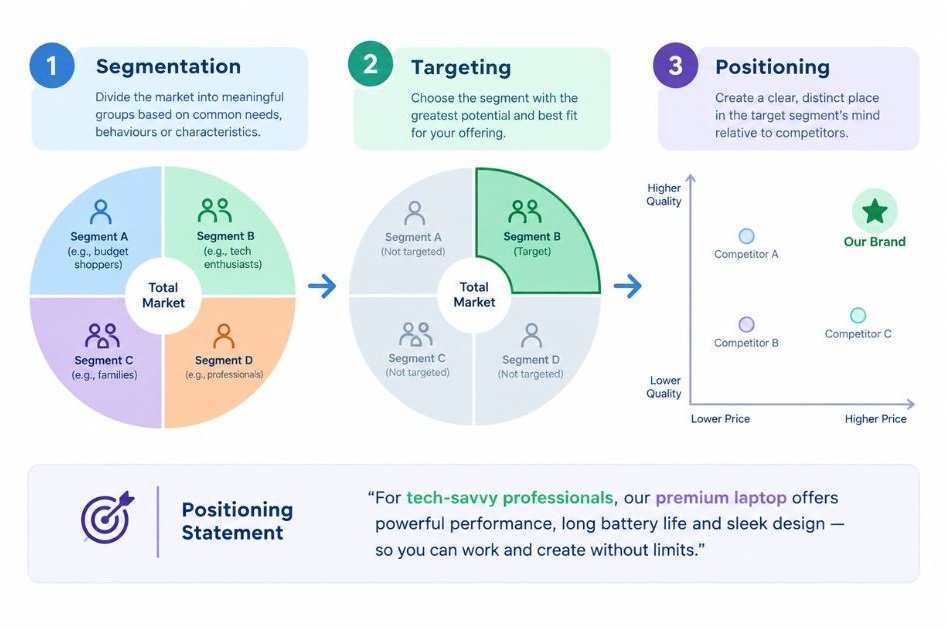
STP stands for Segmentation, Targeting and Positioning. It’s the process of dividing a market into groups, choosing which groups to serve and deciding what place your brand should hold in their minds. Nearly every serious marketing plan starts here.
Segmentation
Segmentation splits a broad market into groups that share something meaningful. There are four standard bases:
- Demographic: age, income, gender, occupation, family stage.
- Geographic: country, city tier, climate, urban or rural.
- Psychographic: values, lifestyle, attitudes, aspirations.
- Behavioural: purchase frequency, loyalty, usage occasion, benefits sought.
Behavioural and psychographic splits usually beat demographics. Two 28-year-olds in Chandigarh can want completely different things from the same product.
Targeting
Targeting means choosing which segments to pursue. Score each one on size, growth, accessibility (can you reach them affordably?), profitability and fit with what you do well. Then pick. Trying to win everyone is the single most common targeting mistake.
boAt is a good case. It aimed squarely at young Indian buyers who wanted stylish audio at accessible prices, a segment the older, pricier brands had underserved.
Positioning
Positioning is the distinct place your brand holds in the customer’s mind compared with alternatives. Al Ries and Jack Trout introduced the idea in their 1981 book Positioning: The Battle for Your Mind. You don’t position the product. You position it in the mind of the prospect.
Geoffrey Moore’s positioning statement gives you a template: “For [target customer] who [need], [brand] is a [category] that [key benefit]. Unlike [competitor], we [difference].” Write it. If it takes more than a paragraph, you haven’t decided yet.
Positioning mistakes get expensive. Tata Nano is often cited as a cautionary tale: launched in 2008 as the world’s cheapest car, a label many say clashed with buyers’ aspirations to look successful.
STP means segmenting a market, targeting the most attractive groups and positioning the brand distinctly in their minds. Behavioural and psychographic segments usually predict buying better than demographics. Choosing a narrow target is almost always cheaper and more effective than trying to reach everyone.
4. How Do You Build a Value Proposition People Choose?
A value proposition is a clear statement of the benefit a customer gets from your product and why that benefit beats the alternatives. It answers one question: why should I choose you? If a competitor could say your sentence word for word, it isn’t a value proposition yet.
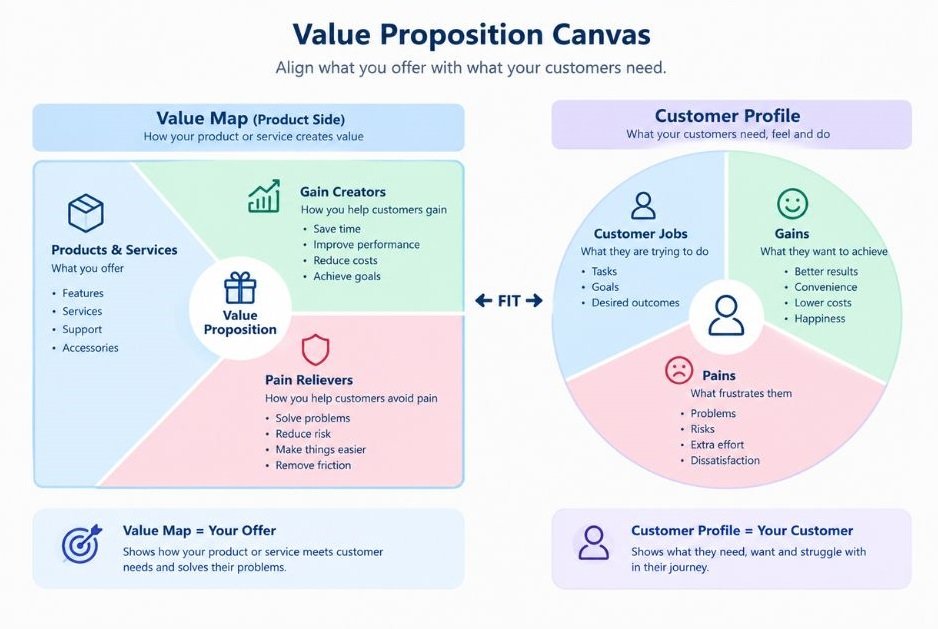
The best-known tool is the Value Proposition Canvas, created by Alexander Osterwalder and the Strategyzer team. It has two halves that must fit together:
- Customer profile: the jobs the customer is trying to get done, the pains they feel and the gains they want.
- Value map: your products and services, the pain relievers that address those pains and the gain creators that deliver those gains.
Fit is the goal. If your biggest pain reliever doesn’t touch the customer’s biggest pain, rework it before you spend on promotion.
A related idea is the Unique Selling Proposition (USP), coined by advertising executive Rosser Reeves in the 1940s: make a specific promise the competition doesn’t or can’t make. Michael Porter’s strategy work adds a useful constraint. Competing on cost leadership, differentiation or a focused niche are real options, and being stuck in the middle usually isn’t.
Back to Zepto. Speed was its promise, and speed is also a fair warning. Rivals such as Blinkit and Swiggy Instamart moved into the same space, so the promise alone stopped being unique. Differentiation has to be defensible, not just first.
Test your draft with the five-second test: show the headline of your landing page to someone for five seconds, then take it away and ask what the product does and who it’s for. If they can’t tell you, your message is too clever.
5. What Is the Marketing Mix (4Ps and 7Ps)?
The marketing mix is the set of decisions you control to deliver value: Product, Price, Place and Promotion. E. Jerome McCarthy popularised the 4Ps in 1960. Service businesses often use the expanded 7Ps, which adds People, Process and Physical Evidence.
Think of the mix as four dials on the same machine. Turn one without checking the others and the machine jams.
Product
This covers features, quality, design, packaging, the brand and the support around it. Ask what the customer is really getting, including the experience, not only the item.
Price
Price signals quality and decides who can buy. Common approaches include cost-plus, competitor-based and value-based pricing. Value-based is usually strongest because it starts with what the customer is willing to pay for the outcome.
Place
Place means where and how customers can buy: your site, marketplaces, retail stores, WhatsApp, distributors. Amul’s strength is partly distribution. Its cooperative model and dense retail reach put products within arm’s length of millions of households.
Promotion
Promotion covers advertising, PR, social media, email, events, influencer work and sales promotions. Amul’s “utterly butterly” topical hoardings, running since 1966, show how one consistent promotional idea can last for decades on a modest budget.
Here’s how the three extra Ps for services fit in:
| Extra P | What it covers | Question to ask |
|---|---|---|
| People | Staff, support teams, anyone customers deal with | Does every customer-facing person represent the brand well? |
| Process | How the service is delivered and how smooth it feels | Where do customers wait, repeat themselves or get stuck? |
| Physical Evidence | Reviews, website, premises, packaging, proof | What visible proof tells a stranger we’re reliable? |
The 4Ps have critics. They describe the seller’s view, not the buyer’s, and some academics prefer customer-centred alternatives. Still, as a checklist it’s hard to beat. If your promotion is excellent but your pricing is wrong, the checklist tells you where to look.
6. Why Does Brand Equity Outlast Any Single Campaign?
Brand equity is the commercial value a brand adds to a product beyond its functional features. It’s the reason a customer pays more, forgives a mistake or picks you without comparing. Campaigns end. Equity compounds when you build it consistently.
Two models give you structure. David Aaker’s 1991 model lists five assets: brand loyalty, brand awareness, perceived quality, brand associations and proprietary assets such as trademarks. Kevin Lane Keller’s customer-based brand equity pyramid, from 1993, climbs four steps: salience (do people recall you?), performance and imagery, judgments and feelings, and finally resonance, meaning real loyalty.
Dove’s Real Beauty campaign, launched by Unilever in 2004, is the standard example. It tied the brand to a belief about how women see themselves, not to a product benefit, and that association has outlived any single ad.
The practical tools are less glamorous:
- Brand guidelines: logo use, colours, typography and tone of voice in one document.
- Brand tracking surveys: aided and unaided awareness, consideration and preference, measured on a regular schedule.
- Message house: one core promise supported by three to four proof points.
Small teams can run a five-question tracking survey every quarter without an agency.
Then there’s the balance with performance marketing. Les Binet and Peter Field’s 2013 research for the Institute of Practitioners in Advertising (IPA), The Long and the Short of It, suggested a 60:40 split between brand-building and activation as a starting heuristic. It’s a guideline based on mostly large-brand data, not a rule, and early-stage D2C companies with thin cash may reasonably tilt toward performance. But ignoring brand entirely tends to show up later as rising acquisition costs.
7. How Does the Marketing Funnel Map the Customer Journey?
The marketing funnel is a model showing how people move from first hearing about you to buying and beyond. The classic version is AIDA: Attention, Interest, Desire, Action, credited to advertising pioneer Elias St. Elmo Lewis in the late 1800s. Modern teams use top, middle and bottom of funnel.
The model is old because it keeps working as a diagnostic. When sales stall, the funnel tells you which stage is leaking.
| Stage | Customer’s question | Typical content and channels | Metric to watch |
|---|---|---|---|
| Top (Awareness) | “Does anyone solve this?” | SEO articles, short video, social posts, PR | Reach, impressions, new visitors |
| Middle (Consideration) | “Is this the right option?” | Comparisons, case studies, webinars, email | Engagement, leads, email signups |
| Bottom (Decision) | “Why this one, and why now?” | Demos, free trials, reviews, retargeting ads | Conversion rate, cost per acquisition |
| After (Retention) | “Did I choose well?” | Onboarding, support, loyalty offers | Repeat rate, referrals |
A customer journey map goes further by plotting every touchpoint, the customer’s thoughts and feelings at each step and the pain points. You can build one on a Miro board or a spreadsheet. In Google Analytics 4, the Funnel exploration report lets you see where users drop off between defined steps.
Nykaa shows the funnel working across stages. Customers can find a product through search or social, read ratings and reviews while deciding, watch tutorials, then buy and return for repeat purchases. Each stage has content built for it.
Here’s the honest caveat. Real journeys aren’t tidy. People jump from stage to stage, loop back to compare and check reviews at the last second. Use the funnel as a map of where to put effort, not as a description of how every buyer behaves.
8. How Does Content Marketing Earn Trust Before the Sale?
Content marketing is the practice of creating and sharing useful material, such as articles, videos, podcasts and newsletters, to attract and keep a defined audience. Instead of interrupting people with ads, you earn attention by being helpful first. It’s a long game, and it compounds.
HubSpot’s inbound methodology frames it as three actions: attract the right people, engage them and delight them after purchase. The same logic sits behind most strong content programmes.
Red Bull is the standard reference. Its Stratos project in 2012, in which Felix Baumgartner jumped to Earth from the stratosphere, was less an ad than a media event, and the company runs Red Bull Media House to produce sport and lifestyle content that sells the lifestyle rather than the drink.
You don’t need Red Bull’s budget. The working toolkit is simple:
- Keyword research with Google Keyword Planner, Ahrefs or Semrush, to find what your audience actually searches.
- An editorial calendar in Notion, Trello or a basic spreadsheet, so publishing doesn’t depend on mood.
- A newsletter platform to own the relationship outside algorithms.
- A repurposing habit: one long article becomes a thread, a short video and an email.
One more point on search. Google AI Overviews and answer engines pull individual passages, not whole pages. Open each section with a clear answer, define terms in one sentence and back claims with named sources. That helps readers and AI systems quote you.
The limitation: content takes months to produce measurable results. If you need sales this week, pair it with paid channels while the compounding begins.
Content marketing earns attention by being useful before asking for a sale. It compounds over months through search and repeat readership, so it works best alongside faster channels. Passages that answer a question clearly in the first few sentences are the ones search engines and AI tools most often extract.
9. Why Is Customer Retention Worth More Than Acquisition?
Customer retention is the ability to keep existing customers buying over time. It usually costs less than winning new customers, and repeat buyers typically spend more. Frederick Reichheld of Bain & Company has long argued that even a 5% rise in retention can lift profits by 25% to 95%, depending on the industry.
Treat that range as directional. It comes from older research and varies a lot by business model. The principle holds well enough.
Three measures belong on your dashboard.
Customer Lifetime Value (CLV) estimates the total gross profit a customer brings over their relationship with you. A simple version: average order value × purchase frequency per year × expected years as a customer × gross margin. Compare it with customer acquisition cost (CAC). A common benchmark is a CLV at least three times CAC, though it varies by industry.
Net Promoter Score (NPS), introduced by Reichheld in a 2003 Harvard Business Review article, asks one question: how likely are you to recommend us, from 0 to 10? Scores of 9 or 10 are promoters, 7 or 8 are passives and 0 to 6 are detractors. NPS equals the percentage of promoters minus the percentage of detractors.
RFM analysis scores customers by Recency, Frequency and Monetary value of their purchases, so you can message your best buyers differently from the lapsing ones.
On the tools side, you’ll typically use a CRM such as HubSpot or Zoho, plus email and WhatsApp lifecycle automations: welcome series, replenishment reminders and win-back flows.
Loyalty programmes work when they feel like a real benefit. Swiggy One bundles free delivery and member discounts so ordering from the app becomes the default. Starbucks Rewards does something similar with points and free drinks. The risk is discount addiction, where customers only buy on offer and your margins suffer.
10. How Do You Measure Marketing Without Fooling Yourself?
Marketing measurement links your activity to business outcomes such as revenue, profit and retention. Without it, you’re guessing. The goal isn’t more dashboards. It’s a small set of numbers you trust and act on.
Know the core metrics first:
- CAC (customer acquisition cost): total sales and marketing spend divided by new customers won.
- ROAS (return on ad spend): revenue from a channel’s ads divided by that channel’s ad spend.
- MER (Marketing Efficiency Ratio): total revenue divided by total ad spend across all channels. It avoids attribution fights because it only needs two numbers.
- Conversion rate: the share of visitors who complete a goal.
Now the tools. Google Analytics 4 (GA4) replaced Universal Analytics, which stopped processing data on July 1, 2023, and tracks events instead of sessions. UTM parameters tag your links so you can tell which campaign drove a visit. Looker Studio turns data sources into shareable dashboards. Meta’s Conversions API sends conversion events from your server to Meta for more reliable tracking when browsers block pixels.
Attribution is where teams fool themselves. Last-click credit overvalues the final touch, such as branded search, and undervalues everything that created the demand. GA4 offers data-driven attribution, but even that is a model. The most honest check is an incrementality test: pause or hold back a channel for a region or audience group and see whether sales actually fall.
Privacy shapes all of this now. India’s Digital Personal Data Protection Act, 2023 puts consent and purpose limits on how you collect and use personal data, so build first-party data, such as email subscribers and purchase history, that people have knowingly given you.
Pick one north-star metric for the quarter, whether that’s revenue, repeat rate or qualified leads, and report it weekly. Everything else supports it.
Where to Start This Week
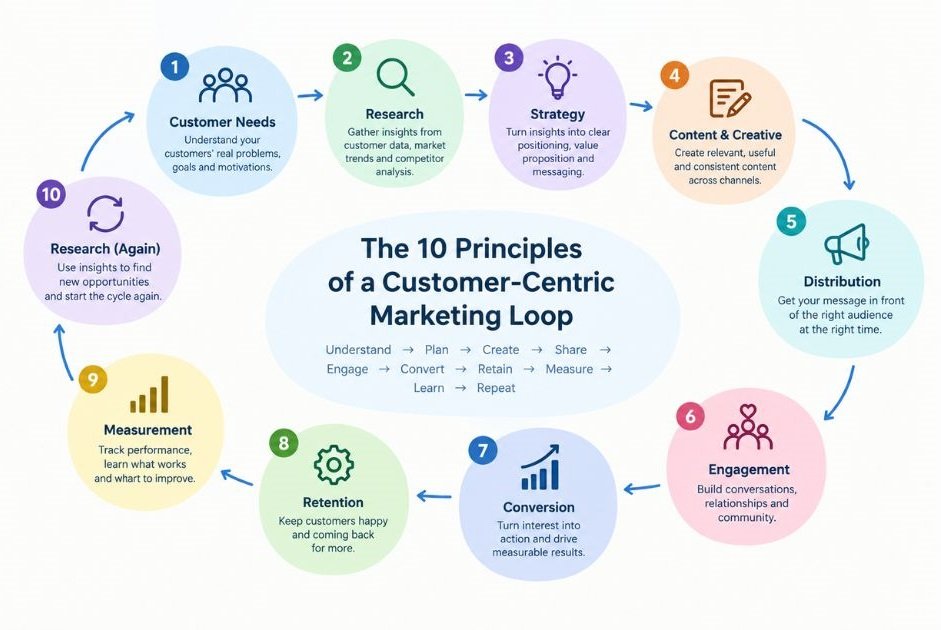
Ten principles can feel like a lot. Don’t try to apply all of them at once. The Core Concepts of Marketing work as a chain: research feeds STP, STP shapes your value proposition, and the mix, brand, content and funnel carry it to customers. Retention and measurement then tell you whether any of it worked.
Pick the weakest link in your own chain. If you can’t describe your customer’s job in one sentence, go back to principle one. If you can, but you’re not tracking CLV or MER, start with principle ten. Spend one week on it and write down what changes.
Frequently Asked Questions
What is marketing in simple words?
Marketing is the work of understanding what people need and then creating, communicating and delivering something valuable to them at a profit. It starts before the product is built and continues after the sale. Advertising is only one small part of it.
Which marketing principle should I learn first?
Start with customer needs and market research. Every other principle depends on knowing who you’re serving and what problem they have. If you skip them, the STP model, pricing and messaging all rest on guesses.
What’s the difference between the 4Ps and the 7Ps?
The 4Ps are Product, Price, Place and Promotion. The 7Ps add People, Process and Physical Evidence, which matter most when you sell services because customers experience the delivery, not just an item. Product businesses can usually work from the 4Ps, while service businesses benefit from all seven.
Is marketing the same as advertising?
No. Advertising is one way to promote something, paid for and controlled by you. Marketing is wider: research, product decisions, pricing, distribution, brand, content and retention all sit inside it. A company can advertise heavily and still market badly.
How do I do market research with no budget?
Use free tools and direct conversations. Check Google Trends and Google Search Console for demand, browse the Meta Ad Library to see competitor ads, read customer reviews in your category and interview five customers for twenty minutes each. You’ll learn more from that week than from a rushed paid survey.
Do I really need branding if I’m a small business?
Yes, though it doesn’t need to be expensive. Branding is what makes people remember and choose you, which matters more when you can’t outspend competitors. A clear positioning statement, a consistent look and a recognisable tone of voice cost very little and start building equity from day one.
How do I calculate customer lifetime value?
Multiply average order value by purchase frequency per year, then by the expected number of years a customer stays, then by your gross margin. For example, a customer spending ₹1,000 per order, four times a year, for three years at a 40% margin is worth about ₹4,800 in gross profit. Compare that number with your CAC.
Why isn’t my marketing working?
Usually one of three things is off. You may be targeting too broad an audience, your value proposition may be the same as every competitor’s, or you’re measuring the wrong thing. Go back to segmentation and positioning first. Fixing the message often helps more than adding budget.
Who should learn these marketing principles?
Founders, marketing managers, freelancers, product managers and anyone switching into marketing. These ideas help you judge agency work, plan budgets and spot weak strategy early. They apply to B2B and B2C, though the funnel length and channel mix differ.
How is AI changing these marketing principles?
AI speeds up research, content drafts, segmentation and reporting, but it doesn’t replace the thinking behind them. Customer needs, positioning and retention remain the same. What changes is how quickly you can test ideas, and how clearly your content must be written for AI answer engines to extract and cite.


