

You can burn through a budget fast by buying software before you know what job it needs to do. A team signs up for an email tool, an SEO suite, a scheduler and a heatmap product in the same quarter, and six months later nobody can say which one moved revenue.
Picking the right digital marketing platforms matters more in 2026 than it did three years ago. Most vendors now bundle AI features, and those features change both the price and the workload.
Whether you run a D2C brand, a SaaS product or a local service business, digital marketing now depends on a connected set of tools rather than one login. This list covers 15 tools that earn their place. For each one you get what it does, what it costs, where it falls short and who should buy it.
Pricing comes from vendor pages and recent reviews as of October 2026. Check before you buy, because several vendors changed their plans this year.
How We Picked These Tools
We chose these tools on four tests: it does one job well, it publishes its pricing or offers a free tier, it connects to other tools, and its AI features save real hours rather than add a chatbot to the sidebar.
We gave extra weight to AI digital marketing platforms that change a decision, like a bid, a segment or a send time, instead of only generating copy. We also made room for tools that work for Indian teams, since local channels like WhatsApp and regional pricing matter.
Every tool here covers a different job. You won’t need all 15. Most businesses need four or five.
Quick Comparison Table
| # | Tool | Best for | Starting cost | AI angle |
|---|---|---|---|---|
| 1 | HubSpot Marketing Hub | CRM plus automation | Free CRM; paid from about $20/seat | Breeze AI assistant |
| 2 | Semrush | SEO and competitor research | $139.95/month | AI visibility tracking (Semrush One) |
| 3 | Google Ads | Capturing search demand | No fee, pay per click | Smart Bidding, Performance Max |
| 4 | Meta Ads Manager | Social ad campaigns | Free tool, pay for ads | Advantage+ campaigns |
| 5 | Google Analytics 4 | Measurement | Free | Predictive metrics |
| 6 | Mailchimp | Simple email | Free tier, paid scales by contacts | AI content helpers |
| 7 | Klaviyo | E-commerce email and SMS | Free tier, scales by profiles | Predictive analytics |
| 8 | ActiveCampaign | Behavior-based automation | Paid, scales by contacts | Predictive sending |
| 9 | Ahrefs | Backlinks and organic research | About $99/month | Brand Radar for AI mentions |
| 10 | Hootsuite | Social management | Paid, roughly $99/month and up | OwlyWriter AI |
| 11 | Canva | Creative production | Free plus paid Pro | Magic Studio |
| 12 | Jasper | Brand-voice content | Paid per seat | Brand voice and agents |
| 13 | Zapier | Workflow automation | Free tier | AI agents and Copilot |
| 14 | Hotjar | Conversion research | Free Basic plan | AI survey summaries |
| 15 | WebEngage | Omnichannel engagement | Custom quote | Journey and segment automation |
The 15 Best Tools for 2026
Each tool below covers a different job in the funnel: capture demand, convert it, measure it and keep customers. Read the “Best for” line first, then the detail.
1. HubSpot Marketing Hub
HubSpot Marketing Hub is a marketing automation suite built on a free CRM. Email, landing pages, forms, ad reporting and contact records sit in one database. Its workflows run multi-step nurture sequences, and Breeze, HubSpot’s AI layer, drafts content and helps with reporting.
Pricing needs careful reading. As of July 2026, the Starter Customer Platform costs about $20 per seat monthly, while Marketing Hub Professional costs $890 a month with three seats and 2,000 contacts. Professional also requires a one-time onboarding fee of $3,000. Workflows sit on Professional, so many Starter buyers outgrow that tier quickly. Contact-based pricing also climbs as your list grows.
Best for: B2B and SaaS teams that want marketing and sales on one system.
2. Semrush
Semrush is an SEO and competitor research suite. You get keyword research, site audits, rank tracking, backlink analysis and content tools in one dashboard. Its newer Semrush One plans add tracking of how your brand appears in AI answers across tools like ChatGPT and Google’s AI Overviews.
Classic plans run $139.95 a month for Pro, $249.95 for Guru and $499.95 for Business, with extra user seats costing $45 to $100 monthly depending on the plan. Semrush One starts at $199 a month. Content tools sit on Guru and above, so Pro can feel limited once you publish at volume. The single included seat also hurts small teams.
Best for: Content and SEO teams that research competitors weekly.
3. Google Ads
Google Ads is Google’s advertising system for Search, YouTube, Display, Maps and Discover. It catches people who are already searching for what you sell, which is why it often delivers the fastest payback.
Smart Bidding uses machine learning to set a bid for every auction. Performance Max builds ads across Google channels from your assets and goals. Google has also been adding AI-led options for Search campaigns, so check the campaign types in your account for the newest ones.
The catch is opacity. Automated campaigns hide some placement and query data, and without clean conversion tracking and negative keywords the system happily optimises toward junk leads. There’s no subscription. You pay per click or impression.
Best for: Local services, e-commerce and any business with clear search demand.
4. Meta Ads Manager
Meta Ads Manager runs campaigns across Facebook, Instagram, Messenger and WhatsApp. It rewards strong creative more than clever targeting, and in India click-to-WhatsApp ads give D2C and service brands a direct line to buyers.
Advantage+ sales campaigns automate audience selection, placements and creative combinations. Meta’s generative tools also produce image and text variants. The downsides are creative fatigue, which hits fast, and weaker attribution since the privacy changes on iPhones. Install the Conversions API alongside the pixel to recover some signal.
Ads Manager itself is free. You pay only for ad spend.
Best for: D2C and app brands that win on creative testing.
5. Google Analytics 4
Google Analytics 4 (GA4) is Google’s free analytics tool, built on events rather than sessions. It replaced Universal Analytics in 2023 and is now the default way to see how traffic turns into sign-ups and sales.
Explorations let you build custom funnels and path reports. The BigQuery export gives analysts raw data, and Looker Studio connects for dashboards. Predictive metrics like purchase probability work once your property has enough data. The learning curve is real, and data thresholds can hide small segments.
Best for: Everyone. It’s the baseline measurement layer under every other tool here.
6. Mailchimp
Mailchimp is an email marketing tool with a drag-and-drop builder, templates, basic automations, landing pages and audience segmentation. It’s owned by Intuit, and its AI helpers draft subject lines and email copy.
It’s the easiest way to send a first newsletter or a welcome series. A free tier exists with limits, and paid plans scale with your contact count, so costs rise as your list grows. Advanced behavior-based automation is thinner than what ActiveCampaign offers.
Best for: Small businesses and creators who want simple, fast email.
7. Klaviyo
Klaviyo is an email and SMS platform built for online stores. It plugs into Shopify, WooCommerce and BigCommerce and uses purchase data to trigger flows like abandoned cart, browse abandonment and win-back.
Its predictive analytics estimate things like the expected date of a customer’s next order, churn risk and lifetime value. That lets you segment by likely behavior instead of guessing. Pricing is based on active profiles, with a free tier for small lists, and it gets expensive at scale. It also depends on commerce data, so it’s less useful for B2B.
Best for: E-commerce brands that want revenue-attributed email and SMS.
8. ActiveCampaign
ActiveCampaign sits between Mailchimp and HubSpot. Its visual automation builder handles conditional logic, lead scoring, site tracking and a built-in CRM, and predictive sending picks delivery times per contact.
Pricing scales with contacts and plan tier, and the best automation features need the higher tiers. The builder is powerful but takes a few hours to learn. Many service businesses and agencies choose it because it delivers sophisticated automation without HubSpot’s Professional price.
Best for: Mid-sized teams that need complex automation on a moderate budget.
9. Ahrefs
Ahrefs is known for its backlink index, plus Site Explorer, Keywords Explorer, Site Audit, Rank Tracker and Content Explorer. Its Brand Radar feature tracks how often your brand shows up in AI-generated answers.
Entry pricing sits around $99 a month, though plans use credits and limits, so check usage rules. Ahrefs has no ad tools, which is the main gap against Semrush. If your priority is link building and understanding why competitors rank, Ahrefs is the stronger pick. If you want one suite that also covers ads and social, choose Semrush.
Best for: Link builders and content teams focused on organic growth.
10. Hootsuite
Hootsuite manages social media across Instagram, Facebook, LinkedIn, X, TikTok, YouTube and Pinterest. You schedule posts, handle a unified inbox and track analytics. Its social listening comes from its acquisition of Talkwalker, and OwlyWriter AI drafts captions.
It’s priced per user and sits at the higher end for small teams. The advanced listening features usually cost more. Hootsuite makes sense when several people touch many accounts and approvals matter, and it’s overkill for a solo founder posting twice a week.
Best for: Agencies and multi-brand teams managing social at volume.
11. Canva
Canva is a design tool that lets non-designers produce social posts, decks, ads and short videos. Magic Studio adds AI features such as Magic Write for copy, Magic Resize for formats and AI image generation. Brand Kit keeps fonts and colors consistent, and the Content Planner publishes to social.
A free plan covers basics and Canva Pro adds brand and resizing tools. Templates can make everything look the same if you don’t customise them, and complex brand work still needs a designer. For lean teams, though, it cuts creative turnaround from days to minutes.
Best for: Small teams producing high volumes of social creative.
12. Jasper
Jasper is an AI writing and content platform aimed at marketing teams. Its main advantage is brand voice: you upload samples and guidelines so drafts match your tone. It also offers campaign workflows, templates and AI agents for repeatable tasks.
Plans are paid and priced per seat, and team tiers cost noticeably more. Output still needs a human edit, and a general-purpose assistant may be enough for solo creators. Jasper pays off when several writers must sound like one brand.
Best for: Content teams that need consistent voice across many writers.
13. Zapier
Zapier connects apps without code. A “Zap” triggers an action in one tool when something happens in another, such as pushing a Typeform lead into HubSpot and alerting Slack. It links thousands of apps, and its AI agents and Copilot help build and run automations.
A free plan covers light use. Beyond that, pricing is task-based, so busy workflows add up. Long multi-step Zaps can also get messy to maintain. Used well, Zapier replaces the manual copy-paste that quietly eats a marketer’s week.
Best for: Teams stitching together tools that don’t integrate natively.
14. Hotjar
Hotjar shows what visitors actually do on your pages. Heatmaps reveal clicks and scroll depth, recordings replay sessions, and surveys capture why someone left. It’s now part of Contentsquare, and AI summaries help condense open-ended survey answers.
A free Basic plan exists, and paid tiers raise session limits. Recordings can capture personal data, so configure consent and masking, especially under India’s DPDP Act. If your landing page gets traffic but few sign-ups, Hotjar usually points to the cause within a day.
Best for: Conversion rate optimisation on landing pages and checkouts.
15. WebEngage
WebEngage is a Mumbai-based customer engagement platform. It orchestrates push, email, SMS, WhatsApp, web push and in-app messages from one journey designer, with behavior-based segments.
It’s popular with Indian consumer apps and D2C brands because of local support and channel coverage. Pricing is by quote, so it isn’t self-serve for tiny budgets. If your growth depends on repeat purchases through app and WhatsApp, it deserves a demo.
Best for: Indian consumer apps and e-commerce brands focused on retention.
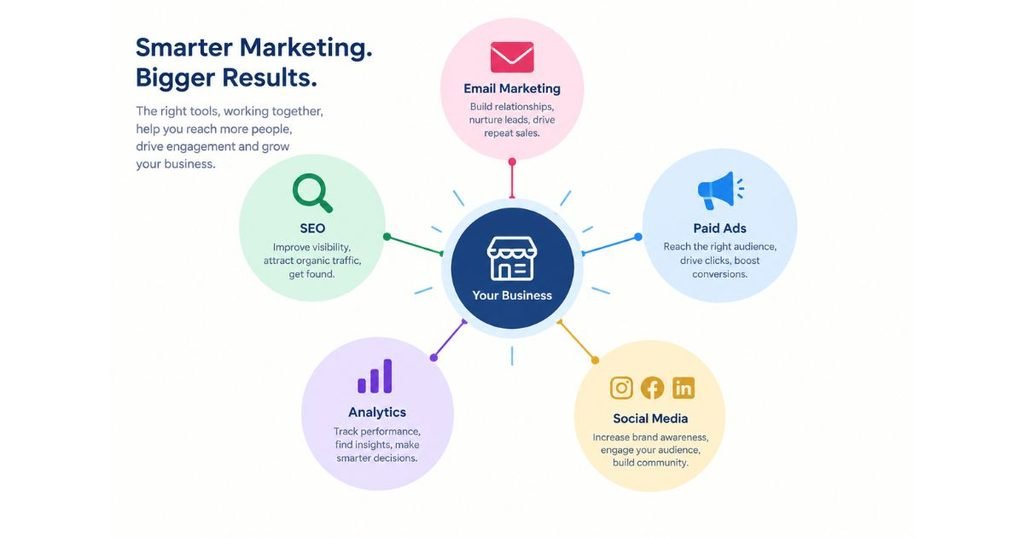
No single tool covers the full funnel. Google Ads and Meta Ads Manager capture demand, GA4 and Hotjar explain what happens next, and email platforms like Klaviyo or ActiveCampaign turn first-time visitors into repeat buyers. Pick tools by the job they do, not by the length of their feature list.
What Is an AI-Powered Marketing Platform, and Do You Need One?
An AI-powered marketing platform is software that uses machine learning or generative AI to automate or improve a marketing task, such as setting bids, building segments, drafting copy or summarising reports. Most tools on this list now qualify to some degree.
The label is easy to misuse. Many vendors bolt a chatbot onto an old product and call it new. The better AI digital marketing platforms change decisions: Klaviyo predicts the next order date, Google’s Smart Bidding adjusts every auction, and Semrush One tracks whether AI engines mention your brand.
Use a quick test before paying extra for AI features:
- Does it change a decision you’d otherwise make by guesswork?
- Does it save a measurable number of hours each week?
- Can you switch it off or override it when it’s wrong?
If the answer is no to all three, you’re paying for a demo feature. And AI doesn’t fix bad data. If your conversion tracking is broken, automated bidding simply optimises faster toward the wrong target.
How Should You Build Your Stack by Budget and Team Size?
Start with free tools, add one paid tool at a time, and only upgrade when you hit a limit you can name. That sequence keeps spending tied to results.
- Starter stack (one to three people): GA4, Google Ads or Meta Ads Manager, Canva free, Mailchimp free, Hotjar Basic, Zapier free.
- Growth stack (small team, steady revenue): Add Klaviyo or ActiveCampaign, Semrush or Ahrefs, and Hootsuite if social is a core channel.
- Scale stack (departments and agencies): HubSpot Marketing Hub Professional or WebEngage for orchestration, Jasper for content, and Zapier to connect them.
None of these digital marketing platforms works alone, and overlapping tools waste money. Choose one email platform and one SEO suite, not two of each. For a strong digital marketing setup, the goal is clean data flowing between tools rather than the most tools.
What Mistakes Do Teams Make When Buying Marketing Software?
The most common mistake is buying for features instead of for a defined job. Others cost more than the subscription itself.
Teams skip the pricing cliff: HubSpot’s jump from Starter to Professional is a classic case, and contact-based pricing at Mailchimp and Klaviyo bites as lists grow. They also skip setup, so tools sit half-configured. A heatmap tool nobody reviews is a wasted subscription, however good the software.
Another mistake is ignoring consent and data rules. If you use recordings, retargeting or WhatsApp messaging, check compliance before launch. Finally, many teams never review the stack. Audit usage every quarter and cancel what nobody opens.
The right marketing stack is small, connected and reviewed every quarter. Buy tools for a named job, watch for pricing cliffs tied to contacts or seats, and judge AI features by whether they change a decision or save hours.
Conclusion
Three points matter most. Buy tools for specific jobs, not feature lists. Watch for pricing cliffs tied to contacts and seats. And judge AI features by the decisions they improve or the hours they save.
Digital marketing in 2026 rewards teams that keep their stack small, connected and measurable. Start with GA4 and one ad channel, add email, then layer in SEO and automation as revenue grows. Review it every quarter.
FAQ
What is a marketing platform?
A marketing platform is software that helps you plan, run and measure marketing activity such as email, ads, SEO, social media and analytics. Some are all-in-one suites like HubSpot, while others do one job, like Hotjar for behavior research. Most businesses combine several.
Which marketing platform is best for beginners?
Start with free tools: Google Analytics 4, Mailchimp’s free tier, Canva and Hotjar Basic. They teach you the fundamentals without a subscription. Add a paid tool only after you’ve outgrown a free one.
HubSpot vs Mailchimp: which one should you pick?
Choose Mailchimp if you mainly send newsletters and simple automations on a tight budget. Choose HubSpot if you need a CRM, lead tracking and automation that connect marketing and sales. HubSpot costs far more once you reach Professional, so match the choice to your current needs.
Semrush vs Ahrefs: which is better for SEO?
Semrush covers more ground, including ads, social and content tools, so it suits generalists. Ahrefs is often preferred for backlink research and competitor analysis. Try both free or trial options on your own domain before paying.
How do I choose the right tools for my budget?
List your top three jobs, such as getting traffic, converting visitors and retaining customers. Pick one tool per job, starting with free tiers. Then upgrade the one tool where a clear limit is holding you back.
best free marketing tools in 2026?
GA4, Google Ads and Meta Ads Manager (you only pay for ad spend), Canva’s free plan, Mailchimp’s free tier, Hotjar Basic and Zapier’s free plan all cost nothing to start. Together they cover measurement, ads, design, email, research and basic automation.
is HubSpot worth it for a small business?
It can be, if you want a free CRM and plan to grow into automation. The free and Starter tiers are fine for contact management, but real workflows need Professional, which costs $890 a month plus a $3,000 onboarding fee. Many small businesses are better served by a lighter email tool until revenue justifies that jump.
Are AI marketing tools actually worth paying for?
Some are. Smart Bidding, predictive segments and AI summaries of survey data can save hours or improve decisions. Generic AI writing add-ons are less clear, so test on one real task before upgrading a plan.
Why isn’t my marketing software delivering results?
The usual causes are broken conversion tracking, poor list quality, half-built automations and no one reviewing reports. Check GA4 events first, then your email flows, then ad targeting. Software amplifies a good process but won’t fix a missing one.
How many marketing tools is too many?
If two tools do the same job or nobody opens a tool monthly, you have too many. Most small teams do well with four or five. Add a tool only when you can name the problem it solves.


