

Digital marketing has a reputation problem in India. Course ads promise ₹10 lakh packages within six months, and then your cousin, who finished the same course, is still sending out applications. Both stories are real, which makes the decision harder than it should be.
So, is digital marketing a good career in India in 2026? Yes, if you pick one channel, get properly good at it, and learn to show results in rupees. No, if you’re hoping a certificate will do the work for you.
Digital marketing means promoting products or services through online channels such as search engines, social media, email, and websites. This guide covers what the job market looks like, what people earn, which roles pay best, which skills and tools you need, how to start from zero, and where the downsides sit. Salary figures come from public salary guides and vary a lot, so read them as ranges, not promises.
Is There Real Demand for Digital Marketers in India Right Now?
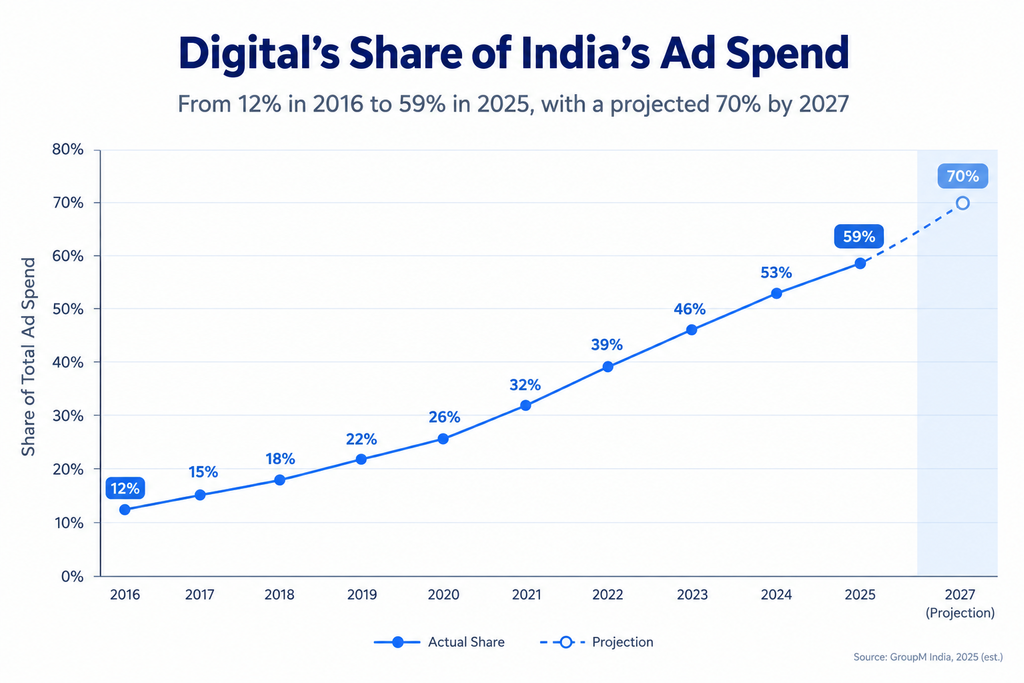
Yes. Advertising budgets in India are moving online faster than traditional channels can match, and every rupee that shifts to digital needs people to plan, run, and measure it. According to the dentsu-e4m Report on Digital Advertising in India 2026, digital reached 59% of India’s total ad spend by the end of 2025.
That figure was 12% in 2016. The same report projects digital will approach 70% of ad spend by 2027, and it values the 2025 digital market at ₹71,621 crore.
Other forecasters land in the same place, even when their definitions differ. The Pitch Madison Advertising Report 2026 expects digital’s share of India’s expanded ad economy to rise from 60% in 2025 to 64% in 2026. WPP Media’s TYNY forecast for 2026 goes higher, at 68.1%, because it counts digital extensions of other media. The numbers don’t match. The direction does.
Now look at the audience side. The IAMAI and Kantar Internet in India Report 2025 counts 958 million active internet users in India, with rural areas making up 57% of them. About 588 million of those users watch short-form video, and 230 million urban users (56% of the urban base) shopped online in 2025. Customers are online, so brands have to follow.
You can see the effect in specific companies. Mamaearth and boAt built their reputations on social, influencer, and performance-led marketing. Madison World forecasts that quick commerce advertising, the category Zepto and Swiggy Instamart compete in, will grow roughly 50% in 2026, from about ₹4,000 crore to ₹6,000 crore. Each of those budgets needs someone who can run campaigns and read the results.
Is digital marketing a good career on demand alone? Demand is the easy part. The harder part is standing out, because courses are everywhere and entry-level applicant pools are crowded. Employers hire for proof of work, and we’ll get to how you build it.
Digital advertising accounted for 59% of India’s ad spend by the end of 2025, up from 12% in 2016, according to the dentsu-e4m Report on Digital Advertising in India 2026. The same report expects digital to approach 70% of total ad spend by 2027. Demand for people who can run and measure digital campaigns is growing because the budgets are moving there.
What Does a Digital Marketer Earn in India?
Most digital marketers in India start between ₹2.5 lakh and ₹5.5 lakh a year, and reach ₹12 to ₹24 lakh at manager level after five to nine years. Specialisation, city, and company type move these numbers more than the job title does.
One warning first. Many salary guides are published by course providers, so the ranges tend to lean optimistic. Cross-check anything you read here against AmbitionBox, Glassdoor, and LinkedIn Salary for your city and role.
With that said, the published sources agree on the broad shape. Amity Online’s 2026 salary guide puts the average across roles at ₹5 to ₹7 lakh per year. Fueler’s 2026 guide places entry-level roles at ₹2.5 to ₹5 lakh. SalaryInHand’s FY 2026-27 data lists ₹3 to ₹5.5 lakh for people with zero to two years of experience, and ₹12 to ₹24 lakh for managers with five to nine years. Networkershome’s 2026 guide puts directors and VPs at funded brands at ₹25 to ₹50 lakh.
| Experience level | Typical annual pay | Source |
|---|---|---|
| Entry level (0-2 years) | ₹2.5 lakh to ₹5.5 lakh | Fueler 2026, SalaryInHand 2026 |
| Average across all roles | ₹5 lakh to ₹7 lakh | Amity Online 2026 |
| Manager (5-9 years) | ₹12 lakh to ₹24 lakh | SalaryInHand 2026 |
| Director / VP at funded brands | ₹25 lakh to ₹50 lakh | Networkershome 2026 |
The biggest single jump usually comes between year three and year five, according to Networkershome’s guide. That’s when you stop executing tasks and start owning a budget or a channel.
What pushes your pay up? Mostly four things:
- A specialisation with direct revenue impact, such as performance marketing. Networkershome puts performance marketing managers at funded D2C brands at ₹15 to ₹22 lakh, while it places SEO roles at roughly ₹3 to ₹8 lakh across levels.
- A metro city or a funded employer. Remote roles have narrowed the city gap, but not closed it.
- Proof of results you can show with numbers.
- Comfort with AI and automation tools, which several 2026 guides now describe as a salary premium.
Freelancers sit outside this table. Their income depends on how many clients they have and what they charge, so it swings far wider in both directions.
Which Digital Marketing Roles Pay Best, and Which One Fits You?
Performance marketing and growth roles tend to pay best early on, SEO and content pay steadier, and analytics gets more valuable as you move senior. The right pick depends on whether you enjoy numbers, writing, or creative work.
You don’t need to choose forever. You do need to choose first, because employers hire specialists faster than generalists.
Performance Marketing
Performance marketers run paid campaigns on Google Ads and Meta Ads Manager and answer for the return. You’ll live in metrics like cost per click (CPC, what you pay for each click) and return on ad spend (ROAS, revenue divided by ad spend). It’s the highest-paying broad track for people under seven years of experience, but it’s also where a bad month shows up in your numbers immediately.
SEO (Search Engine Optimisation)
SEO specialists help pages rank in Google, which means technical fixes, content planning, and link building. It’s patient work. Results take months, so the role suits people who like systems and long timelines.
Social Media Marketing
This role plans content, runs community, and increasingly works with creators. Brands like Nykaa and boAt show how much of a brand’s personality lives on social. The pay at entry level is modest, and the ceiling rises when you add paid social or creator partnerships.
Content Marketing
Content marketers write articles, scripts, emails, and landing pages that bring in and convert customers. Strong writers who understand search and conversion stay in demand. Weak, generic writing is exactly what AI now produces for free, so your edge is original thinking and real examples.
Email and CRM Marketing
Email and CRM (customer relationship management) specialists keep existing customers buying. For D2C and e-commerce brands this is often the cheapest revenue they have. It’s less glamorous than ads, and quietly valuable.
Marketing Analytics
Analysts set up tracking, build dashboards, and tell the team what’s working. The role pays more as you move senior, because few people do it well. If you like spreadsheets and dislike guesswork, start here.
Product Marketing
Product marketers decide how a product is positioned and launched. It’s common in SaaS companies and usually needs a few years of channel experience first. Treat it as a destination rather than a starting point.
What Skills Do You Need to Get Hired?
You need one channel skill, basic analytics, and clear writing, plus the habit of testing instead of assuming. Employers screen for proof that you’ve run something real, not for the number of certificates on your résumé.
Technical skills
Start with one channel and go deep. That could be search ads, SEO, email, or paid social. Then add the supporting skills:
- Analytics. You should read a report and explain why traffic or sales moved.
- Spreadsheets. Google Sheets or Excel, including pivot tables and lookups, handle most reporting jobs.
- Marketing math. Know customer acquisition cost (CAC, the average cost of winning one customer), ROAS, conversion rate, and click-through rate (CTR, clicks divided by impressions).
- A content management system. Basic WordPress skills help you publish and fix pages yourself.
- Copywriting. Ads, subject lines, and landing pages all depend on it.
Thinking and communication skills
Most people underrate this part. A marketer who can explain a result in two clear sentences gets promoted over one who sends a 40-slide report.
Three habits matter most. First, you test small before spending big. Second, you tie your work to revenue, not likes. Third, you learn quickly, because platforms change their rules every few months and nobody will announce it politely.
Which Digital Marketing Tools Should You Learn First?
Start with free tools from Google and Meta, then add one paid tool in your chosen specialisation. Tools don’t make you a marketer, but employers do test them in interviews, and fluency saves hours every week. Below is what each tool does, who uses it, what it costs, and a first task to try.
Pricing and features change often, so check each vendor’s current plans before you commit.
Analytics and tracking tools
Google Analytics 4 (GA4). GA4 is Google’s free analytics platform, and it records everything a visitor does on your site or app as an “event.” It replaced Universal Analytics in 2023 and works quite differently from it. Marketers use it to see which channels bring traffic that actually converts, using reports and its Explorations feature for custom analysis. First task: set up one conversion, such as a form submission, and check which source drives it.
Google Tag Manager (GTM). GTM is a free tool that lets you add and manage tracking code without asking a developer every time. You create tags (the code), triggers (when it fires), and variables (the data it uses). Performance marketers rely on it to install the Meta Pixel and Google Ads conversion tracking. First task: use its Preview mode to fire a tag when someone clicks a button on a test page.
Looker Studio. Looker Studio is Google’s free dashboard tool, and it connects to GA4, Google Ads, Search Console, and Google Sheets. Agencies use it to send clients live reports instead of monthly PDFs. First task: build a one-page dashboard that shows traffic, conversions, and ad spend side by side.
SEO tools
Google Search Console. Search Console is free and shows how your site performs in Google Search. Its Performance report lists the queries people used, plus clicks, impressions, CTR, and average position. It also flags indexing problems through the URL Inspection tool. First task: find five queries where you rank on page two and improve those pages.
Semrush. Semrush is a paid SEO suite for keyword research, competitor analysis, site audits, and rank tracking. Content and SEO teams use it to find keywords competitors rank for and you don’t. It’s priced for professionals, though a limited free tier exists. First task: run a Site Audit on a small website and sort the issues by severity.
Ahrefs. Ahrefs is a paid SEO platform known for its large backlink database. Site Explorer shows who links to any site, and Keywords Explorer estimates how hard a keyword is to rank for. Link builders use it daily. Ahrefs Webmaster Tools is free for sites you own, so you can practise without a subscription. First task: check your own site’s backlinks and find one competitor link worth earning.
Screaming Frog SEO Spider. Screaming Frog is a desktop crawler that scans a website the way a search engine would. It finds broken links, redirect chains, missing page titles, and duplicate content. The free version crawls up to 500 URLs, which is enough for learning. First task: crawl a small site and export every page missing a meta description.
Paid advertising tools
Google Ads. Google Ads lets you show ads on Google Search, YouTube, and partner sites, and it covers Search, Performance Max, and Demand Gen campaigns. Its Keyword Planner tool helps you estimate search demand before you spend. Smart Bidding strategies like Target CPA and Target ROAS let Google adjust bids automatically. First task: build a small Search campaign with tightly grouped keywords and track one conversion.
Meta Ads Manager. Meta Ads Manager runs ads across Facebook and Instagram. You set the objective, the audience, the creative, and the budget, and the Meta Pixel plus the Conversions API report what happened after the click. Advantage+ campaigns automate parts of targeting and creative testing. Meta’s free Ad Library also lets you see which ads any brand currently runs, which makes it a handy research tool. First task: study ten competitor ads in the Ad Library and note the hooks they repeat.
Email and automation tools
Mailchimp. Mailchimp is an email platform that handles newsletters, simple automations, and landing pages. Small businesses and beginners like it because the interface is friendly and a limited free plan exists. First task: build a three-email welcome sequence for a fictional brand.
HubSpot. HubSpot combines a CRM with marketing tools for forms, email, workflows, and lead scoring. B2B and SaaS teams use it to track a lead from first click to closed deal. The CRM has a free tier, and HubSpot Academy offers free certifications. First task: create a form, connect it to a workflow, and watch a test lead move through it.
Klaviyo. Klaviyo is built for e-commerce and connects directly with stores such as Shopify. Its automated flows, like abandoned cart and post-purchase emails, often earn a large share of an online store’s email revenue. First task: set up an abandoned-cart flow for a demo store.
Social media and design tools
Canva. Canva is a design tool with templates for posts, ads, presentations, and short videos. Marketers without design training use it to produce clean creative quickly, and the free plan covers most beginner needs. First task: design one carousel post and one ad creative in the same visual style.
Buffer and Hootsuite. Both schedule posts across social platforms and report on performance. Buffer is simpler and cheaper, which suits solo marketers and small brands. Hootsuite adds approval workflows, team permissions, and social listening, so larger teams and agencies tend to prefer it. First task: schedule a week of posts in one of them and compare engagement across platforms.
Conversion and behaviour tools
Hotjar. Hotjar shows how people actually use a page through heatmaps, session recordings, and on-page surveys. Conversion rate optimisation (CRO) specialists use it to find out why visitors leave without buying. A free plan exists with limits. First task: watch twenty session recordings of your checkout page and write down the three most common stumbling points.
Microsoft Clarity. Clarity is a free tool with heatmaps and session recordings and no traffic cap on the free plan. It’s a good place to start before paying for anything. First task: install it on a test site and look for rage clicks, which are repeated frantic clicks on something that isn’t responding.
AI tools
ChatGPT and Claude. These are AI assistants that draft copy, summarise research, write formulas, and help structure reports. Treat the output as a first draft. Check every number, and add your own examples, because generic output is the first thing a hiring manager or reader spots. First task: give one of them a messy campaign export and ask for three questions the data can and can’t answer.
Perplexity. Perplexity is an AI search tool that shows sources alongside its answers, so you can check where a claim came from. Marketers use it for fast research on competitors and trends. First task: ask it about a competitor’s recent campaigns, then open every source it cites and verify the claims yourself.
A beginner digital marketer can cover most job requirements with free tools: Google Analytics 4, Google Tag Manager, Looker Studio, Search Console, Microsoft Clarity, and Canva. Paid tools such as Semrush, Ahrefs, Klaviyo, and HubSpot become worth learning once you choose a specialisation. Employers care more about what you built with a tool than how many tools you can name.
How Do You Start With No Experience? A 90-Day Roadmap
You start by choosing one channel, learning its fundamentals through free courses, running a small real project, and turning the results into a portfolio. Ninety days is enough to do this if you work on it a few hours every day.
- Pick one channel in week one. Choose between search ads, SEO, email, or paid social based on which of those you’d enjoy doing for a year.
- Complete free foundation courses in weeks one to four. Google Skillshop, Meta Blueprint, and HubSpot Academy all offer free training and certificates.
- Build a real project in weeks three to eight. Start a niche blog, a small Instagram page, or a newsletter. Or offer to run marketing for a local shop for free.
- Spend a small budget in weeks five to ten. Even ₹3,000 on test ads teaches more than any video. Track clicks, cost per click, and conversions.
- Write up your results in weeks eight to eleven. Document what you tried, what changed, and the numbers. A two-page case study with real data beats a certificate.
- Apply from week ten onwards. Target agencies, startups, and D2C brands for junior or intern roles, and attach your case study to every application.
One honest note: a 90-day plan gets you to junior-level readiness, not to the salary ranges quoted for five-year professionals.
Agency, In-House, Startup or Freelance: Which Path Fits You?
Agencies teach you fastest, in-house roles give you depth in one brand, startups give you the most responsibility, and freelancing pays the most if you can find clients. Many people try two or three of these over a career.
| Path | Best for | Main advantage | Main drawback |
|---|---|---|---|
| Agency | Beginners | Exposure to many clients and industries quickly | Tight deadlines, demanding clients |
| In-house at a brand | Specialists | Depth, stability, one brand to grow | Narrower tool and channel exposure |
| Startup | Self-starters | Big responsibility early, fast promotions | Budgets and roles can change fast |
| Freelance | Experienced marketers | Control over income and clients | No fixed salary, constant selling |
If you’re a fresher, an agency or a startup usually builds skills faster than a quiet in-house role. If you’re already two or three years in, an in-house job at a D2C or SaaS company can raise your pay and depth at the same time.
Freelancing deserves a caution. It looks attractive on social media, yet the first year is mostly about finding clients, not doing marketing. Build a reputation and a few references in a job before you try it.
What Are the Downsides Nobody Mentions?
The main downsides are crowded entry-level competition, constantly changing platforms, pressure to prove returns, and AI automating routine tasks. None of them rule the career out, but they do rule out passive effort.
Start with competition. Digital marketing courses are cheap and everywhere, so junior openings attract large applicant pools. Standing out takes real projects and numbers.
Platforms change too. Google and Meta both adjust their ad products and privacy rules regularly, and a tactic that worked last year can stop working. You’ll spend your whole career re-learning, which some people love and others find exhausting.
Then there’s accountability. Marketing budgets are often among the first cut in a downturn, and performance roles get judged on results every month. If your campaign doesn’t deliver, the dashboard says so plainly.
AI is the newest pressure. Routine work such as basic copy, simple reports, and keyword grouping is getting automated. The people at risk are those whose whole skill is routine output. Those who add judgment, strategy, and original thinking are using AI as a tool instead of competing with it.
Is digital marketing a good career for everyone, then? No. It suits people who like experimenting, can handle numbers, and are comfortable being measured. If you want predictable work with little change, you may find it stressful.
So, Where Does This Leave You?
The market is growing, the pay is reasonable at entry level and rises quickly with a specialisation, and the entry barrier is low enough that anyone can try. That same low barrier is why standing out takes proof, not paperwork.
Is digital marketing a good career for you specifically? Ask yourself three things. Do you like testing and measuring? Can you pick one channel and stick with it for a year? Are you willing to build a small project before you apply anywhere? Three yeses mean the odds are in your favour.
Your next action is simple. Choose a channel this week, install GA4 and Search Console on a practice site, and start the 90-day roadmap above.
Frequently Asked Questions
What is digital marketing?
Digital marketing is the practice of promoting a product, service, or brand through online channels such as search engines, social media, email, websites, and mobile apps. Unlike print or TV, it lets you measure who saw an ad, who clicked, and who bought. That measurability is why companies keep moving budgets into it.
How much does a fresher earn in digital marketing in India?
Most published 2026 guides place entry-level pay between ₹2.5 lakh and ₹5.5 lakh per year. Fueler’s 2026 guide gives ₹2.5 to ₹5 lakh, and SalaryInHand’s data gives ₹3 to ₹5.5 lakh for zero to two years of experience. Your actual offer depends on your city, employer, and the proof of work you can show.
Digital marketing vs traditional marketing: which is better for a career?
For most new entrants, digital marketing offers more openings and faster skill growth because most ad budgets are moving online. The dentsu-e4m 2026 report puts digital at 59% of India’s ad spend. Traditional marketing, especially brand strategy and offline media buying, still matters, and the best marketers understand both.
Do I need a degree to get a digital marketing job?
No, a specific degree isn’t required for most roles. Employers usually care more about your portfolio, your results, and your tool skills than your qualification. A degree can help at large companies and MNCs that filter résumés by education, but a strong case study often carries more weight at agencies and startups.
How do I start digital marketing from scratch?
Pick one channel, finish the free courses from Google Skillshop, Meta Blueprint, or HubSpot Academy, and then run a small real project. Spend a little money on test ads, track the results, and write them up as a case study. Then apply for junior or intern roles with that case study attached.
Which digital marketing skill is most in demand?
Performance marketing, meaning paid advertising judged on revenue, is among the best-paid broad skills for professionals with under seven years of experience, according to Networkershome’s 2026 guide. SEO, analytics, and email or CRM marketing are also strongly hired. Pick the one that matches how you like to work, then add AI tool skills on top.
Who should choose digital marketing as a career?
It suits people who enjoy testing ideas, reading numbers, and writing or creating content, and who can tolerate constant change. You don’t need a technical background. You do need curiosity and the patience to build proof before you ask for a higher salary.
Will AI replace digital marketers?
AI will replace parts of the job, not the whole role. Drafting basic copy, grouping keywords, and building simple reports are already being automated. Strategy, judgment, creative direction, and accountability for results still need a person, so the marketers who learn AI tools tend to gain, not lose.
is a digital marketing course worth the money?
A course is worth it only if it makes you build and measure real projects. Free options from Google, Meta, and HubSpot cover the basics at no cost. Pay for a course if you need structure, mentorship, or a portfolio-building programme, and check what recent students actually did afterwards.
why am i not getting interview calls after a digital marketing course?
Usually the problem is the résumé, not the course. Many applicants list the same certificates and tools, so nothing separates them. Add a case study with real numbers, apply to a specific role instead of every opening, and tailor each application to the company’s channel and goals.


