

Marketing used to be the department that made brochures and booked ads. Now it owns revenue targets, customer data, and a growing share of product decisions. That shift is why anyone planning a career in business should understand the real scope of marketing in 2026, and why so many people are still choosing the wrong specialisation.
Here’s the situation. Employers say they can’t find people with the right skills. Budgets are rising, but so is the pressure to prove every rupee worked. And AI is changing which tasks a marketer does by hand and which ones a tool handles in seconds.
This guide covers what marketing includes today, which careers are growing, the skills that get you hired, and every major tool worth learning, explained one by one. You’ll also get a step-by-step plan to build a career from scratch and a clear view of where the field is heading.
What Does Marketing Cover in 2026?
Marketing is the work of understanding what customers need, shaping an offer around it, reaching the right people, and measuring whether it produced business results. In 2026 that includes brand, content, search, social, paid media, email, analytics, product positioning, and customer retention.
The old split between “traditional” and “digital” has mostly collapsed. A hoarding on a highway now carries a QR code. A TV spot gets judged by the branded search lift it creates. Even offline retail teams track campaigns in dashboards.
What actually changed is the measurement layer. TeamLease EdTech’s HY1 2026 Career Outlook Report makes the point that companies now judge marketing by business outcomes first and creativity second. That framing matters for you, because it decides what employers screen for: can you tie your work to a number?
Think about how Zepto and Swiggy operate. Both run consumer apps where acquisition, retention, promotions, and advertising revenue all sit close together. A marketer there isn’t just writing taglines. They’re reading cohort data, testing offers, and working with product teams on what shows up on the home screen.
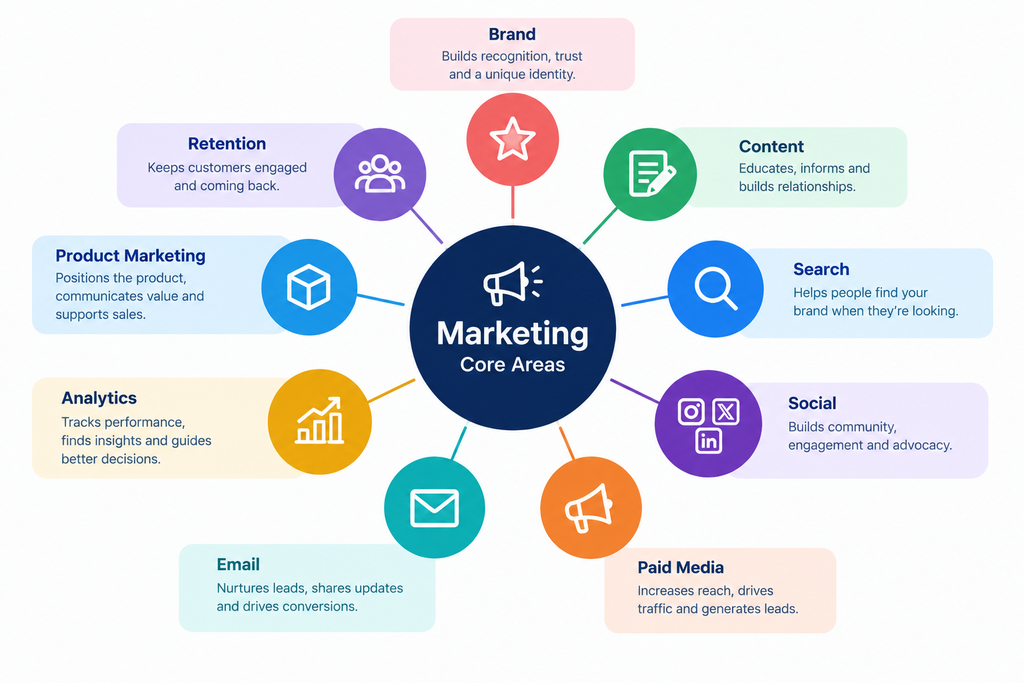
Marketing in 2026 covers research, positioning, content, search, social, paid media, email, analytics, and retention, all tied to measurable business results. The old line between traditional and digital marketing has blurred, and employers now screen for people who can connect their work to revenue.
Why Is Marketing Still a Strong Career Bet in 2026?
Marketing remains a strong career bet because money, jobs, and hiring intent are all pointing up. Ad spend is growing, digital is taking a larger share of it, and official labour projections show faster-than-average job growth for marketing specialists and analysts.
Start with the money. According to the Pitch Madison Advertising Report 2026, India’s total ad spend is projected at ₹1,74,605 crore this year, up 12 to 13% from 2025. Digital is expected to hold a 64% share, up from 60% a year earlier, with digital ad spend forecast to grow about 20%.
Next, jobs. The US Bureau of Labor Statistics projects 7% employment growth for market research analysts and marketing specialists from 2025 to 2035, which it describes as much faster than average. The same data shows roughly 952,700 jobs in 2025, about 82,000 openings a year, and a median annual wage of $78,760 as of May 2025. That’s a US figure, so treat it as a global signal rather than an Indian salary benchmark.
Then hiring intent. TeamLease EdTech’s HY1 2026 Career Outlook Report, based on 1,051 employers, put fresher hiring intent in Indian marketing and advertising at 62%, compared with 11% in HY1 2025. To be fair, that’s below the 67% recorded in HY2 2025, so the market is strong but not a straight line up.
So why does the Scope of Marketing look wider now than five years ago? Because every business with a website, an app, or a product page needs someone who can bring in customers and prove it. Budgets are also rising: HubSpot’s 2026 State of Marketing report, which surveyed more than 1,500 marketers, found 79.2% expect budgets to grow at least slightly this year.
There’s a catch. The same report found 73% of marketers say their budgets face more scrutiny than before, and measuring ROI was the top challenge at 33%. Growth is real, but so is accountability. If your work can’t be measured, it’s the first thing a finance team questions.
India’s ad spend is projected to reach ₹1,74,605 crore in 2026, with digital taking 64% of it, according to the Pitch Madison Advertising Report 2026. The US Bureau of Labor Statistics projects 7% growth for marketing specialists and analysts from 2025 to 2035. Demand is strong, but employers now expect measurable results.
Which Marketing Careers Are Growing the Fastest?
The fastest-growing marketing careers are the ones closest to data, automation, and paid performance: campaign analysts, marketing automation specialists, performance marketers, and AI-focused marketing associates. Creative and brand roles still exist, but they increasingly expect analytical skills too.
TeamLease EdTech’s HY1 2026 report named Digital Campaign Analyst, AI Marketing Associate, Ads Operations Executive, and Market Research Assistant among the fresher roles employers wanted. It also listed marketing automation among the top domain skills in demand. By city, Pune led Ads Operations Executive hiring at 51%, and Hyderabad led Digital Campaign Analyst hiring at 47%.
Here’s how the main career paths compare.
| Role | What you do day to day | Core skills | Best starting tools |
|---|---|---|---|
| Performance Marketer | Run and optimise paid campaigns, track CAC and ROAS | Media buying, testing, analytics | Google Ads, Meta Ads Manager, GA4 |
| SEO Specialist | Grow organic traffic through technical fixes, content, and links | Keyword research, site audits, writing | Search Console, Semrush, Ahrefs |
| Content Marketer | Plan and produce articles, videos, and newsletters | Writing, editing, research | Canva, Claude or ChatGPT, Search Console |
| Email and CRM Marketer | Build lifecycle flows and segment customers | Segmentation, copy, testing | Klaviyo, Mailchimp, HubSpot |
| Marketing Analyst | Build dashboards, attribute results, find patterns | SQL basics, statistics, storytelling | GA4, Looker Studio, Google Sheets |
| Product Marketer | Position products, plan launches, brief sales teams | Research, messaging, strategy | HubSpot, Hotjar or Clarity |
| Marketing Automation Specialist | Connect tools and build workflows | Systems thinking, logic | Zapier, HubSpot |
| Social Media Manager | Plan, publish, and report on social content | Trend sense, community, video | Buffer, Hootsuite, Canva |
A few honest observations. SEO and content roles are being reshaped by AI search, which we’ll cover later. Performance marketing is competitive at entry level, but people who can read data well stand out quickly. And product marketing usually needs a year or two of experience elsewhere before the door opens.
Brand names show how varied the options are. Nykaa grew out of a beauty retail model that leaned heavily on content, community, and customer education. Mamaearth is widely known as a digital-first D2C brand built through online channels. boAt built awareness through creator and celebrity partnerships. Each of those companies hires very different kinds of marketers.
Which Skills Do Marketers Need in 2026?
The skills that get marketers hired in 2026 are data analysis, AI and automation fluency, clear communication across teams, and sharp writing. HubSpot’s 2026 State of Marketing report lists automation and AI prompting, cross-team communication, and data and analytics as the three priority areas for hiring managers.
That list is more useful than any generic “top 10 skills” article, so let’s break it down.
Data and Analytics
You need to read a report and know what to do next. That means understanding conversion rates, customer acquisition cost (CAC, the total spend needed to win one customer), return on ad spend (ROAS, revenue earned per rupee of ad spend), and attribution (the method of crediting a channel for a sale).
You don’t need to be a data scientist. But you should be comfortable in Google Sheets, understand basic SQL, and be able to explain a chart to a founder in two minutes.
AI and Automation Fluency
HubSpot’s 2026 survey found 86.4% of marketing teams use AI in at least a few areas, with content creation, media creation, and admin automation as the most common uses. Also, 68.2% of marketers said they know how to use AI in marketing, up from 47% the year before.
Notice what that means. Knowing AI exists is now the baseline. The edge comes from knowing where it fails: factual errors, bland copy, and invented sources. A marketer who can brief an AI tool well and edit its output hard is worth more than one who pastes whatever comes back.
Writing and Storytelling
Tools can produce a lot of text. They can’t decide what’s worth saying. Strong writers choose the angle, cut the filler, and make a reader care in the first two sentences. Honestly, this is the most undervalued skill in the field right now.
Cross-Team Communication
Marketers work with sales, product, finance, and design. If you can’t explain why a campaign needs a bigger budget in the language of the person approving it, the campaign doesn’t run. This skill shows up in HubSpot’s priority list for good reason.
Channel Depth Plus a Wide Base
The best hiring profile is shaped like a “T”. Go deep in one area, such as paid search, SEO, or lifecycle email, and stay broad enough to understand how the other channels connect. HubSpot’s report found short-form video delivered the best ROI for 48.6% of marketers, which is a good reminder that channel knowledge has to keep updating.
Which Marketing Tools Should You Learn in 2026?
The marketing tools worth learning in 2026 fall into six groups: analytics, search, paid media, customer management and email, creative and AI, and automation and reporting. You don’t need all of them. Pick one tool in each group, learn it properly, and add others when a job demands it.
Here’s each tool explained: what it does, how marketers use it, and where it falls short.
Google Analytics 4 (GA4)
GA4 is Google’s free web and app analytics platform. It records user behaviour as events (a page view, a scroll, a purchase) rather than the session-based model of older versions.
Marketers use GA4 to see which channels bring traffic, where users drop off, and which actions count as conversions. Its Explorations feature lets you build custom funnels and path analyses, and you can link it to Google Ads and BigQuery for deeper work. The learning curve is real, and the interface changes often. Many beginners misconfigure conversions and then trust bad numbers, so learn event setup before you learn reports.
Google Search Console
Google Search Console is a free tool that shows how your site performs in Google Search. It reports impressions, clicks, average position, and click-through rate for each query and page.
SEO specialists and content marketers use its Performance report to find queries where a page ranks on page two and could be pushed up. The URL Inspection tool shows whether Google has indexed a page, and the Core Web Vitals report flags speed problems. Its limit: it only covers Google, and its data is sampled and delayed, so don’t expect real-time answers.
Semrush
Semrush is a paid all-in-one SEO and competitive research platform. It covers keyword research, site audits, rank tracking, backlink analysis, and competitor traffic estimates.
A content marketer might use its Keyword Magic Tool to find questions people ask, then run a Site Audit to catch broken links and duplicate titles. Position Tracking monitors where you rank over time. The catch is that traffic estimates for competitors are modelled, not exact, so use them for direction rather than as facts.
Ahrefs
Ahrefs is a paid SEO suite best known for its backlink data. Site Explorer shows who links to any website, Keywords Explorer estimates search demand and ranking difficulty, and Content Explorer finds the most-linked pages on a topic.
Link builders and technical SEOs often prefer it for backlink research. Semrush and Ahrefs overlap heavily, so most beginners only need one. Choose based on which interface you find easier, and try the free trial or webmaster tools before paying.
Google Ads
Google Ads is the platform for buying placements on Google Search, YouTube, Gmail, and partner sites. Campaign types include Search, Performance Max, Demand Gen, Shopping, and Video.
Performance marketers set budgets, write ads, choose keywords, and pick a bidding strategy such as Target CPA or Target ROAS. Keyword Planner helps estimate demand before spending. The risk is automation: Performance Max can spend your budget in places you can’t fully see, so track conversion quality and not just volume.
Meta Ads Manager
Meta Ads Manager runs advertising across Facebook, Instagram, Messenger, and WhatsApp. You build campaigns by objective, define audiences, and choose creative.
Advantage+ Shopping Campaigns use machine learning to automate targeting and placement for e-commerce sellers. The Meta Pixel and Conversions API send purchase data back so the system can optimise. Custom Audiences let you retarget visitors or use customer lists. The weak spot is creative fatigue: even good campaigns decay when the same ad runs for weeks, so testing new creative is a weekly habit, not an occasional task.
HubSpot
HubSpot is a customer relationship management (CRM) platform with marketing, sales, and service modules. Its CRM stores every contact and interaction in one place.
Marketing Hub adds forms, landing pages, email, lead scoring, and workflows that trigger actions based on behaviour. A B2B marketer might score leads by page visits and email clicks, then alert sales when someone crosses a threshold. HubSpot is easy to start with, but costs rise as you add contacts and features, so check what your company really needs.
Mailchimp and Klaviyo
Mailchimp and Klaviyo are email and SMS marketing platforms. Mailchimp suits small businesses and newsletters, with simple templates and audience management. Klaviyo is built for e-commerce and connects directly with stores such as Shopify.
Email marketers use them to build flows: a welcome series, an abandoned cart reminder, a post-purchase follow-up. Segmentation and A/B testing are the core skills. Deliverability is the hidden challenge, because a great email that lands in spam does nothing.
Canva
Canva is a design platform with templates for social posts, presentations, ads, and video. Its Brand Kit stores logos, colours, and fonts so teams stay consistent, and Magic Resize adapts one design to several formats.
Marketers without a design background use Canva to ship work fast. It’s excellent for social content and quick creative tests. It’s less suited to complex brand systems, so larger teams still rely on dedicated design software.
Claude and ChatGPT
Claude and ChatGPT are AI assistants that marketers use for research, outlines, first drafts, ad copy variations, data cleanup, and campaign analysis. You can upload a spreadsheet and ask for patterns, or paste customer reviews and ask for common themes.
The skill is in the brief. Give the tool your audience, goal, tone, and examples, and the output improves sharply. But always verify facts and statistics yourself, because AI can state wrong numbers with confidence. And never publish raw output; it reads generic.
Zapier
Zapier connects apps without code. You set a trigger (a new form submission) and an action (add the contact to HubSpot and notify the sales channel in Slack).
Marketing automation specialists use it to remove repeat work: syncing leads, posting reports, routing requests. It’s a good first step into automation, but complex workflows can get expensive and hard to debug, so document each automation you build.
Looker Studio
Looker Studio is Google’s free dashboard and reporting tool. It connects to GA4, Google Ads, Search Console, and Google Sheets, so you can build one live report across channels.
Analysts and agencies use it to replace manual weekly reports. The limit is data prep: if your sources use different naming, your dashboard will mislead people, so clean your data first.
Microsoft Clarity and Hotjar
Microsoft Clarity and Hotjar are behaviour analytics tools. They show heatmaps of where users click and scroll, and session recordings of real visits.
Conversion rate optimisation specialists use them to see why people leave a page, such as a button that looks unclickable on mobile. Clarity is free, and Hotjar offers more features on paid plans. Recordings show the “what”, but you’ll still need testing to prove the “why”.
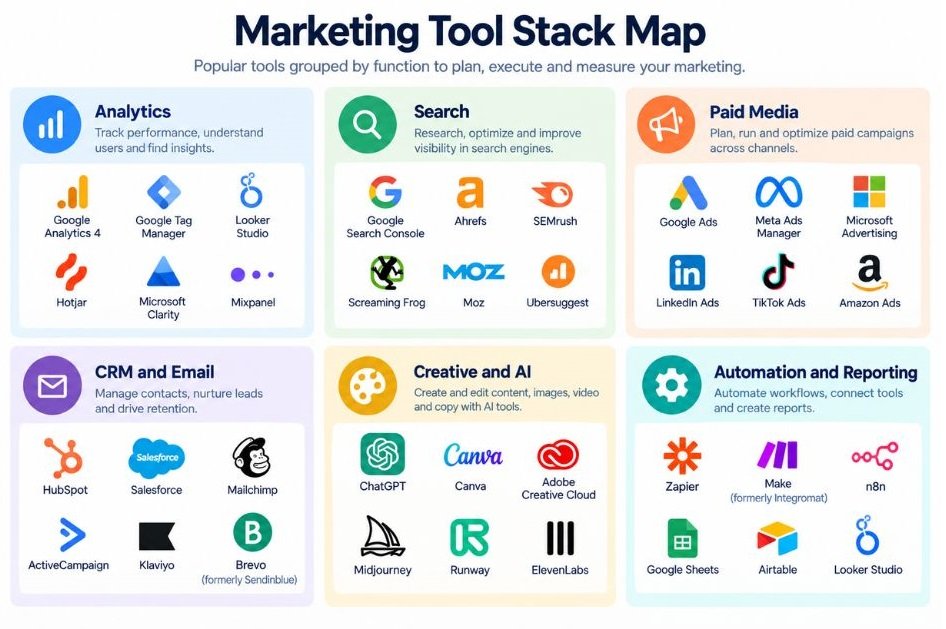
A practical 2026 marketing toolkit includes one analytics tool (GA4), one search tool (Search Console plus Semrush or Ahrefs), one ad platform (Google Ads or Meta Ads Manager), one CRM or email platform (HubSpot, Klaviyo, or Mailchimp), one creative tool (Canva), and one AI assistant. Master one tool per category before adding more.
How Do You Build a Marketing Career Step by Step?
You build a marketing career by learning fundamentals, choosing one specialisation, practising on real projects, and showing measurable results in a portfolio. Certificates help, but proof of work gets interviews.
- Learn the basics. Understand the funnel, positioning, customer research, and core metrics like CAC and conversion rate.
- Pick one channel to go deep in. Search, paid media, email, or content are good starting points.
- Set up a live project. Start a niche blog, a newsletter, or run a small ad budget for a local business.
- Open GA4 and Search Console on that project and read the data weekly.
- Run at least three tests. Change a headline, an audience, or an email subject line, and record the result.
- Write short case studies. State the goal, what you did, and the numbers before and after.
- Learn one AI tool and one automation tool and document how they improved your workflow.
- Apply for internships or junior roles using your case studies, not just your resume.
- Network with practitioners on LinkedIn by sharing what you learn, not by asking for jobs cold.
- Review every six months and add one new skill.
From what we’ve seen with YUP learners, the people who move fastest are the ones who run real campaigns, even tiny ones, before applying. A ₹2,000 test budget with a written outcome beats a certificate with no project behind it.
One caution. This path works best for digital and performance roles. Brand management and some B2B tracks often value an MBA or a few years of experience more heavily.
Where Is Marketing Headed Next?
Marketing is heading toward AI-assisted search, first-party data, short-form video, and tighter measurement. Roles will tilt further toward people who combine strategy, data, and tool skills, while repetitive production tasks shift to software.
AI Search and Answer Engines
Search is changing. Google AI Overviews, ChatGPT, Perplexity, and Microsoft Copilot answer questions directly and cite a handful of sources. Marketers now optimise to be cited, not just to rank. That means clear definitions, structured answers, original data, and named sources. No one knows exactly how this settles, so test and watch your own analytics.
First-Party Data and Privacy
As privacy rules tighten and third-party tracking weakens, brands depend more on data they collect themselves: email lists, app behaviour, purchase history, and loyalty programs. Marketers who can build consent-based data collection and use it well will be hard to replace.
Short-Form Video and Creator Content
HubSpot’s 2026 report found short-form video was the top ROI format for 48.6% of marketers, and Instagram had edged ahead of Facebook as the most-used social platform. Creator partnerships will keep growing, though only 21.2% of brands in the report used influencer marketing, which suggests plenty of room for people who can run it well.
Measurement and Accountability
With 73% of marketers reporting tighter budget scrutiny, expect more demand for incrementality testing, marketing mix modelling, and clean dashboards. If you can show what a campaign added beyond what would have happened anyway, you’re a rare hire.
AI as Assistant, Not Replacement
Most marketers don’t expect AI to replace them. HubSpot’s survey found 73.4% see it as an assistant rather than a replacement. The tasks that shrink are drafting, resizing, and reporting. The tasks that grow are strategy, judgement, taste, and quality control.
Conclusion
The big takeaways are simple. Marketing is growing, but it rewards people who measure their work. The skills that matter most are data, AI fluency, writing, and communication. And you don’t need every tool, just one good one in each category and real projects to prove you can use them.
So what should you do this week? Open GA4 and Search Console on a project you control. Run one small test. Write down what happened. Do that for three months and you’ll have a stronger application than most.
Frequently Asked Questions
Is marketing a good career in 2026?
Yes, for most people who are willing to learn data and tools. Ad spend is growing in India, and US labour projections show faster-than-average growth for marketing specialists. Entry-level competition is high, so portfolio projects matter.
What does a marketer actually do all day?
It depends on the specialisation. A performance marketer checks campaign results, adjusts budgets, and tests creative. A content marketer researches topics, writes, and reviews search data. Most roles involve planning, analysis, and talking to other teams.
What’s the difference between digital marketing and traditional marketing?
Traditional marketing uses channels like print, TV, radio, and outdoor ads. Digital marketing uses search, social, email, and websites, where you can track results at a granular level. In practice most brands blend both, and measurement now applies to both.
Will AI take my marketing job?
Unlikely, but your job will change. HubSpot’s 2026 survey found most marketers view AI as support rather than a replacement. Routine production is being automated, while strategy, judgement, and editing are becoming more valuable.
Which marketing skills are most in demand right now?
HubSpot’s 2026 report points to automation and AI prompting, cross-team communication, and data and analytics. Add strong writing and depth in one channel. These skills work together, so aim to build several rather than one.
How do I start a marketing career with no experience?
Pick one channel, run a small real project, and track results in GA4 or another tool. Write case studies showing what you changed and what happened. Then apply for internships and junior roles with that proof.
Do I need a degree to work in marketing?
Not always. Many digital roles hire on skills and portfolios, and certifications can help. Some roles, especially in brand management or large corporates, still prefer a degree or an MBA, so check job listings in your target area.
Which marketing tools should a beginner learn first?
Start with Google Analytics 4, Google Search Console, and one ad platform such as Google Ads or Meta Ads Manager. Add Canva for creative and an AI assistant for research and drafting. Learn email and CRM tools once you pick that path.
Why am I not getting interview calls for marketing jobs?
Usually it’s a lack of proof. A resume listing tools and certificates looks the same as hundreds of others. Add two or three case studies with real numbers, tailor your application to each role, and make your LinkedIn profile show your work.
Which marketing specialisation should I choose?
Choose based on what you enjoy and what you can prove. If you like numbers, try performance marketing or analytics. If you like writing, try content and SEO. If you like psychology and lifecycle thinking, try email and CRM. Test two for three months each before committing.
How much do marketers earn?
It varies a lot by role, city, company size, and experience. As a reference point, the US Bureau of Labor Statistics reports a median annual wage of $78,760 for market research analysts and marketing specialists as of May 2025. For India, check current salary data on job platforms for your city and role, because ranges differ sharply between agencies, startups, and large brands.
Should I learn SEO or paid ads first?
If you want faster feedback, start with paid ads. You can launch a small campaign and see results within days. If you prefer building something that compounds, start with SEO, but expect to wait weeks or months for results. Many marketers learn both eventually, since search and paid media often work together.
Can I switch to marketing from a non-marketing background?
Yes, and plenty of people do. Your previous experience often becomes an advantage, since a teacher might move into content, an engineer into analytics, or a salesperson into product marketing. Build one or two small projects, write up the results, and explain how your past skills transfer.
Is an MBA in marketing worth it?
It depends on the path you want. For brand management, consumer goods, and large corporates, an MBA can open doors that skills alone may not. For digital, performance, SEO, and content roles, a strong portfolio and tool skills often matter more. Compare the fees against the roles you actually want before deciding.
Why aren’t my marketing campaigns working?
Start with the basics before blaming the platform. Check whether tracking is set up correctly, whether the offer is clear, and whether the audience matches the product. Then test one change at a time, such as the headline, the creative, or the landing page, so you know what moved the result.


