
Two pairs of sneakers roll off the same factory line. Same materials, same price, similar reviews. One pair sells out in a day. The other sits in a warehouse. The gap isn’t the shoe. It’s what people believe about the company that made it.
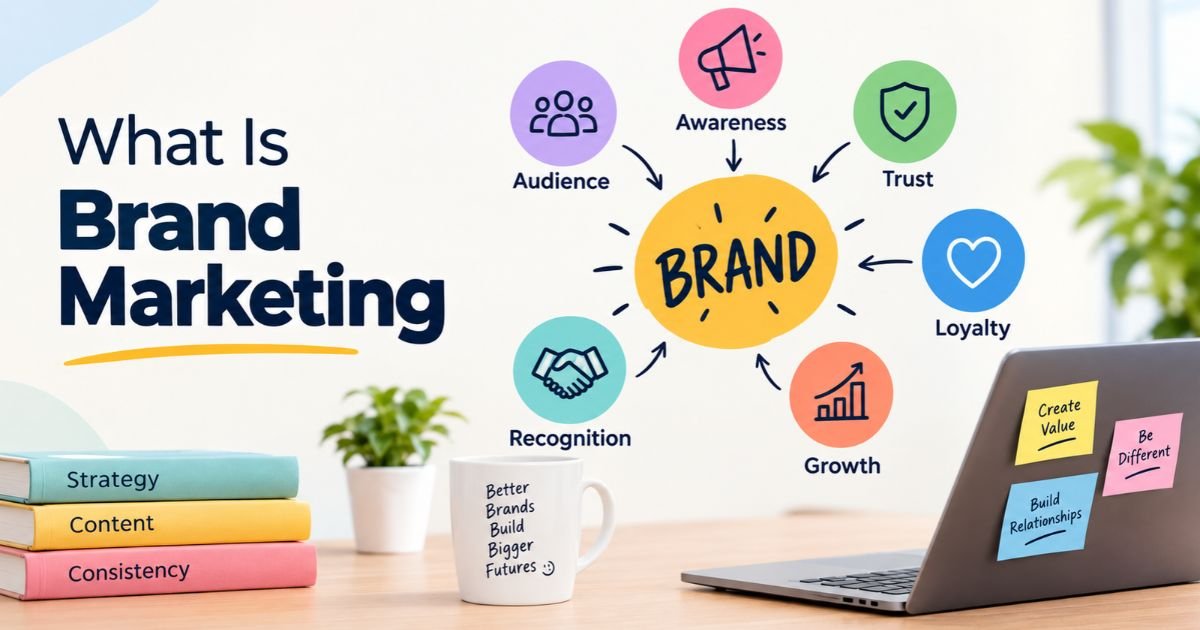
That belief is what good branding creates. Brand marketing is the practice of shaping how people perceive, remember and feel about your company as a whole, so they pick you before they compare features or prices.
It matters more now than it did five years ago. Kantar’s 2026 BrandZ ranking put the combined value of the world’s top 100 brands at a record $13.1 trillion, up 22% on the year before. Meanwhile, AI-generated content is flooding every feed, and sameness has become the default. Brands that feel specific get remembered. The rest get scrolled past.
This guide covers the definition, the core elements, how the discipline differs from product and digital marketing, the strategies that work in 2026, every tool you’ll actually use and what each one does, a step-by-step plan, the metrics, and real examples from India and abroad. You’ll finish with something you can run on Monday.
So What Does the Term Actually Mean?
Brand marketing explained in one line: it’s the long-term work of building awareness, trust and preference for a company, so people choose you even when a cheaper or flashier option sits right next to you.
Notice what’s missing from that sentence. No discount. No product feature. No deadline. That’s deliberate. The goal isn’t an immediate sale. It’s a spot in the buyer’s memory that pays off months or years later.
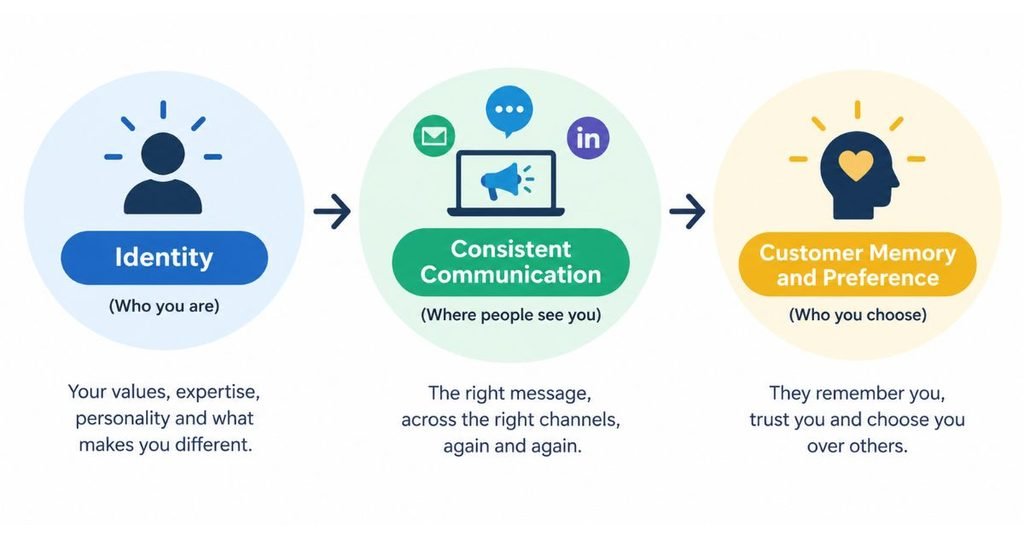
Two terms get mixed up here, so let’s separate them. Branding is the set of decisions and assets that define who you are: your name, logo, colours, tone of voice and positioning. The marketing side is how you spread those assets, repeatedly and consistently, until people recognise them on sight. Branding builds the house. The marketing gets people to visit, and then to move in.
Think about Apple’s 1997 “Think Different” campaign. It didn’t mention a single spec. It told people what kind of person buys an Apple computer. That’s the whole idea in one example.
Why Does It Matter So Much Right Now?
The importance of brand marketing shows up in three places: pricing power, acquisition costs that fall over time, and trust when attention is scarce. A company with a clear brand can charge more, convert warmer audiences and survive a bad quarter without panicking.
The macro numbers back this up. Kantar’s 2026 BrandZ Most Valuable Global Brands report values the global top 100 at a record $13.1 trillion, a 22% rise on the previous year. The same report says Zara overtook Nike as the world’s most valuable apparel brand, and Hermès passed Louis Vuitton in luxury. Kantar ties Zara’s rise to relevance built through personalised, AI-powered shopping experiences.
Consistency pays too, though the evidence needs a caveat. Marq (formerly Lucidpress) reported in its 2019 State of Brand Consistency study that consistent presentation was associated with revenue up to 33% higher. In its 2021 survey of 452 professionals, 68% said consistency had lifted revenue by 10% to 20%. Those are self-reported estimates, and nobody can cleanly separate consistency from everything else a company does. Treat them as directional, not as a promise.
Then there’s trust. The 2026 Edelman Trust Barometer surveyed 33,938 adults across 28 countries between October 25 and November 26, 2025. Its core finding: as people grow more anxious, trust is turning local. In that survey, 58% of respondents said their own employer does well at building trust. Edelman’s June 2026 special report, Brand Growth in an Insular World, covers 15 markets and argues that trust now sits inside tighter communities shaped by creators, peers, earned media and algorithms.
So you can’t just shout louder. You have to be vouched for by people your customers already believe.
Strong brands earn three advantages. They can charge more, they spend less over time to win each customer, and they keep trust when buyers face too many options. Kantar’s 2026 BrandZ data puts the global top 100 at a record $13.1 trillion in value, up 22% year on year.
What Are the Core Elements?
Here’s brand marketing explained as a system with five moving parts. Skip one and the rest wobble.
Purpose and Positioning
Positioning is the specific place you want to own in a customer’s mind compared with the alternatives. It answers one question: why you, and not them?
Mamaearth is a clean example. Founded in 2016 as a direct-to-consumer baby care brand, it built its identity around a toxin-free promise in a category crowded with multinationals, then stretched that promise into skin and hair care. A simple positioning statement follows this pattern: for [audience], [brand] is the [category] that [main benefit] because [proof]. If you can’t fill in all four blanks without hedging, your positioning isn’t ready.
Visual Identity
Visual identity is your logo, colour palette, typography, imagery style and packaging. Its job is recognition at a glance.
Researchers at the Ehrenberg-Bass Institute call the things people use to recognise a brand without seeing its name “distinctive brand assets”. Amul’s mascot girl, which has anchored the company’s topical billboards since the 1960s, is a textbook case. You don’t need a big budget for this. You need two or three assets you use everywhere, every time.
Voice and Messaging
Voice is how you sound. Messaging is what you say. Together they decide whether a caption, an email and a sales page feel like they came from the same company.
Mailchimp published its content style guide openly, and it’s worth reading as a model: it spells out tone in different situations, such as a celebratory message versus an error message. Write down three adjectives that describe your voice, then add a “we sound like this, not like this” example for each.
Story
People remember stories better than claims. Your story covers why you exist, who you exist for, and what proof you can show. Dove’s Campaign for Real Beauty, launched in 2004, built a story around challenging narrow beauty standards, and the soap, lotion and shampoo all sat under it.
Customer Experience
This is the element most teams forget. Packaging, delivery time, onboarding emails, how support answers a complaint: all of it either confirms or contradicts what your ads promised. A brand promise that the experience breaks is worse than no promise at all.
How Does It Differ From Product and Digital Marketing?
The three disciplines overlap, but they answer different questions. Brand work asks who you are and why people should care. Product work asks why this specific offer is worth buying. Digital work asks where and how you reach people online.
Versus Product Marketing
Brand marketing vs. product marketing comes down to what you’re trying to change: a perception or a purchase. Product marketing handles launches, feature messaging, pricing and sales enablement for one offer. The brand side sets the long-term story every product sits inside. A product launch lands harder when the brand is already trusted. A brand can’t survive products that don’t deliver.
Versus Digital Marketing
Brand marketing vs. digital marketing is a mix-up of purpose and channel. Digital marketing is a set of channels: search, social, email, paid ads, websites. Brand building is a goal that can run through those channels or through print, TV, events and packaging. You can run digital campaigns with no brand thinking at all, and plenty of brands do. That’s why their ads look like everyone else’s.
| Dimension | Brand work | Product marketing | Digital marketing |
|---|---|---|---|
| Main question | Who are we and why should people care? | Why is this offer worth buying? | Where and how do we reach people online? |
| Time horizon | Years | Weeks to months | Days to months |
| Typical output | Positioning, identity, story, campaigns | Launch plans, messaging, pricing, sales decks | Ads, SEO, email, social content |
| Core metric | Awareness, preference, trust, share of search | Adoption, win rate, revenue per product | Clicks, conversions, cost per acquisition |
| Owner | Brand or CMO team | Product marketing manager | Performance or growth team |
Which Strategies Work in 2026?
The brand marketing strategies that hold up in 2026 share one trait: they make you easy to recognise and easy to trust, in places where your buyers already spend time. Here are seven that work, and how to apply each.
1. Sharpen Your Positioning Before You Spend
Narrow beats broad. Pick one audience and one promise you can prove. A brand that tries to appeal to everyone gives nobody a reason to remember it. Run five to ten customer interviews and ask why they chose you over the alternative. Their words usually beat yours.
2. Build Distinctive Assets and Repeat Them
Choose a colour, a shape, a sound, a character or a phrase, and use it until you’re bored. Then keep going. Repetition is the entire mechanism. Red Bull’s can, its colours and its extreme-sports imagery appear everywhere from sponsorships to social posts, so you recognise it before you read it.
3. Work With Creators and Communities
Edelman’s 2026 research points to trust forming in smaller circles shaped by creators and peers. That makes creator partnerships a brand strategy, not just a media buy. Pick creators whose audience already matches your positioning, give them room to speak in their own voice, and aim for long partnerships over one-off posts.
4. Earn Media Attention
Earned media means coverage you didn’t pay for: press mentions, podcast appearances, reviews. Create something worth covering, such as original data, a bold stance or a stunt. Red Bull Stratos in 2012, when Felix Baumgartner jumped from the stratosphere, generated worldwide coverage because it was a story, not an ad.
5. Publish Content With a Point of View
Content that could have been written by any competitor does nothing for you. Take a clear position on your category and say it consistently. Pick three to five content pillars, themes you’ll return to for a year, and map each to a format: video, newsletter, long-form article.
6. Keep Everything Consistent Across Channels
Your Instagram, your packaging, your sales deck and your support emails should feel like one company. This is where brand guidelines, templates and review checkpoints earn their keep.
7. Show Up in AI Answers
More discovery now happens inside AI answers, such as Google’s AI Overviews, ChatGPT and Perplexity. Those systems cite sources they consider clear and credible. Publish plain-language definitions of what you do, back claims with named sources, and keep your facts consistent across your site, profiles and press. Then test it: ask those tools about your category every month and note whether you appear.
Effective brand strategies in 2026 make a company easy to recognise and easy to trust where buyers already spend time. That means one sharp positioning, a few repeated distinctive assets, creator and community partnerships, and consistent facts across every channel including AI answers.
Which Tools Do You Need, and What Does Each One Do?
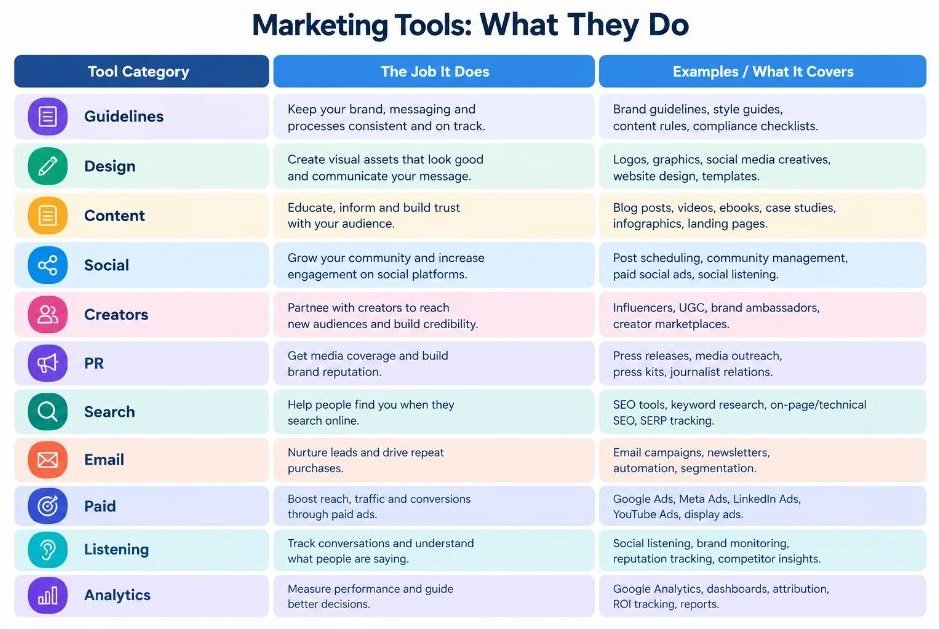
Even the best brand marketing strategies fail without tools to run them. The good news is that none of these need a big budget. Here’s every tool category you’ll use, what it does and how to put it to work.
1. Brand Guidelines and Asset Management (Frontify, Marq)
These platforms hold your guidelines, logos, fonts and approved templates in one place. Frontify combines a guidelines site with a digital asset library, while Marq (formerly Lucidpress) lets teams create documents from locked templates so nobody can change the logo or colours by accident. This matters because the problem is rarely missing guidelines. In Lucidpress’s 2021 report, 77% of respondents had seen off-brand content created, and only 31% said their guidelines were enforced consistently. A free alternative is a well-organised shared Notion or Google Drive folder with a one-page cheat sheet.
2. Positioning and Messaging Frameworks (Notion, Google Docs)
This one is a document, not software. Build a one-page brand platform: purpose, audience, positioning statement, three message pillars, voice adjectives and proof points. Many teams also pick a brand archetype, such as the Hero or the Caregiver, a framework popularised by Margaret Mark and Carol Pearson, to anchor their tone. Validate it with real customers through short surveys in Typeform or Google Forms before you lock it in.
3. Design Tools (Canva, Figma, Adobe Express)
Design tools turn your identity into daily assets. Canva’s Brand Kit stores logos, colours and fonts so anyone on the team can make on-brand posts, usually on its paid plans. Figma suits larger teams: shared component libraries and styles keep website, app and ad designs matching. Adobe Express sits between the two, with brand templates and quick editing. Pick one as your source of truth and retire the rest.
4. Content Planning and Publishing (Notion, Asana, Trello, WordPress)
A brand needs a rhythm. An editorial calendar in Notion, Asana or Trello shows which content pillar each piece supports, who owns it and when it ships. Your CMS, usually WordPress, publishes it. Tag every piece by pillar so that after three months you can see which themes earn attention and which don’t.
5. Social Media Management (Sprout Social, Buffer, Hootsuite, Meta Business Suite)
These tools schedule posts, collect messages and comments in one inbox and report on engagement. Meta Business Suite is free for Facebook and Instagram, which makes it the right starting point. Sprout Social, Buffer and Hootsuite add multi-network scheduling and deeper reporting. Use the shared inbox to answer quickly and in your brand voice, because replies are brand moments too.
6. Creator and Influencer Collaboration (Instagram Collab Posts, Meta Partnership Ads, YouTube BrandConnect)
Collab posts let a creator and a brand co-publish one post to both audiences. Partnership ads let a brand run ads through a creator’s handle, so the content keeps the creator’s credibility. YouTube BrandConnect is Google’s programme for matching brands with creators. In India, follow the Advertising Standards Council of India’s influencer guidelines: paid and gifted content must carry a clear disclosure. Put usage rights and exclusivity in every contract.
7. PR and Earned Media Tools (Google Alerts, Muck Rack, Cision)
Google Alerts is free and emails you whenever your brand name appears in new web content. Muck Rack and Cision are paid databases for finding journalists by beat and sending pitches. Build a simple press kit first: your story, founder bios, high-resolution logos, product images and two or three data points a reporter can quote. Pitch fewer journalists with a sharper angle.
8. Search and AI Visibility Tools (Google Search Console, Google Trends, Semrush, Ahrefs)
Google Search Console shows how many people searched for queries containing your brand name and how often they clicked through. That branded search volume is one of the cleanest brand health signals you can get for free. Google Trends shows relative interest over time, which lets you compare your name against competitors’ names. Semrush and Ahrefs estimate competitor visibility and keyword share. Add a monthly manual check of ChatGPT, Perplexity and Google AI Overviews to see how each describes you.
9. Email and CRM Platforms (Mailchimp, Klaviyo, Brevo)
Email is the one channel where you own the audience outright. Mailchimp, Klaviyo and Brevo let you segment customers and automate flows such as a welcome series, a post-purchase thank-you and a win-back message. Write the welcome series in your brand voice first. It’s the email people actually read, and it sets expectations for everything after.
10. Paid Media for Reach (Meta Ads Manager, YouTube Ads)
Brand campaigns buy attention at scale. Meta Ads Manager offers a Reach objective and reach-and-frequency buying, so you can control how many different people see your ad and how often. YouTube video campaigns add sound and motion, which help recall. Both platforms offer brand lift studies, which survey exposed and unexposed groups to measure changes in awareness and consideration. Judge these campaigns on lift and recall, not last-click sales.
11. Social Listening and Survey Tools (Brandwatch, Mention, Typeform, SurveyMonkey)
Brandwatch and Mention track brand mentions across social platforms and the web, with sentiment and share-of-voice reporting. Typeform and SurveyMonkey run the surveys that measure awareness and preference directly. Ask two questions quarterly: “Which brands in this category can you name?” (unaided awareness) and “Which would you consider first?” Keep the wording identical each round so the trend is valid.
12. Analytics and Dashboards (Google Analytics 4, Looker Studio)
Google Analytics 4 shows direct traffic and returning visitors, both of which tend to rise as a brand strengthens. Looker Studio pulls Search Console, GA4 and your survey data into one dashboard, so you see branded search, direct visits, awareness and sentiment side by side. Build it once and review it monthly.
How Do You Build a Plan, Step by Step?
Build a plan by defining your audience and positioning first, then choosing channels, then measuring against a baseline. The sequence matters more than the polish.
- Audit your current brand. Collect everything customers see, from your homepage to your invoices, and note where the look, tone or promise differs.
- Define your audience and position. Choose one primary audience. Write the positioning statement. Test it on five customers.
- Write your brand platform. Capture purpose, positioning, three message pillars, voice adjectives and proof points in one page.
- Lock your identity and guidelines. Finalise logo, colours, type and imagery rules. Store them where the whole team can find them in under a minute.
- Pick two or three channels. Choose where your audience already spends time. Doing three channels well beats doing eight badly.
- Plan content pillars and a calendar. Assign each pillar a format and a publishing rhythm you can actually sustain.
- Launch, then repeat. Run a first campaign for at least one quarter before judging. Recognition needs repetition.
- Measure and adjust quarterly. Compare against your baseline and change the plan based on what moved.
How Do You Know It’s Working?
Measuring brand marketing is harder than measuring a paid campaign, because the payoff is delayed and spread across many touchpoints. Use a small set of signals together and track the trend, not a single number.
- Unaided and aided awareness. Survey your audience quarterly. Unaided awareness means they name you without prompting.
- Branded search volume. Track branded queries in Google Search Console and compare your interest against competitors in Google Trends.
- Direct traffic and returning visitors. In GA4, rising direct visits and repeat sessions suggest people remember you.
- Share of voice. Compare how often your brand is mentioned versus competitors, using Brandwatch, Mention or Semrush.
- Sentiment and NPS. Net Promoter Score asks how likely customers are to recommend you, on a 0 to 10 scale. Track the score and the written reasons.
- Brand lift. Use Meta or YouTube lift studies to see whether campaigns changed awareness or consideration among people who saw them.
- Repeat purchase and price tolerance. A strengthening brand shows up as more repeat buyers and fewer discount-driven ones.
One honest limit: none of these proves cause and effect on its own. A rise in branded search could come from a PR hit or a seasonal spike. Look for several signals moving in the same direction over two or three quarters.
Which Real Brands Show It Working?
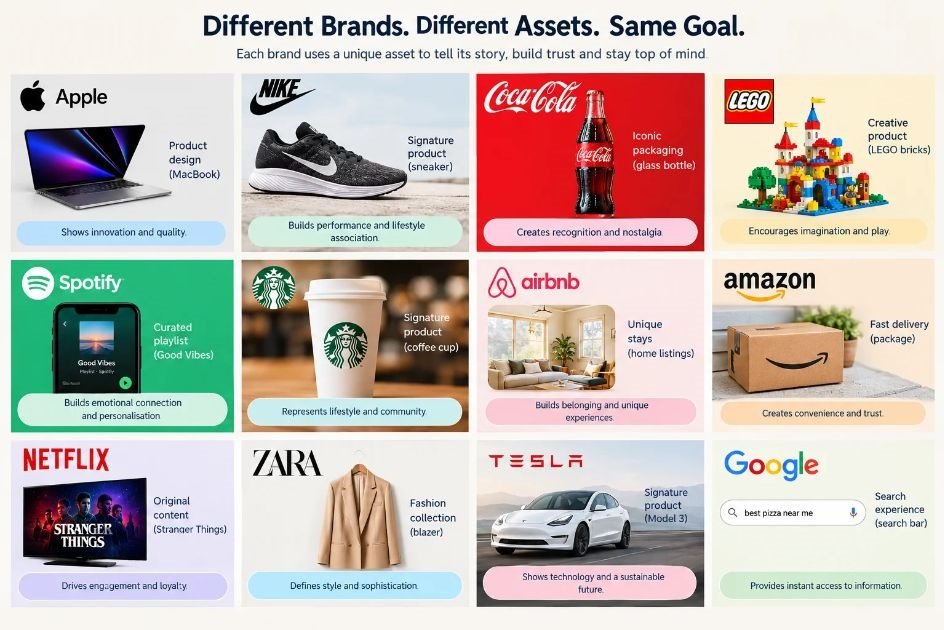
Strong brand marketing examples share a trait: you can recognise them with the logo covered. Here are six worth studying, including two from India.
Apple. The “Think Different” campaign of 1997 sold identity, not specs. Decades later, the same attitude shows in minimal packaging and ads that focus on what people make with the product.
Dove. The Campaign for Real Beauty, launched in 2004, turned a soap brand into a point of view on beauty standards. The takeaway: a clear purpose can stretch across many products.
Red Bull. The company sells an energy drink but markets extreme sport and music. From Stratos in 2012 to its sponsored athletes and events, it behaves like a media company. The takeaway: create content people want, then your product rides along.
Amul. Its topical advertising and mascot have stayed recognisable across decades. The takeaway: one distinctive asset, used patiently, becomes an unfair advantage.
boAt. Launched in 2016, boAt grew into India’s top wearables company by market share in the first quarter of 2022, according to an ICMR case study. Its parent company, Imagine Marketing, said in its draft red herring prospectus that its marketing has stayed consistent across media with brand identity at the core, as reported by Storyboard18 in May 2025. The takeaway: a youth-first identity plus celebrity and creator partnerships can build scale fast.
Mamaearth. Started as a toxin-free baby care brand in 2016 and expanded into skin and hair care while keeping that promise. The takeaway: a precise early positioning gives you permission to grow into new categories.
What Mistakes Quietly Kill Brand Efforts?
Most brand efforts don’t fail loudly. They fade. Watch for these five.
Guidelines that live in a drawer. A PDF nobody opens protects nothing. The Lucidpress numbers above show how common off-brand content is. Put templates where people work.
Copying the category leader. If you look and sound like the biggest competitor, you’ve built their brand, not yours. Look for the gap they ignore.
Changing direction every quarter. Recognition compounds only when you stay put. A fresh look every six months resets the clock each time.
Judging it on last-click sales. Brand effects show up in search, direct visits and repeat buying, often weeks later. Evaluate them on the right timeline.
Forgetting employees. Edelman’s data shows people trust their own employer more than most institutions. If your team can’t explain what you stand for, customers won’t pick it up.
Where Does This Leave You?
The importance of brand marketing comes down to this: when buyers have endless options and shrinking attention, the brand they already know and trust wins the first look, and often the sale. Three takeaways matter most. Get your positioning sharp before you spend. Repeat a few distinctive assets until they become automatic. Measure with several signals over several quarters, not one number in one week.
Your next step is small. This week, write your one-page brand platform and audit your last ten public touchpoints against it. The gaps you find will tell you where to start.
If you want practical brand and marketing breakdowns like this in your inbox, subscribe to the Crystal Clear Newsletter. We share how real brands make positioning, content and measurement decisions, so you can borrow what works and skip what doesn’t.
FAQs
What does it mean to market a brand?
It means building awareness, trust and preference for a company as a whole, not just selling one product. You do it by consistently showing your name, story, voice and visuals across every place customers meet you, so people choose you before they compare options.
Is branding the same as marketing a brand?
No. Branding creates the identity: name, logo, positioning, voice. Marketing the brand spreads that identity to an audience through campaigns, content, PR and partnerships. You need both. Identity with no distribution stays invisible, and distribution with no identity looks generic.
How is it different from product marketing?
Brand marketing vs. product marketing is a question of scope and time. The brand side shapes long-term perception of the whole company. Product marketing focuses on positioning, launches, pricing and sales support for one specific offer. They work best together: trusted brands make launches easier.
Can digital channels replace long-term brand building?
No. Brand marketing vs. digital marketing isn’t an either-or choice, because digital is a set of channels while brand building is a goal. Search, social and email can all carry brand messages. But digital campaigns without brand thinking tend to look interchangeable and only capture demand that already exists.
What’s the split between brand spend and performance spend?
There’s no universal answer, but the best-known benchmark comes from Les Binet and Peter Field’s 2013 IPA study, The Long and the Short of It, which suggested roughly 60% on brand building and 40% on short-term activation. Treat it as a starting point. Early-stage and low-awareness companies often lean more on performance until they have cash flow to invest further.
Do I really need brand building if I’m a small business?
Yes, but scale it down. You don’t need a big campaign. You need a clear positioning, two or three repeatable visual assets, a consistent voice and a way to collect reviews and referrals. Those cost mostly time and make every later ad work harder.
How long does it take to see results?
Expect early signals, such as more branded searches and more direct visits, within roughly six to twelve months of consistent effort. Stronger effects on pricing and repeat purchase usually take longer. Judge progress quarterly, not weekly.
How can I measure it without a big budget?
Use free tools. Track branded queries in Google Search Console, compare interest in Google Trends, watch direct and returning traffic in GA4, and run a simple quarterly survey in Google Forms asking which brands people can name in your category. Keep the questions identical so the trend means something.
Which brands are good examples to study?
Strong brand marketing examples include Apple for identity-led storytelling, Dove for purpose, Red Bull for content, Amul for a distinctive asset, and boAt and Mamaearth for building scale in India through sharp positioning. Study what each repeats, not just what each launched.
Why isn’t my brand building working?
The usual causes are weak positioning, inconsistency across channels, switching direction too often, or measuring it on last-click sales. Audit those four first. Then give any new approach at least two quarters before you judge it.


