
Two ads can promote the same product, reach the same audience and cost the same per click. One fills your pipeline all week. The other quietly burns budget. Nine times out of ten, the difference is the words. Most marketers can describe their audience down to the pin code, yet far fewer can say what is advertising copy and what job each line of it has to do. That gap shows up directly in your cost per acquisition.
This guide fixes that. You’ll get a plain definition, the building blocks that make copy convert, ten real examples from brands like Domino’s, Amul, Mailchimp and boAt, the tools you can use to write and test copy, and a repeatable process you can run on your next campaign.
One caveat before we start. Most brands don’t publish campaign-level conversion numbers, so the examples below are patterns worth studying, not guaranteed results. Where hard data exists, it’s cited with source and year.
Advertising Copy Defined: The Job Every Line Has to Do
Advertising copy is the written text inside a paid message, including the headline, body line, offer and call to action, written to make a specific audience take a specific action. It appears in search ads, social ads, display banners, emails, billboards, video scripts and landing pages.
Put differently, what is advertising copy if not a sales conversation compressed into a handful of words? You don’t get a second paragraph to warm people up. A Google search ad gives you 30 characters per headline. A scrolling Instagram user gives you about a second.
Advertising copy is paid, action-focused writing. Every line in it exists to move a reader one step closer to a click, a sign-up or a purchase. If a line doesn’t do that, it’s decoration.
It helps to separate copy from its neighbours. A tagline is a short brand line that works across years of campaigns. Content writing educates or entertains without asking for an immediate action. Advertising copy sits between them and carries a single, measurable ask. That’s why copywriters track it with click-through rate, conversion rate and cost per acquisition, not just “likes”.
Honestly, this is where a lot of brand teams go wrong. They write copy that sounds good in a meeting, and nobody checks whether it moves a metric.
What Makes Advertising Copy Convert? Six Building Blocks
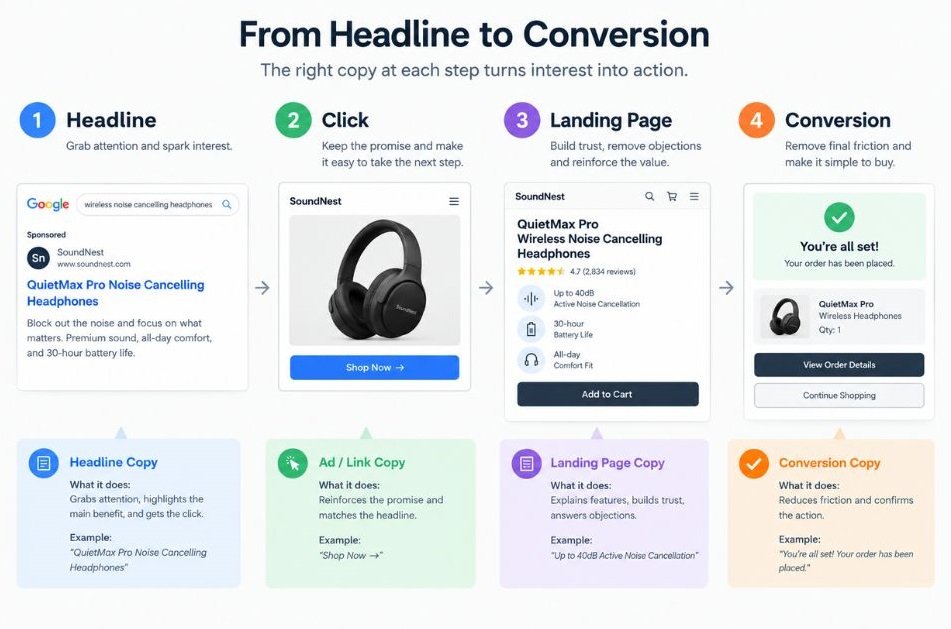
Converting copy usually combines six elements: a headline that earns attention, one clear benefit, proof, an offer, a call to action and a message that matches the page the click lands on. You rarely need all six in every ad, but you should know which one is missing when an ad underperforms.
1. A headline that earns the next line
Your headline decides whether anything else gets read. In a May 2025 split test across 58 websites published by Neil Patel’s marketing stats library, benefit-driven headlines converted at 1.71%, statement headlines at 1.62% and question headlines at 1.40%. The study notes that not every test reached statistical significance, so read it as a direction, not a law. The pattern still matches what most practitioners see: tell people what they get.
Taboola’s Realize team analysed Black Friday and Cyber Monday headline performance and reported in 2025 that curiosity and problem-solution headlines drive engagement. They also warned that urgency headlines can lose punch when every advertiser uses them at once.
2. One benefit, not five
Pick the single outcome your reader cares about most and say it plainly. Features describe the product. Benefits describe the reader’s life after using it. “5GB hard drive” is a feature. A pocketful of songs is a benefit, which is exactly how Apple framed the first iPod (more on that below).
3. Proof that answers “says who?”
Numbers, certifications, warranties, named customers and reviews all do the same job: they reduce doubt. Vague claims like “best quality” invite scepticism. A two-year warranty doesn’t.
4. An offer worth acting on
An offer gives people a reason to act now, not later. That could be a discount, a free trial, free shipping or a guarantee. The offer should be specific. “Save more” is a wish. “Free delivery on orders above a stated amount” is an offer.
5. A call to action that starts with a verb
“Start free trial”, “Get the quote”, “Book a demo”. The verb tells people what happens next. Adding a short reassurance next to it, such as “No card needed”, often removes the last bit of friction.
6. Message match with your landing page
If your ad promises one thing and the page opens with another, people leave. Keep the promise, the wording and the offer consistent from ad to page. This is the cheapest fix in performance marketing, and it’s skipped constantly.
10 Advertising Copy Examples That Drive Conversions
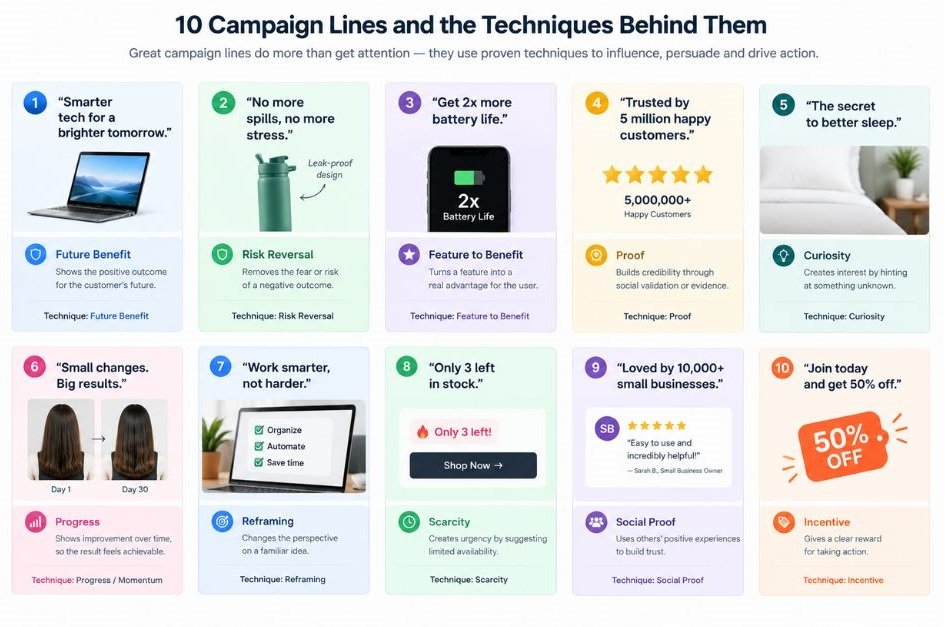
Each example below shows a different copy technique. You’ll see the line, why it works, and what you can borrow. These are famous campaigns, so the lines are short and widely documented, but the brands rarely release conversion data. Treat them as patterns.
Example 1: Domino’s “30 minutes or less” (the risk-reversal guarantee)
Domino’s built its early growth on a promise: your pizza arrives within 30 minutes or you get money off. Reports from MEL Magazine and Food Republic place the guarantee as an official policy by the mid-1980s. It ended in 1993, after a court judgment of nearly $79 million over a driver crash.
Why it converts: a guarantee moves the risk from the customer to the brand. Nobody has to wonder whether they’ll wait an hour.
What to borrow: promise something specific and measurable. What to avoid: promising what your operations can’t safely deliver. The 1993 ending is the cautionary half of this story.
Example 2: Apple iPod, “1,000 songs in your pocket” (feature to benefit)
When Apple launched the iPod in 2001, it didn’t lead with storage size. It described what the storage meant. A thousand songs, in a pocket. You can picture it immediately.
Why it converts: people buy outcomes, not specifications. The line replaces a number with a mental image.
What to borrow: take your biggest spec and finish the sentence “which means you can…” Then use that sentence as your headline.
Example 3: boAt, “Plug Into Nirvana” (emotion backed by proof)
boAt launched in India in 2016, and co-founder Aman Gupta told Outlook Business in April 2019 that the tagline explains the name: you board a boat, leave everything behind and plug into a new zone. The emotional line is the hook.
The conversion work happened in the product copy. The same Outlook Business report describes boAt’s charging cable as Apple-certified, backed by a two-year warranty and pitched as indestructible. The brand also stayed away from TV and print at that stage, relying on digital channels.
Why it converts: the tagline gets attention and the certification and warranty close the doubt. Cheap accessories carry a trust problem, and proof solves it.
What to borrow: pair one emotional line with at least one hard, checkable fact.
Example 4: Mailchimp, “Did You Mean Mailchimp?” (curiosity meets search intent)
Mailchimp’s first major campaign, launched in January 2017 with agency Droga5, built nine fake brands with names that sound like “Mailchimp”, including MailShrimp and KaleLimp. Search for one of the fake names and Google’s own “Did you mean” prompt nudged people toward the real brand. The campaign won the Cyber Grand Prix at Cannes Lions in 2017.
Why it converts: it turned a spelling mistake into a traffic source. The copy was the joke, and the joke pointed at the brand.
What to borrow: look at the queries and typos your audience already uses, then write copy that answers them. You can also use that logic in search ads by matching headline wording to real queries.
Example 5: Amul, “Utterly Butterly Delicious” (consistency plus wit)
Amul’s butter girl first appeared in March 1966 with the line “Thoroughbread”, created by Sylvester daCunha’s agency. AFP reported in 2018 that more than 4,000 of these topical ads had been produced since. One observer describes the formula as a topical event, a visual joke and a pun, all tied to the butter.
Why it converts: reliability builds recall. People remember a brand that shows up in the same voice for decades, so when they reach the dairy shelf, the choice is already half made.
What to borrow: pick a voice and a repeatable format. Consistency is a copy strategy.
Example 6: Avis, “We Try Harder” (honest positioning)
In the early 1960s, Avis was second to Hertz in car rental and said so. Agency DDB turned that rank into a reason to choose Avis: the number-two company has to work for your business.
Why it converts: the copy is believable. Admitting a weakness makes the strength claim credible.
What to borrow: find the true trade-off in your position and write it into the ad. Small and attentive beats big and distant, if it’s true.
Example 7: L’Oréal, “Because You’re Worth It” (identity over product)
Copywriter Ilon Specht wrote the line for L’Oréal in 1971, reportedly in response to a brief she found dismissive of women. It doesn’t mention the product. It speaks to how the reader sees herself.
Why it converts: when products are similar, identity is the tie-breaker. The line makes buying feel like a statement of self-respect.
What to borrow: ask what your customer wants to feel about themselves after buying, then write toward that, not toward the ingredient list.
Example 8: Nike, “Just Do It” (the verb as the call to action)
Wieden+Kennedy introduced the line in 1988. It’s three words, all imperative. The copy and the call to action are the same thing.
Why it converts: it turns the reader’s hesitation into the villain. The ad isn’t asking you to admire shoes. It’s telling you to move.
What to borrow: put a strong verb at the start of your headline or button. Compare “Our running shoes are designed for comfort” with “Start your first 5K this month”.
Example 9: Fevicol, “Mazboot jod” (humour that proves one claim)
Ogilvy India’s work for Fevicol, led by the late Piyush Pandey, built decades of funny scenes around one claim: this adhesive holds. The line “Fevicol ka mazboot jod hai, tootega nahin” has become part of everyday Hindi.
Why it converts: humour makes people watch, and the single claim makes them remember why. Every joke in the series is a demonstration of strength.
What to borrow: if you use humour, tie every joke to the one thing you want remembered. Otherwise people recall the joke and forget the brand.
Example 10: Volkswagen, “Lemon” (specificity builds trust)
A famous DDB print ad from around 1960 showed a single Volkswagen and one word as the headline. The body explained that an inspector had rejected this car because of a blemished glove compartment trim, and that VW inspects cars this strictly.
Why it converts: a tiny, specific flaw proves a large claim about quality control. Specific details feel true in a way adjectives don’t.
What to borrow: replace “high quality” with the exact detail that shows quality. A test, a number, a rejection rate, a process step.
The strongest advertising copy examples share one habit: they make a single promise and back it up with something checkable. A guarantee, a warranty, an honest ranking or a specific detail all work because they lower the reader’s risk of being wrong.
Which Tools Help You Write and Test Advertising Copy?
Three tool types cover most of the work: Google Ads responsive search ads for search intent, Meta’s Advantage+ Creative for social variations, and a disciplined A/B testing routine for everything else. Each has strengths and traps, so here’s how they actually work.
Google Ads responsive search ads
A responsive search ad (RSA) is a Google Ads format where you supply multiple headlines and descriptions and Google tests combinations to find what performs. According to Google Ads Help, you must enter at least 3 headlines, can add up to 15, and can add up to 4 descriptions. Headline fields support up to 30 characters, and descriptions are commonly capped at 90 characters. Google may show one, two or three headlines, in any order, depending on what it predicts will work for each search.
Here’s how to use it well:
- Write 10 to 15 genuinely different headlines. Fifteen rewordings of one idea give the system nothing to learn from.
- Mix angles: a benefit, an offer, a proof point, a question, a keyword-led line.
- Make every headline readable next to every other headline, since they can appear in any combination.
- Pin a headline only when something must appear, such as a legal disclaimer or brand name. Pinning reduces the combinations Google can test.
- Watch Ad Strength. Google says advertisers who move RSAs from “Poor” to “Excellent” see 15% more clicks and conversions on average. That figure comes from Google, so treat it as an average, not a promise.
The trap: Ad Strength is a guide to variety and relevance, not a score for persuasion. A rating of “Excellent” with bland copy still produces bland results.
Meta Advantage+ Creative (text generation)
Advantage+ Creative is a set of enhancements Meta applies at the ad level. Its text generation feature produces alternative versions of your primary text, headline and description, and Meta has added options like persona-based text variants and translations. You upload your ad, then toggle enhancements on or off individually.
A July 2026 write-up from ecommerce brand Common Thread reports that Meta also switched on a default feature that rewrites headline text found inside uploaded ad images, generating up to eight variants that are tested against your original. The same write-up says advertisers can opt out per campaign. Since Meta changes settings often, open your own Ads Manager and confirm what’s active before you rely on this.
How to use it well:
- Start with strong seed copy. The tool varies what you give it, so weak input gives you weak variants.
- Treat generated text as a draft. Read every variant for claims you can’t back up, such as invented discounts or promises.
- Review performance by variant and keep the ones that win.
- Switch off enhancements that alter text inside your images if your offers are legally sensitive or exact, like sale percentages.
The trap: AI variants don’t carry your legal and brand-safety review. Someone on your team still has to read them.
A/B testing and message match
A/B testing means running two versions of one element against each other and measuring which gets more conversions. Whether you use Google Ads experiments, Meta’s A/B test tool or the testing function in your landing page builder, the discipline is the same. Change one thing at a time. Run the test long enough to reach a meaningful sample. Don’t call a winner on early numbers.
Test big levers first: the core promise, the offer, the headline angle. Button colour can wait. The Neil Patel 2025 headline data above shows differences of a fraction of a percentage point between headline types, which is why running tests on your own audience matters more than copying someone else’s winner.
Then check message match. Paste your ad headline and your landing page headline side by side. If a stranger wouldn’t connect them, rewrite one.
Google responsive search ads accept up to 15 headlines and 4 descriptions, and Google tests the combinations for you. Meta Advantage+ Creative generates text variants too. Neither replaces a human reviewing the claims, and neither replaces your own A/B tests.
How Do You Write Advertising Copy Step by Step?
You write advertising copy by defining one action, then writing toward it with a single benefit, proof, an offer and a verb-led call to action, then testing against a variant. Here’s the sequence.
- Define one action. Decide whether the ad should get a click, a lead or a sale. One ad, one job.
- Write down your reader’s problem in their words. Pull phrases from reviews, support tickets and sales calls.
- Choose one benefit. If you have five, you have five ads.
- Add proof. A number, certification, warranty or named customer.
- Attach an offer or a risk reducer. Free trial, free shipping, guarantee.
- Finish with a call to action that starts with a verb.
- Write two versions with different angles, match both to the landing page, and test.
Which Advertising Copy Mistakes Quietly Kill Conversions?
Most underperforming ads fail for the same handful of reasons.
- Leading with the company, not the customer. “We are a leading provider of…” tells the reader nothing about what they get.
- Packing in too many messages. Three benefits compete and the reader remembers none.
- Making claims without proof. “Best in class” gets scrolled past.
- Mismatching the ad and the landing page.
- Writing a call to action that asks for nothing. “Learn more” is weaker than a specific next step in most cases, though it can suit early-stage awareness campaigns.
- Calling tests too early. Small samples make random noise look like insight.
- Copying competitors. If you sound like everyone else, you’re competing on price alone.
That sounds obvious. It almost never happens in practice, which is why fixing these is often the quickest win in a struggling account.
Conclusion
Strong copy isn’t magic. It’s one promise, backed by something checkable, delivered with a clear next step and matched to the page you send people to. The ten brands above use different tricks, from Domino’s guarantee to Mailchimp’s search-intent play, but each one lowers the reader’s risk or raises their curiosity in a few words.
Your next move is simple. Pick your weakest-performing ad this week, find the missing building block from the six above, and write two new versions. Test them against each other for a full cycle before you declare a winner.
FAQs
How would you define ad copy in simple words?
Ad copy is the writing inside an advertisement that persuades someone to act. That includes the headline, the supporting line, the offer and the button text. Its job is to get a click, a sign-up or a sale, not to sound clever.
Ad copy vs copywriting: what’s the difference?
Copywriting is the whole craft of writing to persuade, and it covers websites, emails, scripts and brochures. Ad copy is the part of it written for paid placements like search, social and display ads. Ad copy tends to be shorter and more tightly tied to a measurable result such as click-through rate.
How long should ad copy be?
It depends on the placement. Google responsive search ad headlines are limited to 30 characters, and descriptions are commonly 90. Social ads allow more room, but the first line still has to work on its own because many people never tap “see more”. Write the shortest version that carries one promise, one proof point and one action.
Who needs to learn ad copywriting?
Anyone paying for ads or writing for someone who does. Performance marketers, founders running their own campaigns, social media managers and product marketers all benefit. Small teams with tight budgets feel poor copy fastest because every wasted click is a bigger share of spend.
Is it worth using AI to write ad copy?
Yes, as a drafting and variation tool, not as a final author. Platforms like Meta already generate text variants inside Advantage+ Creative. The sensible workflow is to write strong seed copy yourself, let a tool produce variations, then review every line for accuracy and brand voice before publishing.
Why isn’t my ad copy converting?
Check four things in order. First, is the ad’s promise the same as the landing page’s? Second, is there one clear benefit or several? Third, is there proof near the claim? Fourth, is the call to action specific? If all four pass, the problem is often the offer or the audience, not the wording.
Is ad copy more important than the creative?
Neither wins alone. The image or video earns the stop, and the copy earns the click. On search ads there’s no image, so copy carries everything. On social, test both separately so you know which one is limiting results.
How many headlines should I write for a Google responsive search ad?
Write as many distinct ones as you can, up to the limit of 15. Google requires at least 3 and allows up to 15 headlines plus up to 4 descriptions. Aim for different angles, such as benefit, offer, proof and keyword, rather than rewordings of one line.
How do I test ad copy properly?
Change one variable at a time, such as the headline angle or the offer. Run both versions at the same time to the same audience, wait for a meaningful sample, then keep the winner and test the next variable. Platform tools like Google Ads experiments and Meta’s A/B test feature handle the split for you.
Does humour work in performance ads?
Sometimes. Fevicol and Amul show that humour can build memory over years, but both tie every joke to one product claim. In direct-response ads where you need a click today, test a humorous version against a plain benefit-led one. Your audience’s response, not your taste, decides.


Functions Of Marketing: A Complete Guide To Its Key Roles
October 13, 2026 - 11:17 am[…] what’s missing from that definition: the word “advertising.” Advertising is one piece of one […]
Disadvantages Of E-Commerce: 10 Major Drawbacks
October 14, 2026 - 8:11 am[…] dependence adds a second risk. You pay commission, shipping fees and sometimes advertising to appear on the first page. The platform owns the customer relationship and can change its fees, […]
What Is Quick Commerce In India? Top Brands And Business Models
October 16, 2026 - 8:15 am[…] stock, or a marketplace model, where sellers own stock and the platform earns fees. Most then add advertising, customer fees and memberships on […]
Marketing Vs Advertising: Key Differences Explained Guide
October 23, 2026 - 9:50 am[…] finds customer needs, shapes the product and price, builds demand and keeps buyers coming back. Advertising is one paid part of that system: you pay to put a message in front of a chosen audience. Every ad […]