
Most writers improve slowly because they practise the same format over and over. You write another blog post, then another, and your fortieth draft reads a lot like your fourth. The fix isn’t more volume. It’s studying how different kinds of writing do their jobs.
That’s what these 20 content writing examples are for. Each one comes from a real brand, publication or creator, and each shows a specific skill you can borrow: a hook that holds attention, a structure that makes a hard idea easy, a line of microcopy that stops a user from giving up.
The timing matters. According to the 2025 B2B survey from the Content Marketing Institute (CMI) and MarketingProfs, published in October 2025, 9 in 10 marketers already use AI to create content, yet fewer than 4 in 10 say it has improved performance. When anyone can produce a passable draft in seconds, the writers who stand out have taste, structure and a point of view. Studying good work builds all three.
Below you’ll find the 20 formats in four groups, a table to help you decide where to start, and 10 FAQs.
How Do You Learn From Content Writing Samples Instead of Just Reading Them?
You learn from content writing samples by taking them apart. Read the piece once as a reader, then again as an editor, and note its goal, hook, structure, voice and call to action. Finish by rewriting one section on a different topic, in your own words.
Reading a great piece and feeling impressed teaches you almost nothing. The learning starts when you can explain why the third paragraph made you keep going. Use this routine on every example below.
- Name the goal. Decide what the piece wants from the reader: a click, a sign-up, a share, or plain understanding.
- Mark the hook. Underline the first line or two that earn the next ten seconds.
- Map the structure. Write one short line per section. You’ll often spot a pattern such as problem, proof, process, next step.
- Note the voice. Pick three adjectives for the tone, then find one sentence that proves each.
- Find the ask. Locate where the piece asks the reader to do something, and how much effort it requests.
- Rewrite one section. Keep the structure, change the topic, and write every sentence fresh.
One rule matters more than the rest: borrow structures, never sentences. Structure belongs to everyone. Wording belongs to the writer who produced it. If you rewrite from your own notes and not from the original text, your work stays original and you still absorb the technique.
Keep each teardown to about 20 or 30 minutes. Any longer and you’re reading, not studying.
A teardown breaks a piece of writing into its goal, hook, structure, voice and call to action. Rewriting one section from your own notes, on a new topic, builds the skill without copying the original. Borrow structure, never sentences.
Editorial and Long-Form Formats
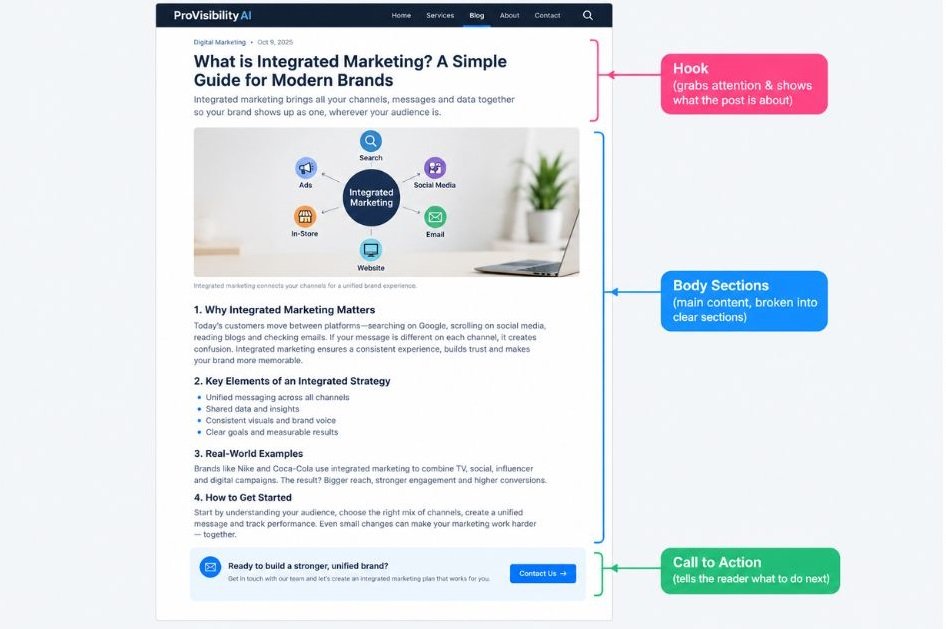
Editorial formats are long pieces that build trust and search traffic: how-to posts, listicles, pillar guides, case studies and research reports. They reward clear structure over clever phrasing. Start here if you want to rank in Google or get cited in AI answers.
These are the examples of content writing most marketers meet first, and they’re also the content writing formats where a reader’s patience is tested hardest. Structure does the heavy lifting.
1. How-To Blog Post: The HubSpot Blog
A how-to blog post teaches one process from start to finish, in steps a reader can follow without leaving the page. The HubSpot Blog built much of its reputation on this format, with posts that name the outcome early, define terms, then walk through numbered steps with screenshots.
The reader knows within seconds whether the post solves their problem. That’s the whole trick.
What to copy: Put the end result in the first two sentences, start every step with a verb, and add one visual per major step.
2. Listicle: BuzzFeed
A listicle is an article built on a numbered list, where each item works as its own mini-section. BuzzFeed popularised the format for entertainment, but it suits serious topics just as well, as this article shows.
Numbers promise a finish line, and readers can scan. The danger is padding. A listicle with six strong items and fourteen filler ones is worse than a short post with six.
What to copy: Test every item with one question: would the reader miss this if it vanished? Keep item lengths consistent and put your strongest items first and last.
3. Pillar Guide: Moz’s Beginner’s Guide to SEO
A pillar guide is one long page that covers a topic from basics to advanced and links out to deeper pages. Moz’s Beginner’s Guide to SEO is a well-known case. It’s split into chapters, ordered so a reader can start with zero knowledge and finish with a working plan
Why does it work? It answers the next question before the reader has to ask it.
What to copy: Outline the guide like a ladder. Each chapter should depend on the one before it, and each should still be useful on its own.
4. Case Study: Shopify Merchant Stories
A case study explains how a real customer solved a real problem using your product or service, with their numbers. Shopify publishes merchant stories that follow a clear arc: the business, the problem, the decision, the result.
Proof beats claims. A founder describing how she cut returns carries more weight than a sentence saying the product reduces returns.
What to copy: Lead with the result, then rewind to explain how it happened. Use the customer’s own quotes and metrics, and get their approval before publishing. One limit to keep in mind: without real numbers, a case study reads like an ad.
5. Research Report: The CMI and MarketingProfs B2B Survey
A research report packages original data and analysis into a long, citable document. The CMI and MarketingProfs B2B survey is a strong model. It’s the 16th annual edition, it draws on more than 1,000 B2B marketers, and it states its sample size and publication date up front.
Original data gets cited, and cited work builds authority faster than opinion does. A report doesn’t need a huge sample to be useful. It needs a clear question and honest limits.
What to copy: Put the headline findings on page one, state your sample size and date, and keep what the data says separate from what you think.
Conversion and Marketing Copy
Conversion copy is writing built to get one action: a purchase, a sign-up or a click. It’s shorter, more specific and judged by results, not applause. Product descriptions, landing pages, emails and ads share one rule: one reader, one promise, one next step.
Here’s the part most beginners get wrong. They write to impress. Marketing copy that converts usually sounds almost boring, because it says exactly what the product does and who it’s for.
6. Product Description: Patagonia
A product description is the copy on a product page that helps a shopper decide whether to buy. Patagonia’s product pages combine practical details such as fit, fabric and intended use with information about how the item is made.
It reads like a knowledgeable shop assistant answering the questions you’d ask in person. How does it fit? What’s it made of? When would I wear it?
What to copy: Lead with the benefit, follow with the specification, and answer the three questions a hesitant shopper would ask. Cut adjectives that any competitor could also use.
7. Landing Page: Calendly
A landing page is a standalone web page built around a single goal, usually a sign-up or a purchase. Calendly’s homepage is a clean case of the pattern: one clear promise about scheduling without back-and-forth emails, quick proof, and one primary button above the fold.
Everything on the page either supports that one action or gets removed. That’s harder than it sounds.
What to copy: Write the headline as the outcome the visitor wants, not the feature you built. Give one button one label, and repeat it at the bottom of the page.
8. Email Newsletter: Morning Brew
An email newsletter is a recurring email that gives subscribers a consistent kind of value, such as news, analysis or curated links. Morning Brew, launched in 2015, made business news feel conversational with short sections, light humour and plain language. In India, Zerodha’s Daily Brief takes a similar approach to explaining markets and business stories.
Consistency is the product. Subscribers open because they know what the next issue will feel like.
What to copy: Fix a repeatable structure, keep sections short, and write the subject line last, after you know what the best line in the issue is.
9. Welcome Email Sequence
A welcome email sequence is a short series of emails sent automatically after someone signs up, designed to turn a new subscriber into an active one. CMI and MarketingProfs found in 2025 that 85% of B2B marketers say their organisations use personalised email, so a generic welcome series stands out for the wrong reasons.
A simple four-email structure works for most businesses:
- Email 1, sent immediately: Confirm the sign-up and ask for one small first action.
- Email 2, a day or two later: Share your most useful idea or your origin story.
- Email 3, a few days later: Add proof, such as a customer result or a popular resource.
- Email 4, about a week in: Make a clear offer or ask a direct question.
What to copy: Give each email one job, and write the first line so it works even if the reader never scrolls.
10. Ad Copy: Amul and Google Responsive Search Ads
Ad copy is short persuasive text written to earn a click or a recall. Amul’s long-running topical hoardings are a famous Indian case, where a witty line riffing on current events keeps a butter brand in conversation year after year.
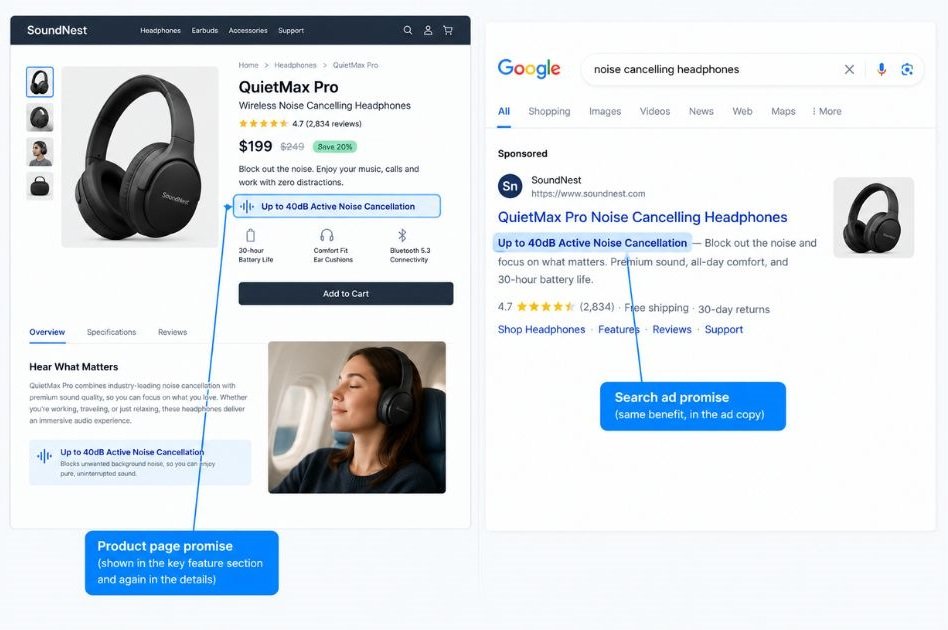
On the search side, Google’s responsive search ads let you supply up to 15 headlines of 30 characters each and 4 descriptions of 90 characters each, and Google tests combinations. Limits like these force you to cut every word that doesn’t earn its place.
What to copy: Write each headline to test a different angle: a benefit, a proof point, a price, a question, a deadline. Treat the headlines as experiments, not as one message repeated 15 times.
Conversion copy has one reader, one promise and one next step. The strongest examples, from product pages to search ads, state exactly what the product does and cut anything a competitor could also say. Specific beats clever.
Social and Short-Form Writing
Short-form writing delivers one idea in a few lines, usually on social platforms or inside a product. Readers decide in seconds, so the first line carries most of the weight. Brevity here doesn’t mean writing less. It means cutting everything that isn’t the idea.
Among all the content writing formats, these are the quickest to practise, because you can publish a draft today and see how it lands by tomorrow.
11. LinkedIn Post: Ankur Warikoo
A LinkedIn post is a short text update used to share a lesson, a story or an opinion with a professional audience. Indian creator Ankur Warikoo is known for posts built from short lines, personal stories and a single clear takeaway, which suits a feed where people skim.
CMI and MarketingProfs reported in 2025 that 96% of B2B marketers say their organisations create thought leadership, but in many companies fewer than 5% of employees contribute to it. That gap is an opening for any writer willing to publish.
What to copy: Open with a line that works without the “see more” click, tell one story, and end with one idea the reader can use today.
12. X Thread: Shreyas Doshi
An X thread is a connected series of short posts that explains an idea step by step. Product leader Shreyas Doshi has become known for threads on product thinking, where the first post states the promise and each following post carries one idea.
The structure is the lesson. If the thread would still make sense after you deleted the last three posts, it’s tight. If it wouldn’t, you buried your point.
What to copy: Write the first post last. Give every post a single idea, and close with a short recap or a question.
13. Instagram Caption: Zomato
An Instagram caption is the text paired with an image or video, and it often decides whether a post gets a comment. Zomato’s social accounts are known for witty, conversational captions that play on pop culture and everyday food moments.
The picture gets attention; the caption gives it a voice. A good caption sounds like a friend talking, not a brand announcing.
What to copy: Match the tone of the platform, keep the joke short, and read the caption aloud before posting. If you wouldn’t say it, rewrite it.
14. UX Microcopy: Mailchimp
Microcopy is the small text inside a product: buttons, error messages, empty states and confirmations. Mailchimp publishes its Content Style Guide online, and it explains how tone should change with the user’s mood, plain and calm when something goes wrong, lighter when something goes right.
Microcopy has a very high cost per word. One unclear error message can cost you a customer.
What to copy: Say what happened, then what the user can do about it. Match the tone to the moment, and never joke when the user has just lost their work.
15. Press Release: Apple Newsroom
A press release is a formal announcement written for journalists and the public. Apple Newsroom’s announcements typically follow the standard structure: a headline, a dateline, a lead paragraph with the main news, an executive quote, availability details and a short company boilerplate.
It’s a rigid format, which makes it ideal for practice. You can’t hide a weak announcement behind style, so the news has to be clear.
What to copy: Put the who, what, when and why in the first paragraph, use quotes to add opinion, not facts, and keep the boilerplate identical across releases.
Short-form writing wins or loses in the first line. The best social posts and microcopy state one idea, match the platform’s tone and cut everything that doesn’t serve that idea. Practise it daily, because feedback arrives fast.
Brand, Script and Technical Writing
These formats carry a brand’s personality and explain complex things: the About page, scripts, show notes, launch posts and documentation. They reward specificity over charm. Writers who explain clearly in these formats are hard to replace.
They also tend to be the least glamorous work on the list. That’s partly why strong examples are rare.
16. About Page: Ben & Jerry’s
An About page explains who a company is, what it believes and why a reader should trust it. Ben & Jerry’s states its mission in three parts: a product mission, an economic mission and a social mission. The structure makes the company’s priorities concrete instead of vague.
Most About pages are generic because they avoid taking a position. Choosing a position is what makes this one memorable.
What to copy: Replace “we are passionate about quality” with a specific claim a reader could check. Name what you stand for, and what you’ll turn down.
17. YouTube Script: Kurzgesagt
A YouTube script is written narration timed to visuals, built to keep viewers watching. Kurzgesagt, the animated explainer channel, is a standard reference for turning a hard subject into a clear story using analogies and a tight structure.
Scripts are written for the ear. Long sentences that look elegant on a page fall apart when spoken.
What to copy: Open with the question the video will answer, use one analogy per concept, and read the script aloud. Cut any sentence you run out of breath saying.
18. Podcast Show Notes: Lenny’s Podcast
Show notes are the written summary that accompanies a podcast episode. Lenny’s Podcast, hosted by Lenny Rachitsky, pairs each episode with a guest introduction, key takeaways, timestamps and links, so a reader can get value without pressing play.
Show notes are a gift to search engines and to readers who prefer text. They’re also underrated practice for summarising a long conversation.
What to copy: Lead with the three biggest takeaways, add timestamps for scanning, and link every tool or book mentioned.
19. Product Launch Announcement: Linear’s Changelog
A launch announcement tells existing users what’s new and why it matters to them. Linear publishes a public changelog where updates are short, dated and written in plain language.
The skill on display is translation. The team shipped something technical, and the writer describes what changes for the user.
What to copy: Write the benefit first and the feature name second. Keep each entry to a few sentences, and add a visual whenever the change is something you can show.
20. Documentation: Stripe Docs
Documentation is writing that helps a user complete a technical task, such as integrating a tool or fixing an error. Stripe’s docs are widely studied. Code samples can be switched between programming languages, a signed-in user’s API test keys are inserted into the samples automatically, and the content adapts to where a user is in onboarding. Stripe also built its own authoring syntax, called Markdoc, to keep that content manageable.
The writing is only half the work. The page is designed to feel like an application, not a manual.
What to copy: Write for someone who’s mid-task and impatient. Put the working example before the explanation, and test every step yourself.
Which Format Should You Practise First?
Practise the format closest to the work you want to be paid for, then add one adjacent format each month. A blogger should start with how-to posts and listicles, a marketer with email and ad copy, and a product writer with microcopy and documentation.
Treat these content writing examples as a practice plan, not a reading list. The table below matches common goals to the formats above. The numbers refer to the examples in this article.
| If your goal is | Start with | Then add | Skill you build |
|---|---|---|---|
| Ranking in Google | How-to blog post (1) | Pillar guide (3) | Structure and search intent |
| Getting clients | Case study (4) | LinkedIn post (11) | Proof and positioning |
| Selling a product | Product description (6) | Landing page (7) | Benefit-led specificity |
| Building an audience | Newsletter (8) | X thread (12) | Voice and consistency |
| Working at a tech company | Microcopy (14) | Documentation (20) | Clarity within tight limits |
| Brand and PR work | About page (16) | Press release (15) | Tone and factual precision |
A simple four-week routine turns that table into a habit:
- Week 1: Run a teardown on two pieces in your starting format.
- Week 2: Write your own version on a topic you know well.
- Week 3: Ask an editor or a peer to mark where they got bored or confused.
- Week 4: Rewrite, then publish it somewhere public.
By the end of the month you’ll have a finished piece and, over time, a portfolio of content writing samples that shows range. This plan has limits. Industry matters, and B2B companies with long sales cycles lean more heavily on case studies and research reports than a consumer brand would.
Where to Go From Here
Twenty formats can feel like a lot, so here’s what to hold on to. Every strong piece above gives the reader a clear job to do. Teardowns turn reading into skill. Structure can be borrowed, wording can’t, and specific details make writing credible.
One more number is worth remembering. In the 2025 CMI and MarketingProfs survey, 45% of B2B marketers named AI-powered marketing tools as a top-three area for increased investment in 2026, while only 9% named people, meaning salaries, training and development. If nobody is going to invest in your writing skills, you’ll need to do it yourself.
So pick one format from the table, tear down one example this week, and publish your rewrite within seven days. Choose the content writing formats that match your goal and ignore the rest for now. Collect your work as you go, because content writing samples you can show beat any claim about your ability.
FAQs About Content Writing Practice
What is content writing?
Content writing is the practice of creating written material, such as articles, emails, scripts and web pages, that informs, persuades or entertains a defined audience. It usually aims to be useful first and commercial second. All 20 formats in this article fall under it.
Is copywriting the same as content writing?
No. Copywriting aims at an immediate action such as a purchase or sign-up, so it’s short and persuasive. Content writing builds trust over time by being useful. Product descriptions, landing pages and ads (examples 6, 7 and 10) lean toward copywriting, while blog posts, guides and newsletters lean toward content writing. Plenty of jobs need both.
How do I start content writing with no experience?
Pick one format from the table above, run a teardown on two strong pieces, and write your own version on a topic you already know. Publish it on LinkedIn or a personal blog so someone can react to it. One real, published piece teaches you more than a month of reading about writing.
Which format is easiest for beginners?
Social posts and how-to blog posts, because the scope is small and feedback comes quickly. Documentation and research reports are harder because they depend on deep subject knowledge. Start small, then move up.
Do I need to practise all 20 formats?
No. Most careers use four or five. Pick the formats tied to your goal, practise those until they’re comfortable, and only sample the rest to understand how other teams write.
How do I learn from a style without copying it?
Take notes on structure, not sentences. Close the original before you start writing. Change the topic, the examples and every line of wording. Studying examples of content writing is normal practice, and copying their wording isn’t. If a stranger could point at a passage and say “that’s from the original”, rewrite it.
Is AI going to replace content writers?
AI is already part of the job. The CMI and MarketingProfs 2025 survey found that 9 in 10 B2B marketers use it to create content, but fewer than 4 in 10 say it has improved performance. Drafting is getting cheaper, while judgement, original data, taste and a clear point of view aren’t. Use AI for research or first drafts if it helps, but practise the skills in this article, because they’re what you’ll be paid for.
Why does my writing sound flat even when I follow good examples?
Usually it comes down to one of three problems: no specific details, no opinion, or sentences and paragraphs that are all the same length. Add one real name, number or example to each section, state a view, and vary your rhythm. Then read the piece aloud and mark every place you stumble.
How long does it take to get better at writing?
There’s no fixed timeline, but short regular practice beats occasional marathons. A 30-minute teardown plus a 30-minute rewrite, three times a week, gives you 12 practice sessions in a month. Track what you notice improving, such as stronger openings or tighter edits, instead of waiting for a feeling.
Where can I get honest feedback on my writing?
Ask an editor or a peer to mark where they got bored or confused, not to tell you whether it’s good. You can also publish on LinkedIn or a personal blog and watch which paragraphs people quote. Tools such as Grammarly and Hemingway Editor catch mechanical problems, but they can’t tell you that your idea is weak.


Top Digital Marketing Project Ideas For Beginners
October 13, 2026 - 10:20 am[…] is the content management system behind a large share of the web. It lets you publish posts, install plugins, and […]
Best Content Marketing Companies In 2026: Top Agencies
October 14, 2026 - 7:41 am[…] why outsourcing is so common. According to the Benchmarker 2026 B2B SaaS Content and Website Performance Benchmarks, published with Contentful in January 2026, 47% of teams […]