

Most people who want to write better copy start in the wrong place. They sign up for another course, bookmark another swipe file, and never open the copywriting books that working copywriters keep within arm’s reach. That’s an expensive gap. The writers behind headlines that get clicked and pages that convert have usually absorbed decades of tested thinking, and most of it sits in print for the price of a lunch.
The catch is that the shelf is crowded. Some titles are classics that still hold up. Others are dated, repetitive, or written for a world of direct mail and print ads with nothing to say about a landing page or a WhatsApp broadcast.
This list sorts that out. You’ll find 15 titles, what each one actually teaches, who it suits, and one exercise you can try the same day. You’ll also get a reading plan, a comparison table, and answers to the questions readers ask most.
How Did We Choose These 15 Titles?
We picked books that teach a repeatable skill, not just a point of view. Each one had to meet three tests: the ideas still work on modern channels, the author has real results or research behind the advice, and a reader can apply a lesson within a day of reading it.
Plenty of lists are really popularity contests. Most copy writing books that sell well earn their sales through famous names, not usefulness. We tried to avoid that. A few titles here are old, and they made the cut only because their core lessons about testing, audience research and persuasion haven’t aged.
To be fair, older titles do show their age on channels. None of them mention Instagram Reels, email deliverability or AI assisted drafting. Read them for the thinking, then translate the lessons yourself. We also mention editions where an updated version exists, but check current availability before you buy, because publishers reissue and retire titles often.

Which Books Should You Read First?
If you’re new, start with The Copywriter’s Handbook, Everybody Writes and Ogilvy on Advertising. If you already write for a living, move to Breakthrough Advertising, Great Leads and The Boron Letters. Order matters less than reading with a pen in hand and a live project nearby.
Here’s the full list at a glance, so you can pick based on where you are right now.
| # | Book | Author | Best for | Level | Core idea |
|---|---|---|---|---|---|
| 1 | Ogilvy on Advertising | David Ogilvy | Research-led brand copy | Beginner | Facts and specifics beat cleverness |
| 2 | The Adweek Copywriting Handbook | Joseph Sugarman | Long-form sales copy | Intermediate | Keep the reader sliding down the page |
| 3 | Scientific Advertising | Claude Hopkins | Performance marketers | Beginner | Test everything and track results |
| 4 | Breakthrough Advertising | Eugene Schwartz | Strategy and positioning | Advanced | Match copy to market awareness |
| 5 | The Copywriter’s Handbook | Robert W. Bly | A full A to Z foundation | Beginner | A proven step-by-step method |
| 6 | Influence | Robert Cialdini | Persuasion psychology | Beginner | Seven principles of persuasion |
| 7 | Made to Stick | Chip and Dan Heath | Messaging and ideas | Beginner | Make ideas simple and memorable |
| 8 | Hey, Whipple, Squeeze This | Luke Sullivan | Ad concepts and headlines | Intermediate | Great ads start with a sharp idea |
| 9 | Everybody Writes | Ann Handley | Content and web writing | Beginner | Clear writing is a habit |
| 10 | Building a StoryBrand | Donald Miller | Website and brand messaging | Beginner | The customer is the hero |
| 11 | Contagious | Jonah Berger | Shareable campaigns | Intermediate | Six reasons things spread |
| 12 | Cashvertising | Drew Eric Whitman | Emotion-driven ads | Intermediate | Write to core human desires |
| 13 | Great Leads | Michael Masterson and John Forde | Openings and hooks | Intermediate | Six lead types that earn attention |
| 14 | The Boron Letters | Gary Halbert | Direct response mindset | Intermediate | Know your market before your words |
| 15 | The Ultimate Sales Letter | Dan S. Kennedy | Sales pages and emails | Intermediate | Follow a tested sales letter structure |
The 15 Best Books to Sharpen Your Writing in 2026
Every title below earns its place for a different reason. Some teach craft, some teach psychology, and some teach you how to think about a market before you type a word. Read two or three from different angles and the picture comes together fast.
1. Ogilvy on Advertising by David Ogilvy
This 1983 book is the best entry point into the mind of one of advertising’s most famous practitioners. David Ogilvy built the agency Ogilvy & Mather, and the book distils what he learned running campaigns for decades.
What you’ll take away: write headlines that promise a benefit, use specific facts instead of vague claims, and treat research as the starting point for every ad. Ogilvy also believed long copy can outperform short copy when the reader is genuinely interested, which is still worth remembering when a client demands “just three lines.”
It’s best for beginners and anyone who writes brand-led copy. The weak spot is that it focuses on print and television, so you’ll need to adapt the lessons for digital. Try this: pick a product page you’ve written, and replace every vague claim with a checkable fact.
2. The Adweek Copywriting Handbook by Joseph Sugarman
Joseph Sugarman built a direct-response business, JS&A, selling gadgets through print ads, and this 2007 book explains how he wrote them. Its best-known idea is the “slippery slide”: every sentence exists to get the reader to the next one.
Sugarman also lists psychological triggers he uses, such as curiosity and the desire to own, and shows how to weave them into a story. The writing is personal and full of his own campaign experiences, which makes the lessons stick.
Read this if you write long-form sales pages or product launches. It’s less useful if your work is mostly short social posts. Exercise: take your last email and read only the first line of every paragraph. If the thread breaks, you’ve found a place where the slide stops.
3. Scientific Advertising by Claude Hopkins
Written in 1923, this is a short book with an outsized reputation. Claude Hopkins argued that advertising should be treated as a measurable discipline, with every ad tested and judged by results. Ogilvy himself recommended it to people entering the trade.
The central lesson is that opinions are cheap and data is not. Hopkins pushed for coupons, tracked offers and small-scale tests before spending big, which is the same logic behind modern A/B testing.
It’s perfect for performance marketers who want the historical root of their craft. Some examples are very dated, and the prose can feel stiff. That said, the testing mindset is more relevant now than ever, because every Meta Ads Manager split test is an echo of this book.
4. Breakthrough Advertising by Eugene Schwartz
Many professionals call this the hardest and most rewarding book on the list. Published in 1966, it focuses on a question most writers skip: what does the market already want, and how aware is it of your product?
Schwartz describes five stages of market awareness, from people who don’t know they have a problem to people ready to buy, and explains how your headline and opening should change at each stage. He also covers market sophistication, meaning how many competing claims your audience has already heard.
This is for intermediate and advanced writers who work on strategy and positioning. Honestly, it can be a slow read. It has also been out of print and expensive on the used market at various times, so check for current editions before paying a collector’s price. Try this: write the same product headline for an unaware reader and for a ready-to-buy reader, then compare.
5. The Copywriter’s Handbook by Robert W. Bly
If you only buy one book on the list, many working writers would say this is the one. Robert W. Bly first published it in 1985, and it has been revised several times since, so look for the latest edition.
It walks through headlines, body copy, email, direct mail, web copy and how to organise the whole process. The checklists are practical. You can apply them straight to a draft and spot weak spots in minutes.
It’s best for beginners who want a full foundation instead of one author’s philosophy. The trade-off is breadth over depth, so you’ll want a specialist title like Great Leads later. Exercise: use its approach to rewrite one headline five ways before you choose.
6. Influence by Robert Cialdini
Robert Cialdini is a psychologist, and Influence (1984) reports years of research on why people say yes. The core is a set of principles: reciprocity, commitment and consistency, social proof, authority, liking and scarcity. The expanded 2021 edition adds a seventh, unity.
You’ll recognise these everywhere once you’ve read it. A “4.5 stars from thousands of reviews” badge is social proof. A limited-time offer is scarcity. Ecommerce brands such as Nykaa and Mamaearth use some version of these every day on product pages.
It isn’t a writing manual, so don’t expect formulas. What you get is a reason behind each tactic, which helps you use persuasion honestly. One warning: the principles can be abused, and good copywriters use them to help readers decide, not to trick them.
7. Made to Stick by Chip Heath and Dan Heath
Why do some ideas survive while others vanish? Chip and Dan Heath answered that in 2007 with a framework summed up as SUCCESs: simple, unexpected, concrete, credible, emotional and stories.
For writers, the useful lesson is concreteness. A vague promise gets forgotten, while a specific image or number gets remembered. The authors back this with memorable examples from business, education and public health.
It suits anyone who writes messaging, taglines or pitch decks. It won’t teach direct-response mechanics, though. Use it as a filter: before publishing, ask which of the six elements your piece has and which it’s missing.
8. Hey, Whipple, Squeeze This by Luke Sullivan
Luke Sullivan’s book started as a guide for advertising creatives in 1998 and has been updated in later editions. It teaches how to come up with ideas, and does it with humour, which is rare in this genre.
The strongest parts cover how to find a single-minded idea, write headlines, and work with an art director. It spends more time on concept than on persuasion science, so it complements Cialdini well.
Best for writers who want to create campaigns, not just fill templates. Think about how a brand like Swiggy builds campaign ideas around one funny, relatable insight: that kind of thinking is what this book trains. Try this: write ten bad ideas on purpose, then see which one has a surprising spark.
9. Everybody Writes by Ann Handley
Ann Handley is Chief Content Officer at MarketingProfs, and her 2014 book (updated in 2022) focuses on the everyday habits of good business writing. It’s less about sales psychology and more about clarity, voice, structure and editing.
It has short chapters on grammar, headlines, tone and storytelling, and a useful section on how to think about the reader first. It also helps with the unglamorous side of writing: how to edit your own drafts without hating them.
It’s ideal for content marketers, founders and anyone who writes emails and blog posts. It’s less helpful for long-form direct response. Exercise: pick one draft and cut it by 20 percent without losing meaning.
10. Building a StoryBrand by Donald Miller
Donald Miller’s 2017 book gives you a simple model for messaging, often called SB7. The structure puts your customer in the role of hero, you in the role of guide, and walks through a problem, a plan, a call to action and the stakes.
The real value is that it forces you to simplify. A lot of websites fail because they talk about the brand’s history before they mention what the visitor gets. The framework fixes that fast, and it works well for service businesses and startups.
It’s best for website copy and brand messaging. The framework can feel formulaic if you follow it too rigidly, so treat it as a starting skeleton. Try this: rewrite your homepage’s top section so the first sentence is about the visitor’s problem, not your company.
11. Contagious by Jonah Berger
Jonah Berger, a marketing professor at the Wharton School, studies why products and ideas spread. His 2013 book offers six principles under the acronym STEPPS: social currency, triggers, emotion, public visibility, practical value and stories.
For copywriters, it’s a lens for campaigns where you want people to share. Think about why a Zepto ad that plays on a relatable late-night craving gets forwarded in group chats. The answer is usually emotion plus a trigger people meet in daily life.
Read it if you write social content or launch campaigns. It’s less relevant for lower-funnel conversion copy. A good exercise: look at a post that did well for you and map it against the six principles.
12. Cashvertising by Drew Eric Whitman
Drew Eric Whitman’s 2009 book is aggressive, practical and focused on emotion. It introduces the “Life-Force 8,” a list of core human desires such as survival, enjoyment of food, freedom from fear and social approval, and shows how to tie your offer to them.
It also covers headline formulas, layout tips for ads, and the psychology of persuasion. The tone is energetic and sometimes salesy, which some readers like and others find heavy.
It’s best for people writing ads, landing pages and promotional emails. Read it critically, and keep your ethics in check, since some tactics lean on fear. Try this: choose a product you’re promoting and identify which of the eight desires it truly serves, then write one headline for it.
13. Great Leads by Michael Masterson and John Forde
The opening of a piece decides whether anyone reads the rest, and this book is entirely about that. Michael Masterson and John Forde describe six types of leads: offer, promise, problem-solution, big secret, proclamation and story.
Each lead type gets its own chapter with examples and guidance on when it fits. That structure makes it a handy reference when you’re stuck on the first paragraph of a sales page or email.
It’s best for intermediate writers who already know the basics. You won’t get much about research or strategy here. Exercise: write one opening in each of the six styles for a single product and test which pulls hardest.
14. The Boron Letters by Gary Halbert
In 1984, direct marketer Gary Halbert wrote a series of letters to his son while serving time in a federal prison camp in Boron, California. They were later collected into a book, and copywriters have passed it around ever since.
The letters are informal and opinionated. A recurring theme is that your market matters more than your words: a mediocre pitch to an eager audience beats a brilliant one to people who don’t care. He also covers practical habits like building a swipe file and understanding how readers sort their mail.
It’s a good fit for anyone drawn to direct response. The style is blunt and some advice is dated, so filter it. Try this: spend an hour reading the reviews and forum posts of your target audience before you write anything.
15. The Ultimate Sales Letter by Dan S. Kennedy
Dan S. Kennedy first published this in 1990, and later editions updated the examples. It breaks down the sales letter into parts: a headline, an opening, the body, an offer, a guarantee and a close with a deadline.
The strength is its checklist-like clarity. If you’ve ever stared at a blank page and not known what comes next, this book provides a map. It’s also direct about the role of the offer, which many beginners treat as an afterthought.
Use it for sales pages, email sequences and launch copy. Some formulas feel old-school, so adapt the tone for today’s readers. Exercise: take a recent sales email and check it against Kennedy’s structure, noting which part is missing.
The best books on this list teach three different skills. Some teach craft, such as Everybody Writes and The Copywriter’s Handbook. Others teach psychology, such as Influence and Cashvertising. A third group teaches strategy, such as Breakthrough Advertising and The Boron Letters. Reading one from each group builds a well-rounded writer faster than reading five from the same group.
How Do You Get Real Value From Reading Them?
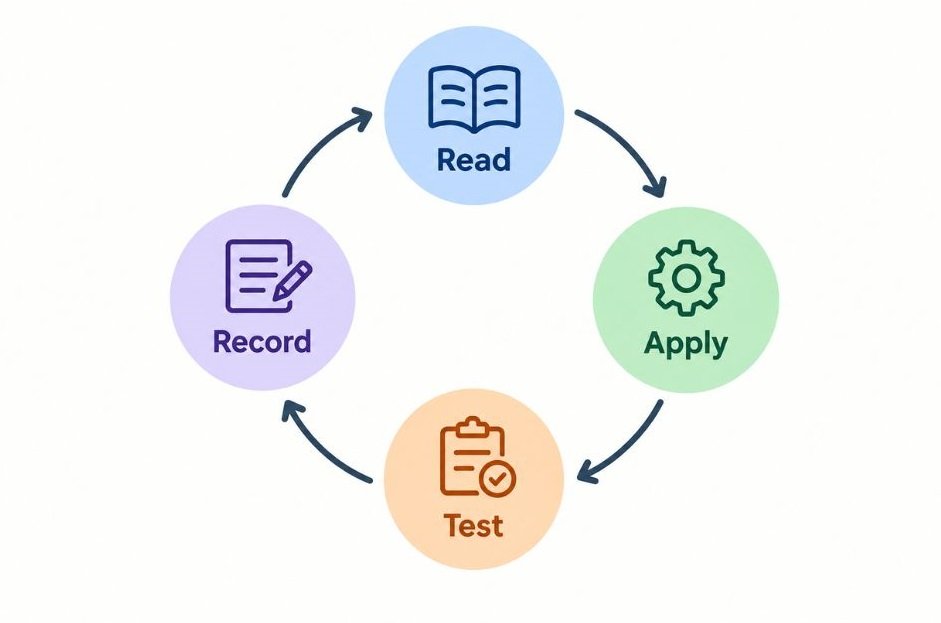
You get value by turning each chapter into a small writing task. Read a section, then apply it to a live piece of work within 24 hours. Without that second step, reading becomes entertainment, and your writing won’t change.
Here’s a simple routine that works for most people.
- Pick one book and one live project, such as a landing page or email sequence.
- Read in short sessions, 20 to 30 minutes, and mark one idea per session.
- Rewrite a real piece of your own copy using that idea the same day.
- Copy out a great ad or sales letter by hand to feel its rhythm.
- Record what changed in a notes file, with the before and after versions.
- Test the new version against the old one where you can, as Claude Hopkins would have insisted.
Why copy by hand? Because it slows you down enough to notice word choices you’d skim past. Many experienced writers still do it, and it’s the oldest training method in the trade.
If you’re building a library, start with three copy writing books from different groups: one on craft, one on psychology and one on strategy. Finish those before you buy more. A small shelf you’ve worked through beats a big one you’ve only skimmed.
What Mistakes Do Most Readers Make?
The most common mistake is treating reading as progress. Most people finish a book, feel productive and change nothing in their writing. The fix is to measure results: a rewritten headline, a tested email, a page that converts better.
A second mistake is collecting formulas without understanding the reader. Headline templates are fine, but they fail when you don’t know who you’re writing for. That’s why Breakthrough Advertising and The Boron Letters both push research before writing.
Third, people copy tone without checking fit. A hard-sell style that works for a mail-order product may feel wrong for a B2B software brand. Keep your audience in mind and adjust.
Another quiet problem is reading only one kind of title. If you read only psychology, your copy may feel clever but unclear. If you read only craft, it may be tidy but flat. Many copy writing books overlap, so mixing the types keeps your thinking fresh.
Finally, don’t wait until you’ve read everything to start writing. Writers improve by producing, getting feedback and editing. Reading just speeds up that loop.
Conclusion
The best copywriting books won’t make you a good writer by themselves. What they do is shorten the road, by giving you tested ideas on research, structure, persuasion and testing that would take years to learn alone.
If you remember three things, make them these. Know your audience before you write a word. Read across craft, psychology and strategy instead of stacking similar titles. And apply each lesson to real work within a day.
So pick one title from the table above, choose a live project, and start this week. Then come back for the next one.
FAQs
What is copywriting?
Copywriting is the practice of writing words that persuade a reader to take a specific action, such as buying, signing up or clicking. It covers ads, landing pages, emails, product descriptions and social posts. Good copy is clear, specific and written for a defined audience.
Which book should a complete beginner read first?
Start with The Copywriter’s Handbook by Robert W. Bly. It covers the full process in a practical order, from research to editing. Pair it with Everybody Writes by Ann Handley if you also write blog posts and emails.
How many of these books do I need to read before I can write good copy?
You don’t need all 15. Two or three titles from different groups, craft, psychology and strategy, are enough to improve noticeably if you practise as you go. Most of the improvement comes from writing and revising, not from the number of books finished.
Is Scientific Advertising still worth reading in 2026?
Yes, mainly for its testing mindset. Claude Hopkins wrote it in 1923, and some examples are out of date, but the idea of measuring every ad is the same logic behind modern A/B tests. Read it for principles, not for channel tactics.
Breakthrough Advertising vs The Copywriter’s Handbook: which is better?
They do different jobs. The Copywriter’s Handbook teaches the process and is better for beginners. Breakthrough Advertising teaches how to match copy to market awareness and suits experienced writers working on positioning. Many professionals read the Handbook first and Schwartz later.
Do I need to read these in order?
No. Choose based on your current work. If you’re writing a sales page this week, read Kennedy or Sugarman. If you’re struggling with openings, read Great Leads. The table near the top of this article shows which titles fit which need.
Can I learn copywriting only from books?
Books give you frameworks and examples, but they don’t replace practice. You need to write regularly, get feedback and compare results. Treat reading as the theory half and live projects as the half that actually builds skill.
Why isn’t my copy getting better even though I read a lot?
Usually because you read without applying. If you don’t rewrite real drafts or test versions, the lessons stay abstract. Pick one idea per session, use it the same day, and track the result.
Are these books useful for Indian marketers writing for local audiences?
Yes, because the principles of persuasion, clarity and research travel across markets. The examples are mostly Western, so you’ll need to adapt references, language and cultural context. Pay attention to how Indian brands such as boAt, Nykaa or Swiggy adjust their tone and humour for their audience.
Should I buy physical copies, ebooks or audiobooks?
For study, physical or ebook copies work best because you can mark passages and return to them. Audiobooks suit commutes, but they make it hard to do the exercises. Many readers use audio for a first pass and print for the second.


