
Your audience has seen every carousel, every “limited time” banner and every founder-in-a-hoodie ad. So has your competitor’s audience. Creative marketing is what you do when polish stops working and people scroll past what you publish without a second look.
The stakes are rising, not falling. According to SparkToro’s analysis of Similarweb clickstream data, 68.01% of US Google searches ended without a click between January and April 2026, up from 60.45% in 2024. Fewer clicks means fewer chances to be found by default. You need a reason for people to look for you, share you or remember you.
This guide covers 20 creative marketing ideas, grouped by what they do for your brand. Each one has a real brand example, a way to run it, and the specific tools to run it with. Some examples are older campaigns, picked because the mechanics still work. Platform features and pricing change often, so check each tool’s current plan before you commit budget.
Which Interactive and Experience-Led Ideas Still Work in 2026?
Interactive ideas work because they make the customer do something instead of watching something. A person who plays, tries or visits remembers the brand longer than a person who saw a 6-second ad. The four ideas below range from a simple quiz to a full physical event.
1. Gamified campaigns
A gamified campaign turns a brand interaction into a game, with points, levels, streaks or prizes, so people spend minutes with you instead of seconds.
McDonald’s Monopoly is the textbook case. For decades, the chain has attached collectable game pieces to ordinary purchases, which gives people a reason to come back for one more fry order. You don’t need McDonald’s scale to borrow the mechanic. A D2C skincare brand can run a 7-day “routine streak” where customers log their routine and earn a free sample.
How to run it:
- Pick one behaviour you want: a purchase, a referral, a signup or a repeat visit.
- Choose the mechanic that fits it: a spin wheel for signups, a scratch card for purchases, a streak for retention.
- Set the prize cost so it stays below your customer acquisition cost.
- Collect consent and an email or phone number at the point of entry, not after.
Tools to use:
- Gleam.io runs giveaways and reward campaigns. You set entry actions such as following an account, visiting a page or referring a friend, and the tool tracks entries and picks winners. It’s a good fit if you want a contest live in an afternoon.
- Outgrow builds quizzes, calculators and polls without code. You can use it to create a “spin” or score-based experience and push the leads into your email tool.
- Zapier connects the two. When someone enters, Zapier can add them to a Google Sheet or an email list so the data doesn’t sit trapped in the game tool.
2. AR try-on and virtual product demos
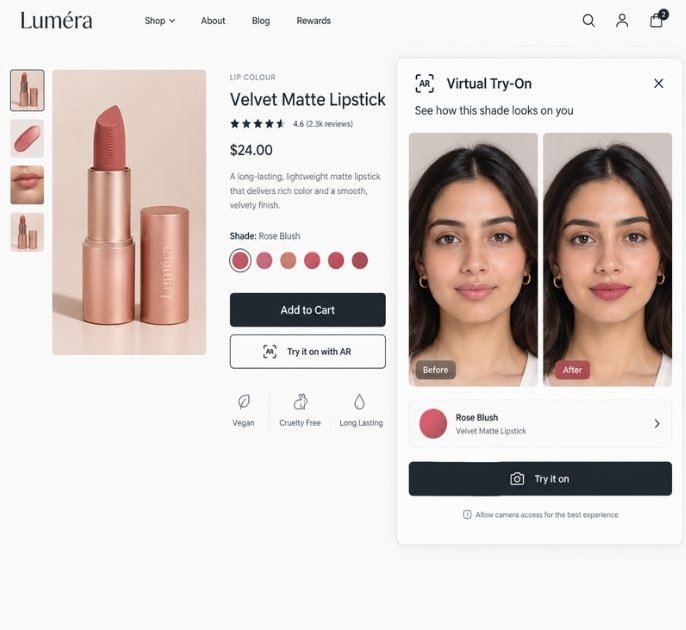
AR try-on lets shoppers see a product on their own face, body or room through a phone camera before they buy. It cuts the doubt that stops people from ordering online.
Nykaa launched ModiFace, an AI-backed virtual try-on built with L’Oreal, on its website and app in December 2021. The system tracks the lips, eyes, cheeks and hair, then applies virtual cosmetics in real time. For a category where shade matching is the biggest purchase blocker, that’s a smart place to put technology.
How to run it:
- Start with the product that has the highest return rate or the most “will this suit me?” hesitation.
- Build or license the try-on for that single product line first.
- Place the try-on button directly on the product page, not buried in a menu.
- Track conversion for shoppers who used the tool against those who didn’t.
Tools to use:
- Snap Lens Studio is a free desktop app for building AR lenses that run in Snapchat. It suits brands that want a shareable try-on experience for a younger audience.
- Shopify’s 3D model support lets you attach a 3D file of a product to its page, so shoppers on supported phones can view it in their own space. It works well for furniture, bags and decor.
- ModiFace, owned by L’Oreal, is the enterprise route for beauty try-on. It’s built for large brands, so smaller teams usually start with Lens Studio or 3D product pages.
A note on Meta Spark: Meta shut down its Spark AR platform in January 2025, so skip any older tutorials that recommend it.
3. Quizzes and personalised finders
A product quiz asks a few questions and recommends the right product, which turns browsing into a guided choice and gives you first-party data in the process.
Warby Parker’s frame quiz is a well-known example in eyewear, where choice overload is a real problem. The quiz narrows hundreds of frames to a short list and nudges the shopper toward its home try-on programme.
How to run it:
- Write 5 to 7 questions. More than that and completion drops.
- Map each answer combination to one or two products, never ten.
- Ask for an email before showing the result, or right after, and explain why.
- Send a follow-up email that repeats the quiz result and the recommended product.
Tools to use:
- Typeform builds one-question-at-a-time forms with logic jumps, so the next question changes based on the last answer. The conversational feel is why completion rates tend to hold up better than on long forms.
- Octane AI is built for Shopify stores. It runs product quizzes and passes the answers into your email and messaging tools, so the quiz becomes the basis for segmentation.
- Klaviyo takes the quiz answers as profile properties. You can then send emails that say “based on your oily skin answer” instead of generic copy.
4. Pop-ups and experiential activations
An experiential activation is a physical or live event built so the brand is the experience, not the sponsor of it. Done well, the photos and videos people share do the advertising for you.
Red Bull Stratos in October 2012 remains the benchmark, when Felix Baumgartner jumped from the edge of space and Red Bull streamed it live. Almost nobody can match that budget, and you don’t need to. A 3-day pop-up in a busy mall, a sampling stall at a college fest or a small workshop for 30 customers uses the same logic: give people something to do and something to photograph.
How to run it:
- Choose one memorable moment, such as a photo wall, a live demo or a free tasting.
- Pick a location where your actual buyers already spend time.
- Create a hashtag and a clear reason to post, like a prize for the best photo.
- Collect RSVPs in advance so you know who’s coming and can follow up afterwards.
Tools to use:
- Eventbrite handles ticketing, RSVPs and check-in. It works for free and paid events and gives you an attendee list for follow-up.
- Luma creates clean event pages with RSVP and reminders, and it’s popular with startup and creator communities.
- Canva covers the signage, social graphics and printed material, so you don’t wait on a designer for a day-before change.
Interactive ideas work because they ask the customer to do something. Games, quizzes, AR try-ons and live events create longer attention and first-party data than a passive ad. Start with one mechanic tied to one business goal, not a bundle of features.
How Can Content and Community Make Your Brand Stand Out?
Content and community ideas work by borrowing trust from people your audience already believes. Instead of telling people you’re good, you let customers, creators and your own founder say it. These four ideas cost more time than money.
5. User-generated content challenges
User-generated content (UGC) is content made by your customers instead of your brand. A UGC challenge asks them to create it around a prompt, which gives you a steady supply of real-looking proof.
GoPro built much of its content library from footage its customers shot, from surfing clips to dog adventures. The product made the content worth filming, and the brand simply collected and credited it. That model is hard to copy exactly, but the principle isn’t: make something your customers are proud to show.
How to run it:
- Give the challenge a simple prompt, such as “show your desk setup” or “your first week with the product.”
- Offer a reward that isn’t just cash: a feature on your page, early access or a small prize.
- Ask permission before you reuse anyone’s content in ads, and keep the written consent.
- Repost the best entries weekly so people see that submitting leads somewhere.
Tools to use:
- Taggbox collects posts from social platforms by hashtag and displays them on a website wall or in an event screen. It’s helpful when you want to show entries live.
- Yotpo combines reviews and photo content for e-commerce stores, and it can request customer photos after purchase.
- Instagram’s Collab posts let a customer and a brand share one post across both profiles, which doubles the reach of a good entry at no cost.
6. Micro-creator partnerships
A micro-creator is an influencer with a small but engaged following, usually in the range of a few thousand to around a hundred thousand people. Their audience tends to trust them more because the relationship feels closer.
Glossier grew its early audience through a community of beauty fans, starting from the Into The Gloss blog, and treated customers as the brand’s loudest voices. The takeaway for you is to work with 30 small creators who actually use the product instead of one celebrity who’s never heard of it.
How to run it:
- Define your buyer in one sentence, then find creators whose followers match it.
- Send product first, with no scripted talking points.
- Offer a small commission code so creators earn when their followers buy.
- Measure each creator on sales and saves, not just views.
Tools to use:
- Modash is a creator search tool that lets you filter Instagram, TikTok and YouTube creators by audience location, size and engagement, so you can check the audience before you send an offer.
- Aspire manages outreach, product seeding and creator payments in one place. It saves hours for teams working with dozens of creators at once.
- Shopify discount codes or UTM links give each creator a trackable code or link, so you know which partnership paid off.
7. Founder-led video
Founder-led video is short, direct-to-camera content where the founder explains decisions, mistakes and the thinking behind the product. It works because people trust a person faster than a logo.
Zerodha’s Nithin Kamath is a useful Indian example. He writes openly about the brand’s decisions, including trade-offs and mistakes, and that openness has become part of why people trust the company. You don’t need a studio. A phone, a window and a clear point are enough.
How to run it:
- Answer one customer question per video, in under 90 seconds.
- Show real numbers or real mistakes when you can.
- Post the same video on LinkedIn, Instagram Reels and YouTube Shorts.
- Reply to every comment in the first hour.
Tools to use:
- Descript lets you edit a video by editing its transcript, so cutting a pause is as easy as deleting a word. That makes it quick for non-editors.
- Riverside records locally on each person’s device, which keeps quality high even on poor internet. It’s useful for founder interviews and remote guests.
- CapCut handles captions, trims and templates on a phone, and it’s free to start with.
8. Branded podcasts and audio series
A branded podcast is an audio or video series that serves your audience’s interests first and your product second. It builds the habit of hearing from you every week.
HubSpot runs a podcast network aimed at marketers and founders, covering topics its customers care about instead of product pitches. The audience that listens gets familiar with the brand long before they’re ready to buy. Be honest with yourself about the timeline, though: a podcast usually needs months of consistent episodes before it pays back.
How to run it:
- Choose a narrow topic that your buyers talk about daily.
- Record 8 episodes before you launch so you never miss a week.
- Cut every episode into 3 short clips for social.
- Invite guests who bring their own audience.
Tools to use:
- Spotify for Creators hosts your show for free and distributes it to major podcast apps.
- Riverside records remote interviews with separate audio and video tracks for each speaker.
- Descript produces transcripts and short clips, which you can reuse as blog content and social posts.
Content and community ideas borrow trust from customers, creators and founders. They cost more time than money and pay back slowly, but they build an audience you own instead of renting from an ad platform.
How Do You Use AI in Marketing Without Losing Your Voice?
AI helps most when it handles scale, speed and personalisation, while a human still decides what the brand says. The risk isn’t the technology. It’s publishing average work faster than anyone else. These four ideas use AI where it adds something people can feel.
9. Personalised video and email at scale
Personalisation at scale means each customer receives a message built from their own data, such as their purchases, listening or usage, instead of one message for everybody.
Spotify Wrapped is the best-known version. It began in 2015 as “Year in Music” and was renamed Wrapped in 2016. Each December, Spotify turns a year of listening data into a personal summary that users share widely on social media. It works for three reasons: it gives something of value without asking for anything, it’s built to be shared, and it creates a little envy among people who don’t use the product.
Hightouch’s breakdown describes the machinery behind it: events from the app are collected, modelled per user, then pushed out to email, the app and other channels through reverse ETL, which means sending warehouse data back into the tools marketers use. You can build a small version with your own customers: a “your year with us” email, a usage recap or a loyalty summary.
How to run it:
- Choose 3 to 5 data points customers would be proud to see, like orders, favourite category or money saved.
- Build one clean template with variable fields.
- Make the result easy to share as an image or a short video.
- Send it at a moment with meaning, such as an anniversary or year-end.
Tools to use:
- Klaviyo stores customer properties and triggers emails and SMS from them, so each recap pulls the right numbers.
- HeyGen creates videos with AI avatars that can speak personalised scripts, which is useful for onboarding or thank-you videos at volume.
- Hightouch syncs data from your warehouse into your marketing tools. It’s aimed at teams with a data warehouse already in place.
10. AI shopping and concierge assistants
An AI assistant answers customer questions, recommends products and handles routine support in a chat window, around the clock.
Klarna rolled out an AI assistant for customer service in 2024 and later reportedly brought human support back into the mix for cases where quality fell short. That’s the lesson. An assistant works best on repetitive questions like order status, sizing and returns, and it needs a clear, fast route to a human for everything else.
How to run it:
- List your 20 most common customer questions from support tickets.
- Train the assistant only on approved answers, such as your help centre and policies.
- Set a rule that sends angry or complicated chats to a person.
- Review 20 conversations every week and fix the weak answers.
Tools to use:
- Intercom offers Fin, an AI agent that answers from your help content and hands over to a human agent when needed.
- Tidio is aimed at small online stores and combines live chat with an AI assistant called Lyro.
- Your own help centre matters more than either tool. The assistant is only as good as the articles it reads, so clean those up first.
11. Optimising for AI search and answer engines
Answer engine optimisation (AEO) is the practice of writing content so that Google’s AI Overviews, ChatGPT and Perplexity can lift a clear answer from your page and cite you.
Here’s the data behind why it matters. SparkToro’s analysis of Similarweb clickstream data found that 68.01% of US Google searches ended without a click between January and April 2026. People are getting answers on the results page, and the brands being quoted there are collecting attention that a blue link no longer earns. Being cited is the new first page.
How to run it:
- List the 15 questions your buyers ask before they purchase.
- Answer each one in 40 to 60 words at the top of a page, then add detail below.
- Add named facts, dates and sources, because vague claims rarely get quoted.
- Add FAQ schema, a type of code that tells search engines a section is a question and answer.
- Search your own questions in ChatGPT and Perplexity every month to see who gets cited.
Tools to use:
- Google Search Console shows the queries that bring impressions to your pages, including long, conversational ones that hint at what people ask.
- Perplexity shows its sources beside each answer. Searching your category there tells you which competitors AI engines already trust.
- Google’s Rich Results Test checks that your FAQ and article markup is valid before you publish.
With 68.01% of US Google searches ending without a click in early 2026, according to SparkToro’s analysis of Similarweb data, being quoted in the answer matters as much as ranking. Write short, self-contained answers under clear headings, back them with named sources, and test your visibility in AI tools monthly.
12. Generative creative testing
Generative creative testing means using AI image and copy tools to produce many ad variations quickly, then letting performance data pick the winners.
Coca-Cola’s “Create Real Magic” platform, launched on 20 March 2023, is a high-profile version of the same idea. Built with OpenAI and Bain & Company, it combined GPT-4 and DALL-E and let artists make original work using Coca-Cola’s brand assets, like the contour bottle and Spencerian script logo. Selected pieces were considered for digital billboards in Times Square and London’s Piccadilly Circus, and 30 creators were invited to a three-day academy at the company’s Atlanta headquarters. It’s one of the clearest creative advertising ideas that turned a new technology into a community project instead of a gimmick.
For your budget, the practical version is simpler: test 10 variations of one concept instead of betting on a single polished ad.
How to run it:
- Write one clear message and one audience.
- Generate 8 to 10 image or copy variations around it.
- Edit each by hand so it still sounds like your brand.
- Run them at equal small budgets for 3 to 5 days, then scale the top two.
Tools to use:
- Adobe Firefly generates images and edits inside Adobe’s tools, and Adobe positions it around content it has licensed, which matters if your legal team worries about rights.
- Canva Magic Studio bundles AI image creation, copy help and resizing into one workspace, which suits small teams.
- Meta Ads Manager’s Advantage+ creative options automatically adjust elements of an ad, like brightness or text overlays, to improve delivery. Treat its output as a test result, not a finished design.
What Brand, Culture and Storytelling Ideas Get Remembered?
Brands get remembered when they stand for something recognisable and show up in the culture people are already talking about. The strongest creative marketing strategies here cost very little to execute. They cost courage and speed instead.
13. Real-time and newsjacking content
Newsjacking is publishing a fast, relevant response to a live event or trend, so the brand appears part of the conversation instead of outside it.
Amul is India’s best-known case. Its topical ads pair a caricature, a witty Hinglish line and the Amul girl to comment on cricket wins, elections, films and world news. They began on hoardings, especially in cities like Mumbai, and moved to Facebook, Instagram and X. What makes these creative marketing examples last is restraint: the humour stays gentle, and the character stays the same while the topics change every week.
Oreo’s “You can still dunk in the dark” post during the Super Bowl blackout in February 2013 is the global example. The brand’s team reacted within minutes because approvals were already in the room. Speed came from process, not luck.
How to run it:
- Pick 2 or 3 categories you can speak about credibly, like cricket, exams or festivals.
- Pre-approve a tone guide and a one-person sign-off so you can post within an hour.
- Skip tragedies, politics and anything sensitive. A joke at the wrong moment costs more than silence.
- Keep a template ready so design takes 10 minutes.
Tools to use:
- Google Trends shows what’s rising in searches by country and time, so you can spot a topic early.
- Mention tracks keywords and brand names across social platforms and the web, and alerts you in real time.
- Canva with a saved brand template lets anyone produce an on-brand graphic quickly.
14. Purpose-led campaigns with proof
A purpose-led campaign ties the brand to a cause it can back with actual behaviour, not just a slogan.
Dove’s Real Beauty campaign, which began in 2004, challenged narrow beauty standards and kept going for years with consistent messaging, including a push into India. The reason it’s still taught is consistency. Dove didn’t switch causes every quarter. And a caution applies: critics have also argued that Dove’s parent company sells products that conflict with the message, which shows how closely audiences check the proof.
That’s the test for you. Before you publish a purpose campaign, ask whether your hiring, pricing and supply chain would survive a curious journalist.
How to run it:
- Choose one cause connected to your product, not a trending one.
- Make one measurable commitment, like a donation per sale or a recycling target.
- Publish progress updates, including the misses.
- Let customers and employees see the evidence directly.
Tools to use:
- Sprout Social includes social listening, so you can see how people react to the campaign in real time and spot backlash early.
- Google Alerts is a free way to track press mentions of your brand and cause.
- A simple public dashboard, built in Google Sheets or Notion, lets you show real progress numbers without a developer.
15. Nostalgia revivals
A nostalgia revival brings back a product, design, jingle or format from the past, so the audience’s memories do some of the selling.
HMD Global’s relaunch of the Nokia 3310 at Mobile World Congress in 2017 got worldwide attention for a basic phone, largely because people remembered the original. The product itself was updated, but the story was memory. The risk is relying on nostalgia alone. It opens the door, and the product has to keep people inside.
How to run it:
- Find the era your target customers grew up in, usually 15 to 25 years back.
- Pick one iconic element to revive: a flavour, a pack design, a character or a tune.
- Bring it back for a limited time so scarcity adds urgency.
- Invite customers to share their own memories with a hashtag.
Tools to use:
- Pinterest Trends shows what’s rising in saves and searches, which reveals style revivals before they hit the mainstream.
- TikTok Creative Center lists trending hashtags and songs by region and period, including older tracks that are returning.
- Google Trends lets you compare interest in a past product against today’s to see if there’s real demand.
16. Self-aware, humour-first advertising
Humour-first advertising uses jokes, self-mockery and a distinct personality to be memorable in feeds where most brands sound identical.
Duolingo is the usual reference. Its social accounts became known for deliberately chaotic, personality-heavy videos starring its owl mascot, and The Drum covered the approach in February 2025. Zepto takes a local version of the same idea. According to Media4Growth, the quick-commerce brand ran localised, witty outdoor campaigns, including Gujarati-language billboards in Ahmedabad and lyrical ones in Rajasthan, so each city felt addressed directly.
One of the best ideas here is to write for the city or the community, not the whole country.
To be fair, humour is hard to scale. It needs a strong brand voice and a team allowed to take small risks.
How to run it:
- Write a one-page voice guide with three words your brand is and three it never is.
- Let one trusted person own the voice, instead of a committee.
- Test jokes on a small audience before paying to boost them.
- Review what flopped, learn, and move on without apologising.
Tools to use:
- CapCut offers templates, captions and effects for quick vertical video.
- Buffer schedules posts across platforms so a small team can stay consistent.
- A shared swipe file, kept in Notion or Google Docs, stores the jokes, formats and replies that worked, so the voice doesn’t depend on one person’s memory.
Culture-led ideas succeed through speed, consistency and a recognisable voice, not big budgets. Amul has kept one character for decades, Dove has kept one cause since 2004, and Duolingo has kept one personality. Pick one voice and keep it.
Which Distribution and Retention Ideas Keep Customers Coming Back?
Distribution and retention ideas decide where your message lands and whether the customer returns. Many creative marketing campaigns fail here, not in the idea. A brilliant concept sent to the wrong channel, or to a customer who never hears from you again, earns nothing.
17. WhatsApp and conversational marketing
Conversational marketing means talking to customers through messaging apps, in two-way chats, instead of pushing one-way broadcasts. In India, WhatsApp is the obvious channel because customers already live there.
JioMart used WhatsApp for grocery ordering, where customers could start and complete an order inside the chat they already had open. The principle is to remove steps. CM.com’s India guide cites Meta’s State of Business Messaging report, saying 73.3% of consumers prefer messaging when communicating with businesses. The page doesn’t say if that figure is India-specific, so treat it as a global signal and check Meta’s latest report before quoting it.
Two rules apply here. Customers must opt in before you message them, and Meta requires approval for the message templates businesses use to start conversations. Break either rule, and you risk blocked numbers and low-quality ratings.
How to run it:
- Add a “chat on WhatsApp” button to your product pages, ads and packaging.
- Collect opt-in with a clear promise, like order updates and one weekly offer.
- Set up three flows first: order confirmation, abandoned cart reminder and delivery update.
- Answer personally within minutes during business hours.
Tools to use:
- WATI is a WhatsApp Business API platform with a shared inbox, broadcasts and chatbot flows. It suits small and mid-sized teams.
- Interakt is an India-focused tool, often used with Shopify, for catalogues, order notifications and customer chats.
- Gupshup is aimed at larger businesses that need messaging at high volume and across several channels.
18. Referral and loyalty loops
A referral loop rewards existing customers for bringing in new ones, and a loyalty loop rewards repeat purchases. Together they lower the cost of acquiring and keeping a customer.
Dropbox’s early referral programme gave extra storage to both the person who invited and the friend who joined, which cost little and fit the product perfectly. Starbucks Rewards uses points, tiers and member offers to build the habit of returning. Both work because the reward is useful to the customer and cheap for the brand.
How to run it:
- Reward both sides, the inviter and the friend.
- Make the reward relevant to the product, like credit, storage or a free item, not a random gift card.
- Place the referral prompt right after a good moment, like a delivered order or a five-star review.
- Track referral revenue against the reward cost every month.
Tools to use:
- ReferralCandy runs referral programmes for online stores and tracks rewards automatically.
- Smile.io builds points and VIP tiers for Shopify and other platforms.
- Klaviyo sends the reminder emails, like “you’re 50 points away from a free item”, which keeps members active.
19. Digital out-of-home with QR triggers
Digital out-of-home (DOOH) means screens in public places, like malls, roadside boards and transit hubs. A QR code on the screen links the real world to a measurable online action.
Coca-Cola’s Create Real Magic billboards in Times Square and Piccadilly Circus showed how a campaign can travel from a platform to a public screen. At a smaller scale, Zepto’s localised outdoor work, covered by Media4Growth, shows how lines written for one neighbourhood stand out. Pair that sort of local line with a trackable code, and you have creative advertising ideas you can actually measure.
How to run it:
- Choose screens near the place where your buyer decides, like a metro exit before a market.
- Write a headline in the local language or dialect.
- Add one QR code with a clear offer, like “scan for 10-minute delivery in your area.”
- Use a separate code for each location so you know which screen worked.
Tools to use:
- Bitly creates short links and QR codes with scan analytics, so you can compare locations.
- Hivestack is a programmatic DOOH platform for buying digital screen inventory in a similar way to online ads.
- Google Analytics 4 with UTM tags shows what scanners did after landing on your site, like browsing or purchasing.
20. Co-branded collaborations
A co-branded collaboration is a joint product or campaign between two brands whose audiences overlap but whose products don’t compete. Each brand borrows the other’s credibility and reach.
Apple and Hermes worked together on Apple Watch Hermes editions, which paired a technology brand’s product with a fashion house’s craft. Neither brand could have created that exact product alone. For smaller brands, the logic scales down: a coffee roaster and a bakery, a fitness app and a protein brand, a stationery label and a school-supplies store.
How to run it:
- List 10 brands your customers already buy from, then remove direct competitors.
- Offer a clear deal: a shared product, a bundle or a joint giveaway.
- Agree on the split of cost, data and revenue in writing before launch.
- Run one landing page and one shared hashtag, so the story stays in one place.
Tools to use:
- Airtable keeps your partner shortlist, outreach status and deal terms in one shared table.
- Unbounce builds co-branded landing pages and lets you A/B test headlines without a developer.
- Bitly gives each partner a unique link, so each side sees the traffic and sales it drove.
How Do You Pick the Right Idea for Your Brand?
Pick the idea that matches your goal, your budget and the time your team can honestly give it. Trying all 20 at once spreads attention thin. Most brands get more from one idea done well for 90 days than from five half-built ones.
Creative marketing works best when it starts from one specific problem: low awareness, weak retention, poor conversion or a forgettable brand. Match the problem to the ideas below, then choose the one your team can actually launch this quarter.
| Idea group | Best for | Effort | Typical budget | Time to first result |
|---|---|---|---|---|
| Interactive and experience-led (1 to 4) | Lead generation, conversion | Medium | Low to high | 2 to 6 weeks |
| Content and community (5 to 8) | Trust, audience building | High | Low | 3 to 6 months |
| AI-powered (9 to 12) | Personalisation, efficiency, visibility | Medium | Low to medium | 1 to 3 months |
| Culture and storytelling (13 to 16) | Awareness, brand recall | Low to medium | Low | Days to weeks |
| Distribution and retention (17 to 20) | Repeat sales, referrals | Medium | Low to medium | 2 to 8 weeks |
Here’s a quick way to decide. If you’ve got under Rs 50,000 a month, start with culture and storytelling or WhatsApp flows, because both cost mostly time. If you’ve got a strong product and weak repeat purchase, start with a referral loop. If your category depends on trust, like skincare or finance, start with creator partnerships and founder videos.
The best creative marketing strategies also share a habit: they measure one number. Pick it before you launch, like cost per lead, repeat rate or share of voice, and review it every two weeks. If nothing moves in 60 days, change the idea instead of increasing the budget.
For a team with more ambition, combine two ideas that feed each other. A quiz (idea 3) can feed a WhatsApp flow (idea 17), and a creator partnership (idea 6) can feed a referral loop (idea 18). Pairing ideas like this is where creative marketing ideas start to compound.
Conclusion
Three things matter most from these 20 ideas. First, one clear idea beats many scattered ones, so choose the single problem you most need to solve. Second, speed and consistency matter more than budget, as Amul, Oreo and Duolingo show. Third, every idea needs a number attached before launch, or you’ll never know whether it worked.
Pick one of these creative marketing ideas, write down the metric, and launch a small version in the next 30 days. Then review what happened and decide whether to scale it, change it or drop it.
FAQs
What exactly makes a marketing idea creative?
A marketing idea counts as creative when it uses an original idea, format or story to make a brand noticed and remembered, instead of relying on standard ads alone. It can be a campaign, a product experience or a way of distributing a message. The test is simple: would a customer talk about it or share it without being asked?
How do I start if I’ve got a small budget?
Start with ideas that cost time instead of money: founder videos, newsjacking, WhatsApp flows or a simple quiz. Pick one, run it for 30 days and track one number. Free or low-cost tools like Canva, CapCut, Google Trends and Typeform are enough to get going.
How is this different from regular marketing?
Regular marketing repeats proven formats, like standard banner ads or discount emails. The creative kind looks for a new angle, format or channel, so the audience notices. Both are needed. Creative work earns attention, and the regular marketing basics, like targeting and follow-up, turn that attention into sales.
Which ideas work best for Indian brands?
WhatsApp marketing, localised outdoor advertising, creator partnerships and topical humour fit India well. Amul’s topical ads and Zepto’s city-specific billboards are strong creative marketing examples of using local language and local references. Test in one city or language first, then expand.
Can you name some real brand campaigns worth studying?
Yes. These creative marketing campaigns are covered in this article: Spotify Wrapped, Amul’s topical ads, Nykaa’s ModiFace try-on, Coca-Cola’s Create Real Magic, Dove’s Real Beauty and Dropbox’s referral programme. Each shows a different mechanic. Spotify personalises data, Amul reacts to the news, and Dropbox rewards both sides of a referral.
Are AI-generated ads actually worth it?
They’re worth it for speed and testing, not as a replacement for judgement. AI can produce ten ad variations in an hour, and your data then shows which one works. Always review the output by hand, because generic AI work looks like everyone else’s and that defeats the purpose.
How do I measure whether a creative idea worked?
Choose one primary metric before launch, linked to your goal. Awareness ideas can use branded search and share of voice, conversion ideas can use cost per lead or sales, and retention ideas can use repeat purchase rate. Add UTM links or unique codes so you can attribute results to each idea.
How long does it take to see results?
It depends on the idea. Newsjacking and WhatsApp flows can show results in days or weeks. Podcasts and creator communities usually take three to six months. If nothing has moved after 60 days on a fast idea, rework the offer or the audience instead of simply spending more.
Why isn’t my campaign getting any engagement?
Usually one of three things is wrong: the idea doesn’t give people a reason to act, the format doesn’t suit the platform, or the audience is wrong. Check whether a stranger would understand the point in three seconds. Then test one change at a time, like the headline, the first frame or the offer.
What are the best ad ideas for 2026?
The strongest creative advertising ideas right now are localised outdoor ads with QR codes, AI-assisted creative testing, humour-first social content and co-branded collaborations. They work because they feel specific to a place, a moment or a community. Generic, broad ads are the easiest for audiences to ignore.


