
Budgets get wasted at the exact point where two words get treated as one. A founder says “we need more marketing,” and the team starts running ads. Or a CMO cuts “marketing” spend and quietly kills the research, email and content work that made the ads convert in the first place. The confusion around marketing vs advertising isn’t a vocabulary problem. It’s a money problem.
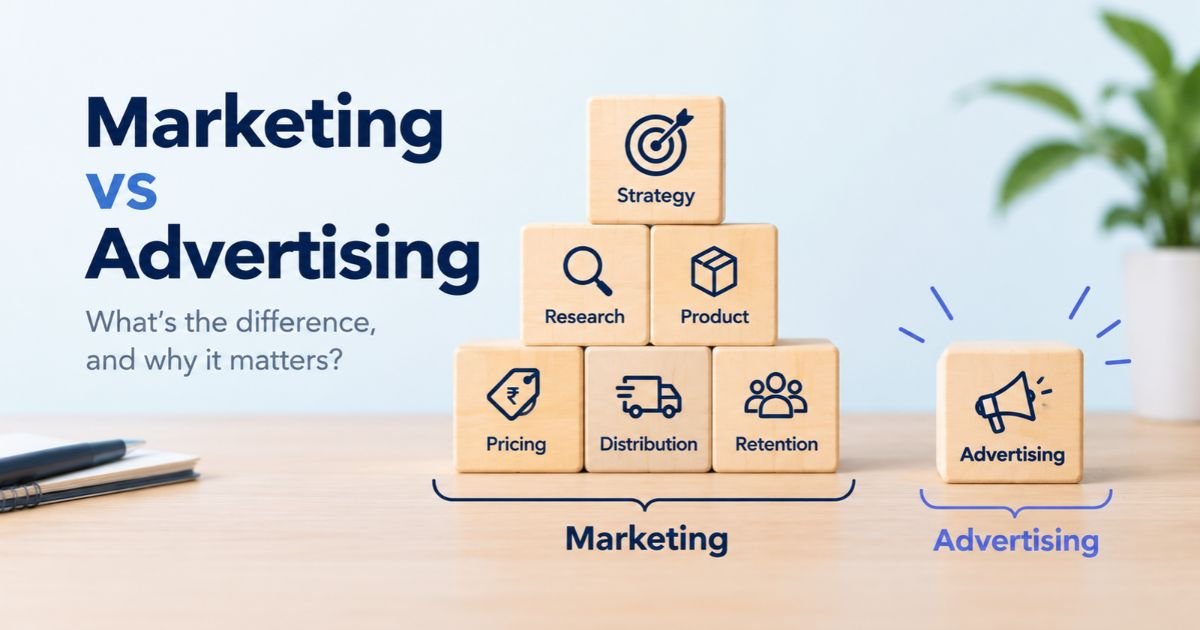
Here’s the short version. Marketing is the full system that finds customer needs, shapes the product and price, builds demand and keeps buyers coming back. Advertising is one paid part of that system: you pay to put a message in front of a chosen audience. Every ad is marketing. Most marketing is not an ad.
The numbers show why this matters right now. According to WARC Media’s Q3 2026 forecast, published on 7 October 2026, global ad spend will grow 11.9% to $1.34 trillion this year. Yet Gartner’s 2025 CMO Spend Survey found that marketing budgets sat at 7.7% of company revenue for the second year running. More money is chasing ads inside budgets that aren’t growing.
This guide shows you where each discipline starts and stops, which tools belong to each, and how to split your effort so neither one starves the other.
What Is Marketing, and What Does It Cover?
Marketing is the process of finding out what customers need, then creating, communicating and delivering value that makes them buy and buy again. It covers research, product, pricing, distribution, promotion and retention. Advertising sits inside promotion, which is only one of those areas.
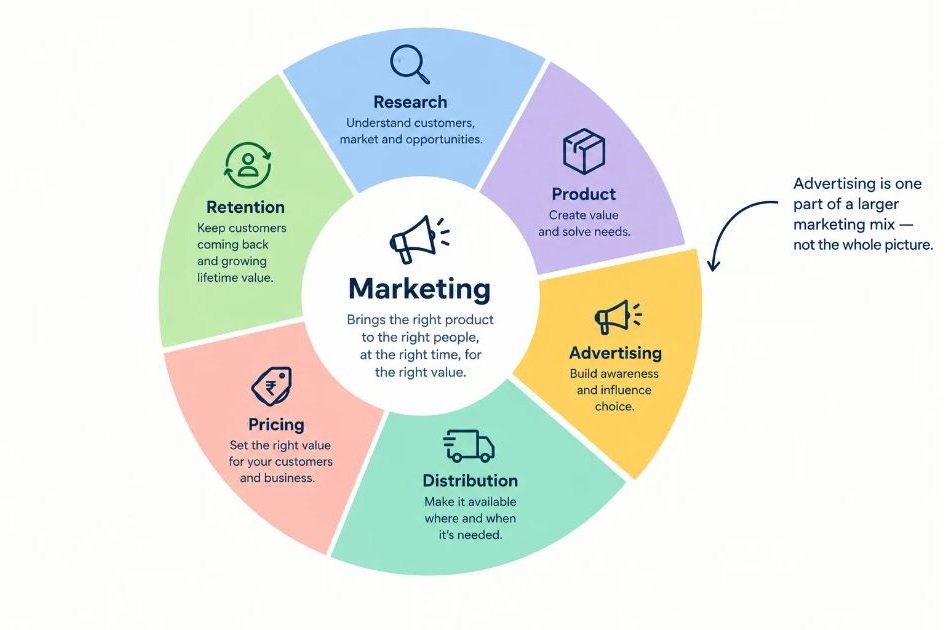
Think of marketing as the job of making a sale likely before anyone clicks anything. The classic model for this is the 4Ps (Product, Price, Place, Promotion), introduced by the American marketing professor E. Jerome McCarthy in 1960. More than sixty years later, it still gives you the fastest way to see how wide the discipline really is.
What the 4Ps Tell You About Scope
- Product: what you sell, how it’s packaged, and which problem it solves better than the alternative
- Price: what you charge, what discounts you allow, and how your price compares with what buyers already pay
- Place: where and how people can buy, from your own website to quick commerce apps to physical shelves
- Promotion: how people hear about you, which includes ads, content, PR, email, events and word of mouth
Notice that three of the four have nothing to do with ads. A brilliant campaign can’t rescue a product nobody wants or a price nobody will pay.
Where Marketing Touches the Customer Journey
Marketing works before the sale (research, positioning, awareness), during it (offers, landing pages, sales support) and after it (onboarding, email, loyalty, referrals). That last stretch is where most small teams drop the ball.
Take Nykaa. It didn’t grow by shouting about lipsticks alone. The company built a beauty content hub, a loyalty programme called Nykaa Prive and a network of physical stores next to its paid campaigns. Ads brought people in. Everything else gave them reasons to stay and come back.
Marketing is the full process of researching customer needs, shaping the offer, communicating its value and retaining buyers after the sale. It is built on product, price, place and promotion, so it covers decisions that happen long before any ad runs. Advertising is one tactic inside the promotion area, not a synonym for the whole discipline.
What Is Advertising, and Where Does It Fit?
Advertising is paid communication through a chosen channel to promote a product, service or idea. You pay for the space or the impression, and you control the message, timing and audience. It’s the most visible tactic inside promotion, and also the easiest part of marketing to measure.
The word “paid” is the dividing line. Marketers often sort promotion into three buckets: paid (ads you buy), owned (your website, email list, app) and earned (press coverage, reviews, word of mouth). Advertising lives in the first bucket only.
Amul shows how long a paid idea can last. Its topical billboards featuring the Amul girl have run since 1966, which makes them one of the longest-running ad campaigns anywhere. The ads work because they sit on top of decades of product consistency and distribution, which is the marketing underneath.
Brand Advertising
Brand advertising builds recognition and preference over time. The goal is that when a buyer finally needs a product, your name is the first one they think of. TV, cinema, outdoor hoardings and YouTube video usually carry this work. You measure it with reach, recall and brand search growth, not same-day sales.
Performance Advertising
Performance advertising targets a specific action: a purchase, a lead, an app install. Google Search ads, Meta Ads and Amazon Sponsored Products dominate here. You measure it with return on ad spend (ROAS, which is revenue divided by ad spend), cost per acquisition and conversion rate.
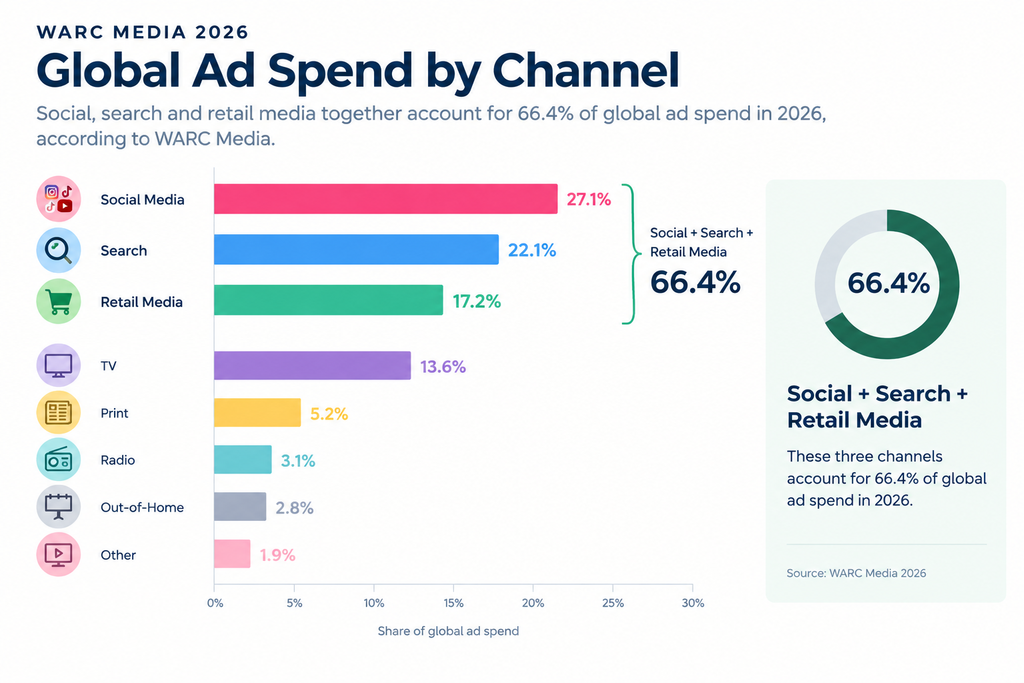
Performance ads now take most of the money. WARC Media’s October 2026 forecast puts social media, search and retail media together at 66.4% of global ad spend this year, rising to 70.0% by 2028. Social media alone is forecast to grow 21.3% to $394.6 billion.
One caution. Concentration is rising too. WARC expects Alphabet, Amazon and Meta to take 59.7% of global ad spend outside China in 2026, worth $659.6 billion. If most of your ad money goes through those three, you’re renting your audience from them.
Advertising is paid communication where you control the message, audience and timing. It splits into brand advertising, which builds long-term preference, and performance advertising, which drives a measurable action. According to WARC Media’s Q3 2026 forecast, social media, search and retail media account for 66.4% of global ad spend this year.
How Do the Two Compare? Scope, Goals, Cost and Metrics
The difference between marketing and advertising comes down to scope. Marketing is the whole strategy for creating and keeping customers. Advertising is a paid tactic inside it. Marketing decides who you serve and what you offer; advertising delivers the message once those decisions are made.
| Factor | Marketing | Advertising |
|---|---|---|
| Scope | Research, product, pricing, distribution, promotion, retention | Paid promotion in selected channels |
| Main goal | Create and keep profitable customers | Get a defined message in front of a defined audience |
| Time horizon | Long term, ongoing | Campaign based, often short term |
| Cost model | Salaries, tools, content, events, sometimes free channels | Pay per click, impression, view, or flat media fee |
| Control | Partial, since you can’t buy word of mouth or rankings | High, since you set budget, audience and timing |
| Measurement | Customer lifetime value, retention, market share, pipeline | ROAS, cost per click, cost per acquisition, reach |
| Typical owner | CMO, head of marketing, brand and growth teams | Media buyers, performance marketers, ad agencies |
| Stops when budget stops? | No, SEO and email keep working | Yes, ads stop the moment spend stops |
That last row matters more than people admit. Stop paying for ads and traffic drops within hours. Stop publishing content and the decline is slower, but it comes.
Where the Lines Blur
Real work doesn’t respect the table. Influencer posts mix paid placement with earned trust. Retail media, like Amazon Ads or Blinkit’s sponsored listings, sits inside the shopping experience itself. Boosting an organic Instagram post turns content into an ad with one tap.
A decent rule: if you paid for distribution, it’s advertising. If you paid for production or tools but not distribution, it’s marketing. Mixed cases count as both.
Gartner’s 2025 CMO Spend Survey, which covered 402 marketing leaders, shows how this plays out in budgets. Paid media took 30.6% of total marketing budgets, equal to 2.4% of company revenue. In other words, even at big companies, roughly two-thirds of the budget goes to everything that isn’t buying media.
Marketing is the long-term strategy for creating and keeping customers, while advertising is the paid tactic that delivers a message to an audience you choose. Marketing keeps working when budgets pause; advertising stops when spend stops. Gartner’s 2025 CMO Spend Survey found paid media took 30.6% of marketing budgets, so most marketing money goes to work beyond media buying.
Which Marketing Tools Do You Need, and What Does Each One Do?
Marketing tools do five jobs: finding insight, attracting organic traffic, engaging people, managing relationships and measuring results. You don’t need all of them on day one. Start with research and analytics, then add one channel you can run consistently for six months.
Market Research and Listening Tools
These tools tell you what people want before you spend on anything else. Google Trends shows how search interest in a topic rises and falls by region, which is useful for timing launches. Survey tools like Google Forms and Typeform let you ask existing customers why they bought. Social listening tools such as Brandwatch track brand and category mentions across platforms.
Use them first. A week of research can stop a six-month mistake.
SEO Tools
SEO (search engine optimisation) earns traffic from search results without paying per click. Google Search Console is free and shows exactly which queries bring impressions and clicks to your site. Semrush and Ahrefs add keyword research, competitor analysis and backlink data, which is how you find topics worth writing about.
Search itself is changing. Google now puts AI-generated answers above many results, so ranking alone isn’t enough. Pages with clear definitions, direct answers and named sources get cited more often. That’s why SEO tools are worth pairing with a plan for being quotable.
Content Marketing Tools
Content marketing means publishing useful material, such as articles, videos and guides, that attracts buyers on its own merit. WordPress runs most business blogs. Canva handles quick graphics. NeuronWriter and Surfer SEO score drafts against pages already ranking, so you see which subtopics you’ve missed. Descript turns a recorded video or podcast into editable text, which helps you reuse one recording across five formats.
The tool matters less than the schedule. A mediocre blog updated weekly beats a beautiful one abandoned in March.
Email Marketing and Automation Tools
Email is your most reliable owned channel because no algorithm sits between you and your list. Klaviyo suits online stores, since it reads purchase data to trigger flows. Mailchimp and Brevo suit smaller teams that want simple campaigns at lower cost. HubSpot bundles email with a CRM when sales and marketing need one view.
Build three automated flows first: a welcome series, an abandoned cart reminder and a win-back message for lapsed buyers. Gartner’s 2025 survey noted that email was the exception among owned and earned digital channels, which mostly saw budget declines. Email kept its funding because it earns it.
Social Media Management Tools
Organic social media builds familiarity and gives customers a place to talk back. Buffer, Hootsuite, Sprout Social and Later schedule posts across platforms, collect replies in one inbox and report on engagement. Instagram’s and LinkedIn’s native analytics are free and good enough to start.
Be honest about the limits. Organic reach on most platforms is low unless your content is strong, which is why teams often pair social posts with paid boosts.
CRM Tools
A customer relationship management (CRM) tool stores every customer’s contact details, purchases and conversations in one place. HubSpot CRM has a free tier. Zoho CRM is popular with Indian small businesses for its pricing, and Salesforce serves larger sales teams with complex pipelines. Without a CRM, retention work is guesswork, because you can’t segment people you can’t see.
Analytics and Behaviour Tools
Google Analytics 4 (GA4) tracks how visitors find your site and what they do there. Looker Studio turns that data into shareable dashboards. Microsoft Clarity and Hotjar add heatmaps and session recordings, so you see where people hesitate or give up on a page.
Set up conversion tracking before you launch anything. Without it, neither marketing nor advertising can prove it worked.
PR and Influencer Platforms
Public relations earns coverage rather than buying it. Tools like Muck Rack help you find journalists who cover your category. For influencer work, platforms such as Qoruz (built for the Indian market) and Modash let you filter creators by audience location, engagement rate and past brand work. Check audience quality, not just follower count.
Marketing tools cover research, SEO, content, email, social, CRM, analytics and PR. Most of them build assets you own, like search rankings, email lists and customer data, which keep producing after you stop spending. Start with research and analytics, then add one channel you can sustain.
Which Advertising Tools Should You Know, and When Does Each Pay Off?
Advertising tools are the platforms where you buy audience attention: search engines, social networks, video, marketplaces, programmatic exchanges and traditional media. Pick based on where your buyers already spend time and how directly you need sales. Search captures existing demand; social and video create it.
Google Ads
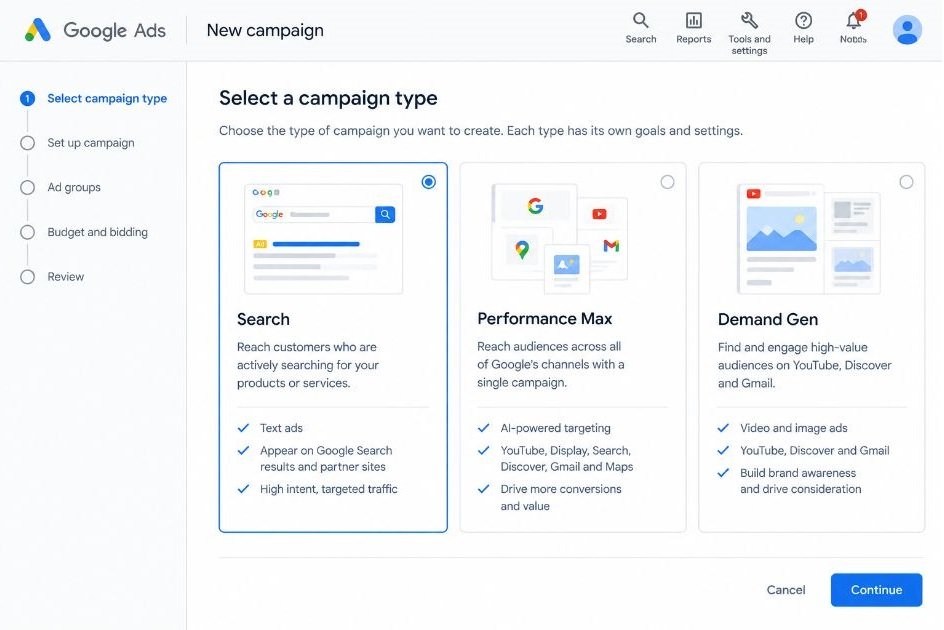
Google Ads covers Search, Shopping, YouTube, Gmail, Maps and partner sites. Search campaigns show your ad when someone types a related query, which makes them the closest thing to buying intent you can purchase. Performance Max uses Google’s AI to run one campaign across all those placements.
Google’s 2026 changes are big. AI Max, now a core part of Search campaign management, expands matching beyond your keywords and can generate ad text. At Google Marketing Live 2026, the company also showed ads inside AI Mode and added Demand Gen placements in Google Maps. Demand Gen has replaced the older Video Action campaigns and is absorbing parts of Display.
Review search terms and AI-written copy regularly. Automation saves time, but it spends your money whether or not it understands your margins.
Meta Ads Manager
Meta Ads Manager runs ads across Facebook, Instagram, Messenger and WhatsApp. Its strength is audience building: you can reach people by interests, behaviour or lookalikes of your best customers. Advantage+ campaigns automate audience and placement choices, and work best when you feed them plenty of strong creative.
Install the Meta Pixel and the Conversions API so the platform can see purchases accurately. Poor tracking is the most common reason Meta campaigns look worse than they are.
YouTube Ads
YouTube suits both brand and performance goals. Skippable in-stream ads charge you when viewers watch past a threshold or click, bumper ads are six-second reach plays, and Demand Gen campaigns now carry conversion-focused video. YouTube works well for products that need demonstration, like skincare, gadgets and software.
Creative decides everything here. The first five seconds must give viewers a reason to stay.
LinkedIn Campaign Manager
LinkedIn lets you target by job title, seniority, company size and industry. That precision makes it the default for B2B, especially for high-value deals. Costs run higher than on most other platforms, so it rarely pays off for low-priced products. Pair it with lead magnets such as reports or webinars rather than asking cold audiences to book a demo.
Amazon Ads and Retail Media
Retail media means advertising inside a store’s own platform. Amazon Ads (Sponsored Products, Sponsored Brands and Sponsored Display) puts your listing at the top of search results where people are ready to buy. Flipkart, Blinkit and Zepto run similar ad systems in India. WARC counts retail media inside the 66.4% share of global spend held by social, search and retail media, and dentsu names it a growth driver for India.
It works because the shopper is already in buying mode. The catch is that you’re competing on price and reviews, so a weak product page wastes the click.
Programmatic Platforms
Programmatic advertising uses software to buy ad space across thousands of websites and apps in real time. Google’s Display & Video 360 and The Trade Desk are the two big demand-side platforms, and both reach connected TV (CTV), which is internet-delivered streaming on television. Programmatic gives you scale and detailed targeting, but it needs careful brand-safety settings and a clean way to measure results.
Traditional Media: TV, Print, Radio and Outdoor
Traditional channels still matter, especially in India. The dentsu-e4m Digital Advertising Report 2026 puts India’s 2025 ad market at ₹1,21,339 crore, with digital at ₹71,621 crore (59%), television at ₹25,964 crore (21%) and print at ₹16,594 crore (14%). Radio and outdoor buys suit local campaigns and high-frequency reminders.
Outdoor is quietly modernising. WARC forecasts digital out-of-home spend to rise 13.7% to $21.7 billion in 2026, because screens let you change creative by time of day or weather.
Advertising tools let you buy attention on search, social, video, marketplaces, programmatic exchanges and traditional media. Google Ads, Meta Ads Manager and Amazon Ads dominate performance buying, while TV, print and digital outdoor still carry brand reach. Google’s 2026 shift toward AI Max, Demand Gen and ads in AI Mode means more automation, so you’ll need to check results more carefully.
How Do the Two Work Together in a Real Campaign?
Marketing sets the plan and builds the foundation; advertising adds reach and speed on top of it. A campaign works when research picks the audience, the offer fits it, content and email prepare and convert it, and ads put the whole thing in front of more people.
boAt is a decent Indian example. The brand pairs cricket-linked advertising with products priced for young buyers and a strong presence on marketplaces like Amazon. The ads create visibility, but the pricing, product range and marketplace placement convert it. Pull out any one piece and the result changes.
Here’s the sequence that makes the two work together.
- Research first. Use Google Trends, customer surveys and Search Console to pick one audience and one problem to solve.
- Fix the offer. Check product, price and delivery against competitors before spending on traffic.
- Build the landing page and tracking. Install GA4, the Meta Pixel and conversion tracking on every key action.
- Publish content that answers buyer questions. Aim each piece at a real search query, and reuse it as ad creative later.
- Launch ads to the warmest audience first. Start with Search for people already looking, then add Meta or YouTube to reach colder audiences.
- Capture and nurture. Send every lead or buyer into email flows through your CRM, so one click turns into repeat revenue.
- Review monthly. Cut weak ads, expand what converts, and feed what you learn back into research.
The loop matters. Ad data shows which messages people respond to, and that data should reshape your content and product pages.
How Should You Split Your Budget Between the Two?
Start with a benchmark, then adjust for your stage. Gartner’s 2025 CMO Spend Survey found the average marketing budget is 7.7% of company revenue, with paid media taking 30.6% of that. That leaves about 70% for people, content, tools, research and events.
That benchmark has a limit. Gartner surveyed 402 leaders, mostly at companies earning over $1 billion a year. A young D2C brand with no audience will usually lean much harder on paid media, because it has no search rankings or email list to fall back on yet. It depends on your margins and how fast you need results, but the direction is clear: shift money toward owned assets as you grow.
Three practical rules help.
- Protect the foundation. Keep funding research, analytics and email even in a tight quarter. They make every ad rupee work harder.
- Cap experiments. Give new ad channels a fixed test budget and a clear success metric before you scale.
- Track both short and long returns. Use ROAS for ad performance and customer lifetime value to judge whether the whole system is profitable.
Budget pressure is real. In the same Gartner survey, 59% of CMOs said they didn’t have enough budget to execute their strategy, and 39% planned to cut agency spending. Teams that treat marketing and advertising as one connected budget make those trade-offs with fewer mistakes than teams that fund them in separate silos.
Also watch the spending trend. WARC expects global ad growth to slow to 8.4% in 2027, reaching $1.46 trillion. Competition for attention stays high, but the easy growth years are cooling.
What Mistakes Do Teams Make, and What Should You Do Next?
The most common mistake is treating marketing vs advertising as a choice between two options. You don’t pick one. You decide the order and the ratio. Ads without foundation leak money; foundation without ads grows slowly.
Here are the errors that show up most.
- Running ads before the offer is ready. If the product page is weak, more traffic just means more people leaving.
- Judging brand ads by sales. Awareness work needs reach and brand search metrics, or you’ll cut it too early.
- Ignoring tracking. If you can’t tell which source produced a sale, you’ll keep funding the loudest channel instead of the best one.
- Letting automation run unchecked. Performance Max and Advantage+ do well with good inputs and badly with poor ones.
- Neglecting existing customers. Most teams spend heavily to acquire and almost nothing to retain.
So what should you do this week? Pick one action from each side. On the marketing side, set up GA4 conversion tracking and one automated welcome email. On the advertising side, launch a small Search campaign against your three highest-intent keywords, with a fixed budget and a clear target cost per acquisition. Review both in 30 days.
Conclusion
Three ideas are worth keeping. Marketing is the whole customer system, and advertising is the paid slice that gives it reach. The difference between marketing and advertising shows up in your budget, your timeline and the way you measure success, so judge each one by its own metrics. And the strongest results come from sequence: research, offer, tracking, content, then ads, then retention.
Your next step is small. Pick one tool from each list above, set it up this week, and review the numbers in a month. That single loop teaches you more than another round of reading.
If you want a steady stream of practical breakdowns like this one, written for working marketers, the Crystal Clear Newsletter is where we send them. It covers what’s changing in ad platforms, what’s worth testing, and what to ignore, so you can decide faster with less noise.
FAQs
What is marketing in simple terms?
Marketing is everything a business does to understand customers and make them want to buy from it. That includes research, product decisions, pricing, content, email, events, partnerships and ads. The goal is to create customers who buy once and come back.
What is advertising in simple terms?
Advertising is paid communication that puts your message in front of a specific audience. You pay a platform or media owner for space or attention, such as a Google search result, an Instagram story or a TV slot. You control what the ad says, who sees it and when.
Is advertising the same thing as marketing?
No. Advertising is one part of marketing, specifically the paid promotion part. Marketing also covers research, product, pricing, distribution, content, email and customer retention. You can do marketing without advertising, but you can’t run advertising well without marketing decisions behind it.
Which should a new business start with, ads or marketing?
Start with the marketing basics: know your customer, fix your offer and set up tracking. Then add a small amount of paid advertising to test what works. Running ads first usually burns cash, because you can’t tell whether poor results come from the ad or from a weak offer.
What are the main types of advertising?
The main types are search ads, social media ads, video ads, display and programmatic ads, retail media ads, and traditional media such as TV, radio, print and outdoor. You can also split them by goal: brand advertising for awareness and performance advertising for measurable actions. Most businesses use two or three channels, not all of them.
Which marketing tools should a small business use first?
Start with Google Analytics 4 and Google Search Console, since both are free and show how people find you. Add one email tool such as Brevo or Mailchimp, and a free CRM like HubSpot CRM. Then pick a single content or social channel and publish on a fixed schedule.
How do I measure whether ads and marketing are working?
Measure ads with return on ad spend (ROAS), cost per acquisition and conversion rate. Measure wider marketing with customer lifetime value, repeat purchase rate, organic traffic growth and email list growth. Check them together, because ads can look profitable while hiding poor retention, and strong retention can make expensive ads worthwhile.
Is paid advertising worth it on a small budget?
Yes, if you keep it narrow. Put the whole budget on one high-intent channel, usually Google Search, and target a small set of buying keywords. Avoid spreading ₹10,000 across five platforms, because none of them will get enough data to learn. Expect to test for several weeks before judging.
Why isn’t my ad spend turning into sales?
Usually the problem sits after the click. Check your landing page speed and clarity, your price against competitors, and whether your tracking records purchases correctly. Then look at targeting and creative. Most teams blame the platform first, when the offer or the page is the actual leak.
Can I skip ads and just do SEO?
You can, but growth will be slower. SEO builds traffic that keeps arriving without per-click costs, yet it takes months to rank, and AI answers on Google now take some clicks away. Ads give you immediate traffic and data. Most healthy businesses use SEO for long-term demand and ads for speed.


Geofencing Marketing: Benefits, Examples & How It Works
October 23, 2026 - 11:12 am[…] around a real place and triggers a pre-set action when a mobile device crosses that perimeter. In marketing, the action is almost always an ad, a notification, or an audience […]