
Most product launches don’t fail because the product is bad. They fail because nobody checked whether the market wanted it. Engineers build what they find interesting, executives back what they believe in, and sales ends up pitching features no buyer asked for.
Pragmatic Marketing is the discipline built to stop that. It starts outside the building, with real buyers and real problems, then works backward to the product, the price, the pitch and the launch.
If you’re a marketer, product manager or founder, the stakes are practical. Every feature built for a problem that doesn’t exist is wasted salary, wasted time and a slower launch. Pragmatic Institute, the company behind the approach, says more than 8,000 active companies now use its framework.
This guide breaks the idea down for beginners. You’ll see where it came from, how its 37 activities fit together, what every tool does, and how real brands show the same thinking. You’ll also get a step-by-step plan to start using it this quarter, plus ten FAQs at the end.
What Does the Pragmatic Approach to Marketing Actually Mean?
The pragmatic approach is a market-driven method for building and marketing products. You decide what to build based on validated customer problems, not internal opinions. Then you position, price, launch and sell the product around those same problems, so every team works from the same evidence.
Pragmatic Marketing explained in one line: build only for problems that are urgent, widespread and worth paying to solve. Everything else in the method supports that single filter.
Here’s the catch. Most companies do the opposite. They start with a product idea, then go looking for a market that fits. Quibi is the classic cautionary tale. Reuters reported in 2020 that the short-video streaming service announced its shutdown about six months after launch, despite raising roughly $1.75 billion. The money was never the problem. The missing proof of demand was.
The pragmatic approach flips that order with three habits:
- Outside-in thinking. Answers sit with buyers, not in meeting rooms. Your team’s opinions, however smart, count as guesses until the market confirms them.
- Problems before solutions. You define the problem a segment has, how often it occurs and what it costs, before anyone sketches a feature.
- One shared language. Product, marketing, sales and leadership use the same terms for the same activities, which cuts the usual turf wars.
All of this sits inside the Pragmatic Marketing Framework, a visual map of 37 activities that Pragmatic Institute now simply calls the Pragmatic Framework. We’ll walk through it box by box.
Is this different from regular marketing? Yes, mostly in where it starts. Campaign-led marketing begins with a message and looks for an audience. The pragmatic approach begins with an audience’s problem and builds the message afterward.
The pragmatic approach to marketing is a market-driven method that validates customer problems before anything is built, priced or launched. Teams only pursue problems that are urgent, widespread and worth paying to solve. A shared framework gives product, marketing and sales one language for the work.
Where Did the Pragmatic Framework Come From?
The Pragmatic Framework began at a training company founded in 1993 that taught product managers and marketers a market-driven process. That company was later renamed Pragmatic Institute. Today the framework is its visual map of the work, organised as 37 activities across seven categories.
The company started life as Pragmatic Marketing, which is why the older label still shows up in blogs, job listings and search results. Pragmatic Institute says the framework was once popularly called the Pragmatic Marketing Framework, so if you see that phrase in an older book, it’s the same thing.
A few details help you judge how established it is. Steve Johnson, a founding instructor who spent more than 15 years teaching the method, left to start his own consultancy and returned as vice president of products in October 2018, according to a company press release. The firm later combined with The Data Incubator to form Pragmatic Institute, and by 2026 it also teaches AI product management and AI product marketing.
Pragmatic Institute reports 250,000+ total alumni, 40,000+ active community members and 8,000+ companies using the framework. Treat those as the vendor’s own numbers, not independent research. They’re still a useful signal of reach.
One more thing worth knowing. Box names have shifted across versions. Older maps listed items such as Technology Assessment and Thought Leadership, while newer ones use labels like Asset Assessment and Advocacy. If a blog post disagrees with this guide on a box name, check the publication date first.
How Is the Pragmatic Framework Structured?
The Pragmatic Framework has 37 boxes arranged in seven categories: Market, Focus, Business, Planning, Programs, Enablement and Support. Each box is one activity, such as win/loss analysis or pricing. Strategy sits on the left and execution on the right, so work flows from market insight to launch support.
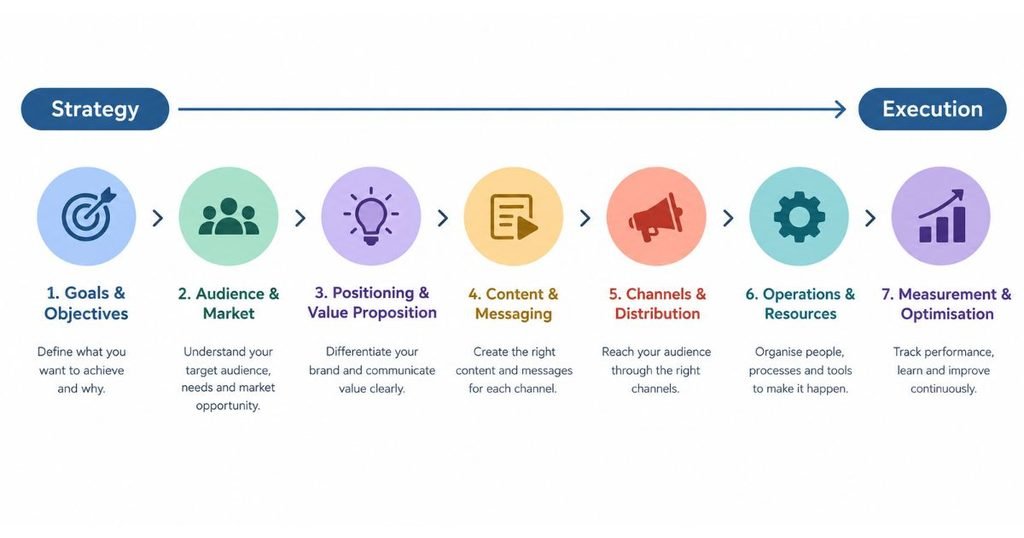
Think of the seven categories as seven questions your team keeps answering.
| Category | Question it answers | Example tools |
|---|---|---|
| Market | What do buyers struggle with? | Market Problems, Win/Loss Analysis |
| Focus | Where should we play? | Market Definition, Product Roadmap |
| Business | Will this pay off? | Business Plan, Pricing |
| Planning | How do we describe and specify it? | Positioning, Buyer Personas |
| Programs | How do we create demand? | Launch, Awareness, Measurement |
| Enablement | How do we help sales sell it? | Sales Tools, Channel Training |
| Support | How do we help the rest of the company? | Events, Operations |
Pragmatic Institute also publishes a short set of “Pragmatic Rules” alongside the map. Two matter most for beginners. First, win/loss interviews should be run by someone who wasn’t involved in the deal, because salespeople unconsciously protect their own story. Second, the building is full of product experts, but your company needs market experts.
The framework doesn’t tell you how to code, design or run a campaign. It tells you which activities need an owner. In Pragmatic Institute’s 13th annual survey of product professionals, the team found a gap between how important certain activities are considered and how well they get performed. That gap is the whole reason to use a map.
The Pragmatic Framework organises 37 product and marketing activities into seven categories: Market, Focus, Business, Planning, Programs, Enablement and Support. Strategy activities sit on the left and execution activities on the right. Its main use is showing which activities exist, who owns them and where performance lags importance.
Now to the part most guides skip: what each tool actually does. I’ve grouped them by category below. Box placement can differ slightly between versions, so treat the grouping as a guide.
Market Tools: How Do You Find Problems Worth Solving?
Market tools are four activities that reveal what buyers struggle with, why they buy or walk away, what you do uniquely well and who you really compete with. They come first because every later decision, from pricing to positioning, depends on this evidence.
Market Problems is the foundation. You interview current customers, recent evaluators and prospects who never bought, then check whether each problem is urgent, pervasive and worth paying for. Ask about the last time the problem hit, what they did about it and what it cost. Don’t pitch. The second you describe your product, people start being polite instead of honest.
Win/Loss Analysis explains why recent evaluators did or didn’t buy and which steps they followed. Interview them within weeks of the decision, while memory is fresh. Use someone outside the sales team, since buyers tell a neutral interviewer things they’d never tell the rep. Honestly, this is the most underused tool in the whole framework.
Distinctive Competencies are the abilities your organisation has that rivals can’t easily copy and buyers actually value. “Great customer service” rarely qualifies, because everyone claims it. A real competency is something like proprietary data, a hard-to-replicate distribution network or deep expertise in one regulated industry.
Competitive Landscape maps the alternatives buyers consider, then assesses each one’s strengths and weaknesses and sets a plan for winning. Include the non-obvious rivals. For Zepto, the quick commerce startup, the competition isn’t only Blinkit and Swiggy Instamart. It’s also the neighbourhood kirana store and the habit of one big weekly grocery trip.
Focus Tools: How Do You Decide Where to Play?
Focus tools are four activities that narrow your attention to the segments, channels, products and plans most likely to succeed. They stop a company from chasing every opportunity at once, which is the fastest way to build a mediocre product for everybody.
Market Definition identifies which segments to pursue and checks that each is large enough to support the current and future business of the product. A segment that looks attractive but holds only a few hundred buyers won’t carry a roadmap. Size it before you commit.
Distribution Strategy decides which channels best fit how your market prefers to buy. Some buyers want a self-serve free trial. Others expect a demo, a reseller or an app-store listing. Picking the wrong channel can sink a good product.
Product Portfolio means managing your set of products as one coherent offer for the market, with each product serving a clear purpose. Pragmatic Institute suggests managing the portfolio like a product of its own, with a plan, positioning and requirements. Nykaa offers a useful picture here: it grew from an online beauty retailer into physical stores and its own labels, and each move served the same shopper.
Product Roadmap is the plan for what gets built and when, tied to validated market problems. A roadmap built from feature requests is a wish list. A roadmap built from ranked, verified problems is a strategy, and it’s much easier to defend in a leadership review.
Business Tools: How Do You Know a Product Will Pay Off?
Business tools are six activities that test whether a product opportunity makes financial sense. They cover the investment case, pricing, how to fill gaps in your offer, ongoing profitability, innovation and the assets you already own.
Business Plan is an objective analysis of a market opportunity that supports an investment decision. It pulls together what you learned from the market, quantifies the risk and includes a financial model. Write it for a skeptical finance leader, not for a cheerleader.
Pricing sets the pricing model, schedules, guidelines and procedures. Price follows value as buyers perceive it, not your cost. Netflix is a good example of adapting to the market: it introduced a mobile-only plan in India in 2019, at roughly ₹199 a month, to match how many Indians watch video.
Buy, Build or Partner is the decision about how to deliver a complete solution when your offer has gaps. Building gives control but takes time. Buying gives speed but costs money and integration effort. Partnering is cheaper but means you depend on someone else’s roadmap.
Product Profitability checks whether a product earns more than it costs over time. Many companies keep old products alive out of habit. Reviewing profitability regularly tells you what to fund, fix or retire.
Innovation points your team’s creativity at solving market problems using your distinctive competencies. It isn’t a hackathon with no brief. It’s creative work with a clear target.
Asset Assessment is taking stock of what you already own, such as technology, content, data and customer relationships, before you build or buy something new. You’ll often find half the solution is already sitting in another team’s backlog.
Planning Tools: How Do You Turn Insight Into Positioning and Requirements?
Planning tools are seven activities that turn market research into the documents teams actually use: positioning, personas, buyer experience, requirements, scenarios and stakeholder updates. They translate what you learned into decisions that product, marketing and sales can act on.
Positioning describes the product by the market problems it solves, using your distinctive competencies. Start with an internal positioning document, then build external messages for each key buyer or persona from it. A simple starting template: “For [persona] who struggles with [problem], our [product] provides [benefit], unlike [alternative].”
Take boAt, the Indian audio brand. It built its identity around young buyers who wanted style and low prices, a clear persona, a clear problem and a clear promise.
Buyer Experience maps what a buyer goes through from first hearing about you to signing, including who’s involved and which questions they ask at each step. It’s the reference point for sales alignment later.
Buyer Personas describe the people who evaluate, influence and approve the purchase. In B2B there can be five or six of them in one deal. Each has different problems, so each needs different messages.
User Personas describe the people who use the product every day, who may never touch the budget. Missing the user persona is how companies sell something that nobody wants to log into.
Requirements describe the market problem in enough detail for engineering to design a solution. They state what the buyer needs, not how to build it. Hand engineers a problem and they’ll often surprise you with a better solution than you’d have specified.
Use Scenarios are short stories showing how a persona solves a problem with the product. They help designers and developers see the context, and they give marketers ready-made material for messaging.
Stakeholder Communications keeps executives, developers, sales and support updated on what’s coming and why. It sounds administrative. It prevents most of the surprises that cause friction between teams.
Programs Tools: How Do You Create Demand and Grow Revenue?
Programs tools are eight activities that create awareness, move prospects through the buying process and keep revenue growing after the sale. They connect your strategy to the funnel, and they put numbers on whether it’s working.
Marketing Plan is the plan for the upcoming fiscal period, including key programs and events, each with a measurement attached. If a program has no measurement, it’s a hope, not a plan.
Revenue Growth covers programs aimed at winning new revenue, such as new segments, new regions and new offers. Revenue Retention is the mirror image: keeping and expanding revenue from existing customers through onboarding, renewals and upsells. Retention is usually cheaper than acquisition, so don’t treat it as an afterthought.
Launch is the coordinated plan for bringing a product or release to market. Zepto’s early launch was built around one clear message, groceries in ten minutes, which made the product easy to understand and repeat. A launch that tries to say five things usually lands none.
Awareness programs raise your profile within the segments you chose, bringing more prospects into your funnel. Content, search, events and PR all sit here.
Nurturing moves prospects quickly and effectively through the buying process after they show interest. Email sequences, webinars and targeted content help. The aim is helpfulness, not pressure.
Advocacy turns satisfied customers into references and amplifies their voice in the market through case studies, reviews and testimonials. Buyers trust peers more than vendors.
Measurement tunes programs so they stay aligned with corporate goals. Track pipeline, conversion and retention, not only clicks.
Programs tools in the Pragmatic Framework cover the marketing plan, revenue growth, revenue retention, launch, awareness, nurturing, advocacy and measurement. Each program should have a measurable link to a corporate goal. Retention and advocacy matter as much as acquisition because existing customers fund the next stage of growth.
Enablement and Support Tools: How Do You Help Sales and Everyone Else Win?
Enablement tools equip sales and channel partners to sell the product, while support tools feed market knowledge to marketing, operations, events and channels. Together they make sure the insight you gathered actually reaches the people who talk to buyers.
Sales Alignment uses what you know about the market to help sales match their process to how buyers actually want to buy. If buyers run a three-step evaluation, your sales process shouldn’t skip the second step.
Content supplies the assets buyers and sellers need at each stage, such as white papers, case studies, comparison pages and demos. Write for a specific persona at a specific step, not for “everyone”.
Sales Tools are materials built for one step of the selling process. Battle cards against a named competitor are a good example, and many teams keep them in sales enablement platforms such as Highspot or Seismic. One tool per step beats a bloated sales deck.
Channel Training teaches sales channels how to sell the product, not how to use it. That distinction matters. A reseller who knows every feature but can’t explain the buyer’s problem will lose deals.
The four support tools work differently. They don’t create assets. They supply market and solution information to the teams that do.
Programs support supplies market and solution knowledge to internal and external marketing programs. Operations support does the same for the operations group, so launches don’t collide with delivery realities. Events support covers conferences, trade shows and webinars, where product and marketing staff brief presenters and booth teams. Channels support helps partners and resellers pursue opportunities with accurate information.
You’ll rarely do all eight well at once. That’s normal.
How Do You Start Using the Pragmatic Framework This Quarter?
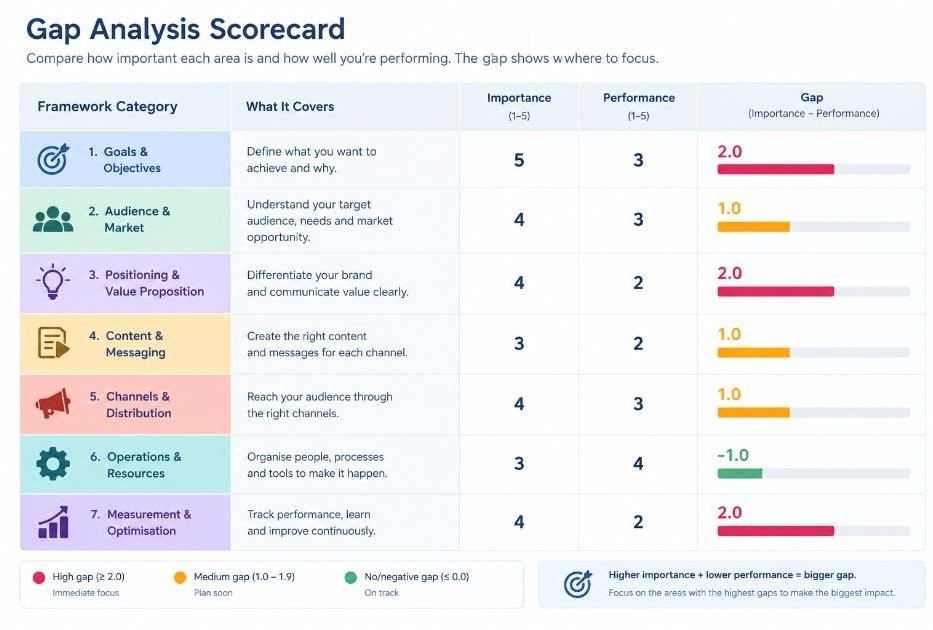
To start, map every framework box to an owner, score each for importance and performance, then fix the biggest gap first. Most teams find that Market Problems and Win/Loss Analysis are weak, so customer interviews are usually the best first move.
Here’s what that looks like in practice. Pragmatic Marketing explained at the team level isn’t a big transformation project. It’s a series of small, ordered moves.
- Map the boxes to owners. Print the framework. Mark each box as owned, shared or nobody’s. Unowned boxes explain most of your recurring problems.
- Run a gap analysis. Score each box for importance and current performance. Pragmatic Institute offers a gap analysis tutorial for exactly this, covering roles, priorities and performance.
- Interview the market. Schedule customer, lost-deal and non-buyer interviews. Aim for ten to fifteen as a starting point, adjusting for how varied your segments are.
- Write one positioning document per persona. Focus on the problem you solve, not the features you ship.
- Tie the roadmap to problems. Every roadmap item should link to a validated market problem. If it doesn’t, ask why it’s there.
- Give sales one tool per buying step. Start with the step where deals stall most.
- Measure and revisit every quarter. Re-run the gap analysis and compare scores.
Steve Johnson has also shared a 13-week guided implementation plan through Pragmatic Institute’s community resources, which is worth reading if you want a more structured rollout.
The best Pragmatic Marketing strategies share one trait: they stay small and specific. Pick one product, one segment and three boxes. Prove the value there, then expand.
A quick warning on Agile teams. The framework and Agile don’t conflict. The framework decides what problems are worth solving, and Agile decides how fast you build the solution. Pragmatic Institute even hosts community discussions on aligning the two.
What Do Real-World Examples of the Pragmatic Approach Look Like?
Real examples show the same pattern: a clear market problem, a focused segment, positioning built around that problem and a launch that’s easy to repeat. These Pragmatic Marketing examples mix one documented training result with brands that illustrate the thinking.
A fair note first. Only the first example is a documented framework result. The others are brands read through the pragmatic lens. None of them claims to follow the Pragmatic Framework, so treat them as illustrations, not endorsements.
Wolters Kluwer is the documented case. Pragmatic Institute reports that the information services company saw a time to market reduction of more than 50% after its product teams took Pragmatic training, according to Brian Diaz, Director of Product. It’s a vendor-reported result, so apply the usual caution, but it shows the kind of outcome teams aim for: less rework, because decisions rest on market evidence.
Zepto shows Market Problems and Launch working together. The problem was clear and urgent for many urban shoppers: needing groceries fast, without a long trip. The launch message, ten-minute delivery, was simple enough to repeat anywhere.
Nykaa shows Product Portfolio and Distribution Strategy. It began as an online beauty retailer, then added physical stores and its own brands, extending the same customer relationship across more channels and products.
boAt shows Positioning and Buyer Personas. By pitching style and affordability to young Indian buyers, it matched the message to a specific persona instead of speaking to everyone.
Quibi, from earlier, shows the opposite. Large funding and a polished product couldn’t replace validated demand.
What links the successes? Each one found a specific problem, picked a specific audience and said one clear thing. The strongest Pragmatic Marketing strategies work the same way, and none of them needs a big budget to begin.
When Does the Pragmatic Approach Fall Short?
The pragmatic approach is strongest for B2B and technology products with defined buyers and sales processes. It’s weaker for fast-moving consumer products, creative brands and very small teams, where 37 boxes can feel like heavy paperwork.
To be fair, there are a few limits worth knowing before you commit.
It was built mainly with B2B technology in mind. Most Pragmatic Marketing examples you’ll find online come from software, and a D2C snack brand may need to adapt several boxes. Treat the Pragmatic Marketing Framework as a checklist for finding gaps, not a rulebook you must follow in order.
It’s also a map, not a method for every craft. You’ll still need design, engineering and campaign skills to carry out each activity. And the main training provider is a commercial vendor, so weigh the claims, including the ones in this article, against your own results.
Finally, it takes discipline. Customer interviews are slow and sometimes uncomfortable. Teams that skip them and only use the vocabulary end up with new labels on the same old habits.
What to Do Next
Three takeaways stand out. Validate problems before you build anything. Position the product around the problems you solve, one persona at a time. And give sales and channel partners tools tied to real steps in the buying process.
The map has 37 boxes, but you don’t need to master them all. Pick the three where your team is weakest, run ten customer interviews this month and see what changes in your next roadmap review.
Frequently Asked Questions
So what’s the Pragmatic Framework in simple words?
It’s a map of 37 activities that product and marketing teams use to build and sell products the market actually wants. The activities sit in seven categories, from market research to sales support. Pragmatic Institute created it, and older sources use a different name for it.
How is this different from traditional marketing?
Traditional marketing often starts with a product or message and looks for an audience. The pragmatic approach starts with validated market problems and builds the product, price and message around them. It also covers product management activities like roadmaps and requirements, not just promotion.
How many boxes does the framework have, and what are the categories?
It has 37 boxes in seven categories: Market, Focus, Business, Planning, Programs, Enablement and Support. Each box is a specific activity, such as Pricing or Win/Loss Analysis. Box names have changed slightly across versions, so check the publication date of any older material.
How do I start using it with a small team?
Pick one product and three boxes, usually Market Problems, Positioning and Sales Tools. Interview ten to fifteen customers or lost prospects, write one positioning document, and give sales a single tool for their weakest step. Score your progress after a quarter and add more boxes only if the first three paid off.
Who should use it?
Product managers, product marketing managers, founders and marketing leaders in companies selling to defined business buyers will get the most value. It also helps leadership teams that argue about priorities, because the map gives everyone a shared language. Solo creators or one-off projects rarely need it.
Is it only for software companies?
No, but it fits software and other technology products best, because those usually have defined buyers, longer sales cycles and frequent releases. The ideas, such as validating problems and writing positioning for each persona, work in many industries. You’ll just need to adapt boxes like Channel Training or Sales Tools.
Is Pragmatic Institute certification worth it?
It depends on your role and budget. Certification gives you a structured path, a shared vocabulary and an alumni community of 40,000+ active members, according to Pragmatic Institute. But the core ideas are learnable from free resources, so the value is mostly structure, practice and credibility, not secret knowledge.
Does the framework clash with Agile?
No. They answer different questions. The framework decides which market problems deserve attention and how to bring the solution to market. Agile decides how your team builds and ships in short cycles. Many teams use both, with market-validated problems feeding the Agile backlog.
What do most teams get wrong?
They adopt the vocabulary without doing the research. A team that writes “personas” from internal guesses and never interviews buyers hasn’t used the framework, it’s just renamed its assumptions. Another common mistake is trying all 37 boxes at once and finishing none.
Do I really need all 37 boxes?
Not at once, and probably not ever at full depth. Use the map to see which activities exist, then invest in the ones where importance is high and performance is low. Most teams get real value from a handful of boxes done properly.

