

Picture your best-ranking blog post. The ranking hasn’t moved, but the clicks have. Google answered the question above your link, and the reader never left the results page. That’s the quiet shift behind the Modern Marketing Concepts every growth team has to understand in 2026: attention is being intercepted by AI answers, privacy law is tightening around customer data, and ad platforms now run on automation you can’t fully see into.
The numbers explain the urgency. SparkToro, using Similarweb panel data, found that 68.01% of US Google searches between January and April 2026 ended without a click, up from 60.45% in 2024. At the same time, Salesforce’s 2026 State of Marketing research reports that 75% of marketing organisations now use at least one form of AI.
So the playbook has changed. This article covers the ideas that matter and the ten tools that put them to work: Semrush, Google Search Console, Google Analytics 4, HubSpot, Meta Advantage+, Google Performance Max, the WhatsApp Business Platform, Klaviyo, Canva and Descript. Each tool gets a plain explanation of what it does, who should use it and where it falls short. You’ll also get a 90-day plan, so you can start this quarter instead of bookmarking and forgetting.
What Has Changed in Marketing Going Into 2026?
Three shifts define marketing in 2026. AI answers reduce clicks from search, privacy rules push brands toward first-party data, and ad platforms automate targeting and creative. Growth now depends on being cited by AI systems, owning consented customer data, and feeding automation better inputs than your competitors do.
Start with search. The SparkToro study found that AI Overviews, Google’s AI-written answer boxes, appear on more than 20% of searches. Pew Research Center’s 2025 browsing study found that people clicked a traditional result on about 8% of visits when an AI summary appeared, compared with about 15% when it didn’t. That’s a big drop for any business that relies on organic traffic alone.
Then there’s AI inside the marketing team itself. The CMO Survey, run by Duke University’s Fuqua School of Business with Deloitte, reported in 2026 that AI now touches 24.2% of marketing activities, up from 13.1% in 2024. Gartner’s 2026 CMO Spend Survey found marketing leaders putting 15.3% of their budgets into AI initiatives. Salesforce adds a useful reality check: only 13% of marketers say they currently use agentic AI, meaning AI that completes multi-step tasks on its own.
Here’s the part most teams miss. Adoption is high, but advantage is not evenly spread. Everyone has access to the same AI writing tools, so the edge comes from your data, your distribution and your judgment.
| Marketing shift in 2026 | What changed | First action to take |
|---|---|---|
| 1. SEO to Search Everywhere | Customers discover brands through traditional search engines, AI answers, social platforms, and online communities. | Audit your brand’s visibility across Google, AI search tools, and social platforms. |
| 2. AI Assistance to AI-Powered Workflows | AI is moving beyond content generation into research, personalization, campaign optimization, and automated workflows. | Identify one repetitive marketing task to automate and measure its time savings. |
| 3. Broad Targeting to Personalized Experiences | Customers increasingly expect relevant content, offers, and messaging tailored to their needs and behavior. | Segment your audience using available customer data and personalize one campaign for each key segment. |
In 2026, 68.01% of US Google searches ended without a click (SparkToro, 2026), and AI now touches 24.2% of marketing activities (The CMO Survey, 2026). Brands that want growth need to be quoted inside AI answers, own their customer data, and give ad platforms strong inputs.
How Do You Get Found When AI Answers the Question First?
Get found by writing passages that AI systems can quote cleanly, then tracking whether you’re actually cited. This practice is called generative engine optimisation (GEO): structuring content so AI search tools such as Google AI Overviews, ChatGPT and Perplexity include your brand in their answers.
Traditional SEO still matters, because AI Overviews draw mostly from pages already ranking well. What changes is the unit of competition. Google extracts passages, not pages, so a single 50-word paragraph under a precise heading can win a citation while the rest of your article goes unread. Write the answer first, name your entities (tools, brands, frameworks) explicitly, and add original numbers that other sources will want to reference.
Does it pay off? Seer Interactive’s 2026 data found that brands cited inside AI Overviews earned a 15.74% paid click-through rate on the same queries, versus 11.19% for brands that weren’t cited. Treat that as directional, since it’s one agency’s dataset, but it matches what many teams are seeing: being quoted lifts everything around it.
Two tools make this measurable.
Semrush
Semrush is an SEO and visibility platform that covers keyword research, site audits, competitor analysis and, increasingly, AI search tracking. Its Keyword Magic Tool surfaces long-tail questions, which matters because AI Overviews trigger most often on low-volume informational queries. Its Site Audit flags technical problems that stop pages from ranking at all, and its AI visibility reporting shows whether your brand appears in answers from AI tools and how often competitors do.
Use it in a weekly rhythm: find ten question-style keywords, check who currently gets cited, then rewrite your page so the answer sits in the first two sentences. The limitation is cost. Plans are priced for agencies and mid-sized teams, and AI visibility data is sampled, so read it as a trend line, not a precise count.
Google Search Console
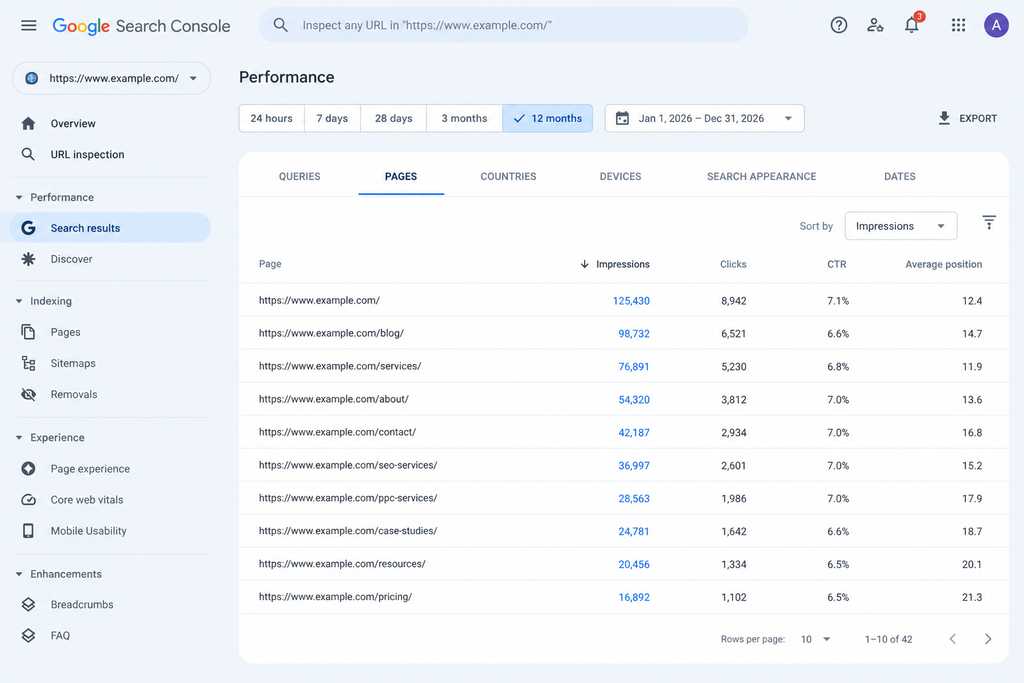
Google Search Console is Google’s free dashboard showing how your site performs in search, including queries, impressions, clicks, click-through rate and average position. Its Performance report is where you spot the new pattern: impressions rising while clicks stay flat, which usually means an AI answer or a featured result is absorbing the demand.
Open the Pages tab, sort by impressions, and look for pages with high visibility and a CTR below roughly 2%. Those are your rewrite candidates. Google has said clicks and impressions from its AI features are folded into the overall Web search data, so you can’t isolate AI Overviews cleanly. That’s the main limit. Still, it’s free, it’s first-party and it’s the closest thing to ground truth you’ll get.
Generative engine optimisation means writing answer-first passages with named entities and original data so AI search tools can quote them. Seer Interactive’s 2026 data showed brands cited in AI Overviews earned a 15.74% paid CTR versus 11.19% for uncited brands.
Why Is First-Party Data the Foundation of Every 2026 Plan?
First-party data is information customers give you directly, such as purchases, email sign-ups and WhatsApp opt-ins. In 2026 it matters more than ever because India’s DPDP Rules require verifiable consent, and AI tools only perform as well as the customer data you feed them.
India’s Ministry of Electronics and Information Technology notified the Digital Personal Data Protection (DPDP) Rules on 13 November 2025, putting operating detail behind the DPDP Act, 2023. Consent has to be clear, specific and tied to an active decision by the user. Penalties for serious violations can reach Rs 250 crore per instance, according to legal analyses published after the notification. Compliance rollout is phased, so check the current timeline with your legal counsel before you build.
Honestly, this is the best thing to happen to disciplined marketers in years. Brands that spent a decade renting audiences from third-party data brokers now face a simple choice: build your own list or fade out. Nykaa is a useful case, because its loyalty programme and beauty content give it a direct line to customers that a pure ad-driven competitor doesn’t have.
Two tools anchor this layer.
Google Analytics 4 (GA4)
Google Analytics 4 is Google’s event-based analytics platform, replacing the older session-based Universal Analytics. Every action, such as a page view, a scroll or a purchase, is recorded as an event, and you mark the important ones as key events. Its Explorations section lets you build funnel and path analyses without a developer, and the free BigQuery export lets your data team query raw events.
Set up consent mode so measurement respects what users agreed to, then connect GA4 to Google Ads so your bidding learns from real outcomes. Its predictive audiences, such as likely purchasers, help once you have enough volume. The catch: GA4’s interface has a learning curve, data sampling appears in heavy reports, and thresholds can hide small segments.
HubSpot Marketing Hub and CRM
HubSpot is a customer relationship management (CRM) system with marketing, sales and service tools built around one contact record. Its free CRM stores every interaction, forms capture consented data at the source, and workflows trigger emails or tasks based on behaviour. HubSpot also ships AI assistants, branded Breeze, for drafting content and summarising records.
It suits B2B teams and service businesses with longer sales cycles, where tracking one person across months matters. Start by importing your contacts, defining three lifecycle stages and building one nurture workflow. The trade-off is price: the free tier is generous, but advanced automation and reporting sit in paid Hub tiers that climb quickly as your contact count grows.
How Do You Run Paid Media When Platforms Control the Targeting?
Give the algorithm strong signals and strong creative, then judge it on business outcomes. Meta Advantage+ and Google Performance Max automate placement, bidding and audience discovery, so your job shifts to conversion data quality, creative variety and budget guardrails.
The temptation is to fight automation with narrow audiences and manual controls. It usually loses. Platforms see far more signals than you do, so the winning move is to improve what they learn from: accurate purchase events, clean product feeds, and a steady supply of different creative angles. Indian D2C brands such as Mamaearth and boAt grew up on paid social, which is exactly why creative testing became their main lever once targeting options flattened.
Two tools dominate this work.
Meta Advantage+ Campaigns
Advantage+ is Meta’s automated campaign setup inside Meta Ads Manager, covering sales, app and lead goals across Facebook and Instagram. You supply a budget, a conversion goal and a set of creative assets, and Meta’s system finds the audience and placement. Advantage+ creative options can generate variations of your images and video, such as adjusted crops and text overlays.
For best results, install Meta’s Conversions API alongside the pixel so purchase data reaches Meta even when browser tracking fails. Then feed it three to five genuinely different concepts, not five versions of one idea. Its weakness is transparency: reporting on who actually saw your ads is limited, and results can swing during the learning phase, so give a campaign about a week before changing anything.
Google Performance Max
Performance Max is a Google Ads campaign type that runs across Search, YouTube, Display, Discover, Gmail and Maps from a single campaign. Instead of building ad groups, you create asset groups containing headlines, descriptions, images, videos and optional audience signals, and Google assembles ads automatically.
It works best for retailers with a product feed in Google Merchant Center and clear conversion tracking. Add brand exclusions so it doesn’t take credit for customers who’d have searched your name anyway, and use asset-group reporting to learn which creative earns the conversions. The main drawback is the black-box feel. You get less control over placements than in a classic campaign, which makes disciplined measurement, covered below, non-negotiable.
Meta Advantage+ and Google Performance Max reward advertisers who supply accurate conversion data and varied creative, not narrow manual targeting. The practical rule is to improve inputs, give campaigns time to learn, and measure results against total business revenue.
Why Does Conversational Marketing Work So Well in India?
Conversational marketing works in India because customers already live inside messaging apps. WhatsApp has roughly 535 million monthly users in India, according to Statista-compiled figures reported in 2026, making it the largest national market on the platform. Brands that join those conversations, with consent, reach people where they actually pay attention.
Email still matters, but plenty of Indian shoppers check WhatsApp ten times a day and email once a week. That’s the whole logic. A cart reminder, a delivery update or a restock alert on WhatsApp sits in the same thread as a customer’s family chat, which gives it a visibility inbox-based channels rarely match.
The catch is trust. Spam gets blocked quickly, and under the DPDP framework, opt-in must be specific and withdrawable. Treat WhatsApp as a service channel first and a promotional channel second.
WhatsApp Business Platform
The WhatsApp Business Platform is Meta’s official API for companies, built for volume, automation and multiple agents on one number. It’s separate from the free WhatsApp Business app, which suits small shops. Through a Meta-approved provider, you can send pre-approved message templates in three categories (marketing, utility and authentication) and chat freely with customers inside a 24-hour window after they message you.
Practical uses include order confirmations, abandoned-cart reminders, catalogue sharing and customer support bots. Collect opt-in at checkout, keep templates short, and add a clear way to stop messages. Pricing: Meta moved to per-message charges in 2025, with marketing messages costing more than utility ones, so a campaign-heavy approach gets expensive. And because template approval takes time, plan promotions a few days ahead.
Klaviyo
Klaviyo is a marketing automation platform for email and SMS, built mainly for ecommerce brands that run on Shopify and similar storefronts. It syncs product, order and browsing data, then lets you segment customers by behaviour, such as people who viewed a product twice and didn’t buy. Automated flows (welcome series, browse abandonment, post-purchase) send messages without manual work, and its predictive features estimate customer lifetime value and churn risk.
Begin with just three flows: welcome, abandoned cart and win-back. Together they usually capture the most revenue per hour of effort. Klaviyo gets pricey as your profile count rises, and its strength is ecommerce, so service businesses may find HubSpot a better match. Pair it with WhatsApp: use email for richer storytelling and WhatsApp for time-sensitive nudges.
What Makes Short Video and Creator Content Work in 2026?
Short video works when it delivers one useful idea in the first three seconds and looks native to the platform. Creator partnerships work when the creator’s audience trusts them and the brief leaves room for their own voice. Polish matters less than relevance and speed of production.
Think about how boAt built its name. Celebrity and creator partnerships, plus a young, cricket-obsessed audience, did more for brand recall than traditional advertising ever could. Different category, same principle for your business: let people who already hold attention carry your message, then repurpose the best-performing clips into ads.
Volume is the real challenge. A single concept needs a vertical cut, a square cut, captions and a thumbnail, and manual editing eats hours. Two tools shrink that work.
Canva
Canva is a browser and mobile design platform for graphics, presentations and video, aimed at non-designers. Its Brand Kit stores your logo, fonts and colours so every asset stays consistent, Magic Resize converts one design into multiple formats, and its video editor handles trimming, captions and templates. Its AI features, grouped under Magic Studio, help generate images and rewrite text.
Use it to build a library of templates for your recurring content: product launches, testimonials, offers. A marketer can turn one idea into ten formats in under an hour. The downside is sameness. Canva’s popular templates show up everywhere, so customise colours, type and layout, or your content will look like everyone else’s.
Descript
Descript is an audio and video editor that works like a text document. It transcribes your recording, and deleting words from the transcript removes them from the video. It can also strip filler words, add captions and clean up background noise, which makes it a fast way to turn a founder interview or webinar into several short clips.
Record a 20-minute conversation, then cut five 30-second moments that each make a single point. Add captions, export vertical, and schedule across Instagram Reels and YouTube Shorts. Descript is weaker at heavy visual effects and fast-cut trend edits, so pair it with a creative editor if that’s your style. For talking-head and educational content, though, nothing saves more time.
How Do You Measure Growth When Attribution Is Unreliable?
Measure growth with blended metrics that don’t depend on tracking every click. Marketing efficiency ratio (MER) is total revenue divided by total marketing spend, and it shows whether your overall marketing is profitable. Pair it with incrementality tests and marketing mix modelling when budgets grow.
Platform-reported ROAS (return on ad spend) is getting harder to trust. Consent rules reduce trackable data, AI answers hide discovery moments, and every ad platform wants credit for the same sale. That sounds obvious. It almost never changes how budgets get reviewed.
Take an illustration. If a brand earns Rs 50 lakh in a month on Rs 10 lakh of total marketing spend, its MER is 5. Your break-even MER is 1 divided by your gross margin, so a brand with a 40% margin breaks even at 2.5. Anything above that is profit contribution before fixed costs. No attribution model required.
Two more methods deserve a place in your toolkit:
- Incrementality tests: Switch a channel off in one region or audience while keeping it on elsewhere, then compare sales. The gap is the channel’s true contribution.
- Marketing mix modelling (MMM): A statistical model that estimates each channel’s effect using historical spend and sales data. It needs a year or more of data and works best for brands spending across many channels.
For day-to-day reporting, build a simple dashboard that shows MER, new-customer revenue and cost per new customer next to platform numbers. When the two disagree, trust the blended view.
| Measurement method | Data needed | Speed | Best use |
|---|---|---|---|
| MER (Marketing Efficiency Ratio) | Total revenue and total marketing spend | Fast — usually available daily or weekly | Measuring overall marketing efficiency and tracking revenue relative to total marketing investment |
| Platform ROAS | Ad spend and attributed conversions or revenue from each ad platform | Fast — near real time, subject to reporting delays | Optimizing individual campaigns, ad sets, creatives, and bidding strategies |
| Incrementality Tests | Test and control groups, campaign exposure, and conversion outcomes | Medium to slow — typically days to weeks | Determining whether advertising generates additional sales that would not have happened otherwise |
| Marketing Mix Modeling (MMM) | Historical sales, channel spend, promotions, pricing, seasonality, and external factors | Slow — typically weeks for initial analysis | Allocating budgets across channels and understanding long-term marketing impact, including offline media |
Marketing efficiency ratio (MER) equals total revenue divided by total marketing spend, and it needs no attribution model. Your break-even MER is 1 divided by gross margin, so a business with 40% margins needs a MER above 2.5 to be profitable on marketing alone.
What Does a 90-Day Rollout Look Like?
A 90-day rollout works if you sequence it: fix measurement first, then data capture, then channels, then scale. Trying everything at once splits your attention and hides what works.
- Days 1-14: Audit your measurement. Install GA4 with consent mode, link Search Console, and define your key events.
- Days 15-30: Set up your data foundation. Add a CRM such as HubSpot, build opt-in forms with clear consent language, and record where each contact came from.
- Days 31-45: Rewrite your top ten pages for AI search. Add answer-first openings, named entities and one original statistic per page, then track citations in Semrush.
- Days 46-60: Launch consented messaging. Build welcome, abandoned-cart and win-back flows in Klaviyo, and add WhatsApp for order updates.
- Days 61-75: Test paid automation. Run one Advantage+ campaign and one Performance Max campaign with at least three distinct creative concepts each.
- Days 76-90: Produce short video at volume. Use Descript to cut long recordings, and Canva to package clips across formats.
- Day 90: Review blended results. Compare MER and new-customer cost against your baseline, then double down on the two channels with the strongest incremental lift.
Honestly, most teams will skip step one. It shows in their results.
Conclusion
Three ideas matter most. Be quotable, because AI answers decide who gets seen. Own your customer data, because consent-led first-party data is the one asset platforms and regulators can’t take away. And measure blended results, because no ad dashboard tells the whole truth anymore.
None of this requires a huge budget or a ten-person team. It requires sequence and discipline. Start with measurement, add one consented channel, and test paid automation with real creative variety. Review MER every month and let it tell you where to push harder.
The Modern Marketing Concepts covered here will keep shifting as AI search and privacy rules develop, so treat this article as a starting point and revisit your assumptions every quarter.
FAQs
What is generative engine optimisation (GEO)?
GEO is the practice of structuring content so AI search tools can quote it in their answers. That means answer-first paragraphs, named entities, original statistics and clear headings. It sits alongside traditional SEO rather than replacing it, because AI Overviews mostly pull from pages that already rank well.
Is SEO dead because of AI Overviews?
No, but it’s changing. SparkToro found that 68.01% of US Google searches ended without a click in early 2026, so rankings alone no longer guarantee traffic. Still, pages that rank are the ones AI systems cite, and a citation can lift clicks on your other results.
What’s the difference between MER and ROAS?
ROAS measures revenue attributed to one ad platform or campaign, while MER divides total revenue by total marketing spend across every channel. ROAS depends on each platform’s attribution model, and MER doesn’t. Use ROAS to optimise inside a channel and MER to judge the business as a whole.
How do I calculate MER and what’s a good number?
Divide your total revenue by your total marketing spend for the same period. A good MER depends on margin: your break-even point is 1 divided by gross margin, so a 40% margin business breaks even at 2.5. Aim comfortably above that, based on your growth goals and fixed costs.
Do I really need all ten tools?
No. Most small teams can start with GA4, Google Search Console and one email or CRM platform, then add tools as bottlenecks appear. Buying software before you have a process just creates unused subscriptions. Pick the tool that fixes your current biggest constraint.
Who should use the WhatsApp Business Platform instead of the regular WhatsApp Business app?
Use the free app if you’re a small shop handling a few chats a day. Move to the Platform when you need automation, multiple team members on one number, template broadcasts or integration with a CRM. It’s usually accessed through a Meta-approved provider and charges per message.
Why are my Meta Advantage+ results unstable?
Most swings come from the learning phase, thin conversion data or too little creative variety. Give a campaign about a week before judging it, make sure purchase events reach Meta through the Conversions API, and test genuinely different concepts. Constant edits restart learning and make results worse.
Is first-party data really worth the effort in India?
Yes. The DPDP Rules, notified on 13 November 2025, require verifiable consent, and penalties can reach Rs 250 crore per instance. Beyond compliance, owned data gives you cheaper repeat sales and stronger inputs for ad platforms. Rented audiences get more expensive and less reliable every year.
Can Canva and Descript replace a video editor?
For most marketing content, yes. Canva handles branded templates and quick edits, and Descript handles interview and talking-head clips. They fall short on complex effects and fast-cut trend styles, so a dedicated editor still helps for hero campaigns.
What do most teams get wrong when adopting AI in marketing?
They treat AI as a content machine and skip the strategy. Everyone can generate copy now, so volume alone doesn’t create an edge. Teams that win pair AI speed with original data, clear positioning and human review, and they measure results by revenue, not output.


Zomato Case Study: Business Model, Marketing Strategy
October 22, 2026 - 10:51 am[…] trends within hours, using short, conversational posts instead of sales copy. This is called moment marketing, which means publishing content tied to something happening in culture right […]
Swiggy Case Study: Growth Of India's Food Delivery Giant
October 22, 2026 - 10:53 am[…] marketing spend. From its December 2025 fundraise, Swiggy earmarked ₹2,340 crore for brand marketing and business promotion, which signals that it knows awareness is a battleground against Blinkit and […]
Market Research Analyst: Job Description, Skills, And Salary
October 22, 2026 - 11:39 am[…] and market conditions to help a company make better decisions about products, pricing, and marketing. According to the BLS, the work involves statistical analysis, software, and presenting results to […]