
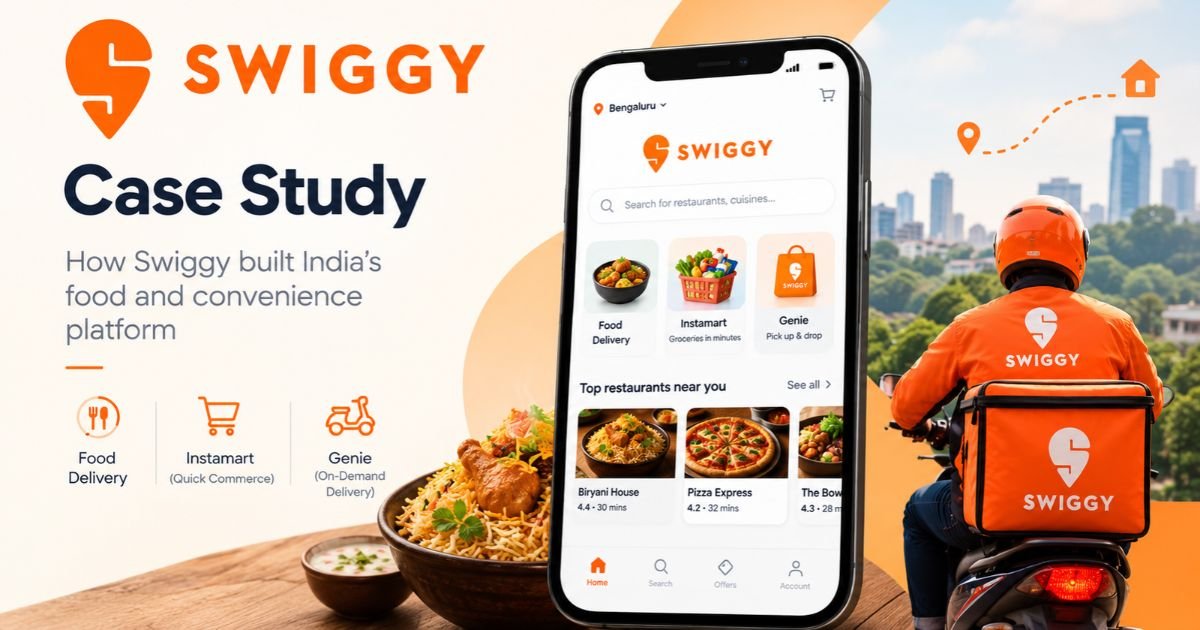
Swiggy has not posted a profit since it listed on the stock exchange in November 2024, and yet it remains one of the most watched consumer brands in India. That tension is exactly why this Swiggy Case Study is worth your time. A company that began with six delivery executives and 25 restaurants in Bengaluru now runs a food marketplace, 1,171 Instamart dark stores across 131 cities, and a growing list of side apps.
You will see how the business started, how it earns money, what every major product does, how its marketing works, and where it is struggling right now. The numbers are current as of 22 October 2026.
One caution before you start. Swiggy’s results for the September 2026 quarter were scheduled for release today, so check the exchange filing for the final figures. Everything below uses the April to June 2026 quarter (Q1 FY27), which is the latest full set of published numbers.
How Did Swiggy Start?
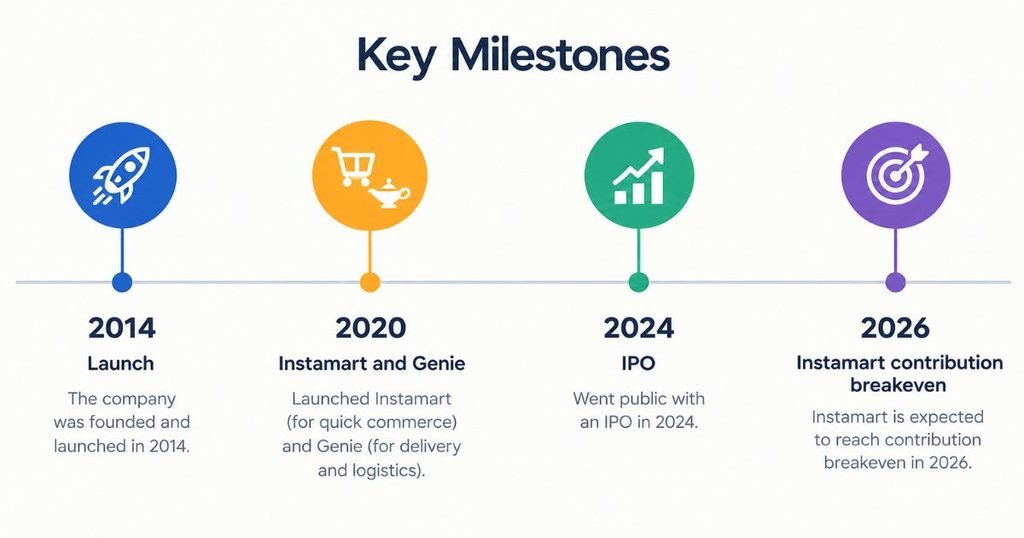
Swiggy was founded in August 2014 in Bengaluru by Sriharsha Majety, Nandan Reddy and Rahul Jaimini. It began with a deliberately small footprint: six delivery executives and 25 restaurants, according to a 2017 Man’s World India profile of the founders.
The idea came out of a failure. Majety and Reddy, both BITS Pilani graduates, had been running a logistics startup called Bundl Technologies. Demand for it never arrived, so they shut it down in 2014 and moved into hyperlocal delivery. They brought in Jaimini, an IIT Kharagpur alumnus who had worked at Myntra, to build the technology.
That pivot matters. Swiggy did not invent food ordering. Restaurants already took phone orders, and rivals already listed menus online. What Swiggy added was its own fleet. Instead of handing delivery to the restaurant, it controlled the last mile, which meant it controlled speed and reliability.
Control of the last mile is the thread that runs through this entire Swiggy Success Story. Every later product, from Instamart to Genie, reuses the same riders and the same routing technology.
The company moved fast after that. Swiggy Access, a network of ready-to-occupy kitchens for restaurant partners, started in November 2017. Swiggy Go became Swiggy Genie in April 2020, and Instamart launched the same year. Swiggy then went public in November 2024 at an issue price of ₹390 per share, valuing the company at about $11.3 billion.
Some bets did not last. The Bowl Company, a cloud kitchen chain started in 2017, was later wound down in Delhi NCR after a pilot. Swiggy also laid off 400 employees in January 2024 ahead of the IPO. Honestly, that willingness to start things and cut them is part of how the company learns.
Swiggy was founded in August 2014 by Sriharsha Majety, Nandan Reddy and Rahul Jaimini after their earlier logistics startup Bundl Technologies failed. It differentiated by running its own delivery fleet rather than relying on restaurants, and it listed on Indian stock exchanges in November 2024 at ₹390 per share.
What Does Swiggy Sell Today?
Swiggy is a convenience platform that sells food delivery, quick commerce, dining out and supply chain services through one parent company. It reports these as separate segments, and understanding them is the fastest way to read its financials.
Here is the Q1 FY27 snapshot, based on Swiggy’s results filing of 30 July 2026 and coverage by Business Standard and YourStory.
| Segment | Key figure | Growth or margin |
|---|---|---|
| Consolidated | Revenue ₹6,812 crore; net loss ₹791 crore | Revenue up 37.3% year on year; loss down from ₹1,197 crore |
| Food delivery | GOV ₹9,490 crore; revenue ₹2,208 crore | GOV up 17.4%; adjusted EBITDA ₹292 crore |
| Instamart (quick commerce) | GOV ₹7,907 crore; revenue ₹1,232 crore | GOV up 39.8%; contribution margin -0.2% of GOV |
| Out-of-home consumption | Revenue ₹126 crore | GOV up 44.8%; adjusted EBITDA 0.9% of GOV |
| Supply chain and distribution | Revenue ₹3,195 crore | Segment loss cut to ₹8 crore from ₹47 crore |
| Platform innovations | Revenue ₹51 crore | Includes Minis, Sports, Snacc, Toing, Crew |
GOV means gross order value, the total value of orders placed through the platform before discounts and costs. It is not revenue. Swiggy’s revenue is the portion it keeps.
Two things stand out. Food delivery is the profitable core, earning roughly ₹292 crore in adjusted EBITDA in a single quarter. Instamart is the growth engine, but it is also where most of the losses sit, with an adjusted EBITDA loss of ₹778 crore in the same quarter.
Swiggy also reported that normalising for restaurant cancellations caused by LPG supply problems early in the quarter, food delivery GOV growth would have been around 18%. Keep that in mind when you compare quarters.
How Does Swiggy Make Money?
Swiggy earns money from restaurant commissions, customer-facing fees, advertising, Instamart product sales and margins, and subscriptions. No single stream carries the company, which is why this Swiggy Business Model Explained section breaks them apart.
Restaurant commissions. Restaurants pay Swiggy a percentage of each order’s value for being listed and getting orders. This is the oldest revenue line and the foundation of the food marketplace.
Customer fees. Delivery fees and platform fees are charged to the person ordering. The platform fee has crept up over time. Storyboard18 reported in 2025 that Swiggy raised the fee on food orders by ₹2 to ₹14, and the Indian government now applies 18% GST on delivery fees for local deliveries.
Advertising. Restaurants and brands pay for sponsored listings and banners. This is a high-margin line because it needs almost no extra cost to serve. Quick commerce is especially good for it, since a packaged goods brand will pay to appear first when someone searches for biscuits.
Instamart margins. Instamart earns a margin on groceries and everyday items, plus its own advertising and fees. Swiggy says it reached contribution breakeven in May 2026, meaning each order covered its direct costs that month.
Subscriptions. Swiggy One charges a recurring fee in exchange for free delivery and discounts, which raises order frequency.
The tradeoff is cost. Delivery payouts, dark store rents and customer discounts are heavy. In Q1 FY27 total expenses were ₹7,813 crore against revenue of ₹6,812 crore, which is why the net loss persists.
Swiggy earns from restaurant commissions, delivery and platform fees, in-app advertising, Instamart margins and Swiggy One subscriptions. In Q1 FY27 its revenue was ₹6,812 crore against expenses of ₹7,813 crore, so the business still runs at a loss while Instamart scales.
Every Swiggy Product and Tool, Explained
Swiggy runs more than a dozen products, and most competitors cover only a few. Think of this list as the second half of the Swiggy Business Model Explained above: the revenue streams are the “what,” and these tools are how each one actually gets delivered.
Swiggy Food: the marketplace
Swiggy Food is the original app where you pick a restaurant, order, and track a rider on the map. It is the company’s profit engine. Rohit Kapoor leads this business as CEO of the food marketplace. Its job is to keep order frequency high while protecting restaurant partner economics.
Bolt: 10-minute food delivery
Bolt lists items from nearby restaurants that can be prepared and delivered quickly, within a two-kilometre radius. YourStory reported in January 2025 that Bolt was on track to account for around 10% of Swiggy food orders. Preparation time limits how far it can grow, which is exactly why Swiggy built separate apps.
Snacc, Toing and the 99 Store: price and speed experiments
Snacc launched in January 2025 as a standalone app for breakfast, meals, beverages and snacks delivered in about 15 minutes, with no platform fee at launch. Toing followed in August 2025 and targets budget buyers, with many items under ₹250, free delivery above ₹99 and a platform fee of ₹12 against ₹15 on the main app, as MediaNama reported in September 2025. By late 2025 Toing was live in 11 cities and had crossed 1 million downloads. The 99 Store sits inside the main app with items priced between ₹49 and ₹149.
Rohit Kapoor told Business Today in December 2025 that Toing exists to run a clean experiment on affordability. The logic is simple: if a price-sensitive customer never opens a premium app, give them a different one.
Instamart and Maxxsaver: quick commerce
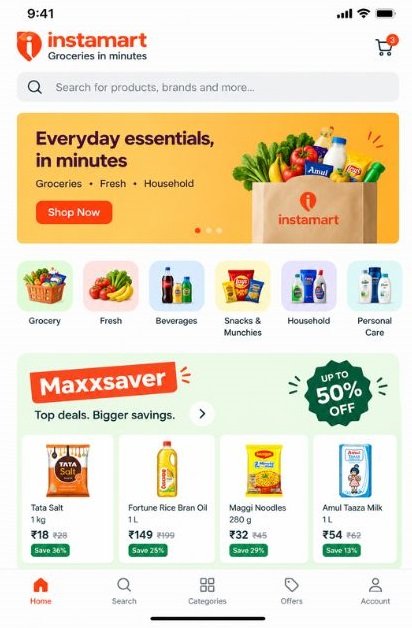
Instamart delivers groceries, household goods, electronics and gifts in roughly 10 to 15 minutes from dark stores, which are small warehouses closed to the public. It reached 1,171 stores in 131 cities by Q1 FY27 and added 28 stores in the quarter.
Maxxsaver is a bulk-discount program that raises basket size, and Swiggy credited it for lifting average order value. The Quick India Movement is an annual sale that returned ahead of the 2026 festive season with discounts of up to 50% to 90% across sellers. In January 2026, Swiggy also made Instamart orderable through ChatGPT, Claude and Gemini using the Model Context Protocol (MCP), a standard that lets AI assistants call a company’s services. Inc42 reported that it covers more than 40,000 SKUs.
Dineout, Scenes and Order-in-Cinemas: going out
Dineout handles restaurant table reservations and discounts. Scenes, launched in December 2024 under the Dineout umbrella, sells tickets to parties, live music and events at partner venues. In 2026 Swiggy added Order-in-Cinemas, which lets moviegoers order snacks to their seats through partnerships with Cinepolis and Asian Cinemas. This out-of-home segment grew GOV 44.8% in Q1 FY27 and is already profitable on an adjusted basis.
Swiggy One, One Lite and One BLCK: subscriptions
Swiggy One is the paid membership with free delivery on eligible orders and discounts across Food, Instamart, Dineout and Genie. One Lite is a cheaper entry tier. One BLCK, launched in December 2024, is invite-only and added partner perks such as Yatra Prime and OTT benefits at ₹299 for three months. MediaNama noted at the time that the benefits overlapped heavily with standard One. Swiggy has said that members spend around three times more than non-members.
Genie, Crew and Minis: services
Genie lets you send and pick up packages within a city. Crew is a concierge app that Nandan Reddy led before stepping down from his executive role. Minis helps small merchants create storefronts inside the Swiggy app. These sit under platform innovations, which earned ₹51 crore in Q1 FY27, up from ₹20 crore a year earlier.
Food on Train
Food on Train delivers meals to passengers at railway stations. Swiggy announced in August 2026 that it grew 12 times between August 2024 and August 2026 and now serves 201 stations, with adoption in tier-2 and tier-3 markets growing twice as fast as in metros.
Swiggy Ads and partner-side tools
Swiggy’s advertising tools give restaurants and brands sponsored placement in search and category pages. For restaurant partners, Swiggy Capital Assist launched in 2017 and had facilitated over ₹450 crore in loans to more than 8,000 restaurants by 2023, through lenders including Indifi, InCred, PayU Finance and IIFL. Swiggy Packaging Assist is a marketplace for food-grade packaging at discounts of up to 5%.
NOICE is Instamart’s private-label food brand, launched in 2025. By October 2026 it worked with 75 food entrepreneurs, and one in every ten Instamart baskets contained a NOICE product, with those customers ordering about 1.5 times more often. A new financing program offers eligible entrepreneurs up to ₹5 crore through SIDBI, Axis Bank and InCred. Swiggy clarified on 5 October 2026 that the loans do not sit on its own balance sheet.
Delivery partner technology
On the rider side, Swiggy uses data science for demand forecasting, matching riders to orders and route planning. The app includes automatic speech recognition to handle calls that mix English and local languages. In October 2026, Swiggy announced a tie-up with Zerodha Fund House to help delivery partners begin investing.
What Marketing Moves Built the Brand?
The Swiggy Marketing Strategy rests on three ideas: be present at the exact moment of hunger, make the habit cheaper through membership, and keep the brand loud during sale periods. It is a performance engine wrapped in brand storytelling.
Moment-based targeting. Swiggy sends push notifications and homepage cards timed to meals, weather, cricket matches and festivals. Personalised homepages and generative AI search, which lets you type something like “nutritious food after a workout,” reduce the effort of choosing.
Loyalty through Swiggy One. Members order more often and across more services, so the program doubles as a retention tool. Cross-selling Instamart to food customers has been a stated priority since the early days, and the Harvard Digital Innovation case on Swiggy documents that logic.
Event-led demand. The Quick India Movement sale created a festival-style moment for non-grocery products. Ahead of the 2026 festive season it returned with discounts of up to 50% to 90%. Sales like this give shoppers a reason to try categories they would not normally order online.
Segmented apps. Toing for students and budget buyers, Snacc for office workers wanting fast snacks, Dineout for weekend plans. Each speaks to one audience instead of one message to everyone.
Brand marketing spend. From its December 2025 fundraise, Swiggy earmarked ₹2,340 crore for brand marketing and business promotion, which signals that it knows awareness is a battleground against Blinkit and Zepto.
The weakness is cost. Advertising and sales promotion costs were a leading driver of expense growth in Q1 FY27. Swiggy also said it removed over 4 million loss-making users over three quarters, a sign that growth bought with discounts was not worth keeping.
How Did Swiggy Fund Its Growth?
Swiggy was heavily venture-funded for a decade, then used public markets to refill its cash. Early rounds included a $210 million Series G in June 2018 led by Naspers with DST Global, which took the valuation past $1 billion. Prosus, SoftBank and Accel remain among its large shareholders.
The IPO in November 2024 raised roughly ₹4,500 crore at ₹390 a share. Within a year, much of that had been spent absorbing Instamart losses. Swiggy then sold its Rapido stake for about ₹2,400 crore and raised nearly ₹10,000 crore through a qualified institutional placement (QIP) in December 2025. A QIP is a way for a listed company to sell shares to large institutions without a full public offer. Demand was about 4.5 times the shares offered, priced near ₹375.
The planned use of that money tells you the strategy: about ₹4,475 crore for quick commerce fulfilment, ₹2,340 crore for marketing, and ₹985 crore for technology and cloud. In October 2026, Swiggy also completed the sale of Lynks Logistics, trimming non-core operations.
Swiggy raised about ₹4,500 crore in its November 2024 IPO, sold its Rapido stake for roughly ₹2,400 crore, and raised nearly ₹10,000 crore through a December 2025 QIP. Most of the QIP money is earmarked for Instamart’s fulfilment network, which is why quick commerce shapes every decision the company makes.
How Does Swiggy Compare With Eternal and Zepto?
Swiggy leads in some areas and trails in others. Its biggest rival is Eternal, the parent of Zomato and Blinkit, and Zepto is the independent quick commerce challenger.
| Metric | Swiggy | Eternal (Zomato + Blinkit) | Zepto |
|---|---|---|---|
| Q1 FY27 revenue | ₹6,812 crore | ₹20,211 crore | Not listed |
| Q1 FY27 profit | Net loss ₹791 crore | Net profit ₹92 crore | Loss-making |
| Quick commerce orders, FY26 | 412.2 million | 916.6 million (Blinkit) | 640.2 million |
| Share of orders among top three, FY26 | 20.9% | Largest | Second |
Sources: Swiggy and Eternal Q1 FY27 results coverage; order data from Zepto’s updated draft red herring prospectus, as reported in 2026.
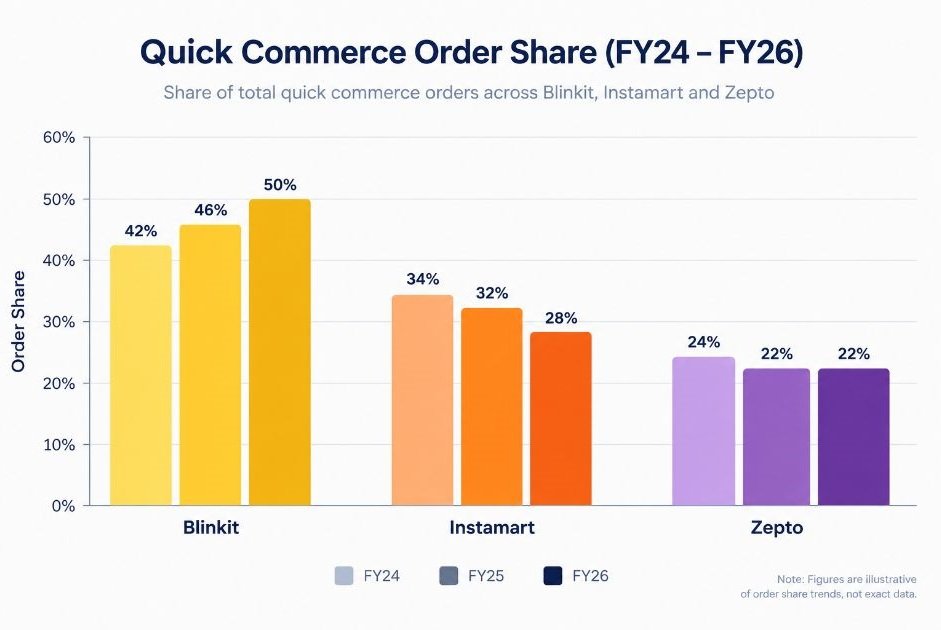
Instamart’s share of orders among the three leading players fell to 20.9% in FY26 from 34.3% in FY24, according to Zepto’s filing. BofA Securities estimates reported in late 2025 put Blinkit above 50% market share. Revenue is not directly comparable across these companies because Swiggy and its rivals follow different business and accounting models, notably around who owns inventory.
That is not all bad news. Instamart still grew GOV 39.8% in Q1 FY27 and reached contribution breakeven, while Zepto’s filing shows an adjusted EBITDA loss of ₹5,042 crore for FY26.
What Is Going Wrong at Swiggy Right Now?
Three problems stand out, and any honest read of the business has to include them.
First, losses persist. Swiggy reported an adjusted EBITDA loss of ₹2,871 crore for fiscal 2026, according to Business Standard. Even with Instamart at contribution breakeven, fixed costs such as stores and technology keep the company in the red. Swiggy itself guided that Instamart contribution margin would stay between zero and negative 100 basis points for the next couple of quarters.
Second, investors are nervous. On 22 October 2026, ahead of Q2 results, the stock hit a record low of ₹209.65, about 46% below its IPO price. Foreign portfolio investors cut their holding to 8.55% in the September quarter from 13.96% in June, per the shareholding pattern. Citi analysts also flagged that Eternal’s food delivery push could cloud the near-term outlook for Swiggy.
Third, the app sprawl may confuse. Snacc, Toing, Crew, Pyng, Instamart and the main app all compete for attention and engineering time. Some of these will probably be merged or shut down. That is normal for experiments, but it is not free.
For Q2 FY27, Kotak Neo expected food delivery GOV to rise about 19% and Instamart’s adjusted EBITDA loss to widen to about ₹840 crore. Treat those as analyst estimates, not reported figures.
What Can You Learn From Swiggy?
Swiggy offers five lessons you can apply even if you are nowhere near its scale. This Swiggy Case Study works best when you turn the facts into decisions.
- Own the step that customers feel most. Swiggy built its own delivery fleet because speed and reliability decide whether people reorder. Find the moment in your product that customers judge you on and control it.
- Reuse infrastructure for new products. Instamart, Genie and Food on Train all run on the same riders and routing technology. New lines are cheaper when they share a backbone.
- Test in separate apps or pilots. Toing was launched in Pune first, as a contained experiment, before any wider rollout. A small test protects the main brand.
- Measure contribution margin, not just growth. Swiggy’s shift toward unit economics, including pruning loss-making users, shows that revenue without margin is borrowed time.
- Treat the Swiggy Marketing Strategy as a system, not a campaign. Notifications, memberships, sales events and audience-specific products work together. Any single piece alone is easy to copy.
Not all of this transfers. Swiggy raised thousands of crores to run these experiments, and most businesses cannot. If you are smaller, copy the discipline, not the spend.
Conclusion
Swiggy shows how far a strong operations core can take a company, and how expensive it gets when growth outruns profit. Three takeaways matter most: control the part of the experience customers feel, reuse infrastructure across products, and watch contribution margin before celebrating growth. Instamart’s breakeven in May 2026 is real progress, but the stock’s record low shows that investors want proof it lasts.
If you take one action from this Swiggy Success Story, make it this: pick one product or campaign you run and calculate its contribution margin this week. You may find that your fastest-growing line is also your most expensive one.
FAQs
Who founded Swiggy and when?
Sriharsha Majety, Nandan Reddy and Rahul Jaimini founded Swiggy in August 2014 in Bengaluru. Majety and Reddy had earlier run a logistics startup called Bundl Technologies, which they closed before pivoting to food delivery. Sriharsha Majety is now Swiggy’s Group CEO.
How does Swiggy make money?
Swiggy earns from restaurant commissions, delivery and platform fees, in-app advertising, Instamart product margins and Swiggy One subscriptions. Advertising is a high-margin stream, while delivery and discounts are the biggest costs. The mix is why the company can post profit in food delivery while still losing money overall.
Is Swiggy profitable in 2026?
Not at the consolidated level. Swiggy reported a net loss of ₹791 crore for April to June 2026, down from ₹1,197 crore a year earlier. Its food delivery segment is profitable on an adjusted EBITDA basis, but Instamart still loses money after fixed costs.
What is the difference between Swiggy and Instamart?
Swiggy Food delivers cooked meals from restaurants, which takes longer than quick commerce because food has to be prepared. Instamart delivers groceries and household products from Swiggy’s own dark stores in about 10 to 15 minutes. They share the same parent company and delivery partners, but they have different economics.
What is Swiggy One and is it worth it?
Swiggy One is a paid membership that offers free delivery on eligible orders and discounts across Food, Instamart, Dineout and Genie. It pays off if you order several times a month. If you order rarely, the fee may cost more than the delivery charges you would save.
Swiggy vs Zomato: which one is bigger?
Zomato’s parent Eternal is bigger. In Q1 FY27 Eternal reported revenue of ₹20,211 crore and a net profit of ₹92 crore, while Swiggy reported ₹6,812 crore of revenue and a net loss of ₹791 crore. In quick commerce, Blinkit also holds a larger share than Instamart.
Why did Swiggy launch apps like Toing and Snacc?
Swiggy wanted to reach customers the main app does not serve well. Toing targets price-sensitive buyers with lower fees, while Snacc focuses on very fast snacks and meals. They also let the company test pricing and operations without changing the main app.
How did Swiggy fund itself?
Swiggy raised money from venture investors including Naspers, Prosus, SoftBank and Accel, then listed in November 2024 and raised about ₹4,500 crore. It later sold its Rapido stake for about ₹2,400 crore and raised nearly ₹10,000 crore through a QIP in December 2025.
Why is Swiggy’s share price falling?
Investor concern centres on continued losses, rising competition in quick commerce and food delivery, and foreign investors reducing their holdings. On 22 October 2026 the stock touched a record low of ₹209.65, about 46% below its IPO price, ahead of Q2 results. Share prices change daily, so check a live source before making any investment decision.
Can I order from Swiggy using ChatGPT or Claude?
Yes. Since January 2026, Swiggy has supported ordering through AI assistants like ChatGPT, Claude and Gemini using the Model Context Protocol. It covers Swiggy Food, Instamart and Dineout. At launch, orders through AI tools supported only cash on delivery, so check the current payment options before you try it.


