

Most students pick a management specialisation the way they pick a seat in a crowded cafe: whichever one is free first. That’s an expensive habit. The scope of management stretches far beyond “managing people”, and the area you choose decides which tools you’ll learn, which roles you’ll interview for and how fast your first promotion arrives.
Here’s the problem. College syllabi list subjects, not careers. You see Marketing, Finance and HR on a brochure, but nobody explains what a day inside each one looks like, or which software you’d actually open on a Monday morning.
This article fixes that. You’ll get ten areas, each with a plain definition, the real tools professionals use (explained properly, not just name-dropped), a named example and the roles you can aim for. Then a comparison table and a simple way to choose.
What Does Management Actually Cover?
Management is the process of planning, organising, directing and controlling people and resources to reach a defined goal. It applies to a ten-person startup and a 100,000-person company in exactly the same way. Only the scale changes.
Henri Fayol, the French mining engineer who wrote about this over a century ago, split the job into planning, organising, commanding, coordinating and controlling. Most textbooks still teach a version of his list. It works because it describes what managers do, not what they’re called.
So where does the modern management scope begin and end? Practically, it covers every function that turns an idea into a delivered product: deciding direction, making the thing, selling it, paying for it, hiring the people, and measuring whether it worked. Each of those functions became its own field with its own tools, which is why we now talk about ten areas instead of one.
Demand for people who can do this is steady. The US Bureau of Labor Statistics’ Occupational Outlook Handbook projects management occupations to grow faster than the average for all occupations between 2025 and 2035, with a median annual wage of $126,520 as of May 2025. That’s US data, so treat it as a global signal, not an Indian salary promise.
The skills side matters just as much. The World Economic Forum’s Future of Jobs Report 2025 found that nearly 70% of employers see analytical thinking as a core skill, and that employers expect 39% of workers’ core skills to change by 2030. Translation: the tools below will keep changing. The thinking behind them won’t.
Management is the process of planning, organising, directing and controlling people and resources to reach a goal. The US Bureau of Labor Statistics projects faster-than-average growth for management occupations from 2025 to 2035, and the World Economic Forum’s 2025 report says employers expect 39% of core worker skills to change by 2030.
The 10 Areas of Management Every Student Should Know
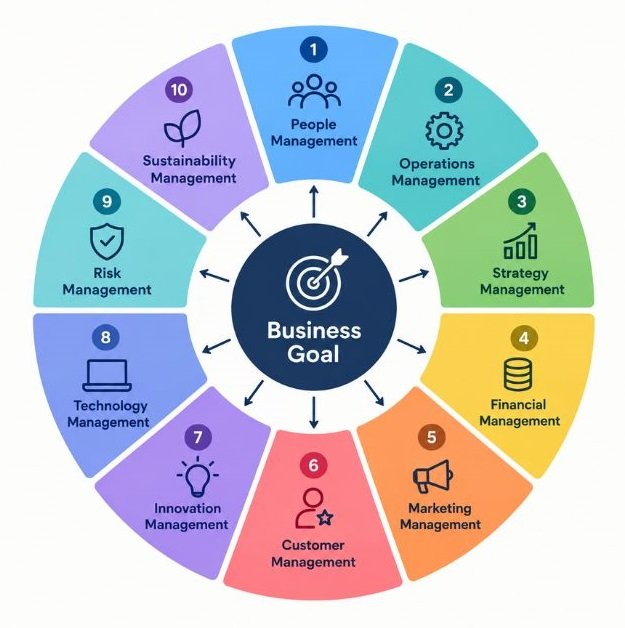
Management breaks into ten practical areas: strategic, operations, marketing, financial, human resource, project, entrepreneurship, supply chain, information and data, and international and sustainability management. Each one answers a different business question, and each one comes with its own toolkit.
1. Strategic Management
Strategic management is the discipline of deciding where a company should compete and how it will win there. It sits at the top of the pyramid because every other area takes its direction from it.
Take Reliance Jio’s 2016 launch in Indian telecom. It entered a market full of established players and chose to compete on ultra-low data pricing at huge scale. That was a strategic choice before it was a marketing one.
Tools you’ll use:
- SWOT analysis: A four-box grid of internal strengths and weaknesses against external opportunities and threats. It’s quick, which is also its weakness. Good SWOTs rank the items; weak ones just list them.
- PESTLE analysis: Scans the outside world across political, economic, social, technological, legal and environmental factors. Use it before entering a new market or launching a product that regulation could affect.
- Porter’s Five Forces: Michael Porter’s model for judging how attractive an industry is, using rivalry, new entrants, substitutes, buyer power and supplier power. If four of the five forces are strong, margins will be thin.
- Balanced Scorecard: Created by Robert Kaplan and David Norton, it tracks performance from four angles: financial, customer, internal process, and learning and growth. It stops a company from steering by revenue alone.
- OKRs (Objectives and Key Results): One ambitious objective paired with three or four measurable results. Intel’s Andy Grove developed the method and John Doerr carried it to Google.
Roles to aim for: strategy analyst, business consultant, corporate planning associate.
2. Operations Management
Operations management is the design and control of the process that turns inputs into finished goods or services. The question it answers: can we make this faster, cheaper and with fewer errors?
Toyota’s production system is the classic case. It built its reputation on removing waste from every step, and nearly every operations syllabus still teaches it.
Tools you’ll use:
- Lean: A way of thinking that classifies every activity as value-adding or waste, then removes the waste. Waiting time, extra movement and overproduction are the usual culprits.
- Six Sigma and DMAIC: A data-driven method that follows five stages: define, measure, analyse, improve, control. The headline target is 3.4 defects per million opportunities.
- Kanban boards: A visual board with columns such as To Do, In Progress and Done. Teams cap how much work sits in each column, which exposes bottlenecks immediately.
- ERP systems such as SAP S/4HANA: Enterprise resource planning software that puts production, inventory, purchasing and accounting into one database, so nobody works from a stale spreadsheet.
- Process mapping: Drawing each step of a workflow as a flowchart. It sounds basic. It’s also where most of the savings get found.
Roles to aim for: operations analyst, process improvement associate, plant or service operations executive.
3. Marketing Management
Marketing management is the work of understanding customers and then creating, pricing, promoting and delivering offers they’ll want. It owns demand.
Indian D2C brands show this clearly. Mamaearth built its early momentum around toxin-free positioning for a very specific buyer, while boAt went after young audio buyers with sharp pricing and youth-first branding. Different customers, same discipline.
Tools you’ll use:
- STP (Segmentation, Targeting, Positioning): You split the market into groups, pick the most promising one, then decide the single idea you want that group to associate with your brand.
- The 4Ps (product, price, place, promotion): A checklist for the marketing mix. Weakness in any one P drags down the other three.
- Google Analytics 4 (GA4): Google’s event-based analytics platform. It records user actions such as page views, clicks and purchases, so you can see which channels bring buyers instead of browsers.
- Meta Ads Manager: The dashboard for running Facebook and Instagram campaigns. You set audiences, budgets and creatives, then read cost per result.
- HubSpot CRM: A customer relationship management tool that stores every lead’s history, from first click to closed deal. Its free tier is common in college projects.
Roles to aim for: digital marketing executive, brand associate, performance marketer, SEO analyst.
4. Financial Management
Financial management is the planning and control of a company’s money: where it comes from, where it goes and whether it earns a return. Every decision eventually shows up here.
Nykaa’s stock market listing in November 2021 is a good case to study. A listing is a financing decision, and it raised questions about valuation, dilution and growth spending that sit squarely inside this field.
Tools you’ll use:
- Microsoft Excel: Still the default workbench. Learn pivot tables, XLOOKUP and scenario analysis before anything fancier.
- Tally Prime: Accounting software widely used by Indian businesses, built around GST and statutory compliance. Many small firms won’t hire you without it.
- Ratio analysis: Liquidity, profitability and leverage ratios that turn financial statements into a health check. A current ratio below 1 tells you short-term bills may outrun short-term cash.
- Net Present Value (NPV) and Discounted Cash Flow (DCF): Techniques that convert future cash into today’s money so you can compare projects fairly. If NPV is positive, the project earns more than your required return.
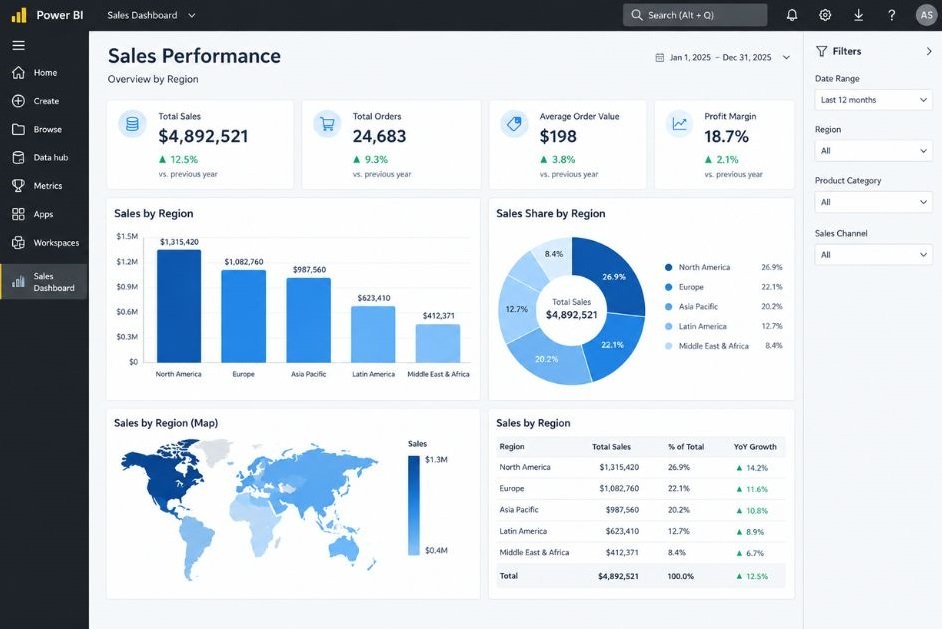
- Power BI: Microsoft’s business intelligence tool for turning raw finance data into dashboards that a CFO can read in two minutes.
Roles to aim for: financial analyst, accounts executive, investment banking analyst, FP&A associate.
5. Human Resource Management
Human resource management covers hiring, developing, rewarding and retaining the people a company depends on. It also handles the legal and cultural side of employment.
Tata Consultancy Services recruits freshers at huge volumes through its National Qualifier Test, which shows how much of HR is systems design, not just interviewing.
Tools you’ll use:
- Applicant Tracking Systems (ATS): Software such as Zoho Recruit or Greenhouse that stores resumes, tracks each candidate’s stage and schedules interviews. It’s why recruiters can handle hundreds of applicants.
- HRIS platforms such as Workday and Zoho People: Human resource information systems that manage leave, payroll data, attendance and employee records in one place.
- 360-degree feedback: A review method collecting input from a person’s manager, peers and juniors. It works best when it’s anonymous and focused on behaviour.
- Employee engagement surveys: Short, regular questionnaires, often run through tools like Culture Amp, that flag attrition risk before resignations start.
- Competency frameworks: Written lists of the skills and behaviours each role needs. They keep hiring and appraisals consistent.
Roles to aim for: HR generalist, talent acquisition executive, learning and development associate, HR analytics associate.
The first five areas, strategy, operations, marketing, finance and HR, form the classic management core. Strategy sets direction, operations makes the product, marketing creates demand, finance funds the plan and HR supplies the people.
6. Project Management
Project management is the practice of delivering a defined piece of work on time, within budget and to an agreed standard. It differs from operations because projects end, while operations repeat.
Software teams run on this. Atlassian’s Jira, for instance, was built for exactly this style of tracked, sprint-based delivery, and thousands of tech teams use it daily.
Tools you’ll use:
- Gantt charts: A bar chart showing each task against a calendar. You can see overlaps and dependencies at a glance.
- Critical Path Method (CPM): Identifies the longest chain of dependent tasks, which sets the minimum project length. Delay anything on that path and the whole project slips.
- Scrum: An Agile framework that works in short cycles called sprints, usually two weeks, with a prioritised backlog and daily stand-up meetings.
- Jira, Asana and Trello: Software that holds tasks, owners and deadlines. Jira suits software teams, Asana suits cross-functional work and Trello suits simple card-based boards.
- Risk register: A table listing what could go wrong, how likely it is, how bad it would be and who owns the fix.
Roles to aim for: project coordinator, associate project manager, Scrum master, program analyst.
7. Entrepreneurship and Small Business Management
This area teaches you to start a business, test an idea cheaply and run a small operation where you handle many functions at once. It’s the broadest area for generalists.
Zepto’s founders, Aadit Palicha and Kaivalya Vohra, launched in 2021 around a single promise of very fast grocery delivery. That sharp, testable idea is what the field trains you to find.
Tools you’ll use:
- Business Model Canvas: Alexander Osterwalder’s one-page map with nine blocks, including customer segments, value proposition, channels and cost structure. You can sketch a whole business on one sheet.
- Lean Canvas: Ash Maurya’s adaptation for startups, which swaps some blocks for problem, solution and unfair advantage.
- Minimum Viable Product (MVP): The smallest version of a product that lets you learn from real customers. Eric Ries popularised it through the Lean Startup approach.
- Unit economics: Customer acquisition cost (CAC) against customer lifetime value (LTV). If you spend more to win a customer than that customer will ever pay you, growth only makes the loss bigger.
- Startup India recognition: A government registration route through DPIIT that opens access to certain benefits for eligible startups. Check current conditions on the official portal.
Roles to aim for: founder, founder’s office associate, business development executive, family business manager.
8. Supply Chain and Logistics Management
Supply chain management coordinates everything between raw material and customer: buying, storing, moving and returning goods. When it fails, customers see empty shelves.
Delhivery and Amazon India’s fulfilment network show the scale involved, with warehouses, sorting hubs and last-mile riders all running on forecasts.
Tools you’ll use:
- SCOR model: A framework from ASCM that describes a supply chain through plan, source, make, deliver, return and enable. Companies use it to compare performance.
- ABC analysis: Ranks inventory into A (few items, high value), B and C (many items, low value) so attention goes where money sits.
- Economic Order Quantity (EOQ): A formula that finds the order size where ordering cost and holding cost balance out.
- Warehouse and Transport Management Systems (WMS and TMS): Software that directs stock placement and picks routes and carriers.
- Demand forecasting: Predicting future sales from past data and seasonality, often in Excel or Python before a company buys specialised software.
Roles to aim for: supply chain analyst, logistics coordinator, procurement executive, demand planner.
9. Information and Data Management
This area covers how organisations collect, store, protect and use information to make decisions. It’s often taught as Management Information Systems (MIS), and it has become one of the fastest-growing corners of business education.
Food delivery apps like Swiggy depend on data to estimate delivery times and match riders to orders, which is a management decision backed by a data pipeline.
Tools you’ll use:
- SQL: The language for pulling records out of databases. A student who can write a clean join gets noticed in any analytics interview.
- Tableau and Power BI: Visualisation tools that turn tables into charts and interactive dashboards.
- Salesforce CRM: A cloud platform that tracks leads, accounts and sales activity for large sales teams.
- Python basics: Used for cleaning data and automating repeated reports. You don’t need to become a developer, only to read and tweak scripts.
- AI assistants and Microsoft Copilot: Used to summarise reports, draft analysis and check formulas. Treat their output as a first draft and verify every number.
Roles to aim for: business analyst, MIS executive, data analyst, product analyst.
10. International Business and Sustainability Management
This area deals with running a business across borders and doing it responsibly. It combines trade, culture, regulation and environmental, social and governance (ESG) reporting.
The pressure is real in India. SEBI’s Business Responsibility and Sustainability Report (BRSR) framework applies to the top 1,000 listed companies by market capitalisation, so sustainability data has become a reporting duty rather than a goodwill gesture.
Tools you’ll use:
- Incoterms: Standard trade terms published by the International Chamber of Commerce, such as FOB and CIF, which state who pays for shipping and bears risk at each point.
- Hofstede’s cultural dimensions: A framework comparing national cultures on factors like power distance and individualism. It helps explain why one negotiation style fails abroad.
- GRI Standards: The Global Reporting Initiative’s guidelines for reporting environmental and social impact.
- BRSR: SEBI’s reporting format that Indian listed companies use to disclose sustainability performance.
- ESG scoring: Ratings from providers such as MSCI that investors use to compare how companies handle environmental and governance risk.
Roles to aim for: international business executive, export-import coordinator, ESG analyst, sustainability associate.
How Do the 10 Areas Compare Side by Side?
Each part of the management scope answers a different business question and uses different software, so the quickest way to compare them is to line up the question, the signature tools and the usual entry-level roles.
| Area | Core question | Signature tools | Typical entry role |
|---|---|---|---|
| Strategic | Where do we compete? | SWOT, Five Forces, OKRs | Strategy analyst |
| Operations | How do we make it better? | Lean, Six Sigma, ERP | Operations analyst |
| Marketing | Who wants this and why? | GA4, Meta Ads Manager, HubSpot | Digital marketing executive |
| Financial | Does it earn a return? | Excel, Tally Prime, NPV | Financial analyst |
| Human resource | Do we have the right people? | ATS, HRIS, 360 feedback | HR generalist |
| Project | Will it ship on time? | Gantt, Scrum, Jira | Project coordinator |
| Entrepreneurship | Is this idea worth building? | Business Model Canvas, MVP | Founder’s office associate |
| Supply chain | Is the product where it should be? | SCOR, ABC analysis, WMS | Supply chain analyst |
| Information and data | What does the data say? | SQL, Power BI, Salesforce | Business analyst |
| International and sustainability | Can we operate across borders responsibly? | Incoterms, GRI, BRSR | ESG or export analyst |
How Should a Student Choose the Right Area?
Choose by matching three things: what you enjoy doing for hours, what you already do well and what the market pays for. Start with the first one. Interest survives bad weeks; salary figures don’t.
Here’s a simple process you can finish in an afternoon.
- Write down three tasks you’ve enjoyed in college, such as running a fest budget, designing a poster or sorting a messy dataset.
- Match each task to one of the ten areas using the table above.
- Pick two areas and download the free tool for each. Try Power BI Desktop for data, or HubSpot’s free CRM for marketing.
- Spend one weekend on a mini project in each, like analysing a public dataset or building a Business Model Canvas for a campus idea.
- Compare how you felt after both. The one you’d happily repeat next weekend is your shortlist leader.
A caution before you commit: the scope of management keeps widening, and these ten areas overlap constantly. A marketer who reads a dashboard, or an HR professional who understands attrition data, beats a pure specialist in most hiring rooms. Treat your choice as a starting point, not a life sentence.
Choose a management area by combining interest, current strengths and market demand, then test two shortlisted areas with a small project each. Overlap between areas is normal, and data skills now help in nearly every one.
Skills That Travel Across Every Area
Management scope is wide, but some abilities pay off no matter which area you pick. Analytical thinking is the obvious one, and the World Economic Forum’s 2025 report ranks it as a top core skill for employers. The same report puts resilience, flexibility and agility at 67% and leadership and social influence at 61% of employers.
Four habits are worth building from your first year:
- Spreadsheet fluency. Every function eventually touches numbers.
- Clear business writing. A one-page memo that gets approved beats a ten-page deck that doesn’t.
- Basic data literacy. Know what an average hides and when a sample is too small.
- Comfort with AI tools. Use them to speed up drafts and checks, not to replace judgement.
Honestly, most graduates underinvest in the second one. Managers get promoted largely on how well they explain a decision, and writing is the cheapest way to practise.
Conclusion
The ten areas aren’t separate worlds. They’re ten angles on the same job: getting a business from idea to result. Strategy sets the direction, operations and supply chain deliver it, marketing and entrepreneurship create demand, finance and data keep score, HR and project management hold the team together, and international and sustainability thinking keeps it all responsible.
Your next step is small. Pick two areas from the table, install one free tool for each and spend a weekend on a mini project. By Monday you’ll know more about your fit than a semester of brochures could tell you.
FAQs
What does management cover, in simple words?
Management covers planning, organising, directing and controlling the people, money and processes a business uses to reach its goals. In practice it splits into functions like strategy, operations, marketing, finance, HR and more. Each function has its own tools and its own career track.
Which area of management has the best career growth?
There’s no single winner, because growth depends on demand in your city and industry. Data-linked roles in finance, marketing analytics and supply chain have seen strong hiring interest, since companies want people who can read numbers and act on them. Pick the area you can stay curious about for five years, then add data skills on top.
Is management the same as administration?
No. Administration sets policies and broad objectives, usually at the top. Management carries those objectives out by organising teams and resources day to day. In small companies one person often does both, which is why the terms get mixed up.
Is a management career still worth it in 2026?
Yes, for most students who build real skills alongside the degree. US Bureau of Labor Statistics data projects faster-than-average growth for management occupations from 2025 to 2035. Still, a degree alone won’t carry you. Employers increasingly check for tool skills, projects and communication.
Can I study management without a commerce background?
You can. Engineers, science graduates and arts students enter management programmes every year, and many do well because they bring a different way of solving problems. You’ll need to catch up on basic accounting and economics, which a few weeks of self-study can cover.
Do I need an MBA to work in management?
Not for entry-level roles. A bachelor’s degree plus relevant skills can land analyst, executive and coordinator jobs. An MBA tends to matter for moving into senior roles or switching functions, so many people take it after two to four years of work experience.
Which management tools should a fresher learn first?
Start with Excel, since nearly every area uses it. Then add one tool tied to your chosen area: Tally Prime for finance, GA4 for marketing, Power BI for data, or Jira for project work. Two tools you know well impress more than ten you’ve only opened once.
How do I choose between marketing, finance and operations?
Ask what kind of problem you enjoy. If you like understanding why people buy, try marketing. If you like numbers and risk, try finance. If you like fixing broken processes, try operations. Then test each with a small weekend project before you decide.
Why do so many management graduates struggle in their first job?
Usually because they know frameworks but haven’t used real tools or handled messy data. Classroom cases come with clean numbers; real work doesn’t. Doing internships and live projects early closes most of that gap.
do i need to be a boss to do management?
No. Management is a set of skills, not a job title. Analysts, coordinators and specialists use planning, budgeting and prioritising every day without anyone reporting to them. Most people practise management for years before they lead a team.


