

Most businesses don’t fail because the product is bad. They fail because nobody knew it existed, nobody could afford it, nobody could find it on a shelf, or nobody trusted it enough to buy twice. Every one of those problems belongs to marketing. The Functions of Marketing are the distinct jobs, from research and pricing to promotion and customer care, that connect what a company makes with what people actually want.
Yet in many teams, “marketing” has shrunk to mean ads and social posts. That narrow view gets expensive fast. According to Gartner’s 2024 CMO Spend Survey, marketing budgets fell to 7.7% of company revenue, so every rupee now has to justify itself across the whole system, not just the campaign.
This guide walks through each role in order. For every one, you’ll get a plain definition, the tools teams use to run it, how to use those tools, and a real brand example. Treat it as an audit checklist: if one role is missing in your business, growth usually stalls right there.
What Does Marketing Actually Do for a Business?
Marketing finds out what customers need, shapes an offer around it, sets a price, tells people about it, gets it to them, and keeps them coming back. That’s the whole job in one sentence. The American Marketing Association defines marketing as the activity and processes of creating, communicating, delivering, and exchanging offerings that have value for customers, partners, and society.
Notice what’s missing from that definition: the word “advertising.” Advertising is one piece of one role.
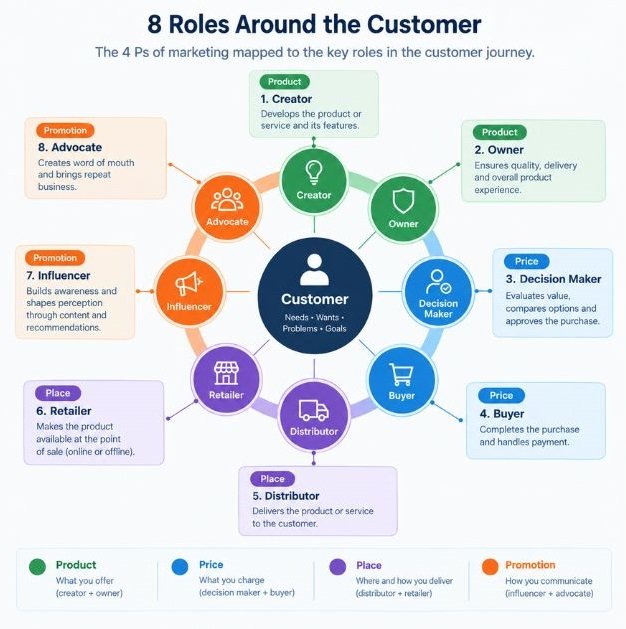
The classic way to organise the work is the 4 Ps (product, price, place, promotion), introduced by E. Jerome McCarthy in 1960 and popularised by Philip Kotler. Modern teams split the same ground into eight roles: market research, product development, pricing, promotion, distribution, selling and customer relationships, marketing finance, and risk management. These eight marketing functions overlap constantly, which is why a weak one drags down the rest.
How Does Market Research Shape Every Other Decision?
Market research is the process of collecting and analysing information about customers, competitors, and demand so that every later decision rests on evidence instead of opinion. It comes first because pricing, product, and promotion all depend on it.
boAt is a useful Indian example. The brand built its early audio range around young, price-sensitive buyers who wanted stylish products, a gap that premium global brands weren’t serving at that price. That’s research turning into a product brief.
Three tools cover most of what a small team needs.
Google Trends is a free tool that shows how interest in a search term changes over time and by region. To use it, enter two or three competing phrases, set the region to India, and compare five years of data. You’ll see whether demand is seasonal, growing, or fading. The “Related queries” panel also shows the exact language customers use, which is gold for ad copy.
SurveyMonkey and Typeform collect direct answers from your audience. SurveyMonkey offers ready-made templates and paid respondent panels, while Typeform shows one question at a time, which tends to hold attention better on mobile. Keep surveys under ten questions. And ask about what people did last month, not what they might do next year. Stated intentions are unreliable.
Semrush shows which keywords competitors rank for, how much traffic they get, and which ads they run. Use its Keyword Gap report to find searches your rivals win and you don’t, then use Traffic Analytics to size up who is actually growing.
The mistake most teams make is running research once, at launch, and never again. Customers change. Re-run a short survey every quarter.
Market research is the first role in marketing because every other decision depends on it. It combines demand data, such as Google Trends, with direct customer feedback from surveys and competitor analysis from tools like Semrush. Teams that repeat it quarterly catch shifts in customer needs before sales drop.
Product and Service Development: Building What People Will Buy
Product development in marketing means shaping the features, design, packaging, and positioning of an offer based on what customers say they need. Marketing doesn’t invent the product alone. It brings the customer’s voice into the room.
Mamaearth is the example worth studying. The brand launched in 2016 with toxin-free baby care products, a specific worry among new Indian parents, and widened into skin and hair care once it had earned trust. It started narrow and expanded by following demand.
Here’s how teams run this role with tools.
Figma is a design tool where you build clickable prototypes of apps, landing pages, or packaging layouts. Share the prototype link with ten target customers, watch where they hesitate, and fix the problem before spending on development.
Productboard collects customer feedback from emails, support tickets, and sales calls into one place, then lets you rank feature requests by how many customers asked and how much revenue they represent. It stops the loudest voice in the meeting from deciding the roadmap.
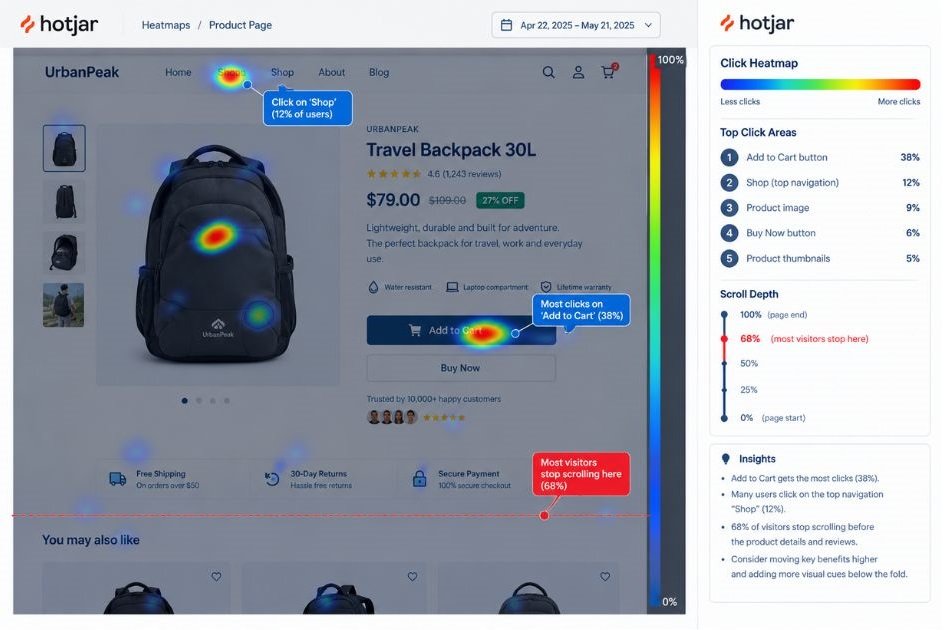
Hotjar records how real visitors use your site through heatmaps and session recordings. If half your visitors never scroll past the first screen, the problem isn’t traffic. It’s the page.
One honest limit: prototype testing with ten people won’t give statistical proof. It gives direction, fast, which is usually what you need at this stage.
Pricing: How Do You Decide What Customers Will Pay?
Pricing is the marketing role that sets what customers pay, and it signals quality as loudly as any advertisement. Set it too low and you lose margin and look cheap. Set it too high and nobody tries the product.
Four approaches cover most situations:
- Cost-plus pricing: add a fixed margin to your costs. Simple, but it ignores what customers value.
- Value-based pricing: price by the benefit customers receive. Apple’s premium iPhone pricing is the textbook case.
- Penetration pricing: start low to win share fast. Reliance Jio launched in 2016 with free services before moving to very low data prices, and it reshaped Indian telecom.
- Dynamic pricing: change prices with demand, time, or stock. Airlines and ride apps do this constantly.
The tools matter here too.
Competera tracks competitor prices across retailers and recommends adjustments, which suits e-commerce sellers with large catalogues. ProfitWell Metrics, now part of Paddle, shows subscription businesses their churn and revenue per customer, so you can test whether a price rise lost you buyers or not. And Google Sheets remains the most underrated pricing tool. A simple sheet with cost, margin, competitor price, and expected volume will answer most pricing questions in an afternoon.
Test one change at a time. If you raise prices and launch a new ad on the same day, you’ll never know which one moved sales.
Promotion: Advertising, Content, Social, and Email
Promotion is the role that makes the right people aware of your offer and gives them reasons to act. It’s the most visible of the eight roles, which is exactly why it gets over-funded while research and retention get ignored.
Paid Advertising
Meta Ads Manager runs campaigns across Facebook and Instagram. Its Advantage+ Shopping Campaigns let the algorithm handle audience and placement once you supply creatives and a budget. Google Ads captures people already searching, and its Performance Max campaigns serve ads across Search, YouTube, and Display from one setup. Start with Search if your buyers already know what they need. Start with Meta if you’re creating demand for something new.
Content, Social, and Email
Canva lets non-designers produce social posts, thumbnails, and brand templates quickly. Buffer schedules posts across networks and shows which ones earned engagement, so you can repeat what works. Mailchimp handles email lists, automated welcome sequences, and basic segmentation. Email still earns its place because you own the list. No algorithm change can take it away.
Personalisation is where promotion is heading. McKinsey’s 2021 “Next in Personalization” report found that 71% of consumers expect companies to deliver personalised interactions, and 76% get frustrated when that doesn’t happen. Even a basic welcome email that mentions what the customer browsed beats a generic blast.
Mamaearth’s early growth leaned heavily on Instagram content and creator partnerships, which suited a brand speaking directly to young parents. Different channel, same logic: go where the buyer already spends attention.
Distribution: Getting the Offer Where Customers Are
Distribution decides where and how customers can buy your product: which channels, which locations, and how fast it arrives. A great product that’s hard to find or slow to deliver loses to a decent one that’s right there.
Zepto built an entire business on this role. Its network of small local warehouses, called dark stores, promises delivery in about ten minutes, which turned location and speed into the product. Nykaa went the other way. It started online and then opened physical stores, because many beauty buyers wanted to test shades before paying.
Shopify lets you open an online store with payments, inventory, and a storefront in one dashboard. It’s the usual starting point for direct-to-consumer brands that want their own customer data. Amazon Seller Central gives you access to Amazon’s traffic, but you pay for it in fees and lose some control over the customer relationship. Shiprocket compares courier rates, creates shipping labels, and tracks deliveries for Indian sellers, which cuts the cost and chaos of fulfilment.
Don’t treat channel choice as permanent. Test one new channel at a time, give it a fixed budget and timeframe, and keep it only if the unit economics hold.
Selling and Customer Relationship Management
Selling turns interest into purchases, and customer relationship management (CRM) keeps customers buying afterwards. This role covers lead handling, sales conversations, onboarding, and loyalty, so it overlaps with sales teams but starts earlier and ends later.
The reason to care about the “afterwards” part is simple. Bain & Company research led by Frederick Reichheld in the 1990s found that raising customer retention by 5% can increase profits by 25% to 95%. Keeping a customer usually costs far less than finding a new one.
HubSpot offers a free CRM that logs every email, call, and website visit against a contact record, and its paid tiers add marketing automation. It’s a good fit for small and mid-sized teams who want marketing and sales in one place. Zoho CRM, built by the Chennai-based company Zoho, costs less and handles pipelines, workflow automation, and multi-channel communication, which makes it popular with Indian small businesses. Salesforce is the heavyweight option. It suits large sales teams with complex processes, but it needs proper setup and admin time to pay off.
Whichever you pick, set up one habit first: a follow-up task triggered automatically 48 hours after any inquiry. Most lost leads aren’t rejections. They’re silence.
Selling and relationship management turn first purchases into repeat revenue. Bain & Company research led by Frederick Reichheld found that a 5% rise in retention can lift profits by 25% to 95%. A CRM such as HubSpot or Zoho CRM makes this practical by logging every interaction and triggering timely follow-ups.]
Marketing Finance: Budgeting and Measuring ROI
Marketing finance is the role that sets budgets, tracks spend against results, and proves which activities actually produce revenue. Without it, marketing is a cost centre that nobody can defend in a budget meeting.
Start with a definition that’s worth memorising. Marketing efficiency ratio (MER) is total revenue divided by total marketing spend across all channels. It needs no attribution model, which makes it harder to game than channel-level numbers.
The cautionary tale here is Procter & Gamble. Chief brand officer Marc Pritchard said in 2018 that the company had cut over $200 million in digital ad spend in 2017 and saw no meaningful drop in results. Plenty of spend that looks productive in a dashboard isn’t. Measuring honestly sometimes means finding out your budget was wasted.
Google Analytics 4 (GA4) replaced Universal Analytics in July 2023. It tracks events rather than sessions, so set up key events for purchases, sign-ups, and form fills, then check which sources drive them. Looker Studio connects GA4, Google Ads, and spreadsheets into a free dashboard, so leadership sees one page instead of five reports. Triple Whale pulls Shopify, Meta, and Google data together for e-commerce brands and shows blended return and customer acquisition cost in one view.
Set a rule before you spend: define what result would make you stop a campaign. Teams without that rule tend to keep funding hope.
Risk Management and Brand Protection
Risk management in marketing means spotting threats to your reputation, legal standing, or customer trust early, and having a plan before they hit. It’s the role nobody budgets for until something goes wrong.
Two cases show both sides. In 1982, Johnson & Johnson pulled Tylenol capsules from shelves nationwide after tampering deaths in Chicago, putting safety ahead of short-term sales. The brand recovered, and the case is still taught as the model response. In 2017, Pepsi pulled an ad featuring Kendall Jenner within a day after widespread backlash that the ad trivialised protest movements. One company acted early, the other apologised late.
Brand24 monitors mentions of your brand across social media, news, and blogs, and flags sudden spikes in volume or negative sentiment. Mention does similar work and adds team alerts and competitor tracking. Google Alerts is free and sends an email when your brand name appears in new web content. Set it up today. It takes two minutes.
Beyond monitoring, write a short crisis plan: who speaks, who approves, and how fast. Also review ads for legal claims, especially in health, finance, and beauty. Claims you can’t back up cost far more than the campaign earned.
How Do the Eight Roles Work Together?
The eight roles form a loop, not a list. Research informs the product, the product shapes the price, the price and product shape the message, the message needs a channel, sales conversations feed new insight back into research, and finance tells you which parts of the loop are worth funding. Skip a link and the others weaken.
Take Zepto again. Customer research showed demand for speed. That shaped a distribution model, which set the pricing and delivery fees, which fed the promotion message, which brought in data to refine the next round of research. The Functions of Marketing only deliver full value when you run them as one connected system.
For a small team, this has a practical meaning. You don’t need a specialist for each role. You need someone accountable for each one, even if that’s the same person wearing three hats.
A quick audit: score each of the eight roles from 1 to 5 for how well your business runs it today. Your lowest score is your next project, not your highest-visibility channel.
Why These Roles Matter More in 2026
Three shifts are raising the stakes. Each one hits a different role.
Search is changing. Google’s AI Overviews and tools like ChatGPT and Perplexity answer many questions directly on the results page. That makes research and content quality matter more, because AI systems quote sources that state facts clearly and credibly.
Privacy rules are tightening. India’s Digital Personal Data Protection Act, 2023 sets rules on how businesses collect and use personal data. Google has repeatedly delayed and then scaled back plans to phase out third-party cookies in Chrome, but the direction is clear. First-party data from your CRM, email list, and store becomes your most valuable asset.
AI is speeding up production, not judgment. Tools can draft copy, resize creatives, and summarise reviews in minutes. They can’t decide which customer to serve or what price protects your brand. To be fair, AI also makes bad strategy cheaper to execute at scale. Judgment is the scarce skill now.
The takeaway: automate the repetitive parts of each role, and keep humans on the decisions.
Conclusion
Three ideas are worth carrying out of this guide. First, marketing is a loop of eight connected roles, and the weakest one limits the rest. Second, each role has practical tools you can set up this week, from Google Trends to HubSpot to Looker Studio. Third, measurement keeps the whole system honest, because plenty of spend that looks useful isn’t.
Your next step is small. Run the 1 to 5 audit, find your lowest-scoring role, and fix just that one before the quarter ends. Most teams that do this find the problem was never the ad creative.
FAQ
What are the main roles of marketing in a business?
Marketing has eight main roles: market research, product development, pricing, promotion, distribution, selling and customer relationships, marketing finance, and risk management. Together they cover everything from learning what customers want to keeping them loyal after the sale. A business can outsource some of them, but each one still needs an owner.
Is marketing the same as advertising?
No. Advertising is one part of the promotion role, which is itself one of eight. Marketing also covers research, pricing, product input, distribution, and customer retention. A business that only advertises is using perhaps a quarter of the toolkit.
What is the difference between marketing and sales?
Marketing creates demand and shapes the offer, while sales converts specific prospects into paying customers. Marketing works at the level of audiences and markets, and sales works with individual buyers. In practice they overlap in lead handling, which is why shared CRM tools like HubSpot help both teams.
How do the 4 Ps relate to these roles?
The 4 Ps (product, price, place, promotion) are a compact summary of the same work. Product maps to product development, price to pricing, place to distribution, and promotion to advertising and content. The eight-role model adds research, selling, finance, and risk, which the 4 Ps leave implicit.
How do I audit these roles in a small business?
Follow these steps:
Step 1: List the eight roles on a single page.
Step 2: Name one owner for each role, even if the same person owns several.
Step 3: Score each role from 1 to 5 based on how consistently it’s done.
Step 4: Pick the lowest score and set one measurable goal for the next 90 days.
Step 5: Re-score every quarter.
Which role should a startup invest in first?
Start with market research and product development. If you build the wrong thing, no amount of promotion saves it. A few customer interviews and a simple survey cost almost nothing compared with a failed launch. Once you’ve confirmed demand, move to pricing and distribution.
Is marketing actually worth the spend for a small business?
Yes, but only when you can measure what the spend produces. Marketing that you track through MER, customer acquisition cost, and repeat purchase rate pays for itself or shows you quickly that it doesn’t. The risk isn’t marketing itself. It’s spending without a stop rule.
Which tools are best for a small team on a tight budget?
Start with free options: Google Trends for research, Google Sheets for pricing, GA4 and Looker Studio for measurement, HubSpot’s free CRM for relationships, and Google Alerts for brand monitoring. Add paid tools like Semrush or Triple Whale only once a specific gap slows you down. Free tools handle most needs in the first year.
Why isn’t my marketing producing sales even though I’m running ads?
The most common mistake is fixing promotion when the problem sits elsewhere. Weak pricing, an unclear product, a slow checkout, or no follow-up on leads will waste even good ads. Use Hotjar to see where visitors drop off, and check your CRM for leads that never got a reply before increasing ad budgets.
How is AI changing these roles?
AI speeds up repetitive work such as drafting copy, resizing creatives, summarising survey responses, and flagging negative mentions. It doesn’t replace decisions about positioning, pricing, or risk. AI search also rewards content that states clear, sourced facts, so research and content quality matter more than before.


