

India now has 958 million active internet users, according to the IAMAI and Kantar Internet in India 2025 report, and advertisers have followed them online. The scope of digital marketing in India has grown from a few agency desks into a full career track with its own specialists, salary bands and leadership roles.
That growth creates a problem for anyone planning a career here. Job titles multiply faster than anyone can explain them. Salary numbers online contradict each other. And every course promises a “high-paying job” without saying which skills employers actually pay for.
This article sorts that out. You’ll see which roles are hiring, what each one pays according to AmbitionBox and Glassdoor data, which tools you need to learn and what each tool does, and where the field is heading as AI changes search and social media. Whether you’re a student, a career switcher or a working marketer who wants to specialise, you’ll finish with a clear next step.
Why Is Digital Marketing Growing So Fast in India?
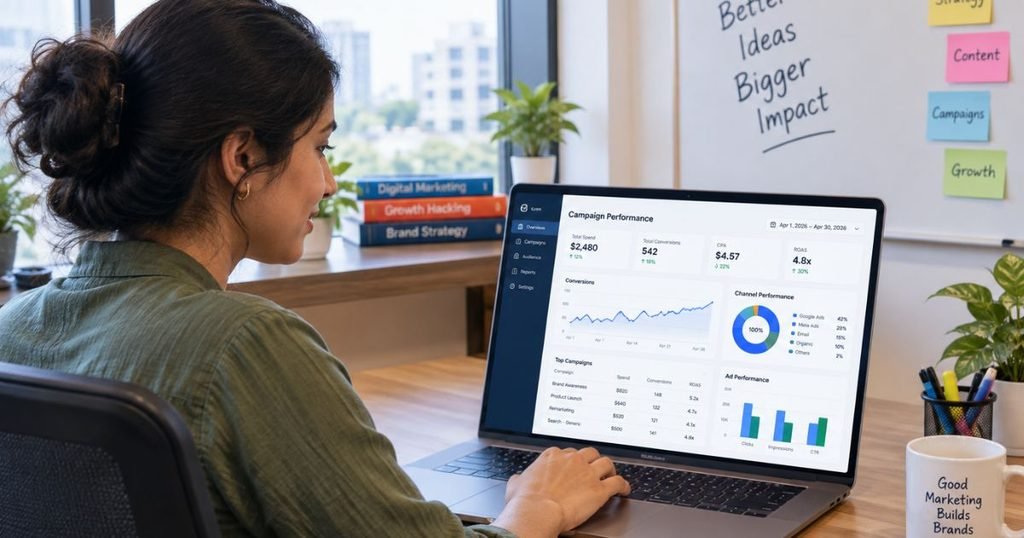
Digital marketing is growing fast in India because more people are online, brands are moving ad budgets to where those people spend their time, and digital channels let companies measure results down to the rupee. Digital advertising reached ₹94,700 crore in 2025, or 63% of total ad spend in India, according to the FICCI-EY 2026 Media and Entertainment report.
Start with the audience. The IAMAI and Kantar Internet in India 2025 report counts 958 million active internet users, up roughly 8% from the year before. Rural India makes up 57% of that base, about 548 million people, and it’s growing nearly four times as fast as urban India. About 588 million users, or 61%, watch short video.
Language matters too. The 2024 edition of the same report found that 870 million users, 98% of the total, access the internet in Indic languages. That’s a strong argument for vernacular content, and it creates steady work for regional copywriters and video editors.
Money follows attention. The FICCI-EY report puts digital advertising up 26% on the previous year. Crisil Intelligence found that social media’s share of digital ad spend rose to 40-45% by FY2025, up from 31-33% in FY2020, helped by creator content and short video.
Brands like boAt and Mamaearth built much of their visibility through social, creator and search-led marketing rather than TV alone. Every rupee spent that way needs someone to plan it, buy it, create for it and measure it. That’s where the jobs come from.
One limitation is worth knowing. As Crisil’s analysis points out, a large share of that ad money goes to foreign-owned platforms such as Meta and Google. So most openings sit inside brands, agencies and ad-tech companies, not at the platforms themselves.
Digital advertising in India grew 26% to ₹94,700 crore in 2025 and accounted for 63% of total ad spend, according to the FICCI-EY 2026 report. With 958 million active internet users, according to IAMAI and Kantar, brands need people who can plan, run and measure campaigns across search, social media and email.
Which Digital Marketing Jobs Are in Demand in India?
Digital marketing jobs in India fall into eight main tracks: SEO, performance marketing, social media, content, email and CRM, analytics, product marketing and AI marketing. Performance marketing pays the most on average, while content and social media roles are the easiest places to start.
Titles are slippery, though. A “digital marketing executive” at a small agency might touch all eight tracks in one week. At a large D2C (direct-to-consumer) brand, the same title could mean only Meta ads. Read the job description, not the title.
SEO Specialist
An SEO (search engine optimisation) specialist helps a website rank higher in Google for the searches that matter to the business. The daily work covers keyword research, fixing technical problems like slow pages and broken links, briefing writers and earning backlinks from other sites.
Beauty retailers such as Nykaa publish guides and tutorials next to their product pages, and someone has to decide which topics are worth the effort. This role suits patient, analytical people, because results take months, not days. Your core tools will be Google Search Console, Ahrefs or Semrush, and Screaming Frog.
Performance Marketer
A performance marketer runs paid campaigns on Google Ads and Meta Ads Manager and answers for measurable results such as leads, sales or ROAS (return on ad spend, the revenue earned for every rupee spent on ads).
You’ll set budgets, test creatives, read dashboards every morning and shift money toward what works. It’s high-pressure work because the numbers are never hidden. It also pays the best of the eight tracks, and quick commerce and D2C companies hire heavily for it.
Social Media Manager
A social media manager plans and publishes content on Instagram, YouTube, LinkedIn and X, replies to comments, reports on engagement and works with creators. For many freshers, this is the first rung on the ladder.
boAt, for example, leans heavily on creator and celebrity-led campaigns, which means its social team spends as much time coordinating partners as posting. The trap in this role is vanity metrics. Likes feel good, but a manager who can connect posts to sign-ups or sales gets promoted faster. Tools to learn: Meta Business Suite, Buffer and Canva.
Content Marketer and Copywriter
A content marketer writes blog posts, video scripts and newsletters that attract and educate buyers. A copywriter writes the shorter, sharper material: ad headlines, landing pages and product descriptions.
Writing in Hindi, Tamil, Bengali, Marathi or another Indian language is a real advantage, given how many users browse in Indic languages. Writers who also understand SEO and basic analytics are rarer than you’d think, and employers notice.
Email and CRM Marketer
A CRM (customer relationship management) marketer keeps existing customers buying through email, push notifications, WhatsApp and in-app messages. Think of the abandoned-cart reminder or the “we miss you” offer.
Apps like Swiggy and Zepto depend on repeat orders, so retention teams matter a great deal there. You’ll build customer segments, set up automated journeys and test message timing. The usual tools are HubSpot, Mailchimp and Indian platforms such as WebEngage and MoEngage.
Marketing Analyst
A marketing analyst works out which campaigns actually produce revenue. You’ll set up tracking in Google Analytics 4 and Google Tag Manager, build dashboards in Looker Studio and answer questions like “Which channel brings customers who come back?”
Spreadsheet skills are the baseline, and SQL (the language used to query databases) will set you apart. Analysts often move into performance marketing or growth leadership because they understand the numbers behind every channel.
Product Marketer
A product marketer decides how a product is positioned, what message each customer type hears and how a launch rolls out. You’ll work closely with product managers, sales teams and customer research.
This track is more common in SaaS (software as a service) and B2B technology companies than in consumer brands. It rewards people who can listen to customers, spot patterns and turn them into clear stories.
AI Marketing Specialist
This is the newest track, and the title is still fuzzy. An AI marketing specialist builds AI-assisted workflows for content drafts, reporting, audience research and ad creative testing, using tools such as ChatGPT, Claude and automation platforms.
Most people in this role today are existing marketers who added AI skills, not people who started there. To be fair, there’s a catch: AI makes volume easy and quality hard. The job is mostly judgment, editing and knowing when the output is wrong.
How Much Do Digital Marketers Earn in India?
A digital marketing fresher in India typically earns around ₹3 to ₹3.6 lakh per year, according to AmbitionBox data published in 2026. Pay climbs with experience and specialisation, and Glassdoor India reports an average of ₹12.65 lakh per year for performance marketing managers as of May 2026.
One quick definition first. LPA stands for lakhs per annum, so ₹3 LPA means ₹3,00,000 per year, or roughly ₹25,000 per month before tax.
Digital marketing salary in India depends far more on skills and role than on your degree. The ranges below come from AmbitionBox and Glassdoor figures compiled in 2025 and 2026 salary guides. They’re self-reported, so treat them as ballparks, not promises.
| Role or level | Typical annual pay | Source |
|---|---|---|
| Fresher (0 to 2 years) | ₹3 to ₹3.6 LPA | AmbitionBox, 2026 |
| Digital Marketing Specialist | ₹4.2 to ₹8 LPA | AmbitionBox and Glassdoor, 2026 |
| Mid-level professional | ₹6.5 to ₹7 LPA average | Glassdoor and AmbitionBox, 2025 |
| Digital Marketing Manager (generalist) | ₹8 to ₹9 LPA average | Glassdoor and AmbitionBox, 2025 |
| Performance Marketing Manager | ₹12.65 LPA average, up to ₹24.5 LPA at the 90th percentile | Glassdoor India, May 2026 |
| Senior manager (8+ years) | ₹16 to ₹28 LPA and above | AmbitionBox, 2026 |
Notice the spread. Naukri’s salary guide puts the average manager salary at ₹6.2 LPA with a ceiling near ₹18 LPA, while the AmbitionBox figures above put senior managers at ₹16 LPA and higher. Different samples, different job titles, different cities. Don’t anchor on a single number.
Three things move your pay the most. The first is specialisation. Performance marketing and analytics roles pay more than generalist roles because their output ties directly to revenue.
The second is the city. One 2026 salary compilation reports that Bengaluru offers higher packages than most other metros, though the cost of living eats some of that gap. The third is the type of employer: in most cases funded startups and D2C brands pay more than small agencies, but with less job security. That varies a lot by company.
Digital marketing freshers in India earn about ₹3 to ₹3.6 LPA, according to AmbitionBox data from 2026, while Glassdoor India reports performance marketing managers average ₹12.65 LPA as of May 2026. Pay depends mainly on specialisation, city and employer type, and published figures vary because they are self-reported.
Which Digital Marketing Tools Should You Learn?
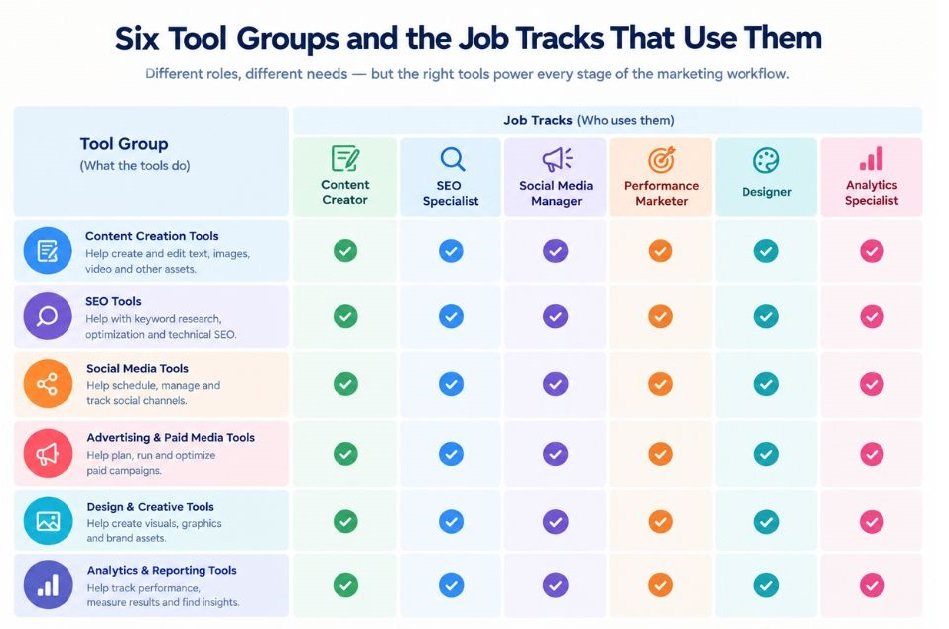
The core digital marketing tool stack has six groups: SEO tools, paid media platforms, analytics tools, social media tools, email and automation platforms, and AI assistants. Start with the free tools from Google and Meta, then add paid tools when a job or client needs them.
You don’t need all twenty tools below. Pick the group that matches your track and learn two or three tools in it properly. Depth beats a long list on your resume.
SEO Tools
Google Search Console is a free tool from Google that shows how your website performs in search. Its Performance report lists the queries people typed, plus clicks, impressions, click-through rate and average position. It also reports indexing problems and lets you inspect individual URLs. If you learn one SEO tool first, make it this one, because the data comes straight from Google.
Ahrefs is a paid SEO suite known for its backlink index. Site Explorer shows the organic keywords and backlinks of any domain, Keywords Explorer estimates how hard a keyword is to rank for, Site Audit crawls your site for technical errors, and Rank Tracker monitors positions over time. Content and link-building teams use it for competitor research.
Semrush covers similar ground with a stronger focus on all-in-one marketing research. Its Keyword Magic Tool generates large keyword lists, Position Tracking monitors rankings, Site Audit flags technical issues, and its advertising research shows what competitors run on paid search. Many agencies prefer it because one login covers SEO, paid and content work.
Screaming Frog SEO Spider is a desktop crawler that scans your website the way a search engine would. It finds broken links, missing page titles, duplicate content and redirect chains in minutes. The free version crawls up to 500 URLs, which is plenty for a small site or a practice project.
Paid Media Tools
Google Keyword Planner sits inside every Google Ads account and is free to use. It shows average monthly searches, competition levels and suggested bids for keywords. Accounts without active spend see search volume in broad ranges, which is enough for early planning. Use it to decide which keywords deserve ad budget.
Google Ads is where you buy ads on Google Search, YouTube, Gmail and partner sites. Campaign types include Search, Performance Max and Demand Gen, and Smart Bidding strategies such as Target CPA (cost per acquisition) and Target ROAS let Google’s system set bids for you. Quality Score, which rates how relevant your ad and landing page are, affects how much you pay. Google Skillshop offers free certification.
Meta Ads Manager runs advertising across Facebook, Instagram and Messenger. Campaigns are organised in three levels: campaign (the objective), ad set (audience, budget, placement) and ad (the creative). The Meta Pixel and Conversions API send website events back to Meta so it can optimise delivery. Advantage+ sales campaigns, earlier called Advantage+ Shopping Campaigns, automate much of the targeting for e-commerce. Meta Blueprint offers training.
Analytics Tools
Google Analytics 4 (GA4) is Google’s analytics platform, and it replaced Universal Analytics, which stopped processing data in July 2023. It tracks user behaviour as events, reports engagement rate instead of bounce rate, and lets you mark important actions as key events. The Explorations section builds custom funnels and path reports, and a free BigQuery export lets analysts query raw data. Every marketer touches GA4 sooner or later.
Google Tag Manager lets you add and manage tracking code on a website without asking a developer each time. You create tags (the code snippets), triggers (when they fire) and variables (the data they use) inside a container. Its preview mode shows exactly what fires on each page, which makes debugging far faster. It’s free and a core skill for analysts.
Looker Studio is Google’s free dashboarding tool. It connects to GA4, Google Ads, Search Console and Google Sheets, then turns the data into charts that update automatically. Agencies use it for client reports, and in-house teams use it to give leadership one live view of performance instead of weekly spreadsheets.
Hotjar and Microsoft Clarity show how real visitors behave on your pages. Heatmaps reveal where people click and scroll, and session recordings replay individual visits so you can spot confusing forms or ignored buttons. Hotjar also offers on-page surveys. Clarity is free. Conversion rate teams use both to decide what to test next.
Social Media Tools
Meta Business Suite lets you manage Facebook and Instagram from one place. You can schedule posts, reply to messages and comments in a shared inbox, and read insights on reach and engagement. For small brands and freshers, it’s the cheapest way to run professional social media accounts.
Buffer is a scheduling tool that supports several networks, including LinkedIn, X, Instagram and Facebook. You queue posts, preview them for each platform and review performance in its analytics view. It offered a free tier at the time of writing, so check current limits before you plan around it.
Canva is a design platform with templates for posts, reels covers, presentations and ads. A Brand Kit stores your colours, fonts and logos so every design stays consistent, and its built-in AI features speed up image edits and resizing. Social media managers and content marketers use it daily, and a free plan exists.
Email and Automation Tools
Mailchimp is an email marketing platform popular with small businesses. You build audience lists, design emails with a drag-and-drop editor, set up automated welcome series and track opens and clicks. It’s a gentle starting point for learning segmentation and campaign testing.
HubSpot combines a CRM with marketing, sales and service tools. Its marketing features include workflows that trigger emails based on behaviour, lead scoring that ranks prospects by interest, forms and landing pages. B2B companies and agencies use it widely, and HubSpot Academy offers free courses and certificates.
WebEngage and MoEngage are Indian-founded customer engagement platforms. Consumer apps use them to send push notifications, in-app messages, emails and WhatsApp campaigns to segments based on what users do inside the product. If you want a retention or CRM role at an app-based company, learning either one gives you a real edge.
AI Tools
ChatGPT is a general-purpose AI assistant from OpenAI. Marketers use it for first drafts, ad copy variations, customer persona brainstorming and spreadsheet formulas. It works best when you give it clear context, examples and constraints. It can state wrong facts confidently, so check every claim before publishing.
Claude is Anthropic’s AI assistant. It handles long documents well, so marketers use it to summarise research reports, rewrite drafts in a specific voice and analyse exported campaign data. As with any AI tool, you stay responsible for accuracy and tone.
Perplexity is an AI answer engine that cites its sources, which makes it useful for fast market research and competitor checks. Click through to the cited pages before you rely on a claim. It’s also worth watching as a place where brands now compete to be cited.
What Does the Future of Digital Marketing in India Look Like?
Digital marketing in India will keep growing through AI-assisted search, vernacular and short-video content, and consent-based data. The scope of digital marketing keeps widening because each new channel creates its own roles, from regional video editors to retention analysts.
That’s good news for digital marketing career growth, as long as you keep learning. Here’s what’s shaping the next few years.
AI Search Is Changing How People Find Brands
Gartner predicted in 2024 that traditional search engine volume would fall 25% by 2026 as people turn to AI chatbots and virtual agents. Whether or not that exact figure holds, people clearly ask Google AI Overviews, ChatGPT and Perplexity questions they once typed into a search box.
That doesn’t kill SEO. It changes the goal from ranking blue links to being the source an AI answer quotes. Pages with clear headings, direct answers and named facts are easier for these systems to lift. SEO specialists who learn this early will have a head start.
Short Video and Regional Languages Keep Pulling Budgets
With 588 million Indians watching short video in 2025 and 98% of users browsing in Indic languages in 2024, according to IAMAI and Kantar, creative teams that work in Hindi and regional languages will stay in demand. Expect brands to hire more video editors, scriptwriters and creator managers, not fewer.
Commerce Moves Closer to the Ad
IAMAI reported that 230 million urban Indians, 56% of the urban active internet base, shopped online in 2025, with quick commerce and social commerce gaining ground. When buying takes two taps, the gap between seeing an ad and placing an order shrinks. That raises the value of performance marketers and CRM specialists who can measure and improve that short path.
Privacy Rules Change How You Track
India’s Digital Personal Data Protection Act, 2023 puts consent at the centre of how brands collect and use personal data. First-party data, meaning emails and phone numbers customers share with you directly, will matter more than third-party tracking. Check how the rules apply to your employer or clients, because requirements phase in over time.
Search is shifting from ten blue links toward AI-generated answers, so content that states facts clearly and cites its sources is more likely to be quoted. Combined with growth in short video, Indic-language content and consent-based data collection, the next phase of digital marketing in India rewards marketers who pair creative skill with measurement.
How Do You Start a Digital Marketing Career in India?
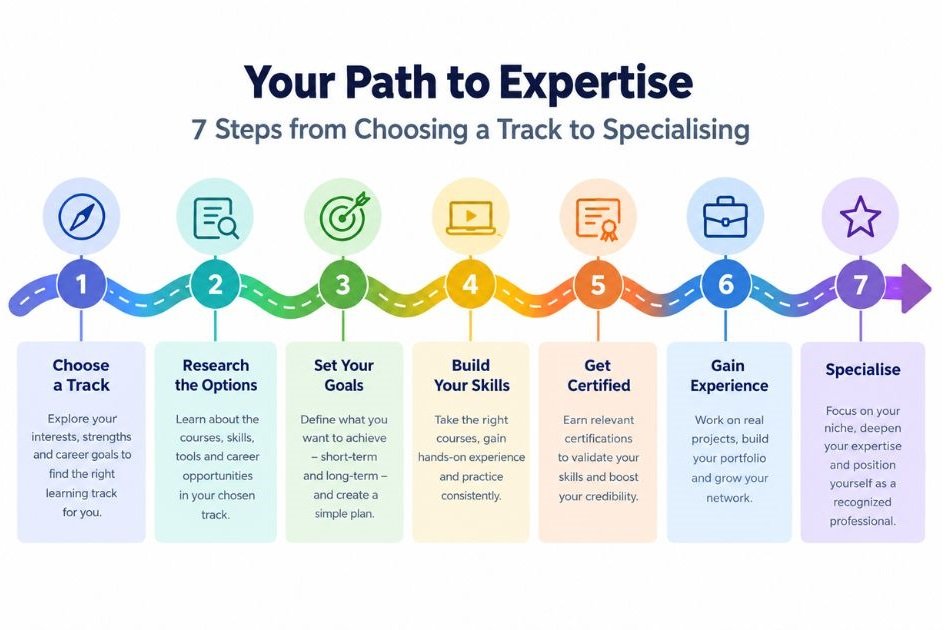
Start by picking one track, learning its core tools and proving the skill on a real project. Hiring managers for entry-level digital marketing jobs in India usually look at proof of work first, so a small portfolio can matter more than another certificate.
- Step 1: Pick one track. Choose from SEO, performance marketing, social media, content, CRM, analytics or AI marketing. Read ten job descriptions for that track and note the repeated skills.
- Step 2: Learn the fundamentals. Complete free courses such as Google Skillshop, Meta Blueprint and HubSpot Academy. They teach platform basics and give you something to put on LinkedIn.
- Step 3: Practise on a real project. Start a blog, run a small ad budget for a local shop, or manage social media for a friend’s business. Real money and real deadlines teach faster than any course.
- Step 4: Build a portfolio. Document each project with the goal, what you did, the numbers before and after, and what you’d change. One page per project is enough.
- Step 5: Learn two or three tools deeply. Match them to your track using the tool groups above, and set up a free GA4 property on your own site to practise.
- Step 6: Apply for internships and junior roles. Small agencies and startups hire freshers more readily, and you’ll touch more channels there.
- Step 7: Specialise after your first year. Digital marketing career growth in India usually comes from going deep in one skill first, then widening into strategy and team leadership.
What Mistakes Do Beginners Make in Digital Marketing Careers?
The most common beginner mistake is learning tools without learning the thinking behind them. Someone who can click through Meta Ads Manager but can’t explain why a campaign should exist will stall quickly.
Another one is ignoring analytics. If you can’t read GA4 or a campaign report, you can’t prove your work mattered, and proving it is how you get raises. This happens more often than it should.
Chasing certificates is a third trap. They help, but ten certificates with no project behind them tell an interviewer very little. Then there’s the opposite problem: staying a generalist for years. A little of everything feels safe, yet the highest pay goes to people with one sharp, provable skill. That’s the surest route to a long, well-paid career.
And finally, copying AI output without checking it. A confident, wrong paragraph with your name on it costs you more trust than a slow, correct one.
Where to Go From Here
Three points matter most. Digital marketing is growing because audiences and ad budgets have both moved online, and India’s numbers back that up. Pay depends on the track you choose, with performance marketing and analytics at the top. And tools are only useful once you’ve picked a direction and proven a skill on a real project.
Your next move is small and concrete. Choose one track this week, set up a free GA4 property or a Search Console account on a site of your own, and start a first project. That’s how digital marketing career growth begins: one visible result, then another.
Frequently Asked Questions
Is digital marketing a good career in India in 2026?
Yes, if you’re willing to specialise. Digital advertising made up 63% of India’s total ad spend in 2025, according to the FICCI-EY 2026 report, and 958 million people are online. The caveats are modest starting pay, around ₹3 LPA for freshers, and strong competition for generic roles. Skills in performance marketing, analytics or CRM improve your odds.
What is digital marketing?
Digital marketing is the promotion of products, services or brands through online channels such as search engines, social media, email, websites and mobile apps. Its main advantage is measurement: you can see how many people saw, clicked and bought. Common channels include SEO, paid ads, social media, content and email.
What’s the difference between digital marketing and traditional marketing?
Traditional marketing uses offline media such as TV, print, radio and hoardings, while digital marketing uses online channels. Digital campaigns can target specific audiences, adjust budgets in real time and report results per rupee spent. Traditional media still reaches broad audiences and builds awareness, so many brands use both.
How much does a fresher earn in digital marketing?
Digital marketing salary in India for freshers generally falls between ₹2.5 and ₹4.5 LPA, with AmbitionBox averages around ₹3 to ₹3.6 LPA in 2026. Pay depends on your city, employer and skills. Freshers with hands-on campaign experience or analytics skills often start at the higher end.
Which digital marketing skill pays the most?
Performance marketing currently pays the most. Glassdoor India reported in May 2026 that performance marketing managers earn an average of ₹12.65 LPA, with top earners reaching ₹24.5 LPA. Analytics and CRM roles also pay well because their results connect directly to revenu.
Do I need a degree to get a digital marketing job?
Many listings ask for a graduate degree, but not necessarily in marketing. For most digital marketing jobs in India, a portfolio with real results and a few platform certifications carries more weight in interviews than the stream you studied. A degree can matter more for management roles at large companies.
Which tools should a beginner learn first?
Start with free tools: Google Analytics 4, Google Search Console, Google Keyword Planner, Canva and Meta Ads Manager. They cover measurement, search, keyword research, design and paid social. Once you’ve picked a track, add one paid tool for it, such as Ahrefs for SEO or HubSpot for CRM.
How long does it take to get your first digital marketing job?
It varies, but many learners who practise on real projects for three to six months become interview-ready. That’s an estimate, not a guarantee. Your timeline depends on how much time you put in, the quality of your portfolio and how many roles you apply for.
Will AI replace digital marketers?
AI is automating routine tasks such as first drafts, reporting and basic ad variations, but it still needs people to set strategy, judge quality and understand customers. Marketers who learn to use AI tools well will likely do more work with the same effort. Those who ignore AI risk falling behind peers who don’t.
Why am I not getting interview calls for digital marketing jobs?
The usual causes are a generic resume, no portfolio and applying to every role at once. Fix this by targeting one track, listing measurable results from your projects (for example, “grew organic traffic 40% in three months”), and tailoring your resume to each job description. Also check that your LinkedIn profile matches the role you’re applying for.


Is Digital Marketing A Good Career In India? Salary, Skills
October 14, 2026 - 10:44 am[…] Digital marketing means promoting products or services through online channels such as search engines, social media, email, and websites. This guide covers what the job market looks like, what people earn, which roles pay best, which skills and tools you need, how to start from zero, and where the downsides sit. Salary figures come from public salary guides and vary a lot, so read them as ranges, not promises. […]