
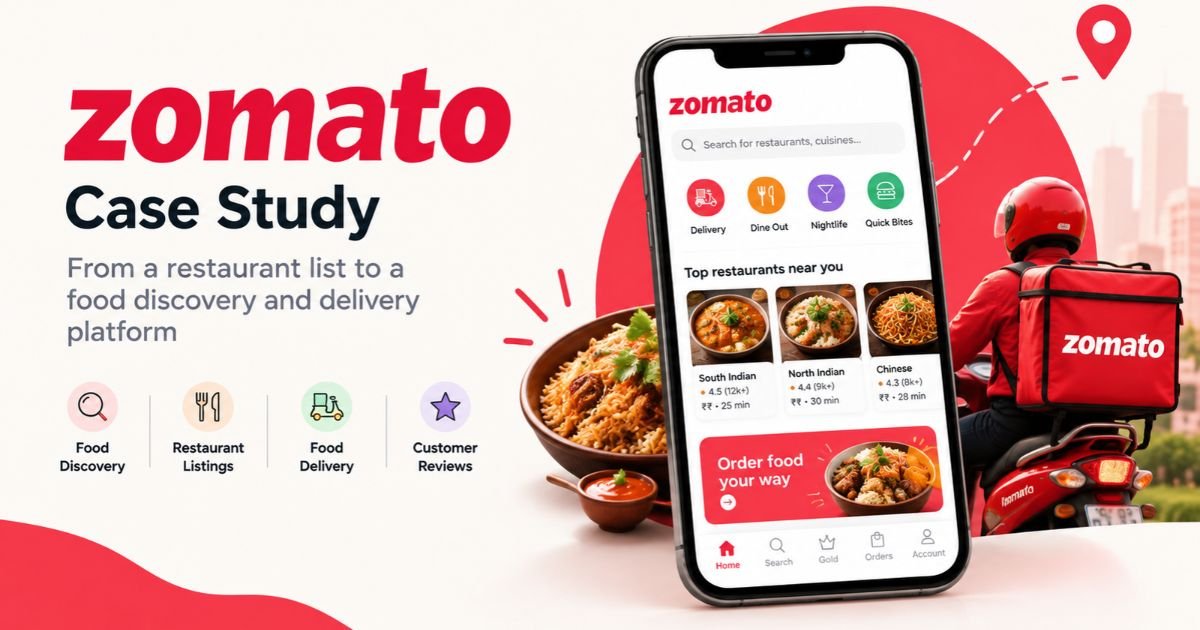
Zomato lost its name on the stock exchange and came out stronger. That’s the odd part of this story. In 2025 the listed company became Eternal Limited, and by the quarter ending June 2026 its biggest business by revenue wasn’t food delivery at all. It was Blinkit, the quick commerce arm. Yet the red Zomato app is still the first thing most Indians open when they’re hungry.
This Zomato Case Study walks through how the company started, how its revenue actually works, which tools and products it runs, how it markets itself, and what you can copy without a billion-rupee budget. You’ll get the latest figures from Eternal’s Q1 FY27 results (filed on July 22, 2026) and the missteps that shaped the brand.
One caveat before we start. Zomato is a marketplace with huge scale and a very specific market. Some of what follows won’t transfer to a small D2C brand. Most of the thinking will.
How Did Zomato Grow From a Menu Directory Into Eternal?
Zomato started in 2008 as FoodieBay, an online restaurant menu directory, and moved into food delivery in 2015. In 2025 its listed parent company was renamed Eternal Limited, which now also owns Blinkit, Hyperpure and District.
Deepinder Goyal, a former Bain & Company consultant, founded the company with Pankaj Chaddah. The early product was simple: scan menus, upload them, let people search. Reviews and photos came next. That user-generated layer became the moat, because nobody could copy years of reviews overnight.
Then came the moves that changed the shape of the business. Zomato listed on Indian stock exchanges in 2021, becoming one of the first big new-age Indian startups to go public. It had already bought Uber Eats India in 2020, which removed a well-funded rival. In 2022 it bought Blinkit, then called Grofers, a bet that looked expensive at the time.
It paid off. On January 21, 2026, Eternal announced that Goyal would step down as group CEO from February 1, 2026, and that Blinkit’s chief, Albinder Singh Dhindsa, would take over. Goyal stayed on the board as vice chairman. The founder handing the group to the head of the acquired business tells you where the centre of gravity moved.
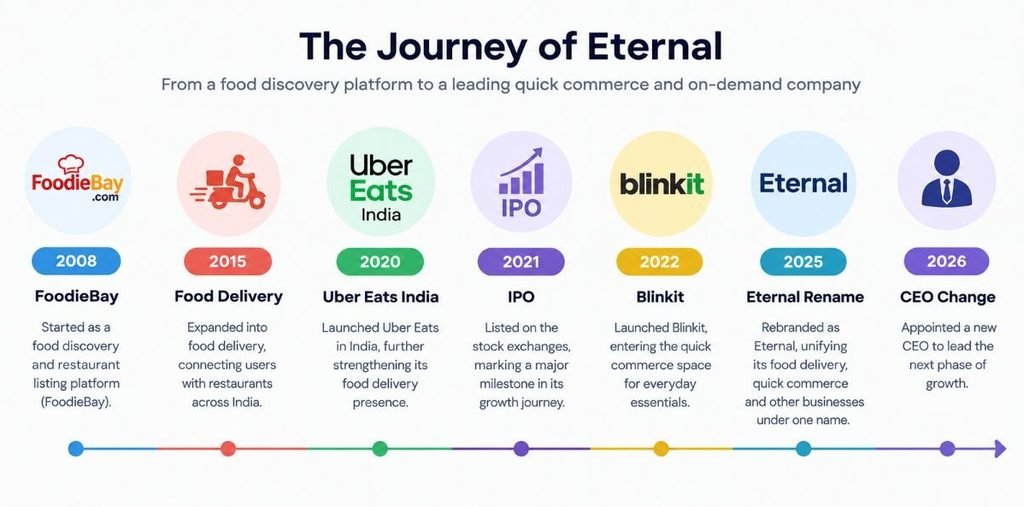
Zomato began in 2008 as FoodieBay, a restaurant menu directory, and entered food delivery in 2015. Its listed parent was renamed Eternal Limited in 2025 and now runs Zomato, Blinkit, Hyperpure and District. Since February 1, 2026, Albinder Singh Dhindsa, who built Blinkit, has been group CEO.
How Does Zomato Make Money?
Zomato earns from four main sources: commissions that restaurants pay on each order, delivery and platform fees from customers, advertising and sponsored listings, and subscriptions through Zomato Gold. Each source supports the others, which is why the model compounds as order volume grows.
Here’s the Zomato Business Model Explained as a loop. More restaurants listed means more choice. More choice brings more customers. More customers make advertising on the app worth paying for. Ad and commission revenue then pays for faster delivery and better discounts, which brings in more customers again.
| Revenue stream | Who pays | What they get |
|---|---|---|
| Commission | Restaurants | Orders, delivery logistics and payment handling |
| Delivery and platform fees | Customers | Doorstep delivery and use of the app |
| Advertising | Restaurants and brands | Higher visibility inside the app |
| Zomato Gold subscription | Customers | Lower delivery charges and member offers |
The commission is the backbone. Zomato keeps a percentage of the food value, and the restaurant keeps the rest. Customers pay on top for delivery, with extra charges during rain or peak demand, plus a small platform fee that Zomato added to every order in 2023. Honestly, that fee draws complaints, but it moved the economics from thin to workable.
Advertising is the quiet profit lever. A restaurant that already gets orders will often pay to get more of them, and Zomato sells that visibility. We’ll get to how in the tools section.
Zomato’s revenue comes from restaurant commissions, customer delivery and platform fees, advertising, and Gold subscriptions. The structure is a two-sided marketplace where more restaurants attract more customers, and more customers make ads more valuable.]
Which Tools and Products Power the Platform?
Zomato runs on a set of connected tools: the consumer app, a delivery fleet with routing technology, the Gold membership, Zomato Ads, an AI support tool called Nugget, and sister businesses Hyperpure, Blinkit and District. Each does a different job in the system.
The Zomato App: Discovery, Reviews and Ordering
The app is the front door. You search by cuisine, dish or restaurant, read reviews, look at user photos, and order. The review and photo library is the oldest asset in the company, and it still drives discovery, because people trust other diners more than a restaurant’s own description.
Every search and order also feeds data back into the system. That data decides what the home screen shows you, which restaurants get recommended and which notifications you receive.
Delivery Partner Network and Logistics Technology
Delivery partners are the independent riders who carry orders. Zomato’s software assigns each order to a rider, estimates the time, and tracks the trip live. Speed matters here more than almost anywhere else, which is why delivery partner availability shows up in management commentary on margins. In July 2025, Goyal blamed a weak quarter partly on fewer riders during festivals and bad weather.
For you as a customer it looks like a moving dot on a map. Behind that dot sits the single most expensive part of the business.
Zomato Gold
Zomato Gold is the paid membership programme. It started as a dining-out offer in 2017 and later became a delivery membership with lower delivery charges and member-only offers. The point isn’t the discount. The point is repeat behaviour, since a member has paid upfront and wants to get their money’s worth.
If you run any subscription or loyalty programme, notice the design. Gold converts a casual user into a habit.
Zomato Ads
Zomato Ads is the self-serve advertising product that restaurants and brands use inside the app. Formats include sponsored listings that push a restaurant higher in search results, banner placements and in-feed promotions, and video ads. Restaurant India’s 2026 guide puts banner costs between roughly Rs 30 and Rs 300 per 1,000 impressions, depending on scale and competition.
It works because the audience is already hungry. Someone scrolling Instagram is killing time. Someone on Zomato at 9 pm is about to buy dinner. That difference in intent is the entire pitch, and it’s the core of the Zomato Advertising Strategy on the supply side.
Nugget by Zomato
Nugget is an AI tool built to automate customer support, and it was the first product to come out of Zomato Labs, the company’s in-house innovation group. Social Samosa reported that Zomato also laid off around 600 customer support employees, a reminder that automation has a human cost the brand had to answer for. In July 2026 Eternal’s board approved moving the Nugget business into a wholly owned subsidiary, Carthero Technologies Private Limited, for Rs 350 crore.
Hyperpure
Hyperpure is Zomato’s business-to-business supply arm. It sells ingredients and kitchen supplies to restaurants, which gives the company a hand in what happens in the kitchen, not just at the doorstep. In Q1 FY27 Hyperpure reported revenue of Rs 1,034 crore, according to Eternal’s filing as reported by YourStory.
Blinkit
Blinkit is the quick commerce service that delivers groceries and everyday items in minutes from local dark stores, which are small warehouses that aren’t open to shoppers. Eternal had 2,443 Blinkit stores by the end of Q1 FY27, up by 200 net new stores in the quarter, per Analytics Insight. Blinkit also runs across more than 300 cities and about 19 million square feet of store and warehouse space, according to YourStory.
District
District is the going-out app that covers restaurant bookings, movies, events and retail offers. Deepinder Goyal said it now brings visibility and business to more than 45,000 restaurants, 5,000 movie screens, 6,000 retail stores and 7,500 events.
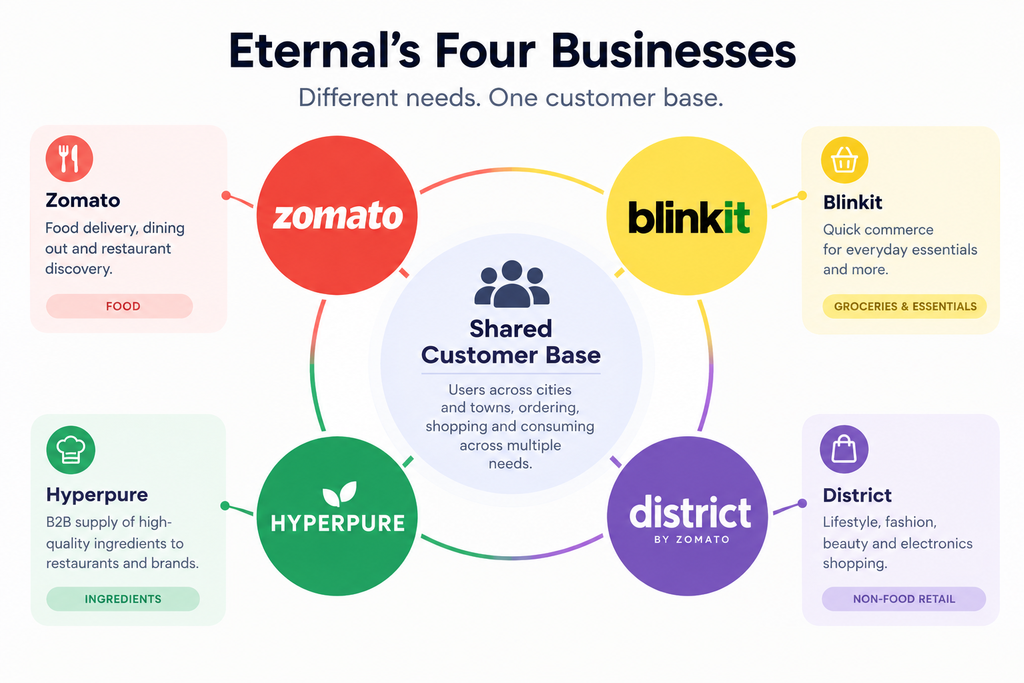
Zomato’s toolset covers discovery (the app), fulfilment (rider network and routing), retention (Gold), monetisation (Zomato Ads), cost control (Nugget) and supply (Hyperpure). Blinkit and District extend the same customer relationship into groceries and going out.
How Does Zomato Market Itself?
The Zomato Marketing Strategy rests on one idea: sound like a friend who’s always hungry, then back it up with fast, reliable delivery. Humour and relevance bring people in. Convenience keeps them there.
Marketers often reduce this to “they post memes”. That misses the structure. It’s a layered system where organic, paid and owned channels each have a job.
Social Media and Moment Marketing
Zomato treats its social channels like a comedy desk. It reacts to cricket matches, film releases and viral trends within hours, using short, conversational posts instead of sales copy. This is called moment marketing, which means publishing content tied to something happening in culture right now.
The payoff is free reach. A witty post gets shared, and every share is an ad you didn’t buy. Worth copying if your audience lives on Instagram or X. Worth skipping if your buyers don’t.
Push Notifications and Email
The Zomato Digital Marketing Strategy leans heavily on owned channels. Push notifications arrive at meal times, written in a casual, often cheeky voice, and many are targeted by area or past orders. Email follows the same tone.
Those messages do two jobs. They prompt an order, and they keep the brand’s personality alive on a screen you check forty times a day. Competitors with duller notifications get muted.
Influencers, Celebrities and Television
Zomato works with food bloggers and creators to build trust, and it also buys bigger moments. Social Samosa reported that Shah Rukh Khan was onboarded as a brand ambassador. For its 10-minute Zomato Quick service, the company ran a campaign that, per Media News 4 U, used digital and social media, print and influencer collaborations together.
Celebrity spots build mass recall. Creators build credibility. Zomato uses both rather than picking one.
Search, App Install and Performance Ads
When someone searches for food delivery on Google or YouTube, Zomato wants to appear. Paid search and app install ads capture people who are already looking, while display and video ads build awareness for those who aren’t.
How much does it spend? Eternal’s consolidated advertising and sales promotion expense was Rs 671 crore in Q1 FY26, up 69.4% from Rs 396 crore a year earlier, according to Storyboard18’s 2025 report. That figure covers the whole group, not only Zomato food delivery. It still shows the scale of a Zomato Advertising Strategy that mixes paid reach with organic buzz.
Zomato pairs humour-led organic content with owned channels like push notifications and email, and with paid search, app install ads and celebrity campaigns. In Q1 FY26 Eternal’s advertising and sales promotion spend reached Rs 671 crore, a 69.4% rise on the year before.
What Makes the Zomato Brand So Recognisable?
The Zomato Branding Strategy is built on a consistent colour, a consistent voice and a stated purpose: better food for more people. Red is the visual signature. The voice is witty, informal and self-aware.
Consistency is the boring secret. Zomato’s tone is the same in a push notification, a billboard and a tweet. People can recognise a Zomato message without seeing the logo.
Purpose shows up in campaigns too. The “Fuel Your Hustle” campaign, run with the Paralympic Committee of India, told the stories of seven para-athletes. Feeding India, the hunger-relief initiative, and Blinkit’s ambulance service are now being brought under a not-for-profit subsidiary, Eternal General Services Foundation, per Inc42. That’s brand-building through action, not slogans.
Zomato also got a lesson in how fast a brand move can backfire. In March 2024 it announced a pure-veg delivery mode with riders in green uniforms. The backlash was quick, and the company dropped the colour-coded uniforms within a day. A good reminder that your brand is also what you do to people who work for you.
Zomato’s brand rests on a recognisable red identity, a witty and consistent voice, and a stated purpose of better food for more people. Social campaigns like Fuel Your Hustle and initiatives like Feeding India link that purpose to action, while the 2024 uniform backlash showed how quickly a misstep can damage trust.
What Do the Latest Numbers Say?
In Q1 FY27 (April to June 2026), Eternal reported revenue of Rs 20,211 crore and a net profit of Rs 92 crore. That’s up from Rs 7,167 crore and Rs 25 crore a year earlier, and the profit was down about 47% from the previous quarter, per Inc42 and Upstox.
| Business | Q1 FY27 figure | Growth |
|---|---|---|
| Zomato (food delivery) NOV | Rs 10,769 crore | More than 20% year on year |
| Blinkit NOV | Rs 17,132 crore | 86% year on year |
| District NOV | Rs 3,218 crore | 60% year on year |
| Hyperpure revenue | Rs 1,034 crore | Reported in Eternal’s filing |
NOV stands for net order value, the value of orders after discounts and refunds. Combined across Zomato, Blinkit and District it grew 54% to Rs 31,120 crore, according to NiftyTrader. Blinkit revenue reached Rs 15,664 crore against Rs 2,400 crore a year before.
Look at that revenue jump of 182% next to NOV growth of 54%. The gap suggests a change in how Blinkit books revenue, not only stronger demand, so use NOV for like-for-like comparisons. Also note that Zomato’s own food delivery revenue was about Rs 3,100 crore, against Rs 2,261 crore a year earlier, per YourStory.
The profit picture is mixed. Management said the sequential decline reflects continued investment, mostly in Blinkit. And CFO Akshant Goyal made the point that quick commerce isn’t asset-light, because it needs stores, equipment and working capital.
Where Is Zomato Under Pressure?
Zomato faces competition in food delivery, heavy capital needs in quick commerce, regulatory scrutiny, and the reputational cost of automation. None of these is fatal. All of them shape the Zomato Business Strategy for the next few years.
Competition first. Swiggy remains the closest rival, and new entrants keep arriving: Swiggy’s Toing and Rapido’s Ownly, for example. Founder Deepinder Goyal said the impact on Zomato has been limited so far, and CEO Albinder Dhindsa pointed to customer traction holding up.
Then there’s capital. Blinkit needs money for stores and inventory long before it makes money from them. Margins can wobble when expansion speeds up.
Regulation adds a third layer. Social Samosa reported that an antitrust case was filed by the All India Consumer Products Distributors Federation against Zomato, Swiggy and Zepto. How that plays out is unclear, so treat it as something to watch, not a conclusion.
What Can Marketers and Founders Learn From This?
This Zomato Case Study points to six habits you can use today. They don’t need Zomato’s budget. They need discipline.
- Own one clear voice. Pick a tone and use it everywhere, from push notifications to billboards.
- Build a trust asset competitors can’t copy fast. Zomato’s was reviews and photos.
- Sell visibility to people who already win. Advertising inside a high-intent app beats broad reach.
- Use a membership to build habit, not to give away margin.
- Buy or build adjacent businesses when the core has stabilised. Blinkit and District came after delivery worked.
- Admit mistakes quickly. The 2024 uniform reversal cost the company a day, not a year.
A final point on the Zomato Business Strategy. The company didn’t win by being everywhere. It won by repeating a few things relentlessly, then moving on to the next one. Compare that with the Zomato Branding Strategy, which has barely changed in a decade.
Conclusion
Three things stand out. Zomato built a trust asset in reviews before it built a delivery fleet. It kept one recognisable voice for years while the business changed shape around it. And it moved from a single app to a group with four businesses without losing its brand.
If you’re building something yourself, start smaller. Pick one voice. Pick one repeat behaviour to encourage. Then test one new channel this month and track what it returns. That’s a more useful next step than copying any single Zomato campaign.
Want more breakdowns like this, with the numbers and the mistakes left in? Crystal Clear, our newsletter, sends practical marketing case studies to your inbox. It’s written for practitioners who’d rather apply an idea than collect another list of tips. Subscribe and you’ll get the next teardown as soon as it’s out.
Frequently Asked Questions
What is the Zomato business model?
Zomato runs a two-sided marketplace that connects restaurants and customers. It earns commissions from restaurants, delivery and platform fees from customers, advertising revenue, and subscription income from Zomato Gold. The Zomato Business Model Explained in one line: it makes money every time someone orders, and again when restaurants pay to be seen.
How does Zomato make money?
Zomato keeps a percentage of each order’s food value as commission. It charges customers delivery and platform fees, sells ad placements inside the app, and collects Gold membership fees. Its sister businesses add more: Hyperpure sells supplies to restaurants, Blinkit sells groceries, and District earns from bookings and events.
Is Zomato the same as Eternal?
No. Eternal Limited is the listed parent company, renamed from Zomato Limited in 2025. Zomato is now the name of the food delivery business within it, alongside Blinkit, Hyperpure and District. The app and brand that customers use are still called Zomato.
Zomato vs Swiggy: what’s the difference?
Both are India’s largest food delivery platforms, and both earn from commissions, fees and ads. The differences sit in the group structure and the brand. Zomato’s parent, Eternal, runs Blinkit for quick commerce, while Swiggy runs Instamart. Zomato leans harder on witty, brand-led communication.
What is the Zomato marketing strategy?
The Zomato Marketing Strategy combines humour-led social media, targeted push notifications and email, celebrity and creator partnerships, and paid search and app install ads. Delivery speed and reliability then turn first-time users into repeat customers.
How does Zomato use digital marketing?
The Zomato Digital Marketing Strategy uses moment marketing on social channels, personalised push notifications at meal times, email, paid search, display and video ads, and influencer content. The aim is to reach people when they’re likely to be hungry, then make ordering easy.
How can a restaurant advertise on Zomato?
Restaurants list on Zomato as partners and then buy visibility through Zomato Ads: sponsored listings, banners and in-feed placements. Start with a small budget, test one format, and track orders rather than clicks. Restaurant India’s 2026 guide says banner costs run roughly Rs 30 to Rs 300 per 1,000 impressions, so costs depend heavily on your area.
Is Zomato Gold actually worth it?
It depends on how often you order. If you order a few times a week, lower delivery charges can cover the membership fee quickly. If you order twice a month, you probably won’t recover it. Check your own order history for the last three months and work out the delivery fees you paid.
Why did Zomato rename its parent company to Eternal?
Because the group had grown beyond food. After the Blinkit acquisition, the parent company needed a name that didn’t describe only one business. The food delivery app kept the Zomato name, so customers saw no change.
What mistakes should brands avoid from Zomato’s story?
Don’t launch sensitive changes without testing how people will react. The 2024 pure-veg uniform plan was reversed within a day. Don’t hide the human cost of automation either, as the support layoffs reported after Nugget showed. And don’t depend on discounts alone to drive orders.


